


While HPLC may be tempting to use for terpenes analysis, a GC/FID or GC/MS is really the most straightforward and recommended way of analyzing terpenes in cannabis. Terpenes, being relatively volatile and neutral, lend themselves rather nicely to GC in general.
As you can see from Figure 1 below, coelutions of the cannabinoids and terpenes are very likely when analyzing real cannabis samples by HPLC-UV methods. A Shimadzu Prominence 20AD HPLC system and Raptor ARC-18, 2.7um, 150 x 4.6mmID column (catalog# 9314A65) was used in Figure 1.
Figure 1- Standards at equal concentrations
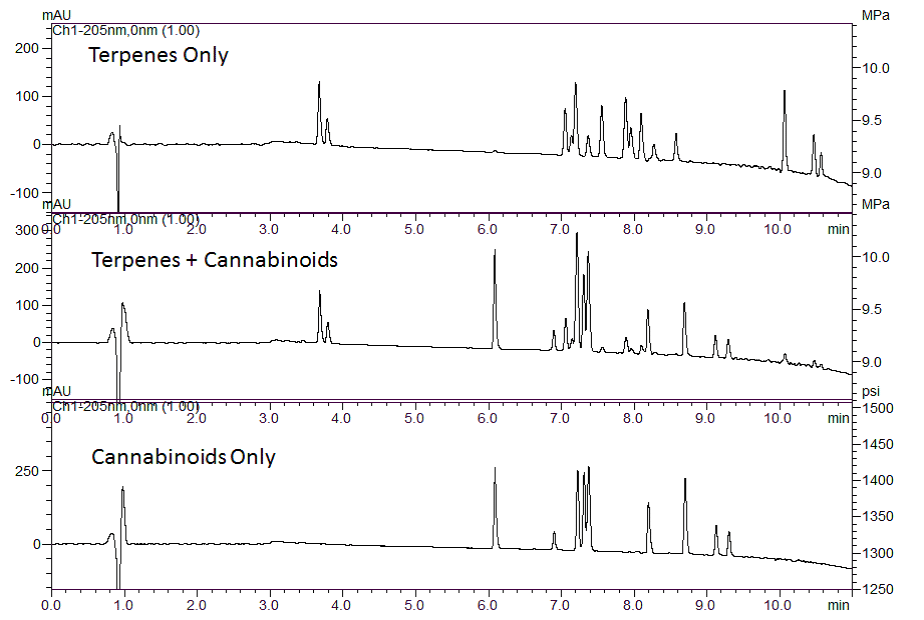
At 205nm, there are many co-elutions of terpenes and the cannabinoids, making identification and quantitation extremely difficult, if not impossible, for either class of compounds.
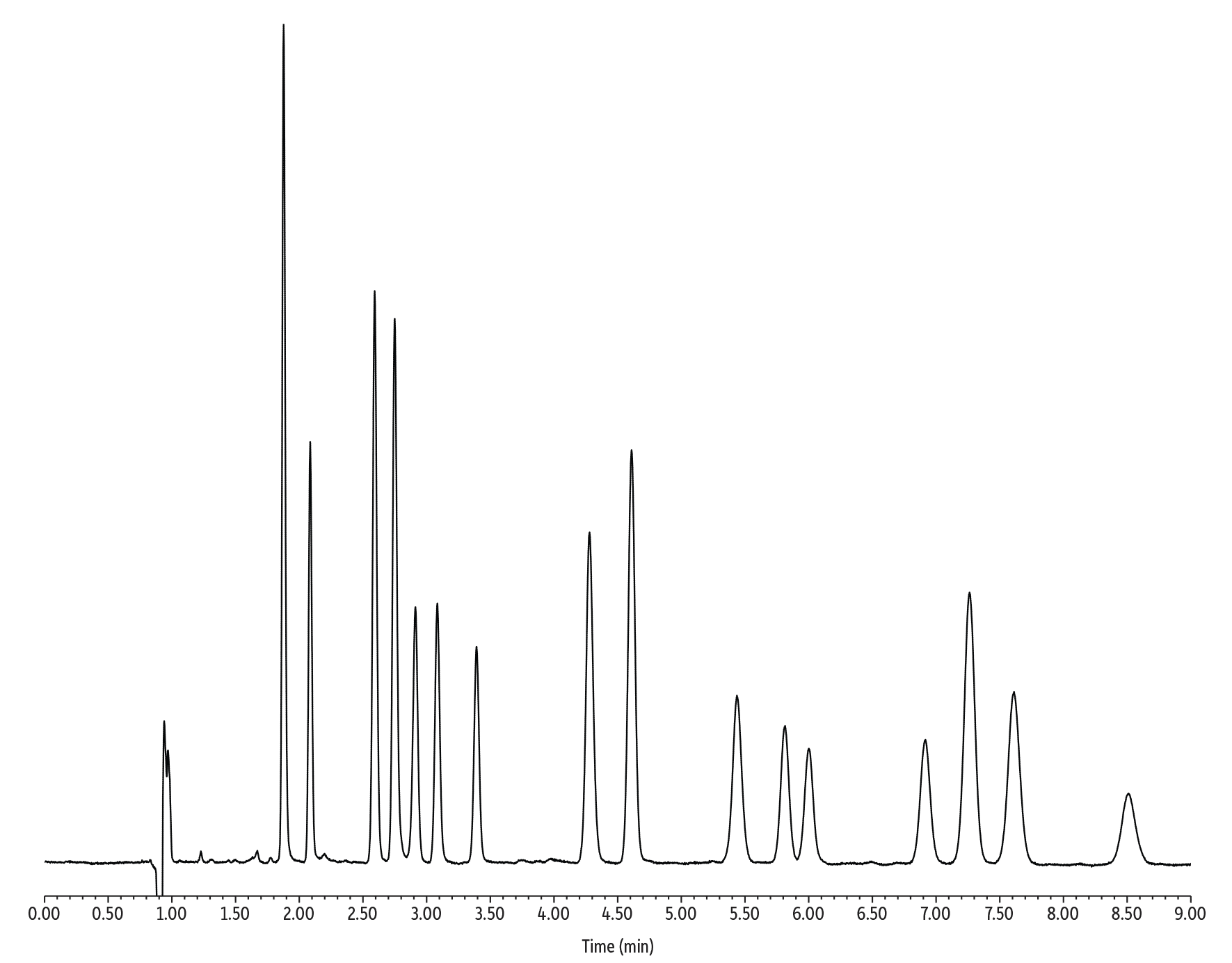
Conversely, cannabinoids can be analyzed by HPLC-UV, as long as the correct UV wavelength is chosen. At 220nm, terpenes yield a very low signal. Because cannabinoids of interest are present at a much higher concentration than terpenes, in addition to providing a stronger UV signal at 220nm, cannabinoids can be reliably analyzed at a wavelength of 220nm. See Figure 2.
Figure 2
LC_GN0578
Peaks
| Peaks | tR (min) | |
|---|---|---|
| 1. | Cannabidivarinic acid (CBDVA) | 1.877 |
| 2. | Cannabidivarin (CBDV) | 2.086 |
| 3. | Cannabidiolic acid (CBDA) | 2.592 |
| 4. | Cannabigerolic acid (CBGA) | 2.750 |
| 5. | Cannabigerol (CBG) | 2.912 |
| 6. | Cannabidiol (CBD) | 3.084 |
| 7. | Tetrahydrocannabivarin (THCV) | 3.391 |
| 8. | Tetrahydrocannabivarinic acid (THCVA) | 4.279 |
| Peaks | tR (min) | |
|---|---|---|
| 9. | Cannabinol (CBN) | 4.609 |
| 10. | Cannabinolic acid (CBNA) | 5.437 |
| 11. | Δ9-Tetrahydrocannabinol (Δ9-THC) | 5.815 |
| 12. | Δ8-Tetrahydrocannabinol (Δ8-THC) | 6.002 |
| 13. | Cannabicyclol (CBL) | 6.916 |
| 14. | Cannabichromene (CBC) | 7.263 |
| 15. | Tetrahydrocannabinolic acid A (THCA-A) | 7.612 |
| 16. | Cannabichromenic acid (CBCA) | 8.510 |
Conditions
| Column | Raptor ARC-18 (cat.# 9314A65) | ||||||||||||
|---|---|---|---|---|---|---|---|---|---|---|---|---|---|
| Dimensions: | 150 mm x 4.6 mm ID | ||||||||||||
| Particle Size: | 2.7 µm | ||||||||||||
| Pore Size: | 90 Å | ||||||||||||
| Guard Column: | Raptor ARC-18 EXP guard column cartridge 2.7 µm (cat.# 9314A0250) | ||||||||||||
| Temp.: | 30 °C | ||||||||||||
| Standard/Sample | |||||||||||||
| Tetrahydrocannabivarin (cat.# 34100) | |||||||||||||
| Cannabidiolic acid (CBDA) (cat.# 34094) | |||||||||||||
| Cannabichromene (CBC) (cat.# 34092) | |||||||||||||
| Cannabigerol (CBG) (cat.# 34091) | |||||||||||||
| delta-9-Tetrahydrocannabinolic acid A (THCA-A) | |||||||||||||
| delta-8-Tetrahydrocannabinol (Δ8-THC) (cat.# 34090) | |||||||||||||
| delta-9-Tetrahydrocannabinol (Δ9-THC) (cat.# 34067) | |||||||||||||
| Cannabinol (CBN) (cat.# 34010) | |||||||||||||
| Cannabidiol (CBD) (cat.# 34011) | |||||||||||||
| Compounds not present in these mixes were obtained separately. | |||||||||||||
| Diluent: | 25:75 Water:methanol | ||||||||||||
| Conc.: | 50 µg/mL | ||||||||||||
| Inj. Vol.: | 5 µL | ||||||||||||
| Mobile Phase | |||||||||||||
| A: | Water, 5 mM ammonium formate, 0.1% formic acid | ||||||||||||
| B: | Acetonitrile, 0.1% formic acid | ||||||||||||
|
| Detector | UV/Vis @ 228 nm |
|---|---|
| Instrument | HPLC |
| Notes | Standard cat.# 34093 was used to produce this chromatogram, but has since been discontinued. For assistance choosing a replacement for this application, contact Restek Technical Service or your local Restek representative. |
In summary, HPLC-UV analysis of terpenes in cannabis is not recommended, and will likely cause more issues than it will provide solutions.
A good solution to the coelutions by HPLC-UV is to choose a GC headspace method. Interferences from the complex sample matrix, as well as the much less volatile cannabinoids can be eliminated then.
Contact us or your Restek sales representative if you have any questions.