

Key Highlights
- Get clean, symmetrical peaks for a wide range of active test probes at low concentrations.
- Keep your GC online and running samples—sharp peaks and reduced analyte breakdown keep your instruments meeting performance criteria longer.
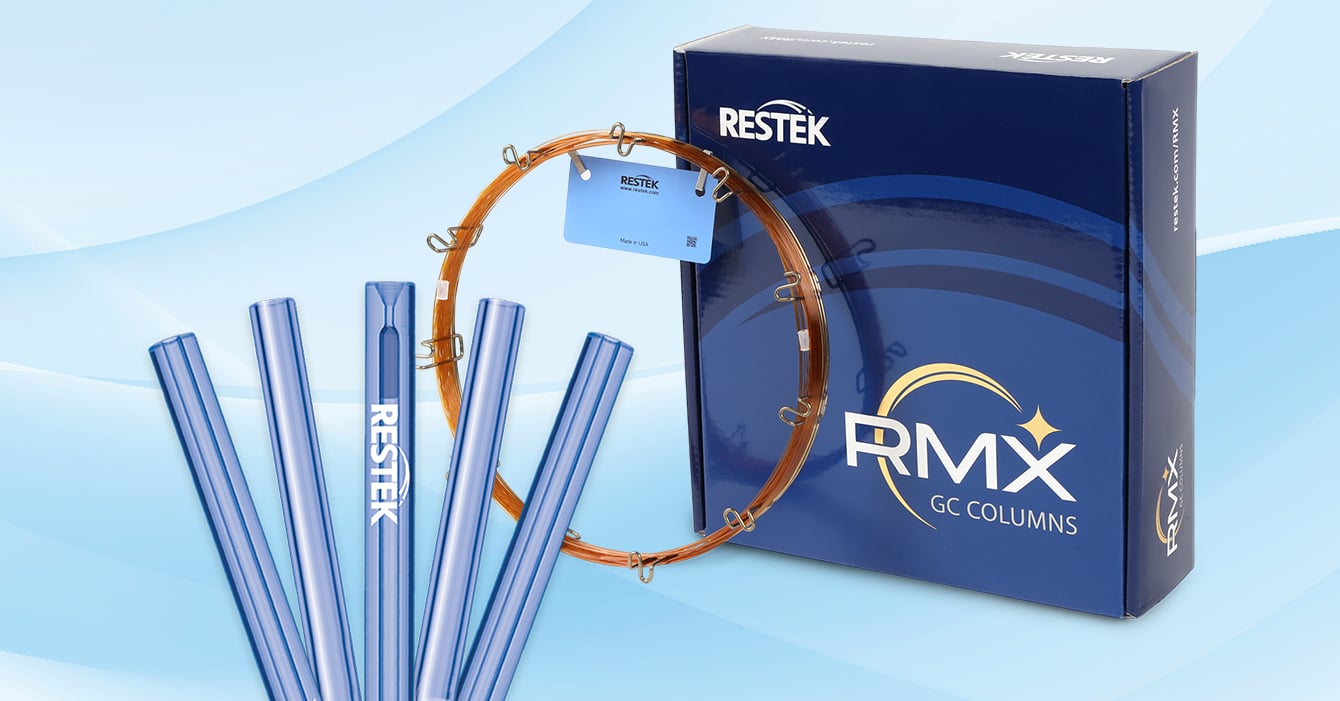
- Pair Topaz inlet liners with RMX GC columns for maximum inertness across the sample flow path.
Labs are under growing pressure to increase sensitivity and minimize downtime in order to maximize instrument performance and lab productivity. Whether the driver is to reduce solvent consumption by scaling down sample extractions or to decrease downtime by keeping calibrations passing longer, peak shape plays an essential role, particularly at low concentrations. To meet these goals, labs are generating more dilute samples, which means low-level detection techniques, such as GC-MS/MS, are required. To further improve sensitivity, splitless and low-split injections are commonly used to maximize the amount of sample being transferred to the column from a dilute extract. Consequentially, analytes spend more time in the inlet liner, where they are vulnerable to peak shape distortion and breakdown before they even reach the analytical column. This means liner inertness plays a critical role in achieving lab performance and productivity goals by improving GC peak shape and sensitivity for accurate low-level detection.
At low levels, inlet inertness and differences in liner deactivation technology can significantly impact peak shape, especially for active compounds. For example, in order to establish system suitability for sample analysis, environmental labs frequently monitor 2,4-dinitrophenol (2,4-DNP); pentachlorophenol; and benzidine specifically because their peak shapes are extremely sensitive to active sites in the inlet liner. Similarly, endrin and DDT may be monitored in both food and environmental laboratories because these pesticides are prone to breakdown in the inlet, so they are also used as indicator compounds to demonstrate inertness and establish system readiness.
In this study, we explored the role of liner deactivation in how to improve peak shape and sensitivity in GC-MS/MS. We analyzed key probes at 0.05 ppm to compare the performance of Topaz inlet liners to a competitor’s traditional deactivation. All testing was performed using splitless injection because the longer residence time in the liner makes for a more rigorous test. In addition, all analyses were performed on a highly inert RMX-5Sil MS column so that performance differences could be attributed to differences between the liner deactivations rather than the column. For each deactivation, three single-taper liners with wool were tested. Acenaphthene-d10 was also monitored to ensure differences between liners were not attributable to leaks or detector failures.
Get Better Peak Shapes with a Broadly Effective Deactivation
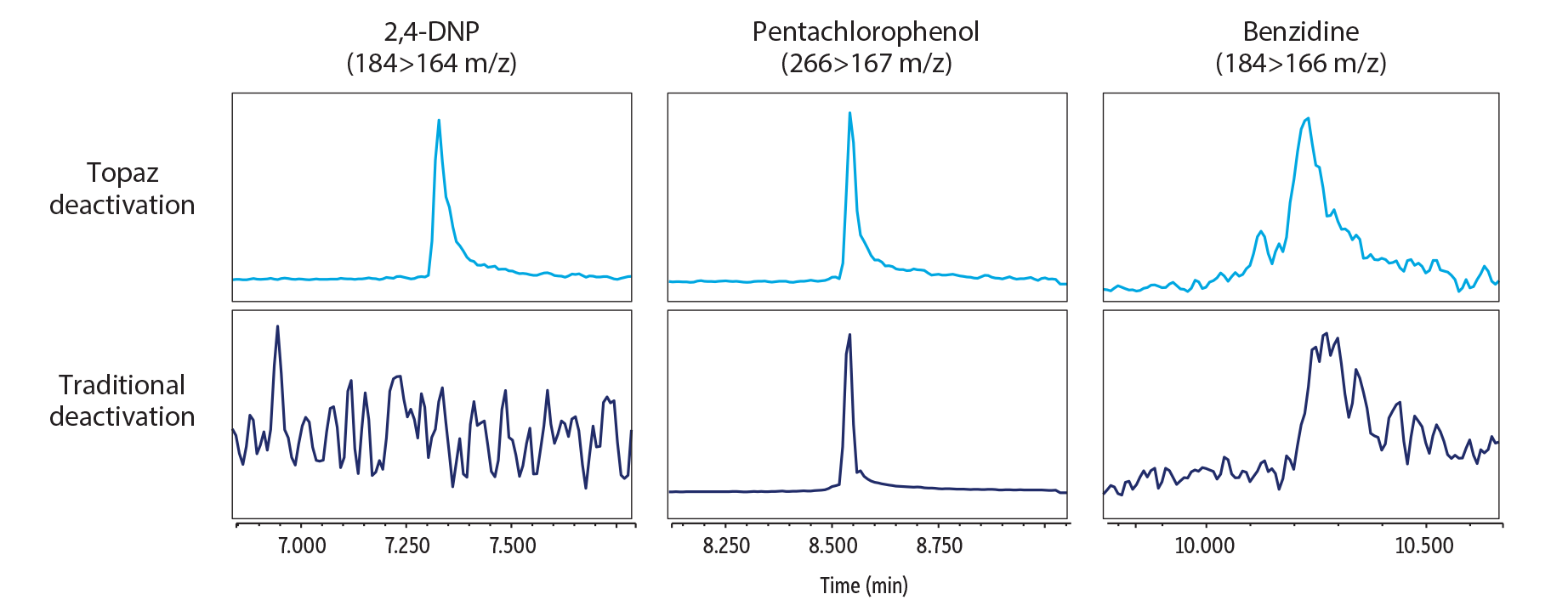
Low-level analyses are very sensitive to deactivation bias and any imperfections in the sample flow path, which makes choosing a broadly inert inlet liner critical to ensure good performance for a wide range of compound chemistries. As shown in Figure 1, using Topaz inlet liners resulted in detectable peak shapes for all three test probes at low levels (0.05 µg/mL, 50 pg on-column), whereas the traditional liner only produced acceptable peak shape for pentachlorophenol. This demonstrates that the Topaz deactivation was effective for both acidic (2,4-DNP and pentachlorophenol) and basic (benzidine) compound chemistries. In contrast, the traditional liner deactivation was not effective for 2,4-DNP and benzidine and only produced an acceptable peak shape for pentachlorophenol. Overall, the Topaz liner deactivation provided more balanced performance and produced good peak shapes at low levels for three key analytes that are sensitive to deactivation effectiveness.
GC_GN1261
Peaks
| Peaks | tR (min) | Conc. (µg/mL) | SRM | |
|---|---|---|---|---|
| 1. | 2,4-Dinitrophenol | 7.60 | 0.05 | 184>164 |
| 2. | Pentachlorophenol | 8.55 | 0.05 | 266>167 |
| 3. | Benzidine | 10.25 | 0.05 | 184>166 |
Conditions
| Column | RMX-5Sil MS GC capillary column, 30 m, 0.25 mm ID, 0.25 µm (cat.# 17323) |
|---|---|
| Standard/Sample | |
| 508.1 GC degradation check mix (cat.# 32093) | |
| Custom QC probe mix | |
| Diluent: | Dichloromethane |
| Conc.: | 0.05 µg/mL |
| Injection | |
| Inj. Vol.: | 1 µL splitless (hold 1.2 min) |
| Liner: | Topaz 4.0 mm ID single taper liner w/ wool (cat.# 23447) |
| Inj. Temp.: | 250 °C |
| Purge Flow: | 5 mL/min |
| Oven | |
| Oven Temp.: | 40 °C (hold 0.9 min) to 240 °C at 24.6 °C/min (hold 0 min) to 265 °C at 6.7 °C/min (hold 0 min) |
| Carrier Gas | He, constant flow |
| Flow Rate: | 1.5 mL/min @ 40 °C |
| Detector | MS |
|---|---|
| Mode: | SIM |
| Transfer Line Temp.: | 330 °C |
| Analyzer Type: | Quadrupole |
| Source Temp.: | 330 °C |
| Tune Type: | PFTBA |
| Ionization Mode: | EI |
| Instrument | Thermo Scientific TSQ 8000 Triple Quadrupole GC-MS |
Reduce Analyte Breakdown with Topaz Inlet Liners
Analyte breakdown occurs when liner deactivations are incomplete, leaving exposed active sites that catalyze chemical breakdown. For endrin and DDT, breakdown is generally expected to be below 20%, but lower levels are preferred because once results stray above 20%, the instrument is taken offline for maintenance, costing valuable sample analysis time. Results shown in Figure 2 demonstrate that at 0.05 ppm, endrin and DDT breakdown was higher and more variable when using inlet liners with the traditional deactivation. In contrast, Topaz inlet liners had extremely low breakdown (DDT <4% and endrin <2%) due to the robust and more inert deactivation.
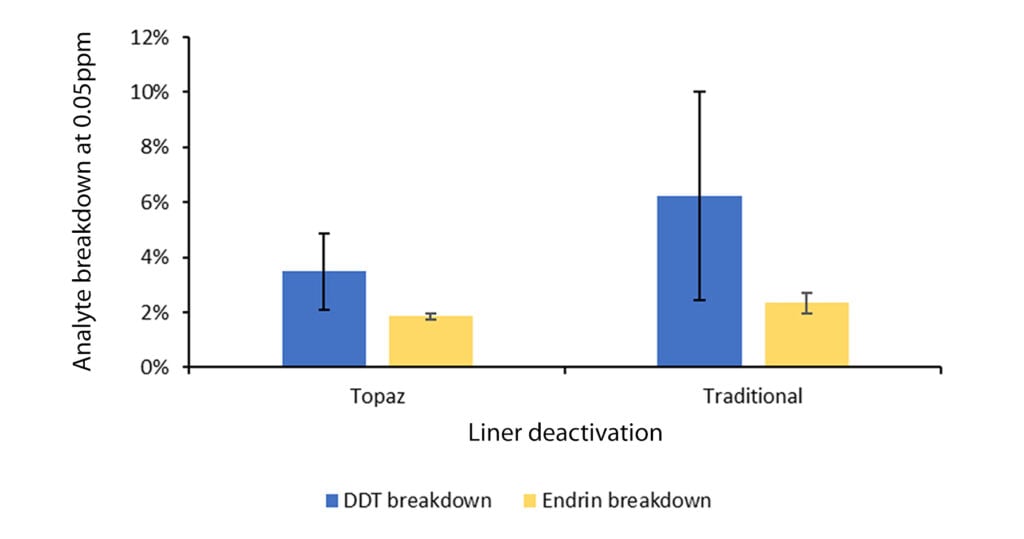
DDT breakdown = (DDE+DDD response)/(DDT+DDE+DDD response).
Endrin breakdown = (endrin ketone + endrin aldehyde response)/(endrin + endrin ketone + endrin aldehyde response)
Choose Topaz Inlet Liners to Improve GC Peak Shape and Sensitivity
Labs seeking higher sensitivity and reduced downtime increasingly rely on low-level GC‑MS/MS analyses where peak shape is critical—especially for dilute samples and splitless injections. Because analytes spend more time in the inlet liner under these conditions, liner inertness strongly influences peak shape, sensitivity, and analyte stability. This study showed Topaz liners consistently delivered good peak shapes for both acidic and basic compounds, and they also reduced breakdown of sensitive test probes. Overall, the more broadly effective deactivation used in Topaz inlet liners improved GC peak shape and sensitivity and proved essential for reliable low-level detection.
Maximize Inertness Throughout the Sample Flow Path with Convenient RMX-5Sil MS Column and Topaz Inlet Liner Kits
| Catalog No. | Description | Units |
|---|---|---|
| 17323-AG01 | RMX-5Sil MS Precision Liner Kit for Agilent, Includes 1 ea.: column cat.# 17323 (30 m, 0.25 mm ID, 0.25 µm) and liner cat.# 23305 (5-pk.) | kit |
| 17323-AG02 | RMX-5Sil MS Single Taper Liner Kit for Agilent, Includes 1 ea.: column cat.# 17323 (30 m, 0.25 mm ID, 0.25 µm) and liner cat.# 23303 (5-pk.) | kit |
| 17323-TH01 | RMX-5Sil MS Precision Liner Kit for Thermo, Includes 1 ea.: column cat.# 17323 (30 m, 0.25 mm ID, 0.25 µm) and liner cat.# 23267 (5-pk.) | kit |
| 17323-TH02 | RMX-5Sil MS Single Taper Liner Kit for Thermo, Includes 1 ea.: column cat.# 17323 (30 m, 0.25 mm ID, 0.25 µm) and liner cat.# 23447 (5-pk.) | kit |
| 17323-SH01 | RMX-5Sil MS Precision Liner Kit for Shimadzu, Includes 1 ea.: column cat.# 17323 (30 m, 0.25 mm ID, 0.25 µm) and liner cat.# 23320 (5-pk.) | kit |
| 17323-SH02 | RMX-5Sil MS Single Taper Liner Kit for Shimadzu, Includes 1 ea.: column cat.# 17323 (30 m, 0.25 mm ID, 0.25 µm) and liner cat.# 23447 (5-pk.) | kit |
| 17323-PE01 | RMX-5Sil MS Precision Liner Kit for PerkinElmer, Includes 1 ea.: column cat.# 17323 (30 m, 0.25 mm ID, 0.25 µm) and liner cat.# 23799 (5-pk.) | kit |
| 17323-PE02 | RMX-5Sil MS Single Taper Liner Kit for PerkinElmer, Includes 1 ea.: column cat.# 17323 (30 m, 0.25 mm ID, 0.25 µm) and liner cat.# 23800 (5-pk.) | kit |
Products Mentioned
Author