


Here’s what happens behind the scenes to ensure every ampul meets the accuracy, purity, and documentation standards your analysis depends on.
01 | Review Customer & Method Requirements
To determine which organic reference standards we should develop as stock products, Restek experts closely monitor government regulations and methods from around the globe and also actively engage with our customers and distributors. Once a product is chosen based on regulatory changes, customer needs, and our 35+ years of experience, a veteran Restek chemist formulates a stable standard containing an ideal mix of compounds and concentrations. All formulations are then subjected to a thorough review of accuracy, compatibility, and solubility by a second chemist.
02 | Verify Compatibility & Stability
All raw materials used in our reference standards are held to strict purity criteria, and compound compatibility is scrutinized during both formulation and review. We also conduct ongoing, long-term stability and short-term shipping stability studies in accordance with ISO 17034 and ISO Guide 35 to ensure reliability and accurate shelf-life reporting—at least 95% of our products provide a 12-month shelf life or longer.
03 | Characterize Raw Materials Thoroughly
Restek’s Quality Control (QC) lab confirms the chemical identity and purity of mixture components and solvents using two or more of the following techniques: GC-FID, HPLC, GC-ECD, GC-MS, LC-MS, refractive index, and melting point.
04 | Calibrate Analytical Balances
All analytical balances are verified at seven mass levels daily using NIST* traceable weights and are also calibrated yearly by an ISO/IEC 17025-accredited provider to guarantee accurate measurement.
*National Institute of Standards and Technology
05 | Proprietary Deactivation of Glassware & Ampuls
Restek reference standards are prepared using Class A volumetric flasks and/or Class A pipettes. Ampuls and vials used in preparation and packaging undergo Restek’s proprietary deactivation process to prevent the loss of target analytes.
06 | Maintain ISO Accreditation
The reference standard manufacturing and QC testing laboratories in Restek’s state-of-the-art Bellefonte, PA, facility feature ISO 17034 and ISO/IEC 17025 accreditation. These accreditations—in addition to ISO 9001 registration, which we have maintained since 1994—serve as recognition that Restek and our labs meet the world-class quality standards established by the International Organization for Standardization (ISO). On-site manufacturing as well as raw material, qualitative, and quantitative analyses are completed in these ISO-accredited labs, including a dedicated facility for PFAS standards manufactured to 99.8% purity. Restek’s ISO-accredited labs offer a full line of both stock and custom CRMs.
Learn more at www.restek.com/iso
07 | Offer a Variety of Documentation
Restek exclusively offers three levels of fully ISO-compliant documentation for our reference standards, and most stock standards come with Certificate of Analysis–Chromatographic Plus documentation.
Certificate of Analysis – Gravimetric includes all raw material information, lot numbers and purity, isomer ratios for isomeric compounds, and calculated concentration(s). Associated uncertainties are also included for certified reference materials (CRMs).
Certificate of Analysis – Chromatographic includes all raw material information, lot numbers and purity, isomer ratios for isomeric compounds, and calculated concentration(s). Associated uncertainties are also included for certified reference materials (CRMs). Additionally, a single sample is withdrawn from the packaged units and is tested via an appropriate technique to verify mixture composition. A chromatogram of the analyzed standard, with each peak identified, is included on the certificate.
Certificate of Analysis – Chromatographic Plus includes all raw material information, lot numbers and purity, isomer ratios for isomeric compounds, and calculated concentration(s). Associated uncertainties are also included for certified reference materials (CRMs). Additionally, a sample of the packaged units is analyzed in triplicate, and the peak areas are statistically compared to a second lot which is either a previous lot (if available) or a freshly produced independent second lot. A chromatogram of the analyzed standard, with each peak identified, is included on the certificate. Plus, a detailed data pack containing the product certificate, all quantitative assay data and statistics, and the Reference Material Batch Record are available at www.restek.com/documentation.
08 | Package Securely & Label Clearly
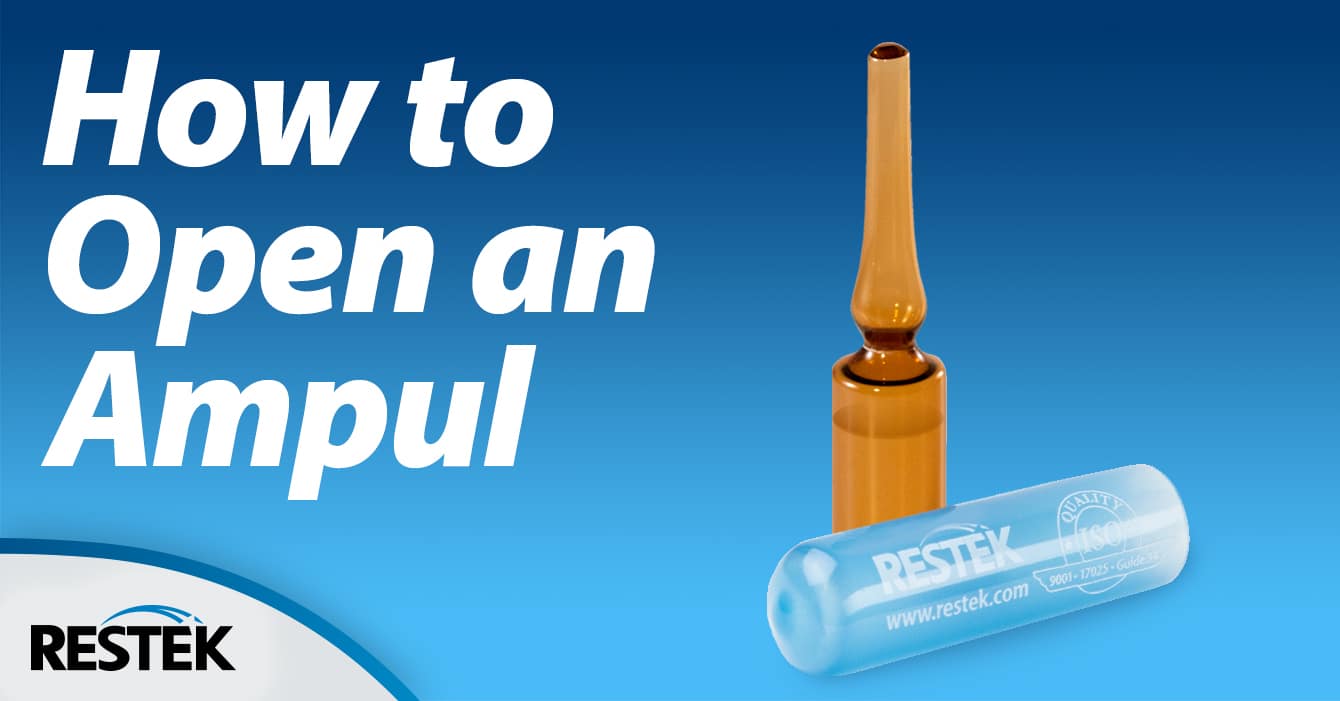
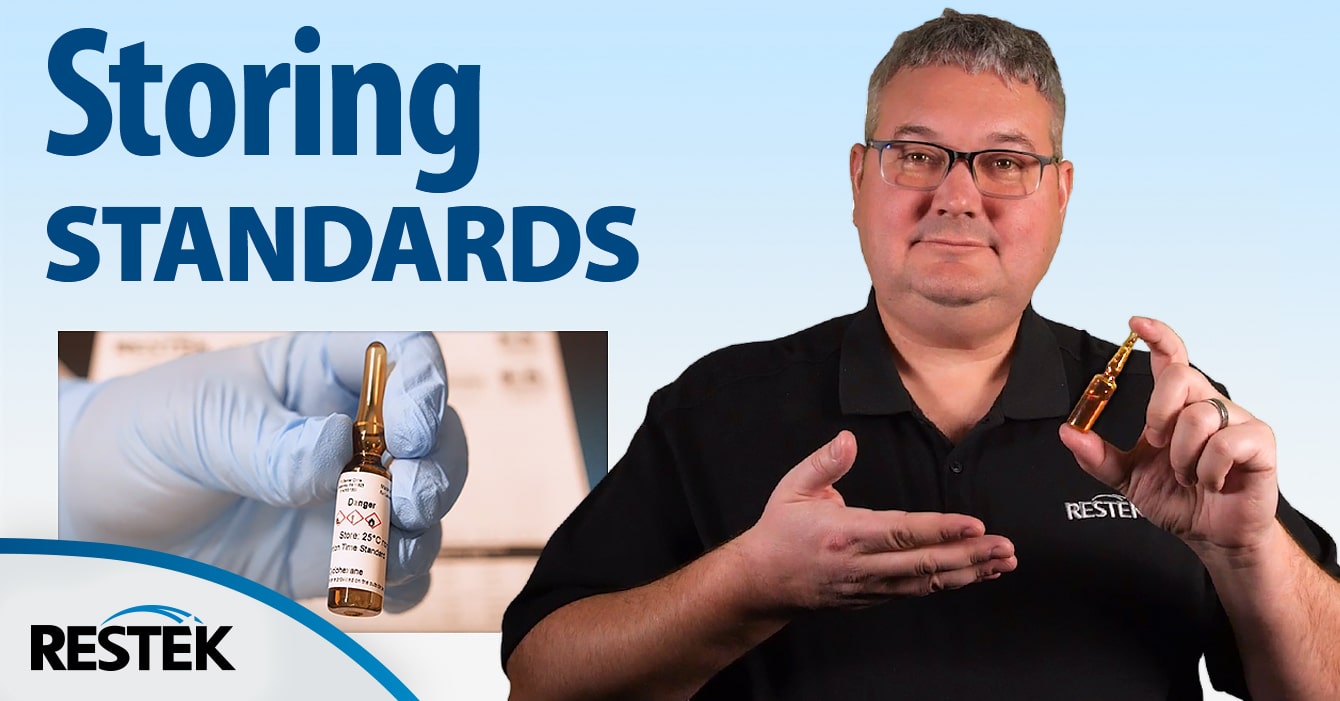
Every Restek standard is placed in compact, durable, and environmentally friendly packaging for dock-to-door protection. Provided notebook and vial labels provide critical storage, safety, and shelf-life information in an easy-to-read format for added safety and GHS compliance. QR codes on the ampul storage tube give you instant access to the certificate of analysis for your specific standard and lot # on Restek.com.
09 | Convenience and Safety Included with Each Ampul
As an added bonus, we include a deactivated screw-top vial (cat.# 24640) with each stock reference standard <5 mL for worry-free transfer. Every order also includes a free Restek Safe Cracker.
10 | Manage Warehouse Inventory
To ensure the inventory is available when it’s needed, Restek continually analyzes and maintains inventory of more than 1200 catalog standards and multiple lots of the most commonly requested calibration standards—as well as more than 6300 neat compounds. We pull inventory months before its expiration date to eliminate inadvertent delivery of expired or nearly expired reference standards.
Frequently Asked Questions
Need Help with Reference Standards?
From method selection to product recommendations, our reference standards experts are here to help you navigate complex workflows and achieve accurate, reliable results.