


Is your lab or business thinking about purchasing a hydrogen gas generator and would like to know more about the different models available from Restek and the maintenance they will require? If so, hopefully this post will answer many of your questions/concerns.
But before we get started, have you ever wondered how a hydrogen generator works?
Generally speaking, deionized water is introduced into a cell that consists of an anode (positive side) and a cathode (negative side). At the anode, electricity splits the water molecules into oxygen and positive hydrogen ions (H+) via electrolysis. A PEM (Proton Exchange Membrane) separates the anode (positive) and cathode (negative) electrodes. Most of the oxygen molecules are vented to atmosphere while the positive hydrogen ions are drawn through the PEM towards the negative cathode electrode and via reduction (addition of electrons), the hydrogen ions (H+) become hydrogen molecules (H2).
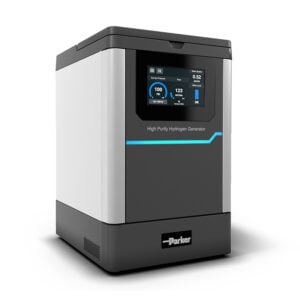
Several years ago I wrote a blog post that provided suggestions for selecting a hydrogen generator. Need some help choosing a hydrogen generator?
As stated in this post, you will need to know the following information to select the most appropriate generator.
- Required hydrogen gas purity.
- Required flow rate and line pressure.
Once you have determined which type and capacity hydrogen generator will fit your needs, you will be able to determine which consumables are needed and the frequency of their replacement to properly maintain the generator. But before we discuss the consumables, let’s begin with the water source.
Water Source
If you’re using a PEM generator, we recommend Parker’s HydroGen Mate DI Water System (cat.# 22000), which meets the water quality specifications of these generators.
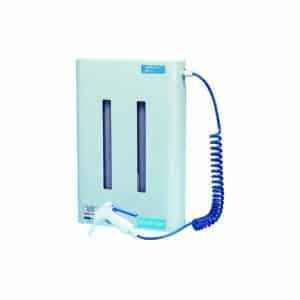
The HydroGen Mate DI Water System also meets the specifications for the PEM generators. Unfortunately, it appears that Parker no longer offers a pdf of the User Guide for the PEM hydrogen generators on their website. However, they do have a Market Application Publication sheet available. MAP_H2FuelGas_B.pdf
Daily System/Generator Check List
- Check that the power ON indicator is illuminated.
- Check the STATUS/FAULT indicator on the control panel.
- Check the water level.
- Check the water conductivity.
- Check the water bottle spillage drains.
- Check for leaks.
Maintenance Kits
Similar kits are available for the H2C generators. The six-month kit is Restek part # 23484 (Parker # MKH2C-6M) and contains the following:
- Deionizer cartridge
- Water filter
- Filter removal tool
- Two environmental filters
The 24-month kits are Restek part #s 23485 (Parker # MKH2C-24M), which contain the following:
- Deionizer cartridge
- Water filter
- Filter removal tool
- Two environmental filters
- Separation chamber float
- Water Pump
Similar kits are available for the PEM generators. The six-month kit is Restek part # 23070 (Parker # MKH2PEM-6M) and contains the following:
- Deionizer cartridge
- Water filter
- Three environmental filters
The 24-month kits are Restek part #s 23071 (Parker # MKH2PEM-24M), and
Restek part # 29289 (Parker # MKH2F-24M), which contain the following:
- Deionizer cartridge
- Water filter
- Three environmental filters
- Water level sensor (Float)
- Water Pump
- Desiccant cartridge
- Filter replacement tool
- Cartridge spanner (wrench)
- Service reset dongle
- 1/4” Tygon tube
There are two maintenance kits for the PEMPD generators, a six-month (4000 hours) and a 24-month (16000 hours). The six-month kit is Restek part # 22154 (Parker # MKH2PEMPD-6M), which contains the following:
- Deionizer cartridge
- 100 µm water filter
- Two environmental filters
- Filter replacement tool
The 24-month kit is Restek part # 22155 (Parker # MKH2PEMPD-24M), which contains the following:
- Deionizer cartridge
- 100 µm water filter
- Two environmental filters
- Filter replacement tool
- Tube clamp
- Water Pump
- Two fan guards
Separate part numbers for the desiccant cartridge and spanner wrench are also available: Restek # 23069 (Parker # MKH2PEM-D) and # 29287 (Parker # MKH2F-D). A note on page 17 from the Parker H2PEM User Guide provides an important cautionary statement (below).
Note: The desiccant cartridge should be changed as and when required; however, it is recommended that it is changed at least every 6, 4, and 2 months on the H2PEM-100/H2PEM-165; H2PEM-260; and H2PEM-510 respectively.
To summarize, owning a hydrogen generator does require a brief daily inspection and maintenance every six-months (or 4000 hours of use). For the PEM generators, the desiccant cartridge may need to be replaced more often depending on the model.
I hope you have found this informative. Keep watching for additional installments of gas generators. Thank you.