

Oral fluid is becoming an increasingly popular matrix due to its ease of collection. While oral fluid is a relatively simple matrix to collect, the collection kits can introduce analytical issues downstream. Kits often consist of an applicator with a sponge attached, a tube filled with 3 mL of buffer solution, and a cap. The sponge is used to collect 1 mL of oral fluid, which is then placed in the buffer solution to ensure analyte stability and inhibit bacterial growth. The total volume of solution for testing should be 4 mL (1 mL of oral fluid and 3 mL of buffer); however, it is often very difficult to recover the full volume of solution from the sponge, which can affect volume recovery and analyte recovery. There are different techniques to manipulate the sponge and improve sample recovery, such as manual compression and centrifugation. The primary objective is to ensure complete analyte recovery by maximizing volume recovery.
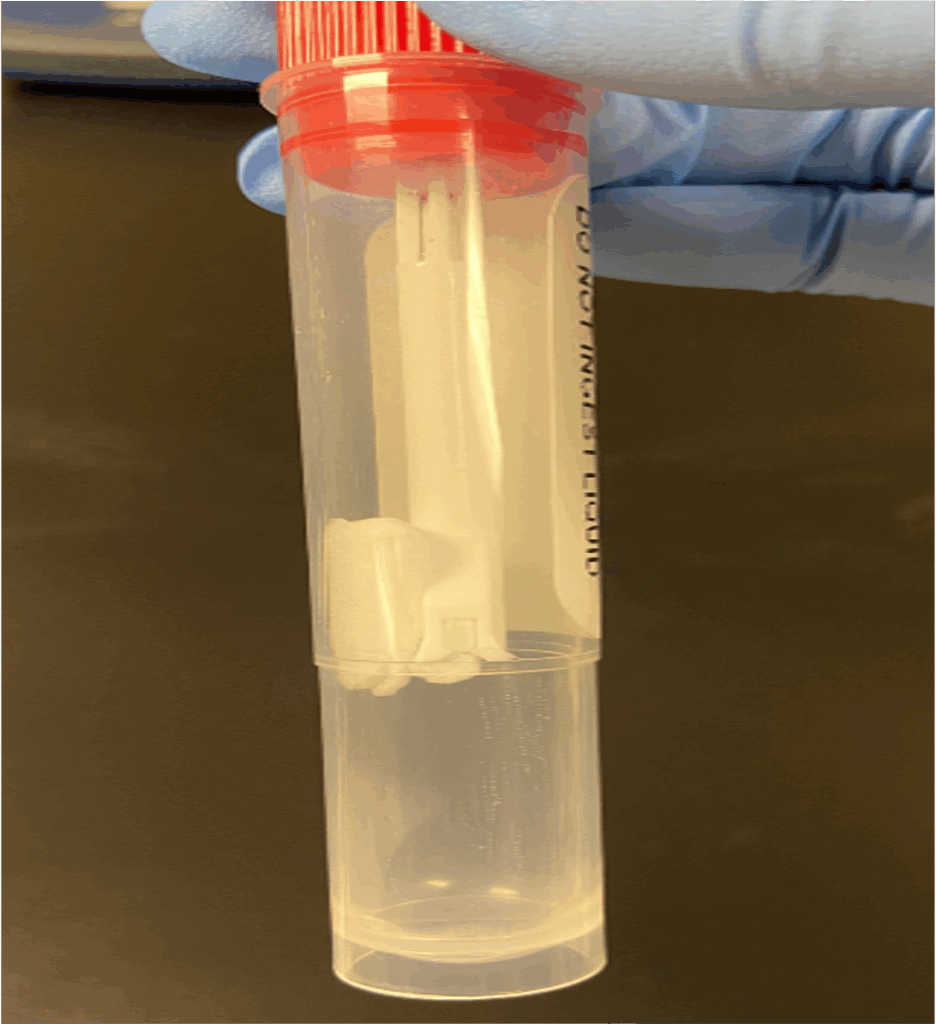
We performed an evaluation of two different techniques to extract oral fluid and buffer solution from a collection sponge: manual compression and centrifugation. The manual compression technique involved pressing the sponge against the side of the tube to attempt to drip as much liquid from the sponge as possible, whereas the centrifugation technique involved folding the sponge above the buffer solution and centrifuging the sample to remove the liquid from the sponge. For analysis, each of these techniques then underwent a salt-assisted liquid-liquid extraction (SALLE). A description of the full extraction method can be found here: A Comparison of Sample Preparation Techniques for Drugs of Abuse in Oral Fluid . When using centrifugation as a technique to empty the sponge, there are a few considerations that need to be made. It is important to try to “perfect” the sponge fold technique to not only hold the sponge high enough above the liquid but also hold it in place during the centrifugation process. This can be challenging but it is possible if the sponge is folded the correct way. In Figure 1 below, you can see the technique for folding the sponge to hold it against the side of the tube. It should be noted that even with the proper technique and proper handling of the sample, there is potential for the sample to splash and be reabsorbed by the sponge.
Figure 1. Sponge Fold Technique for Centrifugation
In order to demonstrate the benefits of centrifugation on oral fluid samples, a series of experiments were conducted to evaluate multiple variables. Quantisal oral fluid collection kits and the corresponding buffer were used as the collection device. Additionally, Specialty Matrix (SMx) synthetic oral fluid from UTAK was used as the matrix. The first experiment was a time comparison which looked at the time it took to prepare samples using both methods. The second experiment assessed volume recovery, and lastly, analyte recovery was assessed by looking at analyte’s accuracy, precision, and peak area improvements. These experiments will be discussed in further detail below.
Time Comparison
It can be argued that the addition of a centrifugation step can add time to the workflow. A comparison was done to calculate the time per sample using manual compression versus centrifugation. While the time is longer for centrifugation when working with smaller sample batch sizes, but when preparing 96 samples, the total time for manual compression is 57.60 minutes while the total time for centrifugation is 36.13 minutes, meaning the centrifugation technique saves over 20 minutes in sample preparation time when compared to the manual compression technique.
Volume Recovery
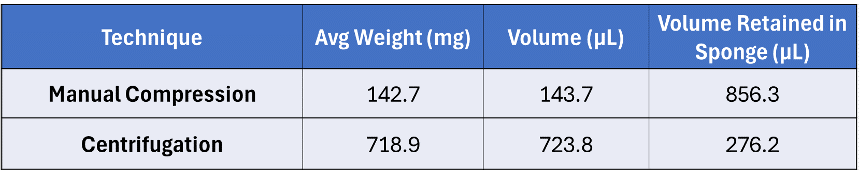
Volume recovery was assessed in a few different ways when comparing the techniques for emptying the sponge. The first was a gravimetrical analysis of the oral fluid to assess how much was recovered from each technique. This was completed by calculating the density of the oral fluid, which was found to be 0.9932 g/mL. In this experiment, 1 mL of oral fluid was collected on the sponge. The sponge then underwent each of the techniques and the oral fluids in the tube were weighed. This was done in triplicate to get an average weight for each technique, which then used density to calculate to total volume recovered. The volume of oral fluid being retained by the sponge was also calculated to highlight the potential loss of sample.
Table 1. Recovery Comparison Based on Density
The next experiment for volume recovery was to measure the actual volume using a graduated cylinder. In this experiment, 1 mL of oral fluid was added to a sponge, and the sponge was added to the tube with the buffer (3 mL). The samples then underwent the different techniques in triplicate. The liquid in the tube was poured into a graduated cylinder, and the volume was recorded. Below, Figure 2 and Figure 3 show a visual of these results and Table 2 outlines the data for this experiment.
Figure 2. Volume Recovery for Manual Compression
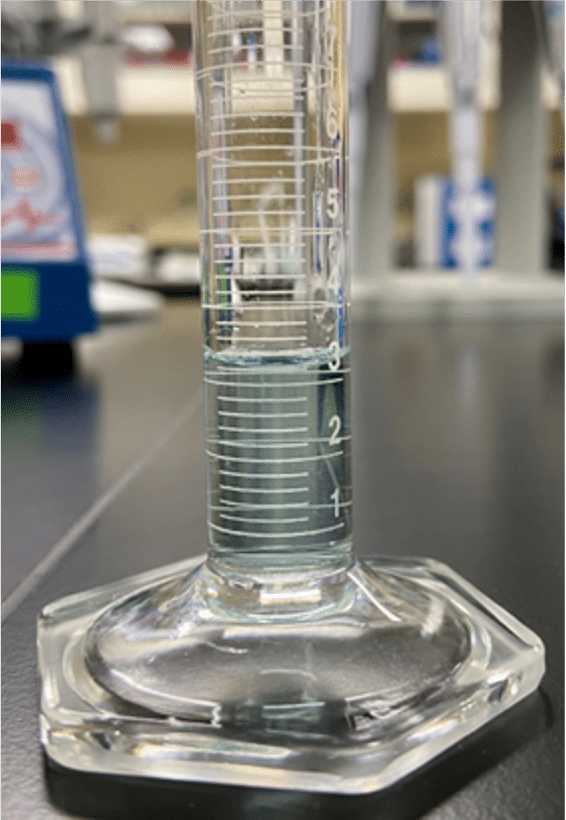
Figure 3. Volume Recovery for Centrifugation
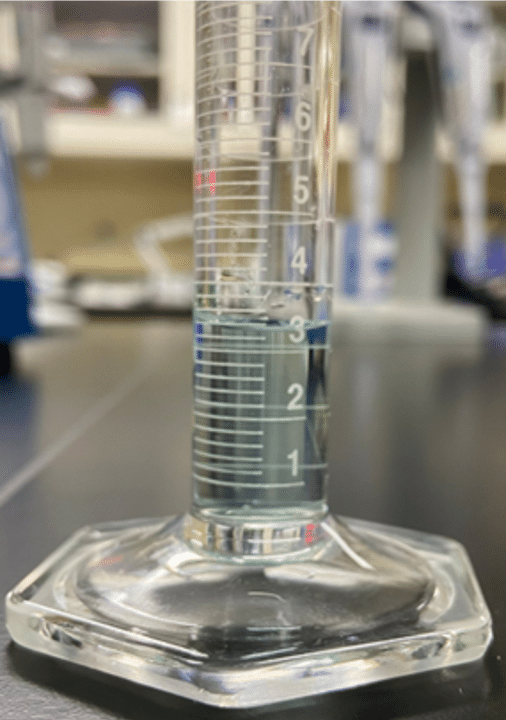
Table 2. Recovery Comparison Based on Volume.

Analyte Recovery
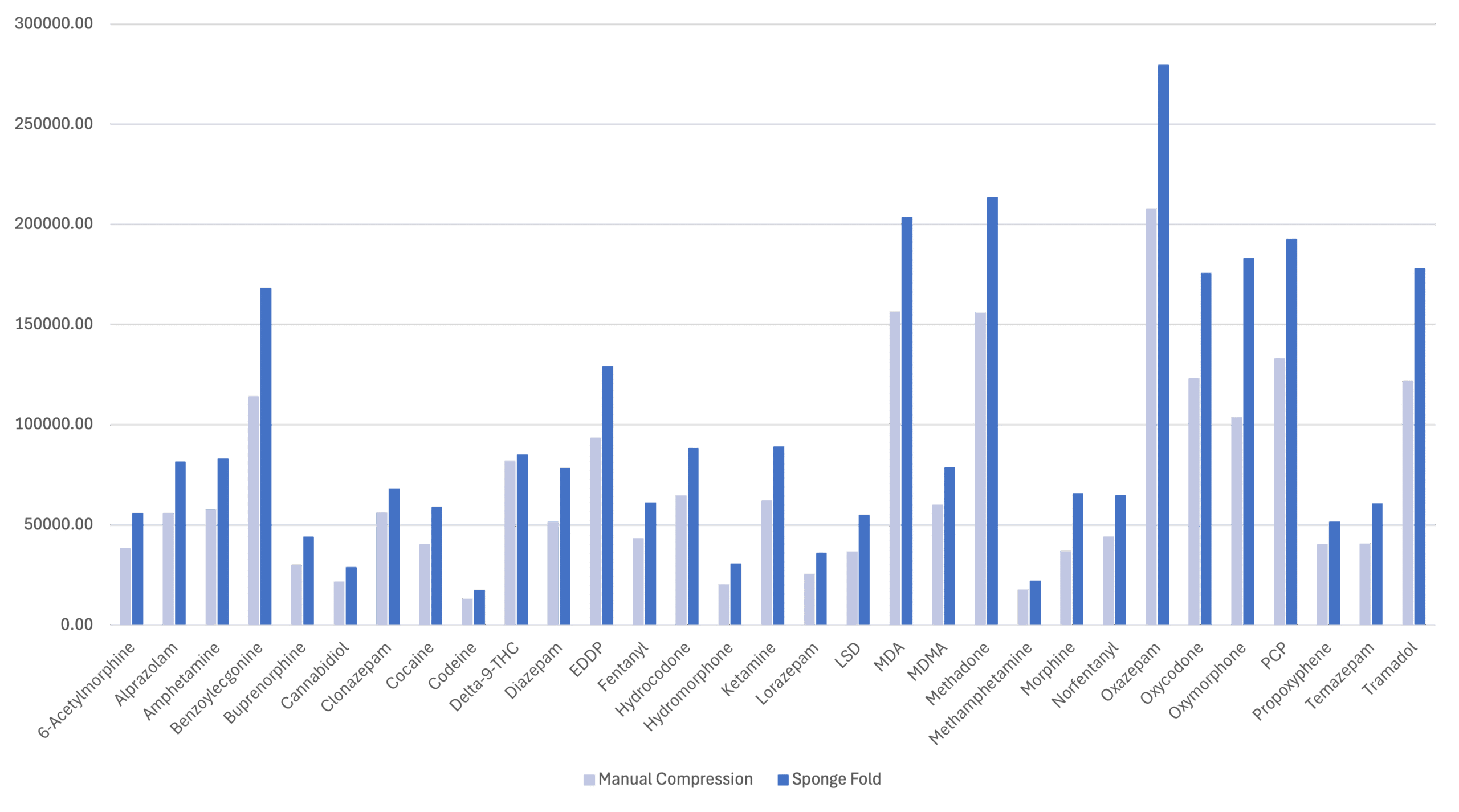
Analyte recovery was assessed by spiking a known concentration into synthetic oral fluid followed by saturation of the sponge with the oral fluid before submerging it in the buffer solution. This concentration was analyzed against a calibration curve that was prepared without using the kits and only using oral fluid and buffer solution, eliminating any recovery issues from the kit. The two recovery techniques were compared and assessed for accuracy, precision, and peak area. These results can be found in Figure 3, 4, and 5.
Figure 4. Accuracy of Analyte Recovery for Manual Compression vs Centrifugation
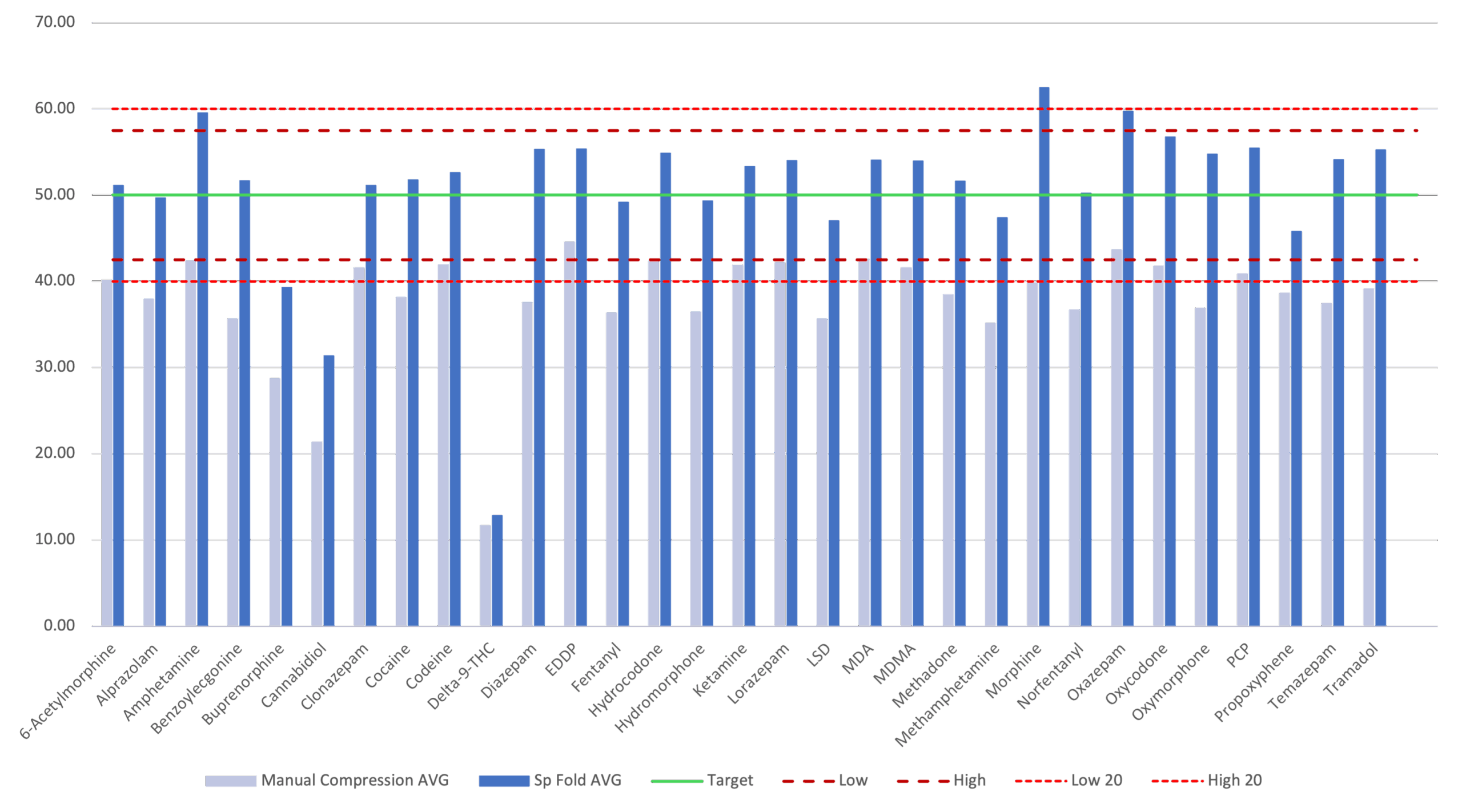
The figure above looks at the accuracy of analytes using both techniques spiked at 50 ng/mL. Using the manual compression technique, 18 analytes were greater than +/- 20% from the target value and 27 analytes were greater than +/- 15 % from the target value. When using the centrifugation step, this improved to just four analytes being greater than +/-20% of the target value and six analytes being outside of the +/-15 % range and the analytes that fell outside appeared to be experiencing some ion suppression or ion enhancement. Overall, the centrifugation technique improved accuracy for 21 analytes, and all analytes saw an increase in recovery as well.
Figure 5. Precision of Analyte Recovery for Manual Compression vs Centrifugation
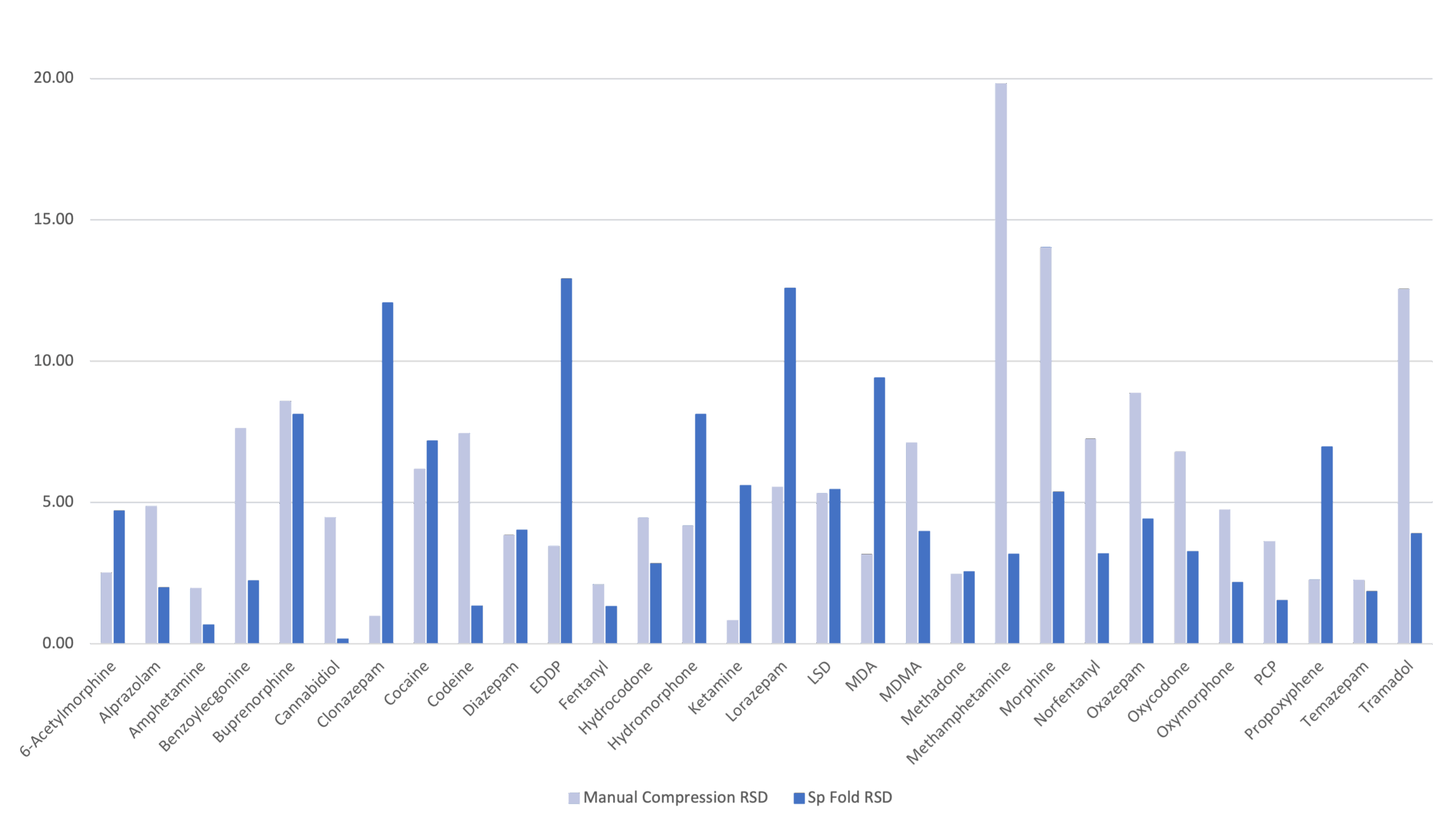
In Figure 4 above, precision was assessed for all 31 analytes by calculating the %RSD for all analytes. The centrifugation technique showed 18 analytes with lower %RSD when using this technique compared to manual compression. Additionally, when using centrifugation, peak area increased for all analytes compared to the manual compression technique. These results can be found in Figure 5 below.
Figure 6. Peak Area for Manual Compression vs Centrifugation
When higher analyte recovery is brought up, there is some concern when it comes to proficiency test samples. However, these samples will remain unaffected as they do not include sponges. These samples would follow your regular sample preparation procedure. The centrifugation step occurs before any sample extraction or preparation techniques.
Overall, there are many benefits to oral fluid sample analysis when using centrifugation as an extraction technique. It can be a technique that takes time to perfect, but centrifugation can provide a quicker and more efficient approach than manual compression for the preparation of large sample batches when used properly. Data indicates that volume recovery is improved when using this technique as compared to manual compression. Results for the centrifugation technique show increase in recovery volume, peak area and recovery for all analytes. Furthermore, when performing quantitation analysis, the centrifugation technique demonstrated enhanced benefits for both accuracy and precision as well.