

Hexahydrocannabinol (HHC) has been an emerging cannabinoid popping up in stores all around. These products are available in cartridges, tinctures, and just about any other medium cannabinoid products are usually sold in, including fortified hemp flower. When these designer-type cannabinoid products emerge, testing labs are strapped with the task of finding a certified reference material to allow them to perform potency testing and this can oftentimes pose a challenge to source.
HHC can be synthesized by hydrogenation of the double bond on THC. This means that delta-9-THC (and the other isomers of THC) have a different molecular weight than HHC because of the two additional hydrogens added.
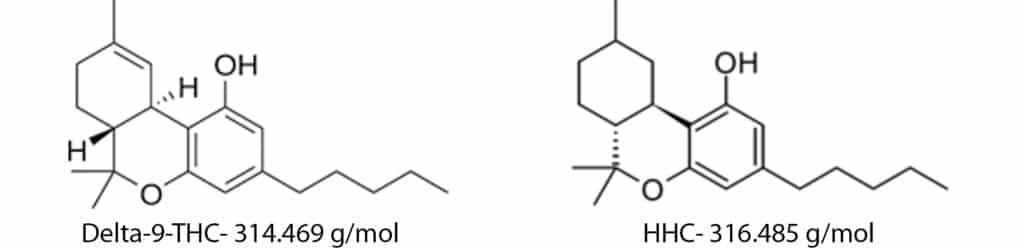
A few months ago a customer reached out about testing a commercial sample of HHC that had two main peaks. It can be challenging in this situation to identify what unknown peaks are without having reference standards or access to an MS and even then can still be difficult. I recently purchased two HHC reference standards labeled as 9S-hexahydrocannabinol and 9R-hexahydrocannabinol and was unsure if these were enantiomers or stereoisomers, as HHC has three chiral centers. If these two compounds were enantiomers and not just stereoisomers/epimers, all of the chiral centers would have to be in opposite conformations of one another. A method was developed to detect these compounds by LC-UV using the following conditions:
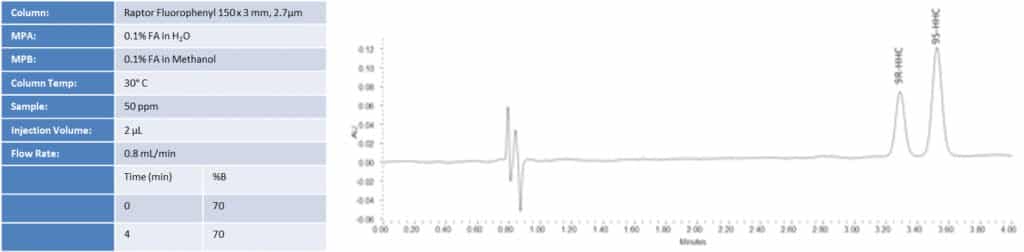
So, as it turns out 9R-HHC and 9S-HHC are stereoisomers, not enantiomers, and good resolution was achieved between the two compounds without the use of a chiral column. Could these two compounds be what the customer was seeing in their commercial HHC sample? It could be, or any other number of stereoisomers that HHC can form. Cannabis research is continuing to gain momentum, but trendy cannabinoids such as delta-10-THC and HHC are not well studied or characterized and will continue to pose analytical challenges as they appear on the market.