




Thyroid hormones are essential for the regulation of development and growth in humans and animals. The thyroid gland produces thyroxin (T4) and tri-iodothyronine (T3) and quickly releases these compounds into the circulatory system. The concentration of circulating T4 is 50-60 times higher than T3 and the majority of these molecules are bound to blood proteins. The unbound or “free” T3 and T4 are the active forms of the hormone which only represent a small portion (less than 1%) of total thyroid hormones. Accurate and sensitive measurement of low pg/mL levels of free hormones is necessary to assess thyroid function for both veterinary and human diagnostics. Reverse tri-iodothyronine (rT3) is an inactive form that results from T4 biotransformation. Since rT3 functions as the feedback inhibitor of thyroid hormone production, the measurement of rT3 can be an important diagnostic marker with clinical implications.
The intent of this application was to develop an LC-MS/MS method for the analysis of thyroid hormones at the free form levels using the highly efficient and selective Raptor Biphenyl LC column. The clinical applicability of this method was demonstrated by analyzing fortified thyroid hormone in phosphate buffered saline (PBS) containing 4% human albumin.
Experimental
Instrument and Analytical Conditions
The instrument and analytical conditions are listed in Table I. The analyte MRMs are shown in Table II.
Table I: Analytical Conditions for Waters Xevo TQ-S with Acquity UPLC
| Analytical Column | Raptor Biphenyl 2.7 µm, 100 mm x 2.1 mm (cat.# 9309A12) | |
| Guard Column | Raptor Biphenyl EXP guard column cartridge 2.7 µm, 5 mm x 2.1 mm (cat.# 9309A0252) | |
| Mobile Phase A | 0.1% Formic acid in water | |
| Mobile phase B | 0.1% Formic acid in methanol | |
| Gradient | Time (min) | %B |
| 0.0 | 70 | |
| 2.0 | 80 | |
| 2.01 | 70 | |
| 3.5 | 70 | |
| Flow Rate | 0.4 mL/min | |
| Column Temp. | 40 °C | |
| Ion Mode | Positive ESI | |
| Capillary Voltage | 2.0 kV | |
| Gas Flow | 800 (L/Hr) desolvation | |
| 200 (L/Hr) cone | ||
| 7.0 (bar) nebulizer | ||
| Desolvation Temp. | 600 °C | |
Table II: Analyte MS/MS Transitions
| Analyte | Precursor Ion | Product Ion Quantifier | Product Ion Qualifier |
|---|---|---|---|
| T3 | 652.07 | 606.10 | 508.10 |
| rT3 | 652.07 | 606.10 | 508.10 |
| T4 | 778.03 | 731.97 | 323.87 |
| T4-13C6 | 784.09 | 738.04 | – |
Sample/Calibration Standard Preparation
Human albumin was dissolved in PBS solution to a final concentration of 4%. This solution was used to prepare calibration standards ranging from 2 to 400 pg/mL. Standard solutions (0.5 mL) were fortified with 5 µL of internal standard (T4-13C6 [1 ng/mL]) and mixed with 1 mL of acetonitrile in a 4 mL glass vial. A 2 mL aliquot of ethyl acetate was added, stirred for 2 min, and then centrifuged for 10 min at 4,300 rpm. The organic phase was removed and placed into a 4 mL glass vial, then evaporated to dryness at 55 °C under a gentle stream of nitrogen. The dried extract was reconstituted with 80 µL of a 30:70 water:methanol solution and injected (10 µL) into the LC-MS/MS for analysis.
Results
Chromatographic Separation of Thyroid Hormones
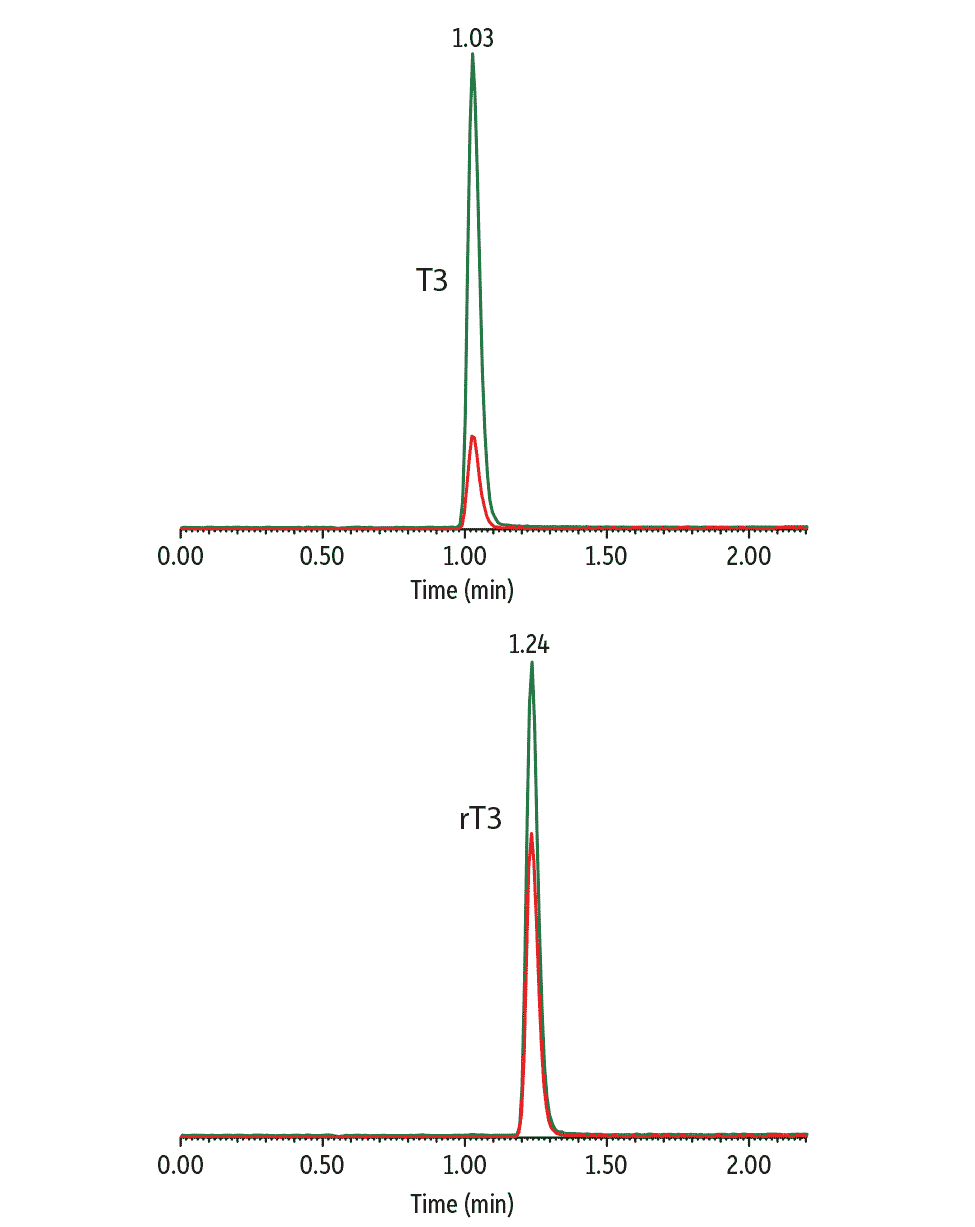
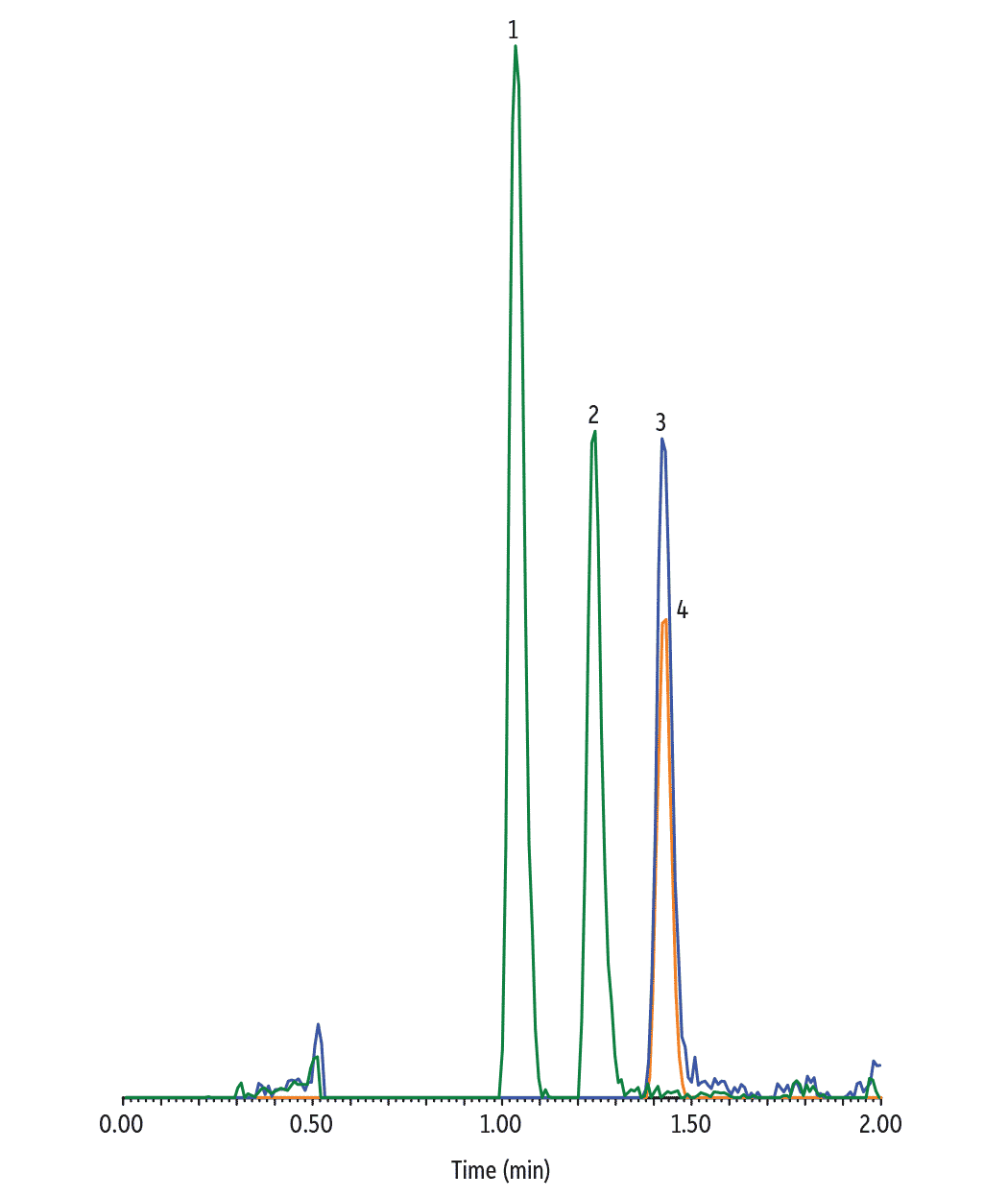
Since the most sensitive mass transitions for T3 and rT3 are identical, it is necessary to chromatographically separate these two compounds for accurate quantitation. With independent injections of T3 and rT3, it was shown that T3 and rT3 were completely resolved with the Raptor Biphenyl column (Figure 1). An example chromatogram (Figure 2) shows the baseline resolution of 3 forms of thyroid hormone from extracted sample (20 pg/mL) within 2 minutes.
LC_CF0603
Peaks
| Peaks | tR (min) | Precursor Ion | Quantifier Ion | Qualifier Ion | |
|---|---|---|---|---|---|
| 1. | Tri-iodothyronine (T3) | 1.03 | 652.07 | 606.10 | 508.10 |
| 2. | Reverse tri-iodothyronine (rT3) | 1.24 | 652.07 | 606.10 | 508.10 |
LC_CF0605
Peaks
| Peaks | tR (min) | Precursor Ion | Product Ion | |
|---|---|---|---|---|
| 1. | Tri-iodothyronine (T3) | 1.04 | 652.07 | 606.10 |
| 2. | Reverse tri-iodothyronine (rT3) | 1.25 | 652.07 | 606.10 |
| 3. | Thyroxin (T4) | 1.43 | 778.03 | 731.97 |
| 4. | Thyroxin-13C6 | 1.43 | 784.09 | 738.04 |
Conditions
| Column | Raptor Biphenyl (cat.# 9309A12) | ||||||||||||||||||||
|---|---|---|---|---|---|---|---|---|---|---|---|---|---|---|---|---|---|---|---|---|---|
| Dimensions: | 100 mm x 2.1 mm ID | ||||||||||||||||||||
| Particle Size: | 2.7 µm | ||||||||||||||||||||
| Pore Size: | 90 Å | ||||||||||||||||||||
| Guard Column: | Raptor Biphenyl EXP guard column cartridge 5 mm, 2.1 mm ID, 2.7 µm (cat.# 9309A0252) | ||||||||||||||||||||
| Temp.: | 40 °C | ||||||||||||||||||||
| Standard/Sample | |||||||||||||||||||||
| Diluent: | 30:70 Water:methanol | ||||||||||||||||||||
| Conc.: | 20 pg/mL | ||||||||||||||||||||
| Inj. Vol.: | 10 µL | ||||||||||||||||||||
| Mobile Phase | |||||||||||||||||||||
| A: | 0.1% Formic acid in water | ||||||||||||||||||||
| B: | 0.1% Formic acid in methanol | ||||||||||||||||||||
|
| Detector | MS/MS |
|---|---|
| Ion Mode: | ESI+ |
| Mode: | MRM |
| Instrument | HPLC |
Linearity
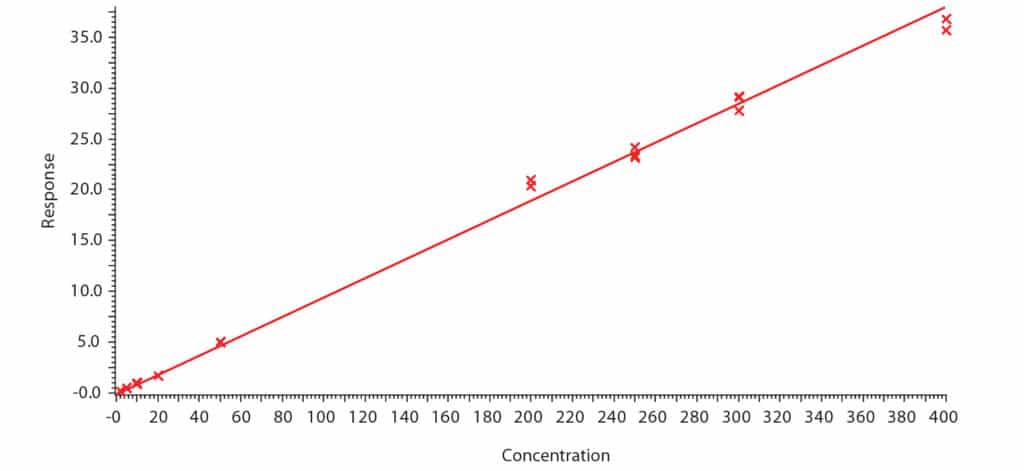
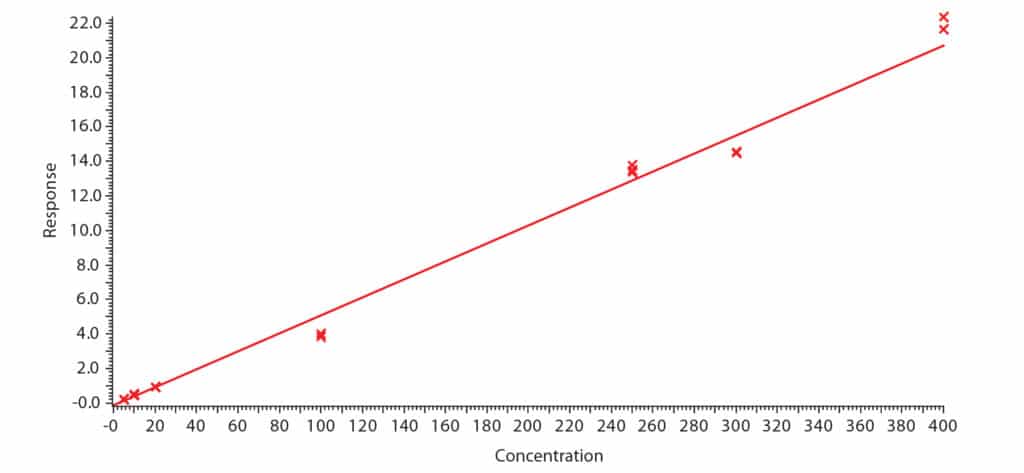
Good linearities (1/x weighted) were obtained for all 3 forms of thyroid hormones with coefficient of determination (R2) values > 0.990 from 2 to 400 pg/mL (for T3) or 5 to 400 pg/mL (for T4 and rT3). The %deviation was < 15%. Linearity plots are shown in Figure 3.
A) T4 Calibration Curve, R2 = 0.999
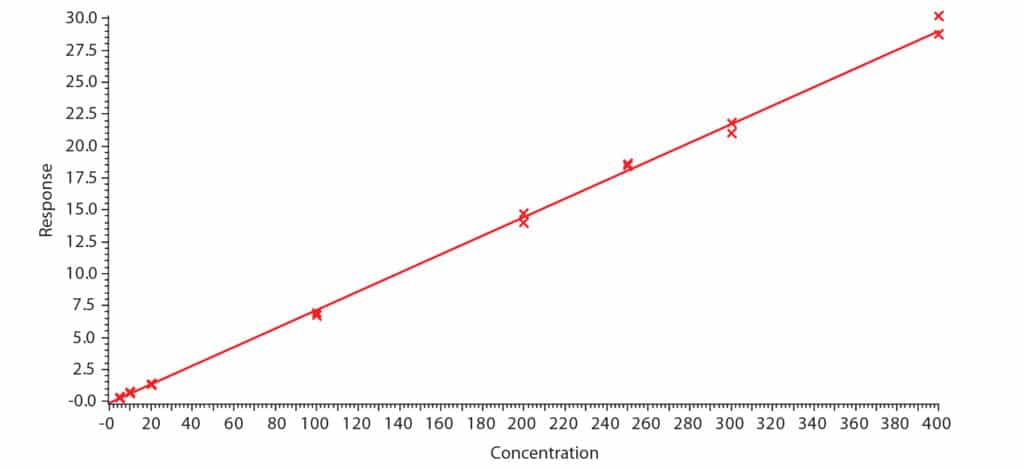
B) T3 Calibration Curve, R2 = 0.998
C) rT3 Calibration Curve, R2 = 0.991
Conclusions
The Raptor Biphenyl column is excellent for rapid and sensitive analysis of thyroid hormones. With the method described here, concentrations of thyroid hormones as low as 2 pg/mL (T3) or 5 pg/mL (T4 and rT3) can be determined with less than 3.5 minutes of total analysis time. The analytical method is thus applicable to the clinical analysis of free thyroid hormone at low pg/mL levels.