




Why pay for a separate injection port when a simple liner change can convert your programmable temperature vaporization (PTV) inlet to allow for true cold on-column injections? Save time and money by using Restek’s PTV On-Column Liner.
While PTV is popular internationally, it is an emerging technique in US laboratories and is expected to grow with the awareness of this versatile technique. Now, using a PTV On-Column liner, the capabilities of PTV can be expanded to include true on-column injections, which normally would have required a separate injection port. Why incur the additional expense of a separate injection port when the same results can be achieved with a simple liner change? Restek’s PTV On-Column liner, available for Agilent PTVs and the Gerstel CIS4, allows you to perform true cold on-column injections with a PTV port, saving you money and retaining the versatility of the PTV inlet.
A Simple Solution
Figure 1 illustrates how this liner works. A 0.53mm ID retention gap column is pressed into the bottom restriction of the liner, forming a leak-free seal between the retention gap’s polyimide coating and the inner wall of the liner. The liner’s top restriction guides a 26-gauge needle down into the 0.53mm ID retention gap, allowing samples to be injected directly on-column.
Protect Sensitive Compounds
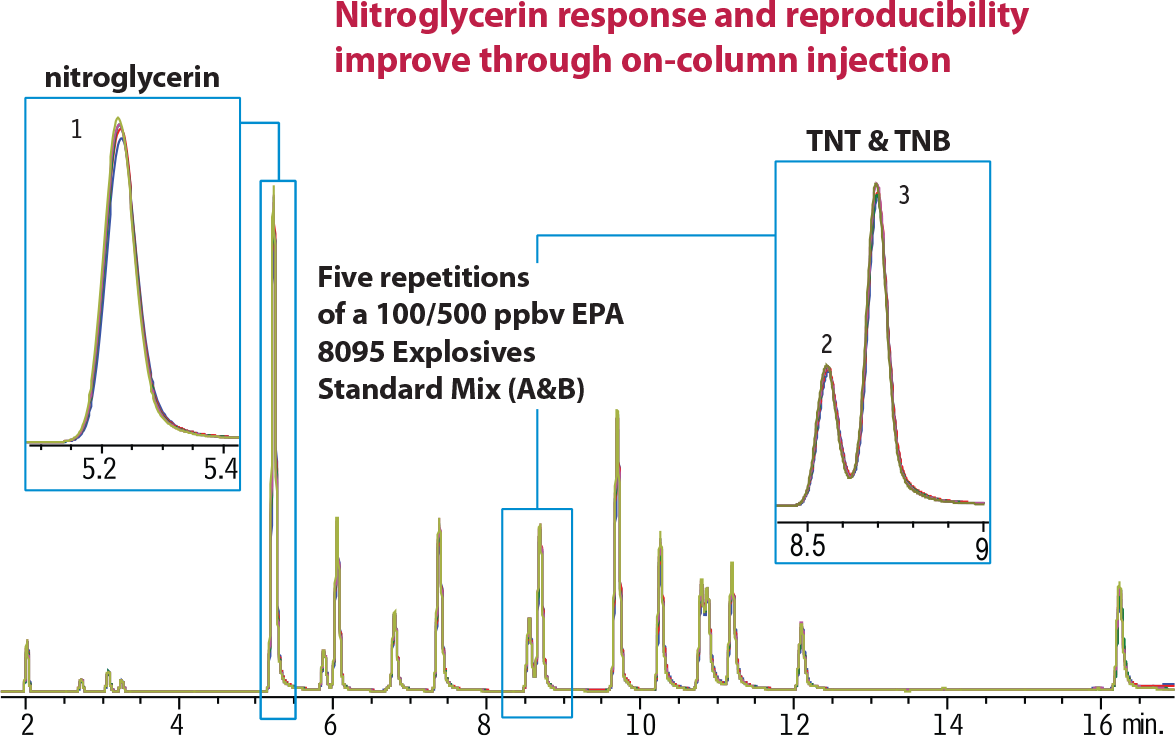
By operating the inlet at low temperatures, an initial flash vaporization is eliminated, protecting thermally labile compounds. Injecting the sample directly into the column also helps avoid injection port activity issues and increases transfer of lower volatility compounds. Both of these features help decrease sample degradation, increase sensitivity, and improve reproducibility. Figure 2 illustrates the outstanding reproducibility that can be achieved with this liner using an example of explosives as probes. Absolute standard deviations were just 2.6% (500pg/µL nitroglycerin) and 1.5% (100pg/µL TNT) for relative peak areas over 5 replicate injections. Variation in relative area was similarly low for both compounds.
Increase Injection Volume
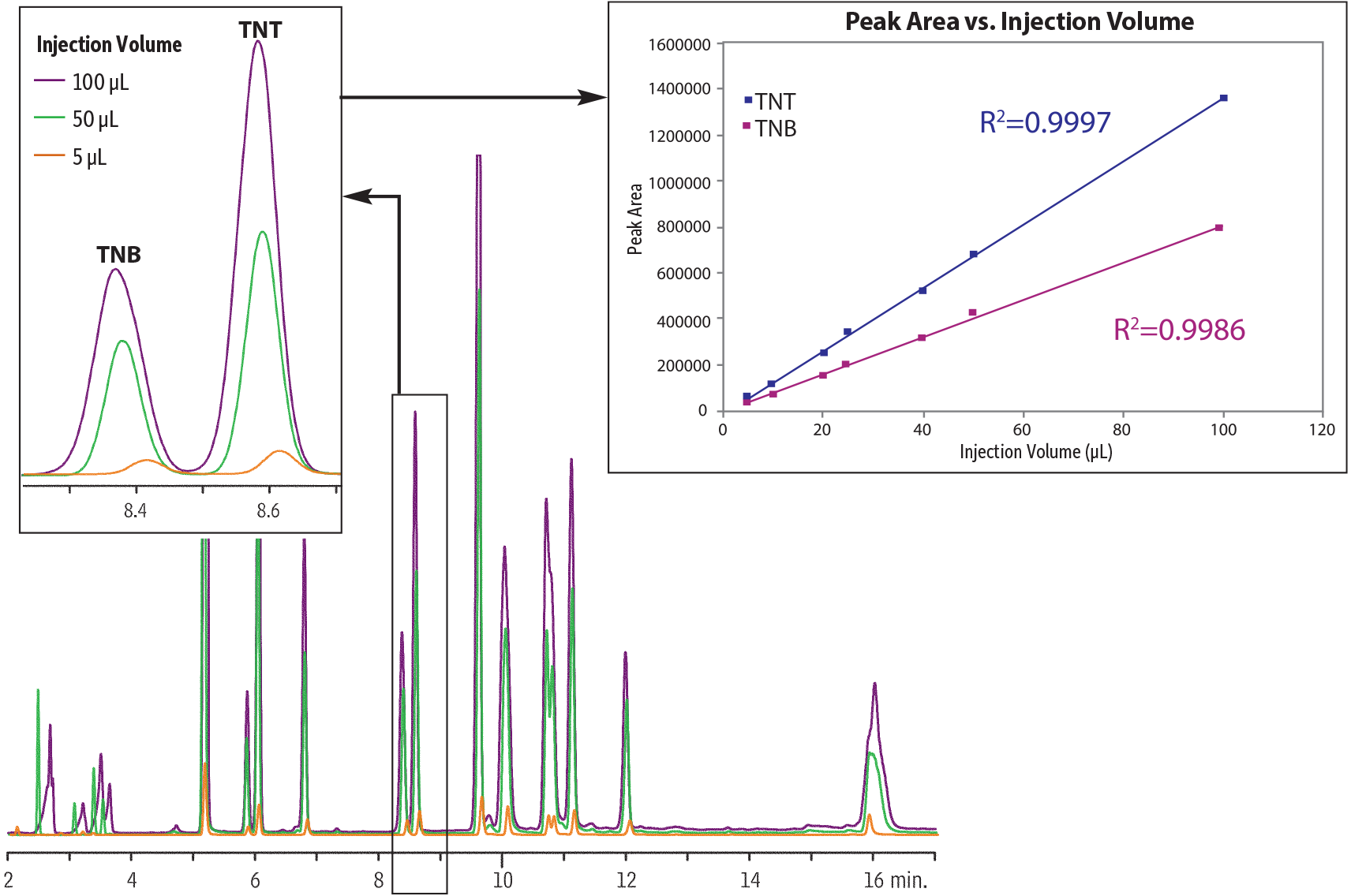
An additional advantage of this liner configuration is the increased analytical sensitivity that can be obtained by injecting a larger sample volume. When the sample needs to be flash vaporized, sample volume expansion in the liner quickly becomes a concern, limiting injection volume to 1-2µL of sample. However, with cold on-column injections, larger sample volumes can be used because the solvent can be gradually vaporized and eluted before the analytes. Using a larger sample volume means more analyte is loaded on-column, giving greater overall sensitivity. The data in Figure 3 demonstrate the excellent linearity achievable using the PTV On-Column liner across a range of injection volumes. Instead of a traditional calibration curve that plots response vs. increasingly concentrated standards, this plot illustrates response vs. increasing volumes of the same standard, in effect producing the same result of more mass on-column. The correlation between peak area and injection volume (5 -100µL) was evaluated and r2 values of 0.9986 (TNB) and 0.9997 (TNT) were obtained. Note that a linear response is maintained—even for high injection volumes.
Why pay for two injection ports when a simple liner change gives you the benefits of having two inlets in one? Using a PTV On-Column liner saves you money and gives you flexibility in the lab. Use this liner and reliably perform true cold on-column injections with your PTV injection port.
Figure 1 Use a PTV On-Column liner to perform cold on-column column injections in a PTV injection port.
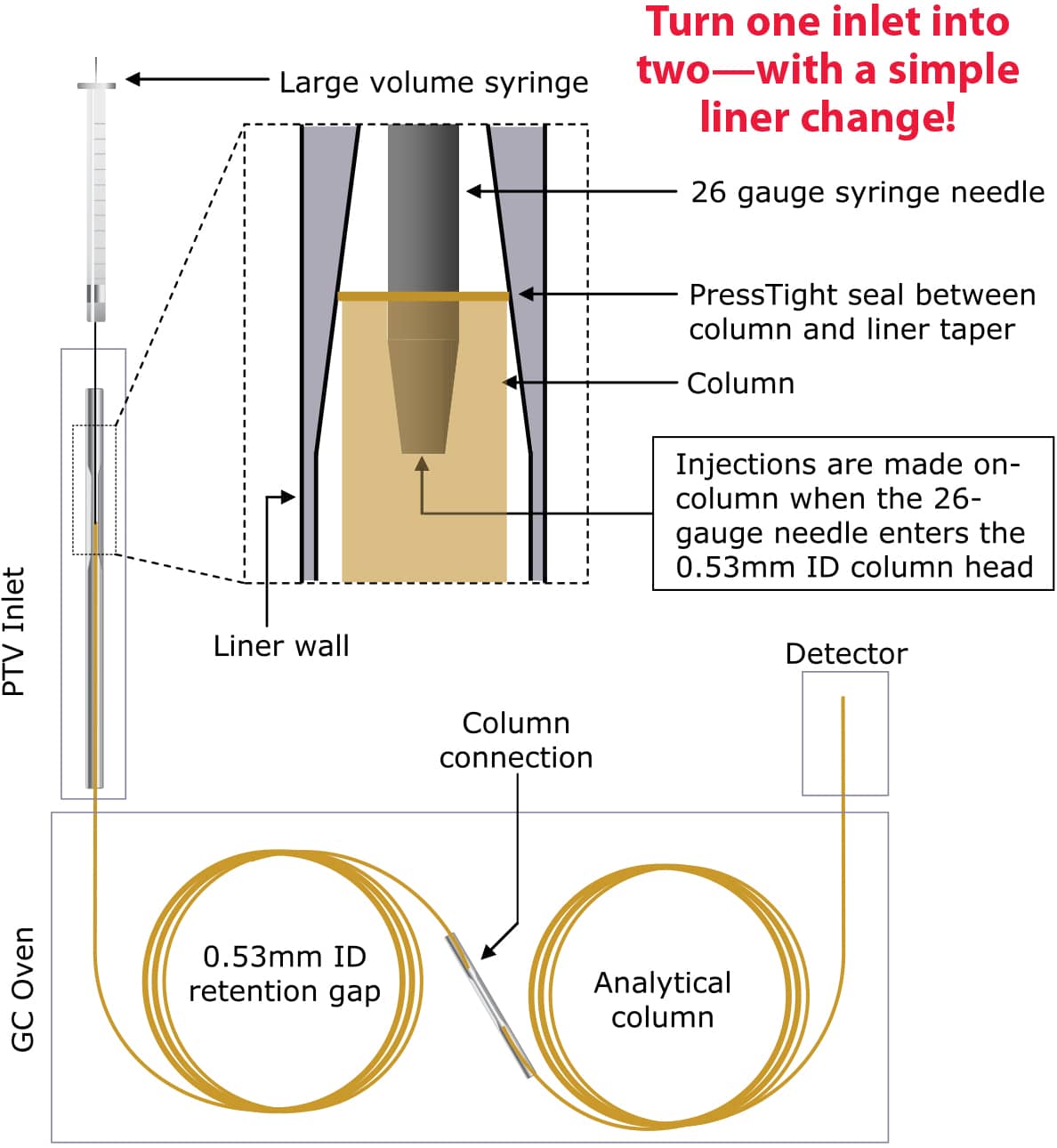
Figure 2 Increase reproducibility and sample integrity with a PTV On-Column liner.
GC_EV01041
Peaks
| Peaks | Conc. (µg/mL) | |
|---|---|---|
| 1. | Nitroglycerin | 500 |
| 2. | 1,3,5-Trinitrobenzene | 100 |
| 3. | 2,4,6-Trinitrotoluene | 100 |
Conditions
| Column | Rxi-5ms (custom), 6 m, 0.53 mm ID, 0.5 µm |
|---|---|
| using IP deactivated guard column 5 m, 0.53 mm ID (cat.# 10045) | |
| Standard/Sample | |
| 8095 Calibration mix A (cat.# 31607) | |
| 8095 Calibration mix B (cat.# 31608) | |
| Diluent: | Acetonitrile |
| Injection | PTV splitless (hold 0.35 min) |
| Liner: | PTV on-column liner |
| Inlet Temp. Program: | 55 °C to 285 °C at 10 °C/min (hold 10 min) |
| PTV Splitless | |
| Purge Flow: | 15 mL/min |
| Oven | |
| Oven Temp.: | 50 °C to 280 °C at 10 °C/min (hold 10 min) |
| Carrier Gas | He, constant flow |
| Linear Velocity: | 60 cm/sec @ 300 °C |
| Detector | µ-ECD @ 300 °C |
|---|---|
| Make-up Gas Flow Rate: | 60 mL/min |
| Make-up Gas Type: | N2 |
| Notes | GC liner cat.# 24976 was used to produce this chromatogram, but it has since been discontinued. For assistance choosing a liner for this application, contact Restek Technical Service or your local Restek representative. – – – – – – Absolute area reproducibility improves for all compounds, and sensitive compound responses improve dramatically because of the lack of contact with the injection port. Nitroglycerin: Absolute Area % RSD = 2.6%; Relative Area % RSD = 1.6% TNT: Absolute Area % RSD = 1.5%; Relative Area % RSD = 1.4% |
Figure 3 Improve sensitivity with larger injection volumes using a PTV On-Column liner.
GC_EV01042
Conditions
| Column | Rtx-TNT1 (custom), 6 m, 0.53 mm ID, 0.5 µm |
|---|---|
| using IP deactivated guard column 5 m, 0.53 mm ID (cat.# 10045) | |
| Standard/Sample | |
| 8095 Calibration mix A (cat.# 31607) | |
| 8095 Calibration mix B (cat.# 31608) | |
| Diluent: | Acetonitrile |
| Injection | PTV splitless (hold 0.35 min) |
| Liner: | PTV on-column liner |
| Inlet Temp. Program: | 55 °C to 285 °C at 10 °C/min (hold 10 min) |
| PTV Splitless | |
| Purge Flow: | 15 mL/min |
| Oven | |
| Oven Temp.: | 50 °C to 280 °C at 10 °C/min (hold 10 min) |
| Carrier Gas | He, constant flow |
| Linear Velocity: | 60 cm/sec @ 300 °C |
| Detector | µ-ECD @ 300 °C |
|---|---|
| Make-up Gas Flow Rate: | 60 mL/min |
| Make-up Gas Type: | N2 |
| Notes | GC liner cat.# 24976 was used to produce this chromatogram, but it has since been discontinued. For assistance choosing a liner for this application, contact Restek Technical Service or your local Restek representative. |