


During some recent Photochemical Assessment Monitoring Station (PAMS) analyses I had to start scanning down to 26 (you have to if you want to analyze ethylene, acetylene, ethane, and propane). So when I did this methyl alcohol popped up in ALL my analyses (i.e., blanks, standards, etc… you name it). See the figure below. My initial gut reaction was that I had a leak on my Nutech 8900DS (something that has only happened one other time in the past 2 years and thousands of runs) and I was sucking in some methanol from the lab. Now mind you, I had no other prior indication of a leak (i.e., excessive CO2, other laboratory solvents, etc…). DESPITE THIS, I went up and down and back and forth over the Nutech. NO LEAK!!! I was racking my brain (remember… this scenario could drive you to the ethyl alcohol) and losing my hair to no avail. I could not figure out where the methanol was coming from!?!?!?
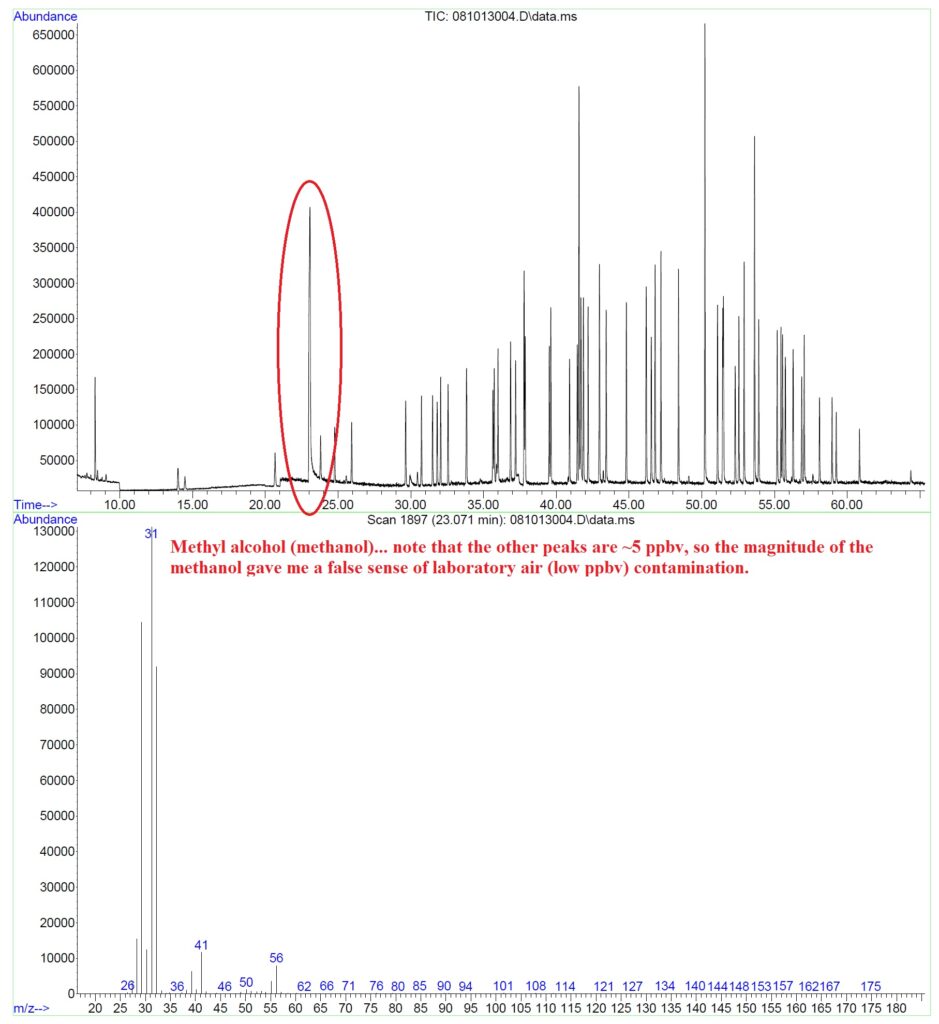
So I bounce my problem off a colleague and right away he suggested I consider my standards. He suggested that the standard manufacturer more than likely loads the standards into the gas cylinder with methanol and then fills up with the balance gas (nitrogen). See… he saw this kind of stuff with 8260 (Purge and Trap), so it was no surprise to him. I already disconnected all internal and external standards from my system, but methanol still persisted. Well… remember 2 years and thousands of runs mean I saturated the heck out of my Nutech with methanol. Long story short… and you already know the answer now… I made some runs with and without standards and sure enough the theory (methanol is present in my gas standards) was confirmed.
So… lessons to be learned:
- Do not go hunting for a leak if your air preconcentrator appears to have a lot of methanol, but no prior indication of a leak.
- Always humble yourself to ask for the help/opinion of fellow colleagues. Sooner than later… as this may save you some valuable time.
- Scan above 32 when you know methanol is on its way… unless of course you want to analyze for methanol, which will be problematic because of its ubiquitous presence in your gas standards, but that is for a whole other conversation/blog. Note: scanning down to 35 is sufficient for EPA Method TO-15.
- If things continue to be bad… stick to the ethyl (not methyl) alcohol.