


If your lab runs EPA 525.2 or EPA 8270, you’re likely already navigating the operational and compliance challenges that come with the near-total ban on methylene chloride (DCM) under the Toxic Substances Control Act. Both methods were developed with DCM as the primary extraction solvent, and direct substitution isn’t generally permitted within the existing method frameworks, so finding a workable path forward takes some thought. Restek’s Director of GC Product Management, Ramkumar Dhandapani, sat down with Eduardo Morales at Weck Laboratories, Inc., to talk through a practical approach to this transition.
“RMX-5Sil MS preserves performance when reduced DCM leaves less room for compromise.”
Ramkumar Dandapani, PhD
Director of Product Management
Restek Corporation

“As DCM use decreases, RMX-5Sil MS helps maintain the sensitivity and resolution labs depend on.”
Eduardo Morales
Environmental Scientist
Weck Laboratories, Inc.
Ramkumar: To start, what approach did you and Restek take to evaluate a path through this transition?
Eduardo: Working with Restek’s applications team, we evaluated the RMX-5Sil MS column (cat.# 17323) under both EPA 525.2 (GC/MS) and EPA 8270 (GC-MS/MS) conditions to see how well it supports one of the most practical adaptation strategies available: reducing solvent and sample volumes proportionally to limit DCM use while staying within established method parameters.
Ramkumar: Why has methylene chloride been so difficult to replace in these methods?
Eduardo: Methylene chloride became the default extraction solvent for semivolatile methods because it genuinely performs well across a broad range of compound classes—PAHs, phenols, pesticides, phthalates, nitroaromatics. EPA 525.2 and 8270 were both built around fixed solvent-to-sample ratios that assume routine DCM use, which is a significant part of what makes adapting these methods so challenging.
The health hazards associated with DCM are well established: central nervous system depression, acute inhalation toxicity, potential carcinogenicity, and organ toxicity with repeated exposure. The TSCA restrictions reflect those concerns, and they’ve added real compliance, documentation, and operational costs on top of the analytical challenge. Because direct solvent substitution isn’t permitted under these methods, reducing DCM volume—while maintaining the required phase ratio by scaling sample volume accordingly—is the most feasible option for most labs.
Ramkumar: What’s the analytical trade-off when a lab reduces solvent volume that way?
Eduardo: That proportional reduction in sample and solvent volume comes with a direct analytical consequence: less total analyte mass reaching the detector. For methods that are already operating at trace levels, this places greater demands on chromatographic sensitivity, peak shape, and column inertness. The column, in other words, has to work harder to compensate for what’s been lost in the extraction step. This is the core challenge the RMX-5Sil MS was evaluated against.
Ramkumar: Walk me through what you actually tested.
Eduardo: Working with Restek’s applications team, we ran approximately 90 analytes across both methods, covering PAHs, pesticides, phenols, phthalates, and nitroaromatics.
The column under evaluation, the RMX-5Sil MS (cat.# 17323), is part of Restek’s RMX GC column family and incorporates TriMax deactivation technology, a three-dimensional bonding and cross-linking approach engineered for enhanced inertness across acids, bases, and neutral compounds with low thermal bleed. Those characteristics make it particularly well suited to the demands of reduced-volume extractions, where sensitivity and inertness have less margin for compromise. The Topaz 4 mm Precision inlet liner with wool (cat.# 23305) was used throughout to complement the column’s inertness for active compound classes.
EPA Method 525.2 was run on a single quadrupole GC/MS platform, where we focused on long-term robustness, baseline stability, and column durability over extended injection sequences. EPA Method 8270 was run on a triple quadrupole GC-MS/MS platform, where the emphasis was on sensitivity, low-level performance, and resolution of critical semivolatile analytes.
Ramkumar: What did you find regarding baseline stability under EPA 525.2?
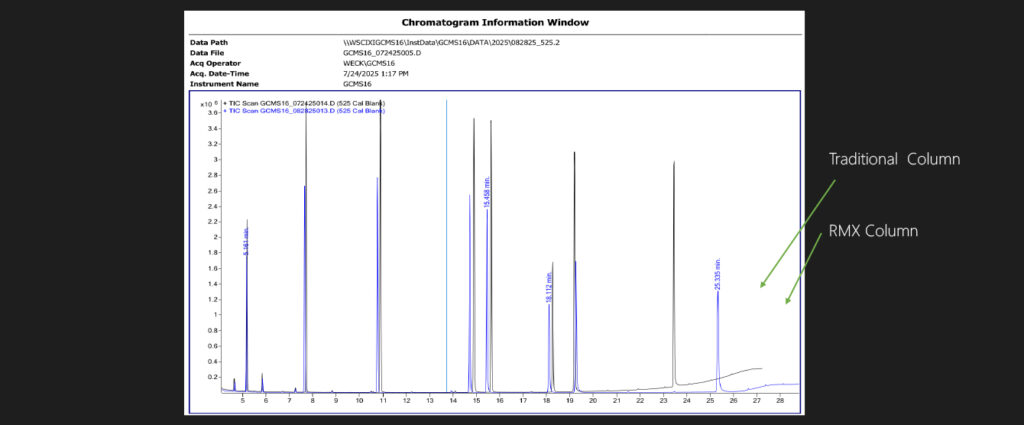
Eduardo: EPA 525.2 and 8270 both require elevated final oven temperatures to fully elute late-eluting PAHs and other semivolatiles, and column bleed at those temperatures is a real concern. Elevated bleed raises the baseline, degrades signal-to-noise ratios, and contributes to ion source contamination over time.
The RMX-5Sil MS showed significantly lower thermal bleed compared to the traditional 5-type MS column under EPA 525.2 GC/MS conditions. The cleaner baselines translated directly into improved signal-to-noise ratios at elevated temperatures, which matters even more when reduced extraction volumes are already limiting the analyte mass available for detection.
Ramkumar: And what about resolution of critical analyte pairs under EPA 8270?
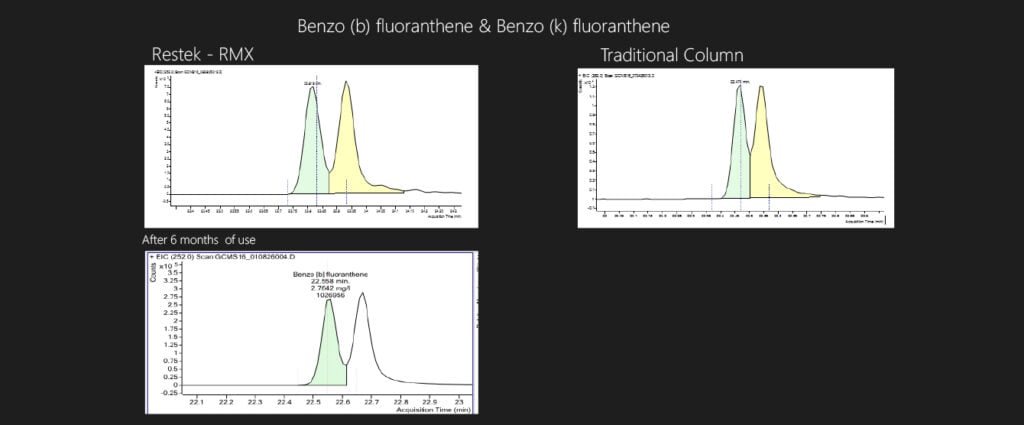
Eduardo: Reliable separation of isomeric compounds is a fundamental requirement for EPA semivolatile methods, and separation of benzo(b)fluoranthene and benzo(k)fluoranthene is one of the most closely watched performance indicators in EPA 8270 workflows. It’s often one of the first things to degrade as a column ages.
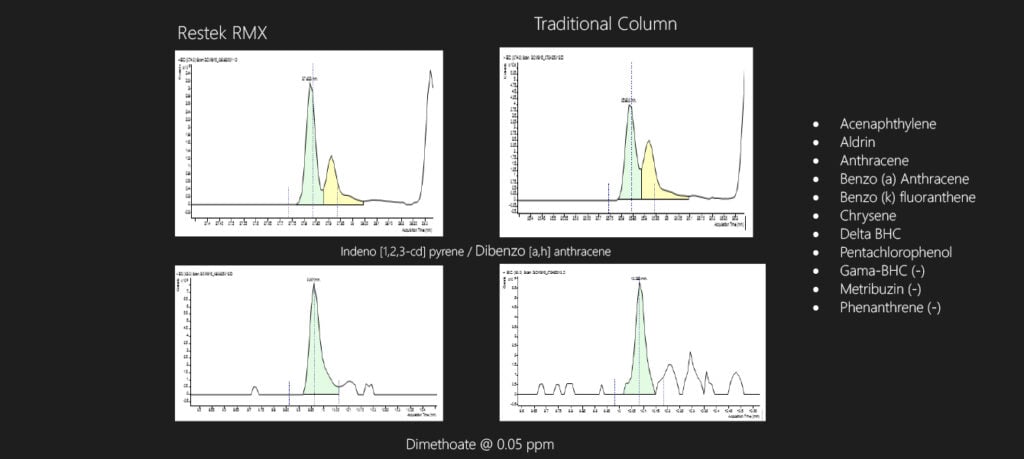
Under EPA 8270 GC-MS/MS conditions, the RMX-5Sil MS provided improved and sustained resolution of benzo(b)fluoranthene and benzo(k)fluoranthene, including after extended use. Resolution of indeno[1,2,3-cd]pyrene and dibenzo[a,h]anthracene was similarly improved along with additional critical analyte pairs across the 8270 target compound list. Beyond baseline stability, the RMX-5Sil MS also delivered meaningful improvements in peak resolution under EPA 8270 GC-MS/MS conditions. Sustained resolution over hundreds of injections means fewer column changes, fewer recalibrations, and less downtime—all of which matter when labs are already managing the added complexity of a DCM transition.
Ramkumar: How did the column perform on sensitivity and linearity at trace levels?
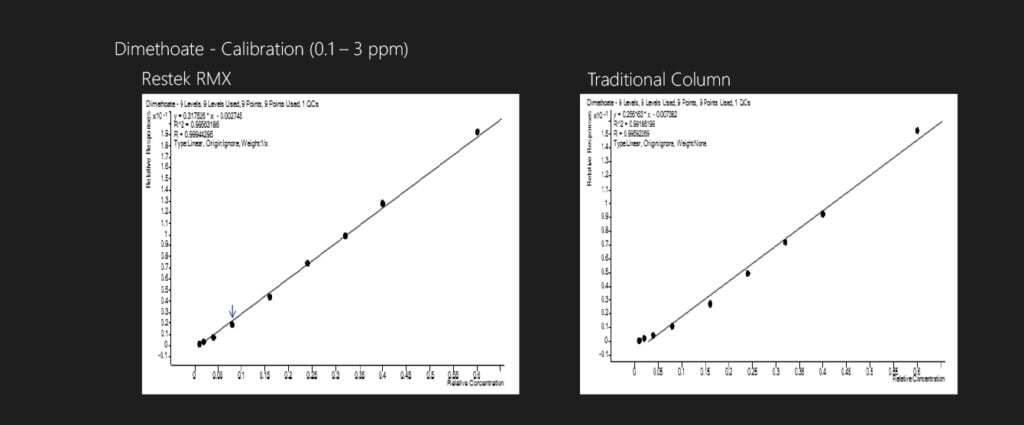
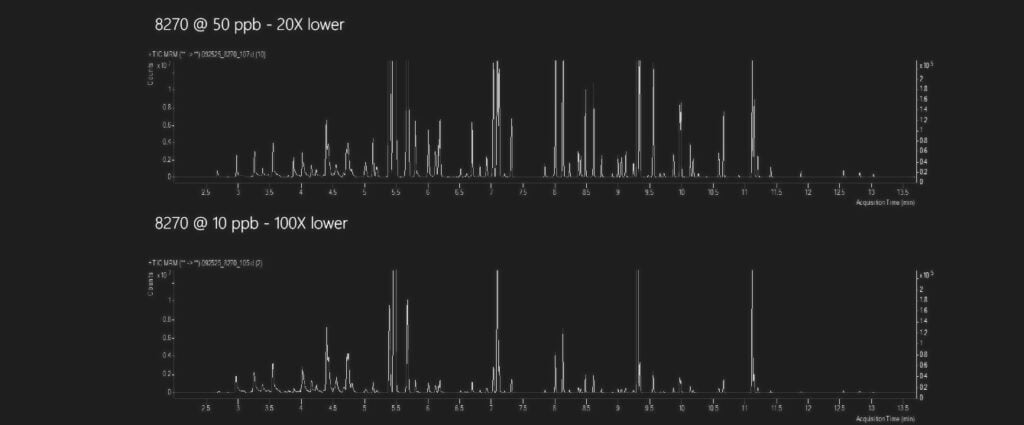
Eduardo: Under EPA 8270 GC-MS/MS conditions, where reduced extraction volumes make sensitivity most critical, the RMX-5Sil MS delivered narrower peak widths and more consistent peak shape, which contributed to improved signal-to-noise ratios at low concentrations. Low-level calibration standards at 10 ppb and below produced consistent responses with minimal background interference, and calibration curves demonstrated good linearity across the working range.
Ramkumar: Does that performance hold up over time and across a large sample set?
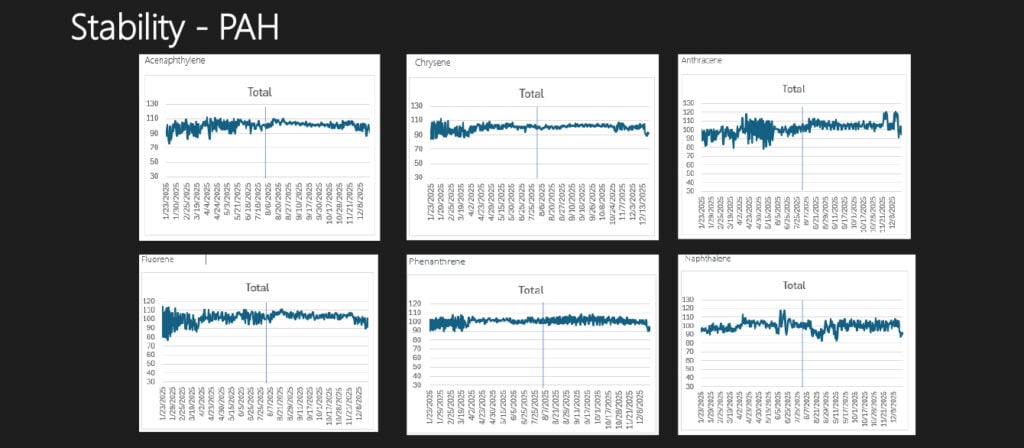
Eduardo: Routine drinking water analysis under EPA 525.2 requires consistent performance across extended injection sequences, and column drift or loss of inertness translates directly into downtime and recalibration. This is especially relevant when labs are already managing the operational complexity of scaling down extraction volumes. Any instability in the chromatographic system compounds an already demanding transition.
Recovery data at low- and mid-level concentrations remained consistent over extended use with the RMX-5Sil MS column. The chromatograms below show the column maintaining reliable sensitivity at concentrations well below standard method levels—20x lower at 50 ppb and 100x lower at 10 ppb—across an extended sequence of injections.
Ramkumar: To close, what’s your overall takeaway for labs navigating this transition?
Eduardo: Reducing methylene chloride and sample volumes is currently the most practical approach for laboratories adapting EPA 525.2 and 8270 to the TSCA restrictions. It avoids method redevelopment while bringing DCM use into compliance. The trade-off is reduced analyte mass, and that places real demands on the chromatographic system.
In this work with Restek, the RMX-5Sil MS column demonstrated low bleed, sustained resolution; trace-level sensitivity; and long-term robustness across both platforms with GC-MS/MS conditions under EPA 8270 highlighting particularly strong gains in sensitivity and critical analyte resolution at low concentrations. I recommend evaluating your column and inlet liner setup early in this transition. Chromatographic performance is often the limiting factor when extraction volumes are scaled down, and it’s one of the more straightforward variables to address.
For foundational performance data on the RMX-5Sil MS under optimized EPA 8270E GC-MS/MS conditions, see Restek’s Trace-Level Semivolatiles application note.