


- Increase sample throughput with fast analysis times.
- Complete separation of all target HAAs; two elution order changes.
- Excellent for other GC/ECD methods—fewer column changes means less downtime.
Modern water treatment technologies provide safe, reliable drinking water and have substantially curbed outbreaks of water-borne diseases such as typhoid and cholera. However, the use of disinfectants in water treatment facilities can also lead to adverse health effects caused by the formation of disinfection byproducts (DBPs). DBPs are created by the reaction of the disinfection agent with naturally occurring organic matter and inorganic salts. Haloacetic acids (HAAs), for example, are a type of DBP that can form when chlorine is used as a disinfectant. DBP levels must be monitored in potable water supplies to ensure that the maximum allowable levels are not exceeded. Testing for HAA compounds in drinking water is usually done according to EPA Method 552.2; however, labs using this method struggle with low sample throughput due to long analytical run times.
Sample throughput can be significantly increased by choosing phases with a unique selectivity for HAAs. Using Rtx-CLPesticides and Rtx-CLPesticides2 columns all target HAAs were resolved in less than 13 minutes (Figure 1). Two elution order changes were observed between the columns: methyl trichloroacetate/1,2,3-trichloropropane and methyl bromodichloroacetate/methyl dibromoacetate. Notably, pairs which are extremely difficult to separate under method conditions, such as methyl dichloroacetate/dalapon methyl ester and methyl chlorodibromoacetate/methyl 2,3-dibromopropionate, were easily resolved on these columns.
In addition to performing well for haloacetic acid analysis, Rtx-CLPesticides and Rtx-CLPesticides2 columns give excellent results for other GC/ECD methods, including methods for chlorinated pesticides, chlorinated herbicides, and PCBs. Labs can increase HAA sample throughput and reduce the downtime spent changing columns between methods by switching to Rtx-CLPesticides and Rtx-CLPesticides2 columns.
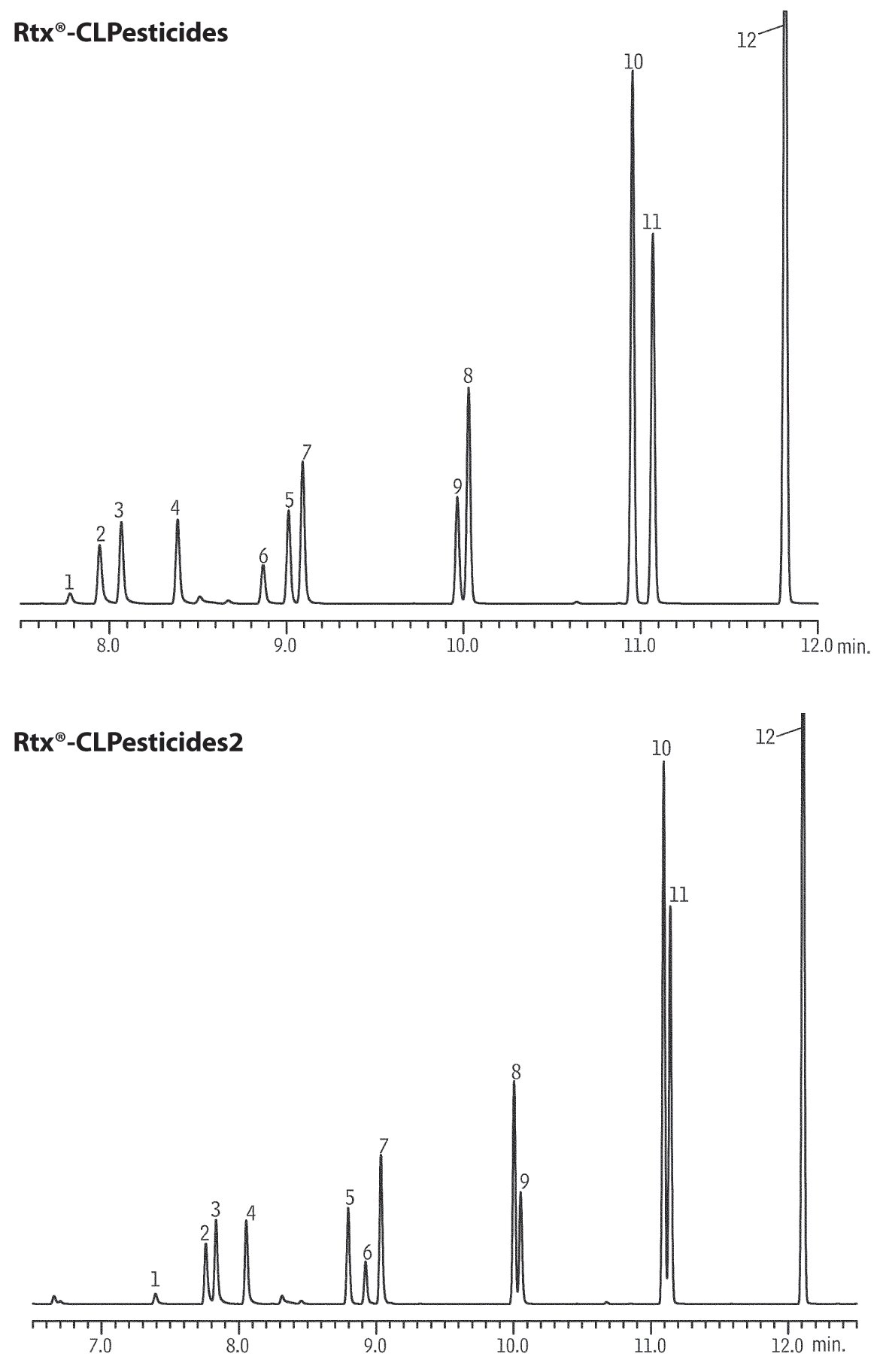
GC_EV01006
Peaks
| Peaks | Conc. (µg/mL) | |
|---|---|---|
| 1. | Methyl monochloroacetate | 1.2 |
| 2. | Methyl monobromoacetate | 0.8 |
| 3. | Methyl dichloroacetate | 1.2 |
| 4. | Dalapon methyl ester | 2 |
| 5. | Methyl trichloroacetate | 0.4 |
| 6. | 1,2,3-Trichloropropane (IS) | 4 |
| Peaks | Conc. (µg/mL) | |
|---|---|---|
| 7. | Methyl bromo(chloro)acetate | 0.8 |
| 8. | Methyl bromodichloroacetate | 0.8 |
| 9. | Methyl dibromoacetate | 0.4 |
| 10. | Methyl chlorodibromoacetate | 2 |
| 11. | Methyl 2,3-dibromopropionate (SS) | 2 |
| 12. | Methyl tribromoacetate | 4 |
Conditions
| Columns | Rtx-CLPesticides2 30 m, 0.32 mm ID, 0.25 µm (cat.# 11324) |
|---|---|
| and Rtx-CLPesticides 30 m, 0.32 mm ID, 0.32 µm (cat.# 11141) | |
| using Rxi guard column 5 m, 0.32 mm ID (cat.# 10039) | |
| with deactivated universal “Y” Press-Tight connector (cat.# 20405-261) | |
| Standard/Sample | |
| Haloacetic acid methyl ester mix #2 | |
| Dalapon methyl ester (cat.# 32057) | |
| Methyl-2,3-dibromopropionate (cat.# 31656) | |
| 1,2,3-Trichloropropane (cat.# 31648) | |
| Diluent: | Methyl tert-butyl ether (MTBE) |
| Injection | |
| Inj. Vol.: | 1.0 µL splitless (hold 0.75 min) |
| Liner: | Cyclo double taper (4 mm) (cat.# 20896) |
| Inj. Temp.: | 250 °C |
| Oven | |
| Oven Temp.: | 35 °C (hold 4 min) to 250 °C at 15 °C/min (hold 5 min) |
| Carrier Gas | He, constant flow |
| Linear Velocity: | 25 cm/sec |
| Detector | Micro-ECD @ 300 °C |
|---|---|
| Notes | Standard cat.# 31647 was used to produce this chromatogram, but has since been discontinued. For assistance choosing a replacement for this application, contact Restek Technical Service or your local Restek representative. – – – – – – This chromatogram was obtained using an Agilent micro-ECD. To obtain comparable results, you will need to employ a micro-ECD in addition to confirmational dual columns connected to a 5-meter guard column using a “Y” Press-Tight connector. |