

Abstract
Fuel laundering is the illegal process of removing chemical markers or dyes from government-subsidized fuel to sell as more expensive and higher-taxed fuel. In some nations, subsidized fuel is used for agricultural purposes and residential heating as well as other specific uses. Some methods for removing the chemical markers and dyes include chemical treatment, filtration, and distillation. The illegal laundering of fuel has many negative consequences for the surrounding community, such as the government missing out on the tax revenue needed to maintain critical public services; the improper disposal of chemical waste leading to the contamination of the environment; exposing humans and animals to health risks; and the creation of negative economic aftereffects with market distortion.
Countermeasures developed to combat this problem involve the development of a more sophisticated fuel marker that is harder to remove and easier to detect. This application note provides a one-dimensional GC-MS analytical method for the identification and quantitation of a commercial fiscal marker and its preferred marker compound.
Introduction
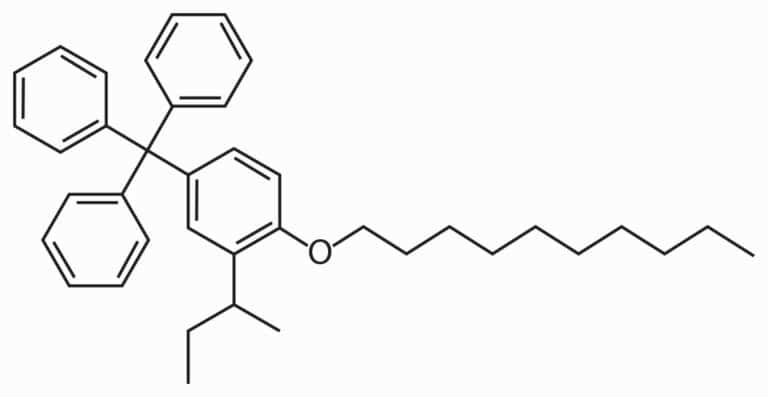
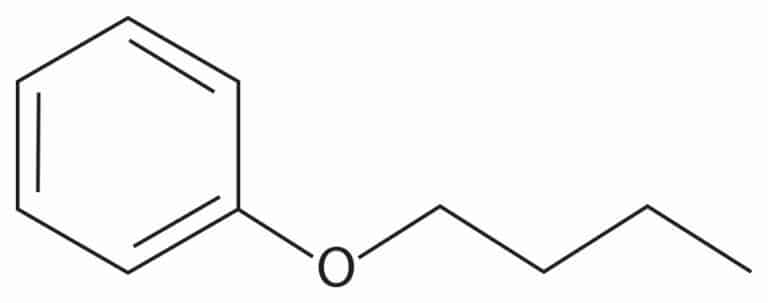
Fuel laundering describes an effort to remove fiscal markers from fuel, making it difficult and ineffective for most testing methods. This adulterated fuel, which is obtained at a decreased price, is then sold at a higher price [1]. To prevent tax evasion and fraud of subsidized mineral oils and fuels, governments of the European Union (EU) have adopted regulations phasing in Dow’s patented ACCUTRACE Plus S10 fuel marker. This new, commercially branded fuel marker is colorless, removing the visual test barrier that fuel launderers evaded, and can be seen at incredibly low levels, withstanding common marker removal attempts. The European Commission has adopted this fuel marker at the dosage of 2.5 ppm (2.5 µg/mL) in diesel fuel. ACCUTRACE Plus S10 fuel marker (figure 1) contains butoxybenzene as the preferred marker compound in the detection of this fiscal marker [2]. Fuel marker analysis has been performed with two-dimensional GC (GCxGC) analytical methods; however, this application note provides a one-dimensional GC (1D-GC) analysis as an effective alternative.
Experimental
Chemicals and Reagents
Butoxybenzene (CAS# 1126-79-0) was purchased from Sigma Aldrich. 2-sec-Butyl-1-(decyloxy)-4-tritylbenzene (CAS# 1404190-37-9) was purchased from LCG Standards Ehrenstorfer. All solvents were purchased from ThermoFisher Scientific. Unmarked diesel was obtained from a local gas station.
All standards were prepared in methylene chloride. All analyses were operated with helium as the carrier gas. A seven-point calibration curve was prepared for both butoxybenzene and the 2-sec-Butyl-1-(decyloxy)-4-tritylbenzene at the following concentrations: 0.075, 0.1, 0.125, 0.15, 0.2, 0.225, and 0.25 µg/mL. See calibration conditions below in table I.
Instruments and Method
The instrumentation used includes an Agilent 7890 gas chromatograph (GC) system equipped with a 7693A autosampler with a split/splitless injector and a Restek Rxi-5ms column 30 m x 0.25 mm ID x 0.25 µm (cat.# 13423). A Restek Topaz Precision inlet liner, 4.0 mm x 6.3 x 78.5 (cat.# 23305) was also used.
An Agilent 5975 GC/mass spectrometer detector (MSD) with an extractor source and selected ion monitoring (SIM) mode for m/z 94, 150, 315, 455, 532 at dwell times of 60 milliseconds was used as well.
A 400-to-1 split ratio was used to minimize the amount of diesel reaching the MSD. Dirty matrices can deposit residues in the ion source of the mass spectrometer, affecting its performance and requiring frequent cleaning. Split injection limits the introduction of such residues, thus reducing maintenance needs and downtime. See table I for analysis conditions.
Table I: GC-MS Method with a Calibration Curve that Ranges from 0.075 to 0.25 µg/mL to Demonstrate the Ability to Detect the Fuel Markers Even with Diluted Fuel
| Agilent 7890 GC | |||
| Oven | °C/min | Hold (°C) | Hold (min) |
| 40 | 1 | ||
| 30 | 320 | 0 | |
| 16 | 330 | 8 | |
| Inlet (Split/Splitless) | |||
| Liner | Topaz Precision Inlet Liner, 4.0 mm x 6.3 x 78.5 (cat.#: 23305) | ||
| Temperature | 250 °C | ||
| Mode | Split | ||
| Split Ratio | 400:1 | ||
| Analytical Column | |||
| Column | Restek Rxi-5ms 30 m x 0.25 mm ID x 0.25 µm (cat.#: 13423) | ||
| Mode | Constant Flow | ||
| Flow | 1 mL/min | ||
| Agilent 5975C MSD | |||
| Acquisition Mode | SIM | ||
| Gain Factor | 1 | ||
| SIM Ions | |||
| m/z | Dwell Time | ||
| 94 | 60 | ||
| 150 | 60 | ||
| 315 | 60 | ||
| 455 | 60 | ||
| 532 | 60 | ||
| Chemicals and Reagents | |||
| Analyte | Butoxybenzene (1126-79-0) ACCUTRACE PLUS S10 fuel marker (2-sec-Butyl-1-(decyloxy)-4-tritylbenzene (1404190-37-9)) |
||
| Solvent (Standard Preparation) | Methylene Chloride; Diesel | ||
| Calibration Curve Concentration | 0.075, 0.1, 0.125, 0.15, 0.2, 0.225, 0.25 µg/mL | ||
Results and Discussion
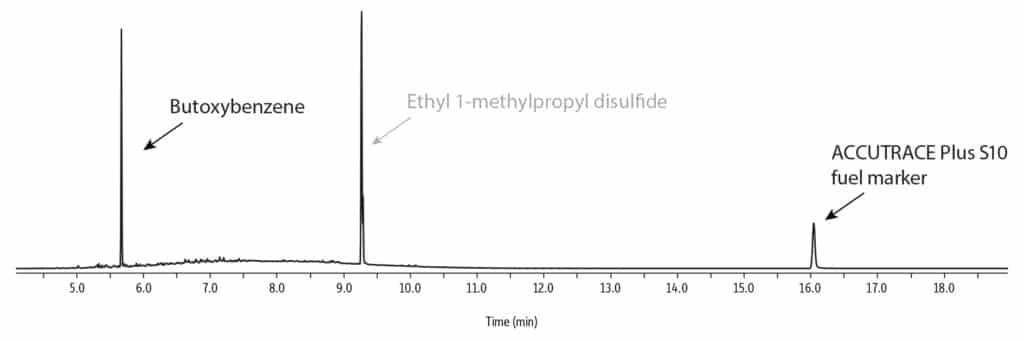
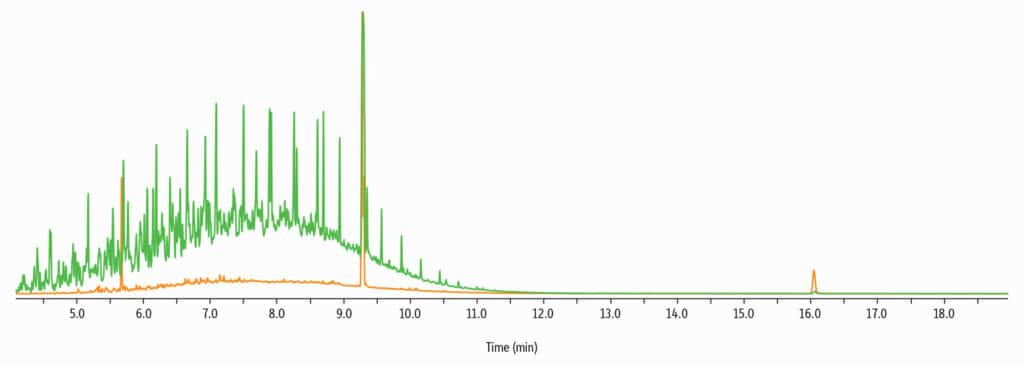
Figure 3 exhibits the SIM (Single Ion Monitoring) analysis in diesel matrix (m/z 94, 150, 315, 455, 532) showing both butoxybenzene and ACCUTRACE Plus S10 fuel marker under 19 minutes using the above conditions. Notice that the sulfur compound found in the diesel fuel does not interfere with the compounds of interest. Figure 4 shows an overlay of the SIM (orange) and SCAN (green) chromatograms to demonstrate where the peaks of interest elute within the diesel matrix spiked sample; diesel sample was spiked with butoxybenzene and ACCUTRACE Plus S10 fuel marker at a concentration of 0.25 µg/mL.
A calibration curve ranging from 0.075 to 0.25 µg/mL demonstrated the low levels of detection that are possible to reach with a one-dimensional GC approach. In Figure 5 and Figure 6, the linear regression of 0.998 of the method is shown. In Table II and Table III, the calibration accuracy of all calibration points is shown to be below 4%.
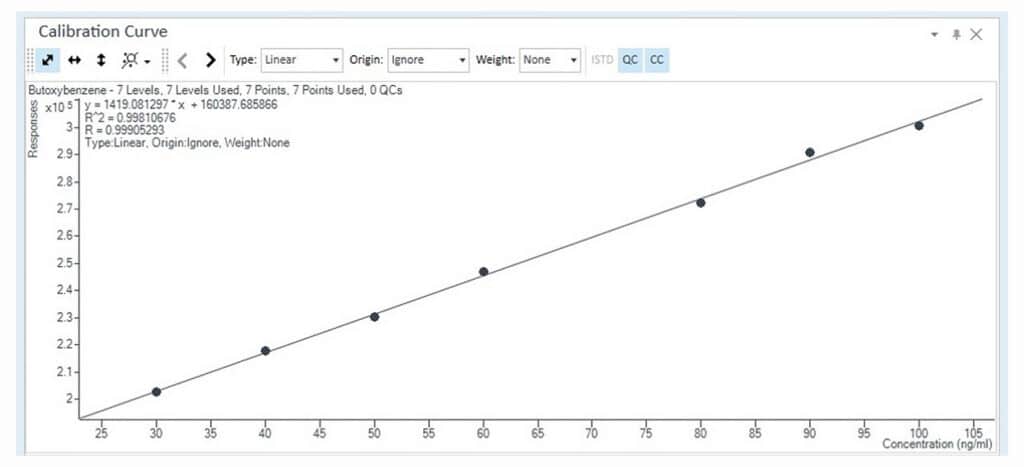
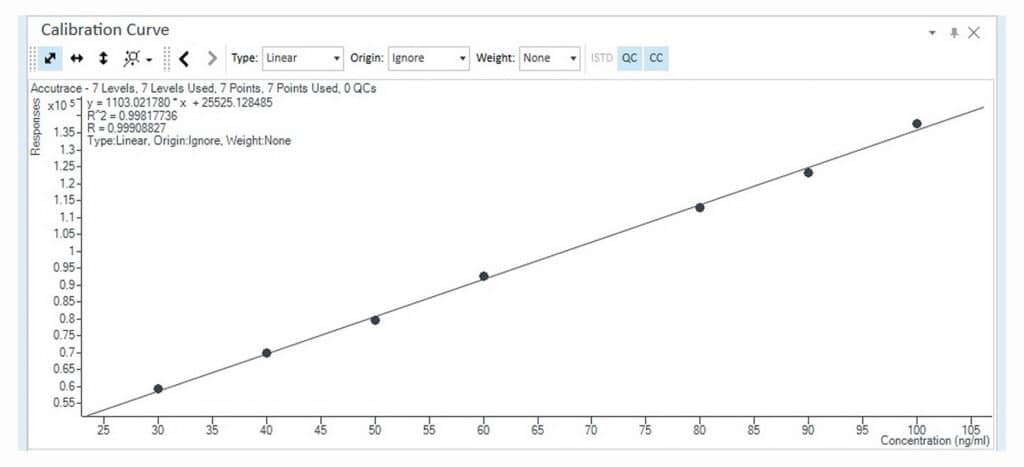
Table II: Calibration Curve Accuracy (in Diesel Matrix) for Butoxybenzene
| Rxi-5ms Column – 400:1 Split Injection | ||||||
| Name | RT (min) | Area | S/N | Amount (µg/mL) | Calibrated Amount (µg/mL) | Accuracy (%) |
| Butoxybenzene | 5.669 | 202652 | 210677 | 0.075 | 0.0781 | -3.97 |
| 5.669 | 218564 | 561.13 | 0.1 | 0.0969 | 3.20 | |
| 5.669 | 230214 | 34.36 | 0.125 | 0.1204 | 3.82 | |
| 5.669 | 246794 | 278425 | 0.15 | 0.1495 | 0.33 | |
| 5.669 | 272383 | 321341 | 0.2 | 0.1971 | 1.47 | |
| 5.669 | 290039 | 359070 | 0.225 | 0.23 | -2.17 | |
| 5.669 | 297606 | 363391 | 0.25 | 0.2441 | 2.42 | |
Table III: Calibration Curve Accuracy (in Diesel Matrix) for ACCUTRACE Plus S10 Fuel Marker
| Rxi-5ms Column – 400:1 Split Injection | ||||||
| Name | RT (min) | Area | S/N | Amount (µg/mL) | Calibrated Amount (µg/mL) | Accuracy (%) |
| ACCUTRACE Plus S10 fuel marker | 16.042 | 59259 | 4126.9 | 0.075 | 0.0753 | -0.40 |
| 16.042 | 69796 | 2649 | 0.1 | 0.0996 | 0.40 | |
| 16.042 | 80701 | 5091.4 | 0.125 | 0.1246 | 0.32 | |
| 16.042 | 92551 | 3843.9 | 0.15 | 0.1519 | -1.25 | |
| 16.042 | 112823 | 7385.4 | 0.2 | 0.1985 | 0.76 | |
| 16.042 | 123251 | 11541 | 0.225 | 0.2225 | 1.12 | |
| 16.042 | 136321 | 6746.7 | 0.25 | 0.2526 | -1.03 | |
Even at the lowest level of calibration (0.075 µg/mL) for both butoxybenzene and ACCUTRACE Plus S10 fuel marker, the signal-to-noise ratio (S/N) remains high, as indicated by the yellow cells in Table II and Table III. A high S/N allows for the detection of trace levels of analytes that might be present in low concentrations within a sample. It enhances sensitivity, improves quantitative and qualitative accuracy, aids in the reliable identification of compounds, and aids reproducibility.
Conclusions
Fuel laundering is a serious economic, environmental, and safety issue. It undermines legitimate businesses, causes significant tax revenue losses, and poses health and environmental risks. Governments are continuously improving detection technologies, enhancing regulatory measures, and promoting public awareness to combat this illicit activity effectively.
A 1D-GC approach can detect both butoxybenzene and ACCUTRACE Plus S10 fuel marker at extremely low levels. With this method, both compounds can meet regulatory detection limits in under 20 minutes. This method is robust, reliable, and has a high utility in ensuring fuel quality and safety. The established calibration curves demonstrated excellent linearity, and all recoveries of calibration curve and matrix replicates were well within 80%-120%.
Choosing between one-dimensional gas chromatography and two-dimensional gas chromatography depends on the specific requirements of your analysis. While GCxGC offers significant advantages in terms of resolving complex mixtures, 1D-GC analyses offer simplicity, cost-effectiveness, variety, and robustness.
To use 1D-GC over 2D-GC is often based on practical considerations where the added complexity and cost of GCxGC do not provide enough additional benefit to justify its use. For many laboratories, especially those handling routine analyses with relatively simple matrices, 1D-GC provides the necessary analytical performance while being more accessible and manageable.
Acknowledgements
Hansjoerg Majer, Didier Dupont, Kristi Sellers, Whitney Dudek-Salisbury, and Chris English.
References
- Office of the Comptroller & Auditor General, Report on the Accounts of the Public Services 2015: Tackling Fuel Laundering, Dublin, Ireland, 2015, 1555-170. https://www.audit.gov.ie/en/find-report/publications/2016/tackling-fuel-laundering.pdf
- Commission Implementing Decision (EU) 2022/197, Establishing a Common Fiscal Marker for Gas Oils and Kerosene, Official Journal of the European Union, Brussels, Belgium, 17 January 2022, 52-55. http://data.europa.eu/eli/dec_impl/2022/197/oj
Related Products
Auteurs