

I have been involved in several conversations recently where the terms “qualitative” and “quantitative” have been used incorrectly when discussing data. Let’s take some time to go over the definitions of both terms and discuss when it is appropriate to use each term. Analytical data processing is typically broken into two unique categories: qualitative and quantitative. These two terms can often be confused but fundamentally they are different approaches that can have significant implications in accurate data reporting.
So, what is the difference, why does it matter, and when should we use them? To dive into this, some definitions will be defined below:
Qualitative data [1]:
Data representing information and concepts that are not represented by numbers.
Quantitative data [2]:
Data represented numerically including anything that can be counted, measured, or given a numerical value.
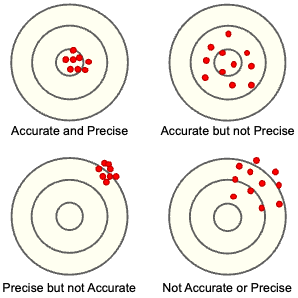
Accuracy [3]:
Degree of conformity of a measure to a standard or true value.
Precision [4]:
How well measurements agree with each other across multiple tests.
Graphical Representation of Accuracy and Precision [3,4]
Mean [5]:
The total sum of values in a sample divided by the number of values in your sample.
Standard deviation (SD or σ) [6]:
A measure of how dispersed the data is in relation to the mean.
Percent relative standard deviation (%RSD) [7]:
The standard deviation expressed as a fraction of the mean and reported as
a percentage of the mean (%RSD) aka coefficient of variation.
In simplified terms:
Qualitative
Can I see it?
Quantitative
Can I calculate an acceptable value?
Standard Deviation
How precise is my data set?
%RSD
The precision of the result where the closer the number to
zero the more precise the result.
Let’s look at an example using a cannabinoid data set. This experiment monitored 16 cannabinoids in cannabis flower over three distinct injections. The data was processed via instrument software and the mean, standard deviation, and % RSD were subsequently tabulated in Excel. Results can be found in Table 1.
Table 1: Data Collected for 16 Monitored Cannabinoids Where ND Is Non-Detectable
| Analyte | Injection 1 | Injection 2 | Injection 3 | Mean | SD | % RSD | ||||||
| Rt | Area | Rt | Area | Rt | Area | Rt | Area | Rt | Area | Rt | Area | |
| CBDVA | ND | ND | ND | ND | ND | ND | ND | ND | ND | ND | ND | ND |
| CBDV | ND | ND | ND | ND | ND | ND | ND | ND | ND | ND | ND | ND |
| CBDA | 2.01 | 13004 | 2.00 | 13006 | 2.01 | 13069 | 2.00 | 13026 | 0.00 | 36.96 | 0.10 | 0.28 |
| CBGA | 2.08 | 624863 | 2.09 | 623180 | 2.09 | 625897 | 2.09 | 624647 | 0.00 | 1371.36 | 0.10 | 0.22 |
| CBG | 2.21 | 22328 | 2.21 | 22209 | 2.21 | 22191 | 2.21 | 22243 | 0.00 | 74.45 | 0.11 | 0.33 |
| CBD | 2.34 | 14686 | 2.34 | 14436 | 2.36 | 14594 | 2.34 | 14572 | 0.00 | 126.44 | 0.09 | 0.87 |
| THCV | ND | ND | ND | ND | ND | ND | ND | ND | ND | ND | ND | ND |
| THCVA | ND | ND | ND | ND | ND | ND | ND | ND | ND | ND | ND | ND |
| CBN | 3.34 | 1311 | 3.34 | 1730 | 3.35 | 1974 | 3.35 | 1672 | 0.01 | 335.33 | 0.18 | 20.06 |
| CBNA | ND | ND | ND | ND | ND | ND | ND | ND | ND | ND | ND | ND |
| Δ9-THC | ND | ND | ND | ND | ND | ND | ND | ND | ND | ND | ND | ND |
| Δ8-THC | ND | ND | ND | ND | ND | ND | ND | ND | ND | ND | ND | ND |
| CBL | ND | ND | ND | ND | ND | ND | ND | ND | ND | ND | ND | ND |
| CBC | 5.071 | 6284 | 5.077 | 7194 | 5.084 | 6782 | 5.077 | 6753 | 0.01 | 455.68 | 0.13 | 6.75 |
| THCA-A | ND | ND | ND | ND | ND | ND | ND | ND | ND | ND | ND | ND |
| CBCA | ND | ND | ND | ND | ND | ND | ND | ND | ND | ND | ND | ND |
There are different ways to make these calculations. If making the calculations by hand, the following formulas should be followed:



An alternative approach to these calculations is using an application like Excel. In an ideal situation, acceptable standard deviation and %RSD values often vary by industry and method. For cannabis/hemp analysis, an acceptable %RSD is between 10-20% [6-8], depending on the state regulations. For this example, we are going to assume the average at 15% RSD. As mentioned above, a total of 16 cannabinoids were monitored, six were detectable.
Because of the inconsistencies in response from injection to injection and the elevated %RSD value, CBN can only be reported as qualitative. This can be typical for CBN as it is a degradation product (minor cannabinoid) of Δ9- THC rather than a primary cannabinoid.
The five additional detectable cannabinoids demonstrate %RSD values ≤7%, indicating reproducible accurate data from injection to injection, and ensuring valid quantitation of data.
When processing data for means of reporting, it is important to differentiate if it is qualitative or quantitative. These two reporting mechanisms vary depending on the work being performed and, in some instances, one method be more relevant than the other. Statistical analysis like standard deviation and %RSD can help ensure that the method is working appropriately and the data is precise when performing quantitative analysis. These calculations will help indicate which analytes should only be reported as qualitative or quantitative when method reporting is required.
References:
- NIH, National Library of Medicine, Qualitative Data, (2022). https://www.nnlm.gov/guides/data-glossary/qualitative-data#:~:text=Definition,Relevant%20Literature
- NIH, National Library of Medicine, Quantitative data, (2022). https://www.nnlm.gov/guides/data-glossary/quantitative-data
- Merriam-Webster.com, Accuracy, (2026). https://www.merriam-webster.com/dictionary/accuracy
- MedCalc, MedCalc Manual, Accuracy and precision, (2026) https://www.medcalc.org/en/manual/accuracy-precision.php Accessed August 24, 2025.
- M. Hurley, S. Tenny, NIH, National Library of Medicine, Mean, StatPearls Publishing, (2025) https://www.ncbi.nlm.nih.gov/books/NBK546702/
- NIH, National Library of Medicine, Finding and using health statistics, Common terms and equations: Standard deviation, https://www.nlm.nih.gov/oet/ed/stats/02-900.html Accessed August 24, 2025.
- G. Christian, P. Dasgupta, K. Shug, Analytical Chemistry, Seventh edition, John Wiley & Sons (2014) 74. https://kvmwai.edu.in/upload/StudyMaterial/Analytical-Chemistry-by-Gary-D_-Christian-Purnendu-K_-Dasgupta-Kevin-A_-Schug-z-lib_org_.pdf
- Calculator.net, Math: Standard Deviation Calculator. https://www.calculator.net/standard-deviation-calculator.html Accessed August 24, 2025
- New Jersey Cannabis Regulatory Commission, Testing guidance, revision 2.0 (February 6, 2025). https://www.nj.gov/cannabis/documents/businesses/Business%20Resources/NJ-CRC_Testing_Guidance_2-19-25.pdf