
Testing ready-to-drink teas and fruit juices for PFAS raises a specific set of questions, especially now that ultrashort-chain (USC) compounds like TFA are recognized as major contributors to total PFAS burden. Below are direct answers to the questions labs most often ask when building or troubleshooting a beverage PFAS method. For complete method verification data, MRM transitions, calibration tables, and more, see the full application note, Incorporating Ultrashort-Chain PFAS into Comprehensive PFAS Analysis in Ready-to-Drink Teas and Fruit Juices.
How do you analyze PFAS, including USC PFAS, in beverages?
Quick answer: A dilute-and-shoot LC-MS/MS method using a mixed-mode stationary phase in an inert-coated column (Ultra IBD Inert) quantifies 43 PFAS—from ultrashort-chain compounds through long-chain (C1– C14) and alternative compounds—in teas and juices in a single, 12-minute run with recoveries of 71–122% and %RSD ≤12%.
What are ultrashort-chain PFAS, and why do they matter for beverage testing?
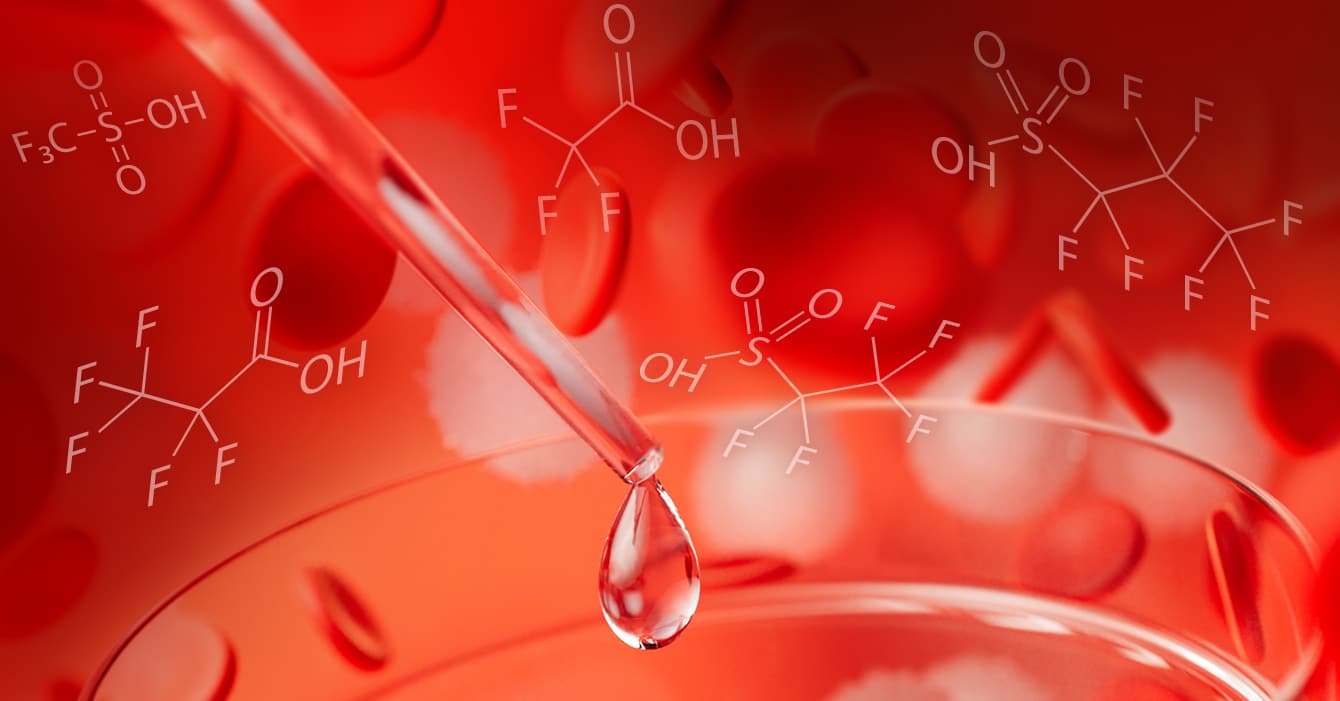
Ultrashort-chain (USC) PFAS are compounds with one to three perfluorinated carbons, shorter than the C4 cutoff most conventional PFAS methods are built around. Trifluoroacetic acid (TFA) is the most common example. Because beverages are water-based and consumed across all age groups, they’re a direct route of exposure to these highly mobile and persistent compounds. Methods that only target C4-and-longer PFAS systematically miss the class of compounds that turn out to be most abundant in teas and juices.
Why do conventional C18 columns miss USC PFAS like TFA in beverage samples?
Standard C18 columns perform well for PFAS with chain lengths of C4 and longer, but they provide little to no retention for highly polar USC compounds. TFA, TFMS, and similar analytes elute too close to the void volume to be reliably separated from matrix interferences on a C18 phase, which is why most existing PFAS methods perform poorly for USC PFAS or simply exclude them from the target analyte list.
What column and conditions retain both ultrashort-chain and long-chain PFAS in a single method?
An inert column with a mixed-mode stationary phase, such as the Ultra IBD Inert column (100 × 2.1 mm, 3.0 µm, cat.# 9175312-T), has been shown to provide sufficient retention for polar USC compounds while maintaining optimal retention of long-chain PFAS, resulting in comprehensive PFAS analysis with a short analytical run time. Pairing it with an Ultra IBD delay column (150 × 2.1 mm, 3.0 µm, cat.# 9175362) helps sequester background PFAS contamination from the LC system, which is essential for accurate low-level quantification. Full gradient and MS parameters are provided along with method performance data in the full application note.
How is a beverage sample prepared for PFAS LC-MS/MS analysis?
Sample prep is dilute-and-shoot: aliquot the beverage, spike with isotopically labeled internal standards, dilute with acetonitrile, vortex, and centrifuge—no extraction, evaporation, or cleanup steps are required. This minimizes lab-introduced contamination and keeps sample throughput high. Orange juice is the one matrix in this study that needed an extra water dilution step first since it showed stronger matrix effects than the other beverages tested.
How long does the run take, and how many PFAS can it detect in one injection?
The chromatographic method runs in 12 minutes and simultaneously quantifies 43 PFAS analytes, covering ultrashort-chain; short-chain; long-chain; and alternative PFAS (including fluorotelomers, sulfonamides, and polyfluoroether acids) in a single injection. This is much more efficient for laboratories than typical comprehensive PFAS approaches that require a second method or complex ion-exchange workarounds to cover the USC compounds.
What recovery, precision, and LOQs can a lab expect when testing tea and juice matrices?
Across five representative beverages (green tea, black tea, apple juice, blended berry juice, and orange juice), average recoveries ranged from 71–122% with %RSD ≤12% at every fortification level tested. Most of the 43 analytes were quantifiable down to 2 or 4 ng/L. Certain compounds—such as TFA (monitored using 13C2-TFA); TFMS; HFPO-DA; fluorotelomer carboxylic acids; perfluorooctane sulfonamides; and sulfonamidoacetic acids—exhibited higher LOQs of 10 or 20 ng/L due to relatively lower MS detection sensitivity or stronger matrix interferences, varying by beverage type. Full data sets for recovery, precision, LOQs, calibration ranges, etc. for every analyte in every matrix are available in Appendices II and III of the application note.
Do different beverage matrices, such as tea vs. juice, need different sample prep or method conditions?
Mostly no. The study referenced here found that the same dilute-and-shoot preparation and chromatographic method were effective across all five of the matrices tested. The one exception was orange juice, which required an additional water dilution step before the acetonitrile dilute-and-shoot procedure due to stronger matrix suppression. Matrix-specific results for LOD, linearity, accuracy, and precision for each beverage type are summarized in Tables I and II of the application note.
Which PFAS are actually showing up in commercial teas and juices?
In a screen of 23 commercial beverages, TFA was detected in every single sample, often at concentrations far higher than any other PFAS. In fact, the levels were high enough in some beverages to exceed the calibration range and require additional dilution. TFMS, PFPrA, and PFPrS were also commonly detected. Long-chain PFAS like PFOA and PFOS, by contrast, showed up only occasionally. In other words, the PFAS burden in beverages is dominated by the ultrashort-chain compounds for which conventional methods largely aren’t effective.
Where can I find the full data, conditions, MRM transitions, and calibration ranges?
All of that, chromatographic conditions, MS/MS transitions, cone/collision voltages, linearity and LOD/LOQ data, and complete accuracy/precision tables for all 43 analytes across six fortification levels in all five matrices is available in the full application note: Incorporating Ultrashort-Chain PFAS into Comprehensive PFAS Analysis in Ready-to-Drink Teas and Fruit Juices. Start there for validation planning and method transfer. You can also contact Restek with any technical questions you may have.