- Outstanding inertness keeps calibrations passing and samples running.
- Excellent resolution of critical pairs for improved accuracy.
- Consistent column-to-column performance.
- Long column lifetime.
Ensure Consistent Performance
Designed specifically for semivolatiles analysis, Restek’s new Rxi-SVOCms columns ensure consistent performance that will keep calibrations passing longer, so you can run more samples before needing to recalibrate the instrument or replace the column. Our new polymer and deactivation chemistries produce highly inert columns with tightly controlled selectivity resulting in exceptional performance for a wide range of analytes (acidic, basic, and neutral).
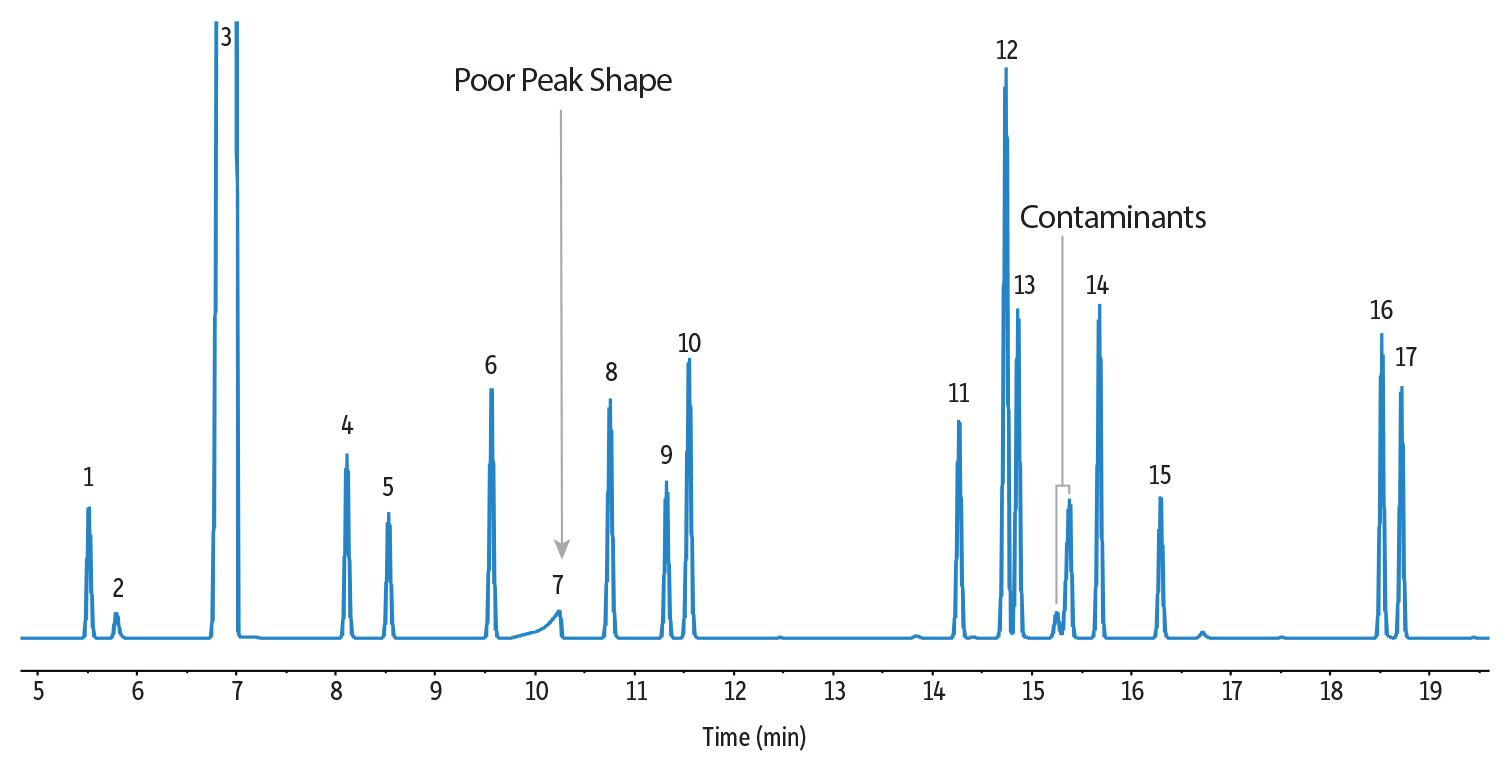
Rxi-SVOCms columns are tuned specifically to improve peak shape for challenging SVOCs, such as pentachlorophenol, pyridine, and benzidine, as well as to ensure optimized resolution of difficult polycyclic aromatic hydrocarbons (PAH). As shown in Figure 1, the most problematic reactive analytes show highly symmetrical peak shapes and good responses. In addition, excellent resolution (≥85% valley) is obtained for benzo[b]fluoranthene and benzo[k]fluoranthene, which are isobaric PAHs that must be separated chromatographically, as well as for indeno[1,2,3-cd]pyrene and dibenz[a,h]anthracene.
For chemists in the environmental industry who are slowed down by variable column performance, frequent calibration failures, and poor column lifetimes, switching to rugged Rxi-SVOCms columns can ensure data requirements are met longer and downtime is minimized.
Figure Heading 1
GC_FF1387
Conditions
| Rtx-502.2, 60 m, 0.25 mm ID, 1.4 µm (cat.# 10916) |
| Ethanol |
| 100 µg/mL 100:1 split |
| 1.0 µL split (split ratio 100:1) |
| Topaz precision split liner (cat.# 23305) |
| 250 °C |
| 140 mL/min |
| 35 °C (hold 3 min) to 220 °C at 8 °C/min (hold 5 min) |
| 1.4 mL/min |
| 25.503 cm/sec @ 35 °C |
| FID @ 250 °C |
| 25 mL/min |
| N2 |
| 35 mL/min |
| 400 mL/min |
| 50 Hz |
Heading 2
GC_FF1397
Conditions
| Rtx-1301, 60 m, 0.25 mm ID, 1.0 µm (cat.# 16056) |
| 1 µL split (split ratio 100:1) |
| Topaz Precision inlet liner w/wool, 4.0 mm x 6.3 mm x 78.5 mm (cat.# 23305) |
| 250 °C |
| 140 mL/min |
| 35 °C (hold 2.45 min) to 220 °C at 7 °C/min (hold 5 min) |
| 1.4 mL/min |
| 30.261 cm/sec @ 35 °C |
| MS |
| Scan |
|
| Group | Start Time
(min) | Scan Range
(amu) | Scan Rate
(scans/sec) |
|---|
| 1 | 0 | 30-400 | 7.16 |
|
| 280 °C |
| Quadrupole |
| 230 °C |
| 150 °C |
| 1116 eV |
| 0 min |
| PFTBA |
| EI |
Stable Calibrations Increase Sample Throughput
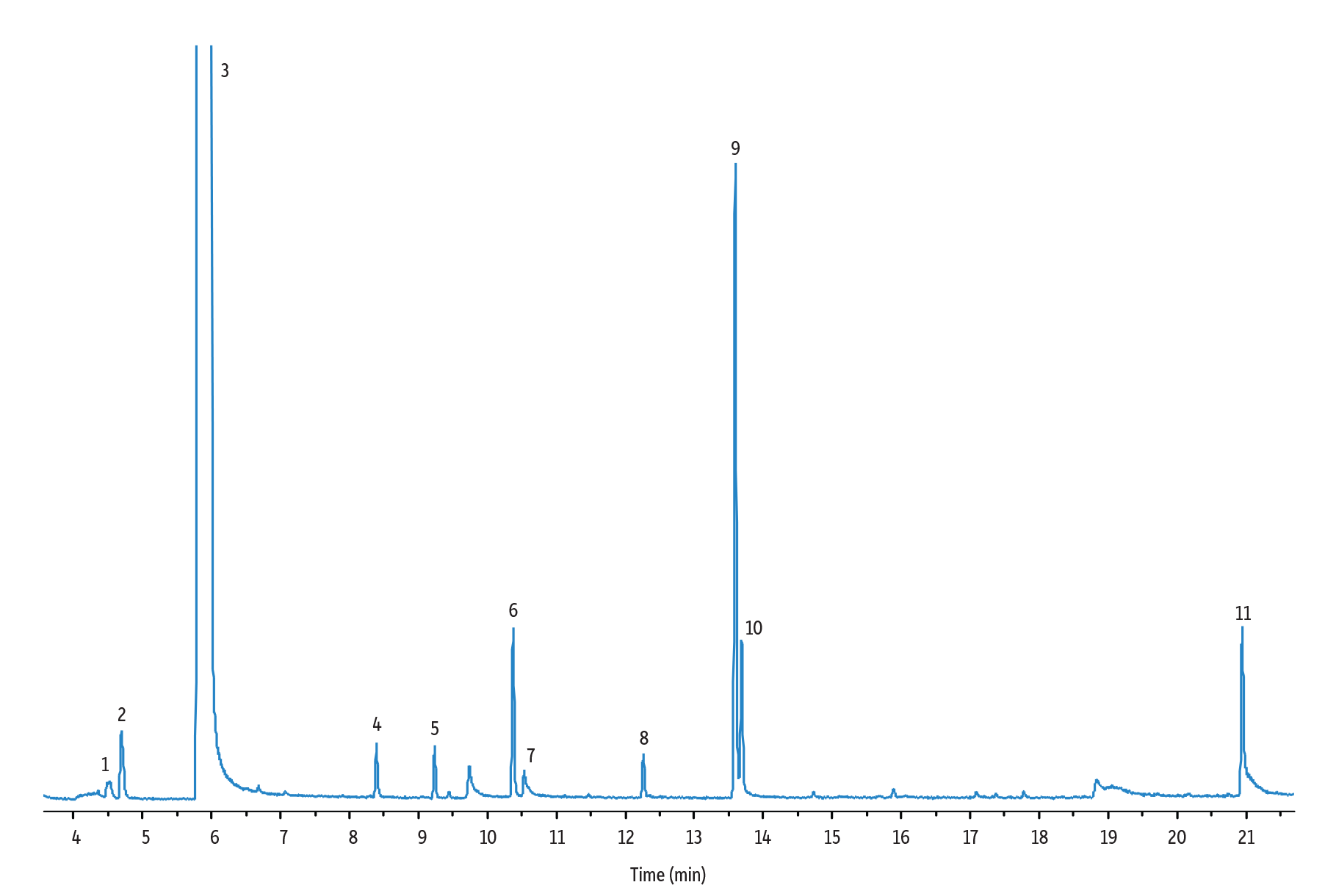
Failed calibrations mean lost productivity as sample analysis must be put on hold for time-consuming maintenance and recalibration. The improved inertness of Rxi-SVOCms columns overcomes this, resulting in an average response factor %RSD from the initial calibration of six columns of just 6% over all compounds and columns (Table I). Extremely low and consistent response factors ensure that calibrations will last longer, allowing more samples to be run before recalibration is required. As shown in Figure 2, consistent peak shapes and retention times are seen even across different concentrations of pyridine and pentachlorophenol, which are problematic compounds that tend to tail and often fail calibration criteria on columns that are not highly inert.
Products Mentioned
Colonne capillaire Rxi-SVOCms, L 30 m, DI 0.25 mm, 0.25 µm
Colonne capillaire Rxi-SVOCms, L 30 m, DI 0.32 mm, 0.25 µm
Tubes désactivés, désactivation apolaire, 30 m, DE 0.25 mm
Tubes désactivés, désactivation apolaire, 60 m, DE 0.25 mm




![[28] What do Chromatograms tell us? First Eluting Peaks are very Broad when using Direct Injection and Water as Matrix.](https://discover.restek.com/wp-content/uploads/Restek_placeholder.jpg)