


Cannabinoid neutrals are a group of chemical compounds naturally produced by cannabis plants. They are primarily found in the resin produced by the flowers and leaves of the cannabis plant. Some of the most well-known neutrals include delta-8- and delta-9-tetrahydrocannabinol (THC) and cannabidiol (CBD). Respectively, these compounds are known for the psychoactive effects of cannabis and the potential for therapeutic uses.
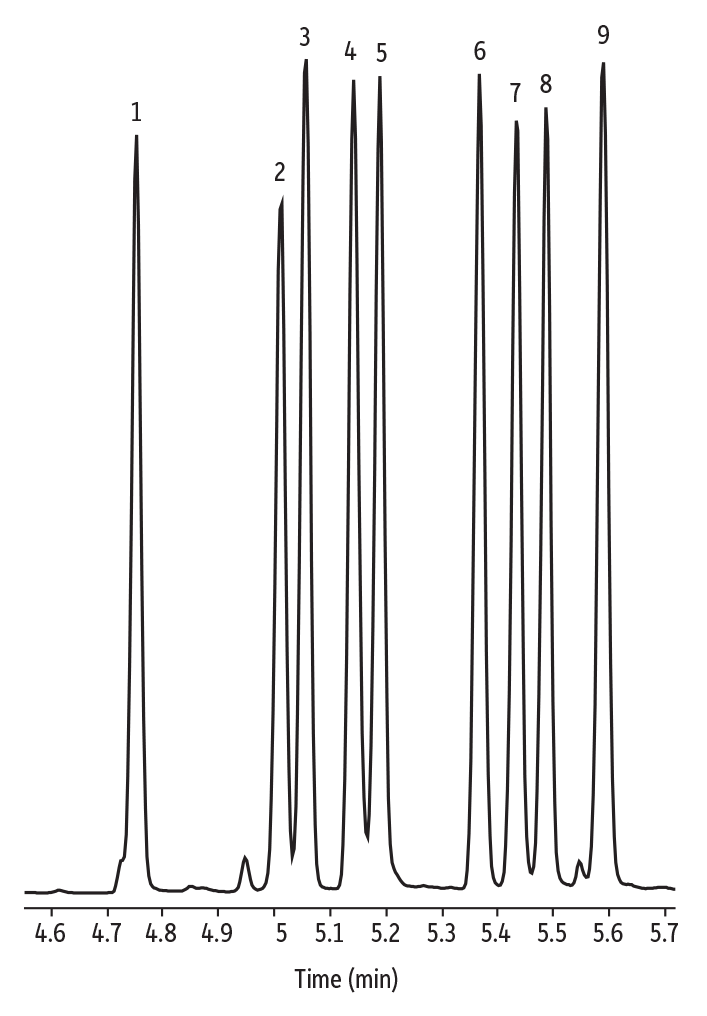
GC_GN1243
Peaks
| Peaks | tR (min) | Conc. (…) | |
|---|---|---|---|
| 1. | Cannabidivarin | 4.753 | 20 |
| 2. | Tetrahydrocannabivarin | 5.013 | 20 |
| 3. | Cannabicyclol | 5.057 | 20 |
| 4. | Cannabichromene | 5.142 | 20 |
| 5. | Cannabidiol | 5.189 | 20 |
| 6. | d8-Tetrahydrocannabinol | 5.367 | 20 |
| 7. | d9-Tetrahydrocannabinol | 5.433 | 20 |
| 8. | Cannabigerol | 5.487 | 20 |
| 9. | Cannabinol | 5.590 | 20 |
Conditions
| Column | LPGC Rxi-35Sil MS, includes Rxi-35mSil MS 10 m 0.32 mm 0.25 µm w/ 5 0.15 mm ID Rxi restrictor connected via SilTite connector |
|---|---|
| Standard/Sample | Cannabinoids Neutrals 9 Standard (cat.# 34132) |
| Diluent: | Methanol |
| Conc.: | 100 µg/mL (20 µg/mL on column) |
| Injection | |
| Inj. Vol.: | 1 µL split (split ratio 5:1) |
| Liner: | Topaz, splitless, single taper inlet liner, 4.0 mm x 6.5 x 78.5 (cat.# 23303) |
| Inj. Temp.: | 290 °C |
| Split Vent Flow Rate: | 4.5 mL/min |
| Oven | |
| Oven Temp.: | 80 °C to 300 °C at 40 °C/min (hold 1 min) |
| Carrier Gas | He, constant flow |
| Flow Rate: | 0.9 mL/min |
| Detector | MS | ||||||||
|---|---|---|---|---|---|---|---|---|---|
| Mode: | Scan | ||||||||
| Scan Program: | |||||||||
| |||||||||
| Transfer Line Temp.: | 300 °C | ||||||||
| Analyzer Type: | Quadrupole | ||||||||
| Source Temp.: | 330 °C | ||||||||
| Quad Temp.: | 180 °C | ||||||||
| Solvent Delay Time: | 1.5 min | ||||||||
| Tune Type: | PFTBA | ||||||||
| Ionization Mode: | EI | ||||||||
| Instrument | Agilent 7890A GC & 5975C MSD | ||||||||
| Sample Preparation | The sample was in a 2 mL short-cap, screw-thread vial (cat.# 21143) and capped with a short-cap, screw-vial closure (cat.# 24495). | ||||||||
This analysis was completed using low pressure gas chromatography mass spectrometry (LPGC GC-MS). LPGC is a great technique to pair with a mass spectrometer detector in the confirmation and identification of various compounds. LPGC uses a deactivated microbore column joined via a connector to a medium bore or megabore analytical column. With fast temperature programming and reduced flow rates, LPGC allows for increased optimum linear velocity. Using this technique can result in faster GC run times, increased sensitivity, and taller, narrower peaks.
The cannabinoid neutrals standard was run on an LPGC kit consisting of an Rxi-35Sil MS analytical column (10 m × 0.32 mm × 0.25 µm) with a 5 m × 0.15 mm ID Rxi restrictor connected via SilTite connector. The Rxi-35Sil MS is an excellent choice for cannabinoid analysis due to its selectivity and increased thermal stability. It is also compatible with a diverse range of analytes, including polar and nonpolar compounds, making it versatile for different analytical applications.
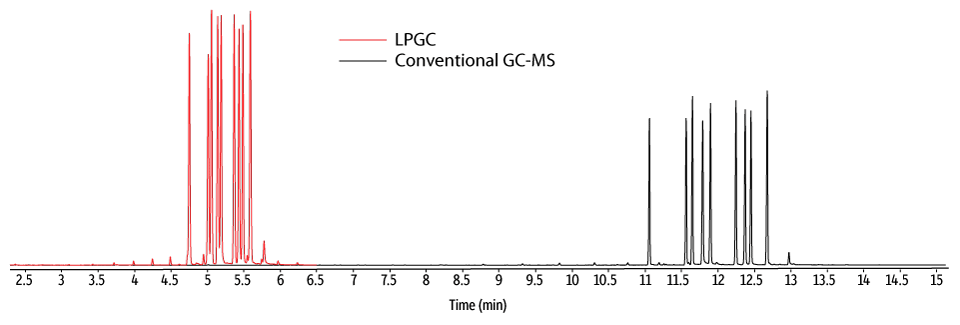
The image below shows the difference between a conventional GC-MS (black) analysis of cannabinoid neutrals and the LPGC (red) analysis. By using LPGC, the first eluting compound—cannabidivarin (CBDV)—comes out six minutes sooner than the conventional analysis times. Run times are reduced to six minutes with LPGC as the last compound—cannabinol (CBN)—measured against the thirteen minutes needed for a regular GC analysis. Despite the reduced separation efficiency, LPGC was able to provide satisfactory resolution for these analytes.
| Cannabinoid Neutrals | |||||
| Number | Compound | LPGC-MS RT | Conventional GC-MS RT | Primary Ion(s) | Resolution* |
| 1 | Cannabidivarin (CBDV) | 4.753 | 11.06 | 203 | 8.29 |
| 2 | Tetrahydrocannabivarin (THCV) | 5.013 | 11.564 | 271 | 1.37 |
| 3 | Cannabicyclol (CBL) | 5.057 | 11.652 | 231 | 2.57 |
| 4 | Cannabichromene (CBC) | 5.142 | 11.793 | 231, 174 | 1.46 |
| 5 | Cannabidiol (CBD) | 5.189 | 11.9 | 231, 246 | 5.68 |
| 6 | d8-Tetrahydrocannabinol (d8-THC) | 5.367 | 12.248 | 231, 314 | 2.05 |
| 7 | d9-Tetrahydrocannabinol (d9-THC) | 5.433 | 12.373 | 299, 315 | 1.77 |
| 8 | Cannabigerol (CBG) | 5.487 | 12.451 | 193 | 3.28 |
| 9 | Cannabinol (CBN) | 5.590 | 12.677 | 295 | 5.60 |
*LPGC only.