


The cannabis industry is always innovating with a constant revolving door of hot new products. In the past we’ve seen buzz around products containing delta-8-THC, delta-10-THC, and THCP.
Recently there has been a lot of interest in tetrahydrocannabinol acetate, or THC-O acetate. THC-O acetate is a psychoactive synthetic compound produced by acetylating THC. As far as legality, there is arguably some grey area and varies by state. There are claims of THC-O acetate being stronger than delta-9-THC and many products containing THC-O acetate are becoming available on the market. As such, labs are interested in including this compound into their cannabinoid potency methods.
Herein, three methods have been developed to monitor 12 cannabinoids, including delta-10-THC and THC-O acetate by LC-UV. Since labs have different requirements, different methods were developed so the user has the flexibility to use an unbuffered or a buffered mobile phase system as well as methanol or acetonitrile in order to best fit their needs. For this analysis, a Raptor ARC-18 150 x 3 mm, 2.7 µm column was chosen to achieve desired resolution while keeping the analysis time under 12 minutes.
Figure 1. Method conditions and extracted chromatogram for the analysis of 13 cannabinoids by LC-UV using acetonitrile as an organic modifier and buffered aqueous mobile phase.
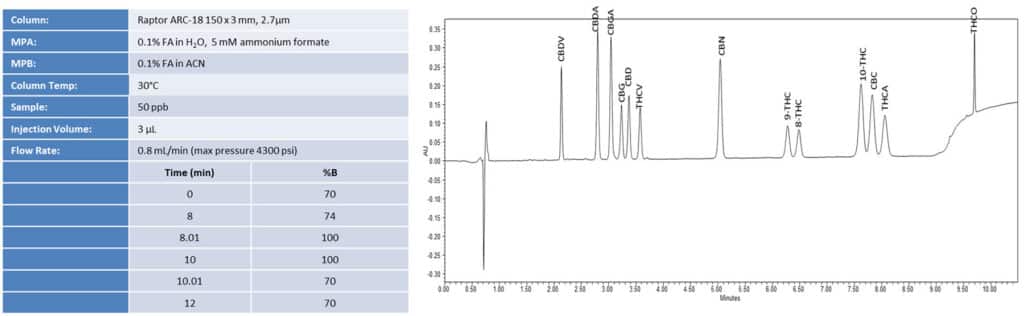
Figure 2. Method conditions and extracted chromatogram for the analysis of 13 cannabinoids by LC-UV using acetonitrile as an organic modifier without the use of buffer.
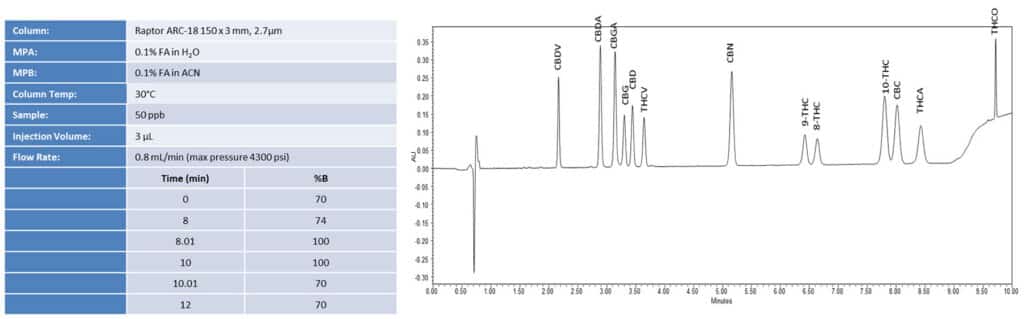
Figure 3. Method conditions and extracted chromatogram for the analysis of 13 cannabinoids by LC-UV using methanol as an organic modifier and buffered aqueous mobile phase.
By using one of these methods, resolution can be achieved for all compounds analyzed within a 12 minute total analysis time.