



Key Question
Which GC inlet liner should I use?
For most GC analyses, choose your liner based on injection mode: use a Precision liner with wool for split injection and a single taper liner with wool for splitless injection. Always use well-deactivated liners, such as Topaz liners, and confirm that the liner volume can handle your solvent expansion volume. Here, Restek’s Ramkumar Dhandapani and Chris English explain the details of what you need to consider when selecting a GC inlet liner, and they share practical tips for getting the most out of it.
“How can busy labs simplify GC liner selection?”
Ramkumar Dhandapani, PhD
Director of Product Management

“Start with these tips to get the best results”
Chris English
Senior R&D Manager
How to Choose the Right Inlet Liner
1. Does injection mode affect which GC inlet liner I should use?
Yes, injection mode is the main driver in your decision.
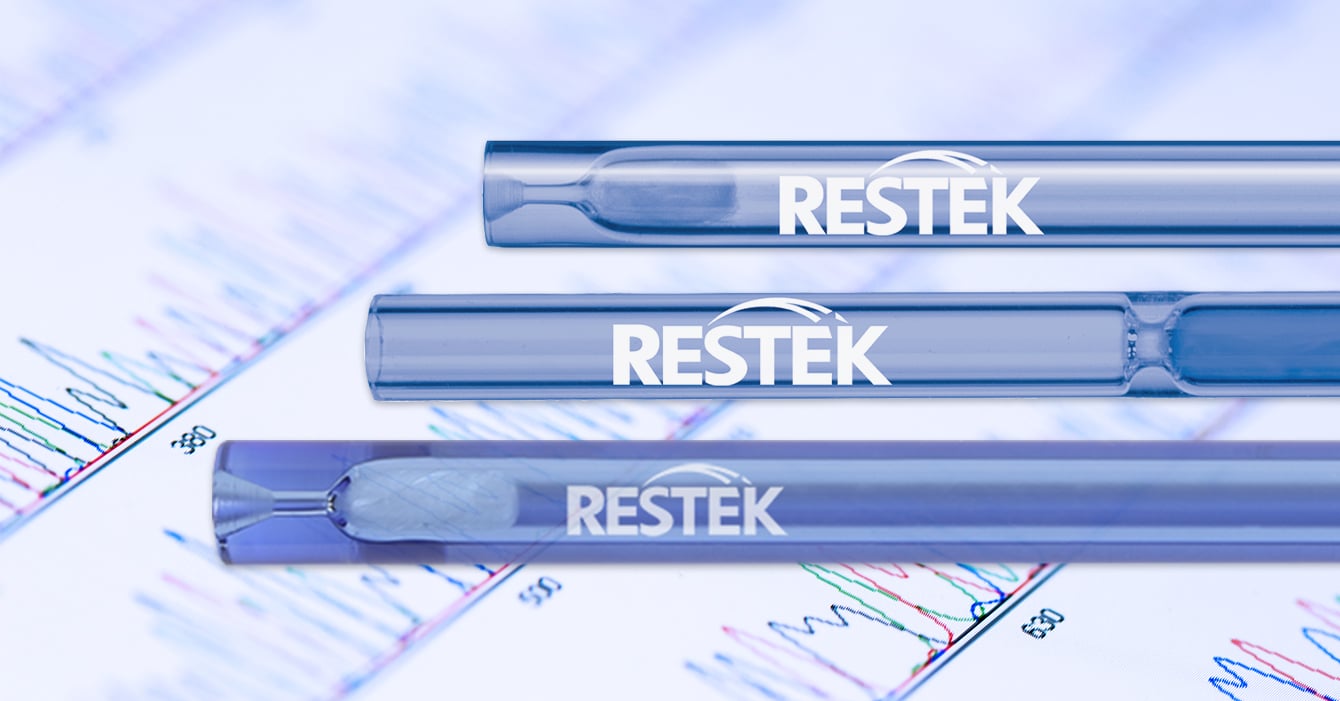
Chris: Most GC applications are run in split or splitless mode. This simplifies your decision considerably because two inlet liners cover the vast majority of those analyses: a Precision liner with wool for split injection and a single taper liner with wool for splitless injection. Get the mode right first, and your liner choice practically makes itself.
Ramkumar: I agree, the injection mode you are using should drive liner choice. Generally speaking, split injection provides speed and ruggedness, but the trade-off is less sensitivity. In contrast, splitless injection loads more sample onto the column, so you get better sensitivity; but, it also loads more solvent, so you must carefully manage conditions to prevent backflash or flooding the column. Mode determines everything downstream.
2. Will the liner deactivation affect my results?
Yes, using a GC inlet liner with a high-quality, broadly effective deactivation is essential in protecting analyte response.
Ramkumar: Effective deactivation is critical for good analytical performance because the glass liner surface carries active silanol sites. If those aren’t fully deactivated, they will adsorb or break down sensitive compounds before they reach the column. Endrin and DDT are good indicator compounds for liner deactivation; when you see poor peak shape or reduced sensitivity for these analytes, that’s strong evidence that the liner was not sufficiently deactivated.
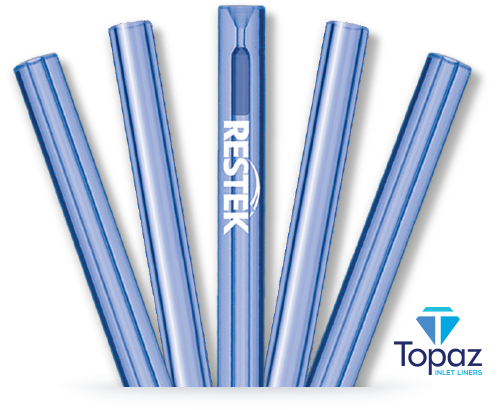
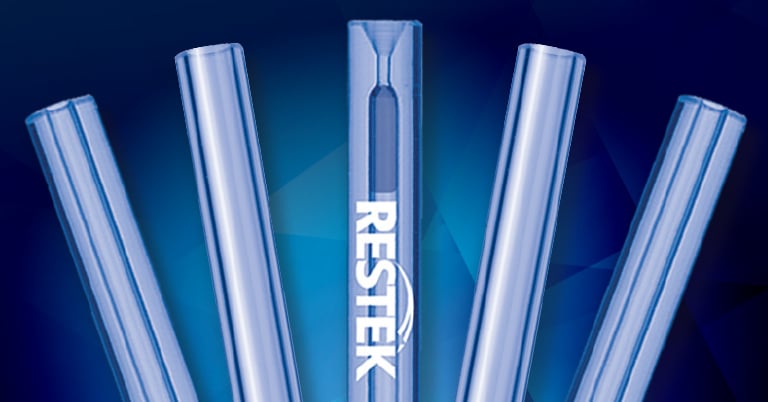
Chris: It’s a common misconception that every deactivation performs the same, but that’s simply not true. On technical service calls, I’ve had customers report in-house deactivations that yield 3-80% Endrin/DDT breakdown, which is too big of a range to be considered reliable. Commercially deactivated liners give much better performance, and of those, I consider Topaz liners to be the best because they consistently deliver 1.5–2% breakdown, which is outstanding. In my lab, we even go a step further and pair Topaz liners with highly inert RMX columns, which gives us best-in-class deactivation from inlet to detector.
Ramkumar: I would add that Topaz liners have another benefit; they are deactivated after the wool is packed, so the wool is fully deactivated. If the wool is deactivated first and then packed in the liner, active sites can form where the wool breaks during packing.
3. What liner format should I use?
Simple liner geometries work for most applications. Start there and only use a more complex one if you need it.
Chris: There are lots of liner geometries out there, but for most analyses keeping it simple is best. For split injections, I always start with the 4 mm Precision liner with wool. I’ve gotten good results from other geometries, like a simple straight liner with wool, but I personally recommend the Precision liner because it has a constriction that locks the wool in place. Consistent wool positioning is critical because the moment the wool shifts, your response shifts with it.
Ramkumar: Reproducibility is what labs live and die by, and it can be a bigger problem with splitless injections. For splitless mode, a single taper liner with wool gives excellent results in most situations because the taper minimizes analyte contact with the metal inlet seal, and the wool traps heavy contaminants and enhances analyte vaporization. It should be all you need for most applications, so it’s simplest to try it first and only use more complex and expensive geometries if you need to for special use cases.
4. Should I choose a liner with or without glass wool?
A liner containing deactivated glass wool is best for most applications because it provides more surface area, which is essential for complete vaporization as well as protecting the column from matrix contamination.
Ramkumar: I always recommend using wool. Did you know that wool provides roughly 30 cm² of surface area versus just 4.4 cm² for the liner wall? That’s a big increase in surface area, which is what drives rapid and complete vaporization. Wool also traps nonvolatile compounds, such as matrix components, so it improves accuracy and protects your analytical column from contamination.
Chris: Another benefit is that in split mode the solvent wets the fiber surface and vaporizes really quickly. Without wool, the liquid pools at the inlet seal and boils off unevenly, which means you lose both response and reproducibility if you don’t use wool.
5. Does the volume of my GC inlet liner matter?
Yes, the liner volume must match the solvent expansion volume to prevent poor chromatographic results, such as carryover.
Ramkumar: Speaking of the solvent, when you are choosing a liner, it’s important to consider your liner’s volume versus your expected solvent expansion volume. This is critical because if the vapor cloud exceeds the liner volume, you get backflash, which manifests as ghost peaks, carryover, or contamination.
Chris: I always recommend that analysts use Restek’s solvent expansion calculator before committing to a liner volume. Just enter your solvent, temperature, head pressure, injection volume, and liner dimensions, and the tool will tell you instantly whether you’re in range. I’ve seen this calculator solve problems that labs have been chasing for months.
6. What is an intermediate-volume liner, and when should I use one?
An intermediate-volume liner is a GC inlet liner with a mid-range volume. It is used to maximize the performance of narrow-bore GC columns.
Chris: Liner volume brings up a special use case we should mention. If you are using a narrow-bore column (e.g., 0.18 or 0.15 mm ID), you really should consider using an intermediate-volume liner. These liners offer higher capacity than smaller volume liners, so you can load more sample for better sensitivity, and they also transfer the sample to the column faster than larger volume liners, which gives you sharper peaks. You should use the solvent expansion calculator before deciding to make sure you won’t experience backflash, but intermediate-volume liners can really help you get the full benefits of using a narrow-bore column.
Ramkumar: I agree, there is a real performance benefit to using intermediate-volume liners with narrow-bore columns, particularly for splitless injections. These liners can help you improve sensitivity and reproducibility so you get the most out of your fast, high-efficiency column because you can inject more sample without backflash or poor peak shape.
How to Optimize Conditions for Best Performance
7. Does the inlet temperature match the set point temperature?
No, depending on where your sample is deposited in the liner and what injection mode you are using, your sample can experience a temperature that is much different than the set point.
Chris: Most people don’t realize this, but the temperature inside the liner is actually a gradient, not a constant, so the set point temperature isn’t necessarily what your sample experiences. For example, if you set your inlet to 250 °C, the temperature hits 250 °C in the center of the liner, but the top and bottom can be 100 °C cooler. We’ve measured this across multiple instruments and confirmed it.
Ramkumar: You’re right, this is a point many analysts overlook, but it really should inform sample placement strategy along with injection mode. In split mode, your sample spends only fractions of a second in the inlet, so you should deposit it in the hottest zone. In splitless mode, you have 60+ seconds, so injecting the sample in the cooler region is actually better. Thermally labile compounds, such as deltamethrin, certain explosives, etc., won’t survive in the hottest zone very long, so if you are seeing issues, it could be due to where your sample is being introduced along the temperature gradient in the injection port.
8. How can I prevent my analytes from breaking down?
Controlling temperature exposure and using inert GC inlet liners and columns is the best way to protect sensitive compounds.
Ramkumar: Knowing how inlet temperature and injection mode affect the thermal stability of your target analytes is really important. Primary amines, HMX, and certain explosive residues break down so severely in a hot inlet that other techniques may need to be considered. For less extreme compounds that are still sensitive to thermal breakdown, understanding the temperature profile in your liner and injecting the sample appropriately can make the difference between analyte stability and breakdown.
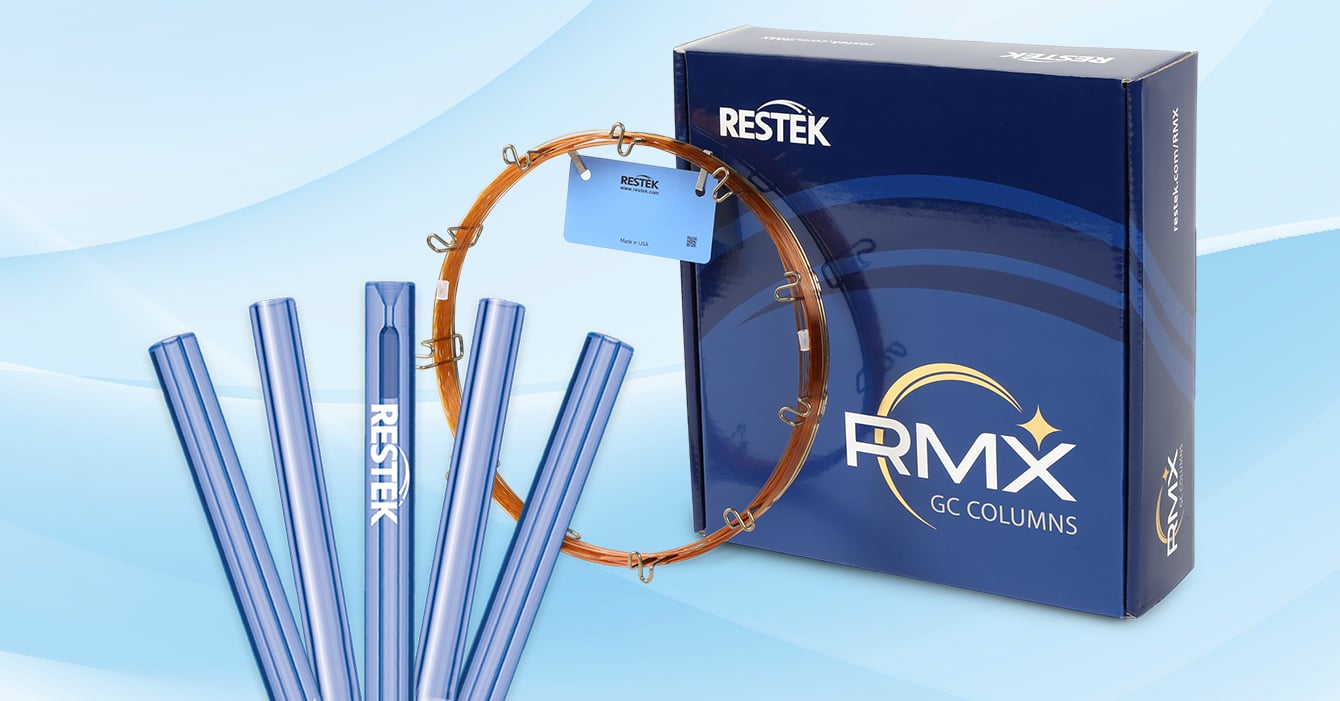
Chris: In addition to thermally labile compounds, you also need to monitor and protect chemically reactive compounds. For example, with semivolatiles analysis, benzidine, pentachlorophenol, and 2,4-dinitrophenol are so sensitive to adsorption in the inlet that they are commonly used as indicator compounds for system suitability and continuing calibration checks. By using Topaz liners and RMX GC columns, you maximize inertness across the sample flow path, so peak responses stay strong, which means your calibrations stay valid longer and more samples can run before maintenance is required.
Ramkumar: That’s right, and every extra hour of valid calibration corresponds directly to lab revenue. So, deactivation quality is a business decision, not just a chemistry one.
9. Does the splitless hold time affect my analysis?
Yes, you need to optimize the splitless hold time to maximize sensitivity and chromatographic data quality.
Chris: Temperature and deactivation are definitely critical, but coming back to the injection strategy again for a minute, I always recommend that analysts take a look at their splitless hold time. Too short a hold time, and you can leave analyte behind. Too long a hold time, and you can flood the column with solvent, burying early-eluting compounds. The sweet spot is typically around 60 seconds, just watch the solvent peak area plateau, that’s a helpful indicator of when to stop. Also, Restek’s free EZGC flow calculator is a great tool for determining the specific splitless hold time that’s right for your application.
Ramkumar: With splitless injection, it’s also really important to start your oven at least 20 °C below the solvent’s boiling point. If you don’t, you’ll have poor focusing because the solvent and analytes will interact with each other on the stationary phase causing smeared peaks. Dropping the temperature below the solvent boiling point adds a few minutes to the cycle time, but the improvement in data quality is worth it.
10. How often should I change my GC inlet liner?
Sample matrix complexity and your injection parameters determine exactly how often you need to perform maintenance. Don’t wait for your calibrations to fail; set up a routine maintenance plan based on your instrument usage to prevent downtime.
Ramkumar: There’s one last topic I want to talk about, and it’s one that lab managers push back on until they run the numbers, and that’s preventive maintenance. Replacing the liner, O-ring, and inlet seal proactively seems expensive at first, until you consider the real cost of downtime when the system fails in the middle of a batch of samples.
Chris: Proactive replacement costs $20–30 and takes only minutes, and the biggest benefit is that you plan it, so it doesn’t disrupt sample analysis. The best labs I visit replace the liner, O-ring, and inlet seal after every calibration verification, and their uptime is exceptional. Preventative maintenance is cheap—unplanned downtime, and the troubleshooting and reruns that can be associated with it is what’s really expensive.
Let’s Wrap It Up!
Why Are Topaz Liners and RMX Columns the Best Choice for High-Sensitivity Analyses?
Because they give you a truly inert sample flow path from injection to detection so you don’t lose analytes along the way.
Ramkumar: Chris, let’s close with the solution that keeps coming up in every high-sensitivity discussion: an RMX column paired with a Topaz inlet liner. What makes this combination so beneficial when labs are pushing down to trace-level concentrations?
Chris: It’s the only combination where best-in-class deactivation at the inlet meets best-in-class deactivation on the column. The Topaz liner’s ultra-inert surface preserves peak shape and response by minimizing adsorption in the inlet before the sample even enters the stationary phase. Then, the next-generation TriMax deactivation that’s used in all RMX columns carries that performance through the entire separation. This protects the sample more completely so the most challenging analytes, including acids, bases, phenols, pesticides, and more, actually make it to the detector intact.
Ramkumar: The data I’ve seen certainly backs this up. In several studies, Topaz liners measurably outperform other liners at the low-level concentrations that labs need.
Chris: We’ve also found that RMX columns have extremely high efficiency, and having more theoretical plates means a sharper, taller peak for the same amount of analyte, which directly improves signal-to-noise ratios. So, with the Topaz and RMX combination, you’re getting two separate sensitivity gains: fewer active sites robbing analyte response, and a column that produces narrower, more intense peaks.
Ramkumar: For compounds like 2,4-dinitrophenol, pentachlorophenol, or benzidine that are frequently used to demonstrate system readiness, this performance capability is often the difference between passing and failing calibrations. When you’re working at the edge of detection, every active site that doesn’t destroy your analyte is a point in your favor.
Chris: Yes, and the practical takeaway for analysts is this: if you’re struggling with poor sensitivity or high variation for difficult analytes, consider the liner and the column together, not independently. In our lab, we’ve found that pairing Topaz liners and RMX GC columns is the fastest path to a stable, high-sensitivity system that generates reliable performance at the trace levels we need.
Find Your Solution Today
Ready to take your analysis to the next level of quality and reliability? Learn more about the benefits of Topaz inlet liners and RMX GC columns and shop for your solution today!
- Topaz GC inlet liners feature revolutionary technology and inertness to deliver the next level of True Blue Performance.
- RMX GC columns with TriMax deactivation maximize trace-level performance, so you can increase productivity and profitability.