



Today, many modern herbicides are designed to selectively kill specific types of vegetation. Even though these herbicides are not environmentally persistent and degrade in less than one year, EPA Method 8151A was developed for chlorinated herbicide analysis in wastewater and soil matrices. The most commonly used compounds targeted in this method are the chlorophenoxy herbicides. Of these herbicides, (2,4-dicholorophenoxy)acetic acid, also known as 2,4-D, is the most widely used and widely monitored herbicide worldwide.
According to Method 8151A, samples containing the target herbicides are analyzed using a parallel dual-column confirmation setup and an ECD, the recommended method of detection. Because of this, many laboratories acquire chlorinated herbicides on the same instrument setup used for chlorinated pesticide and PCB analyses. The Rtx-CLPesticides and Rtx-CLPesticides2 column pair also performs exceptionally well for chlorinated herbicide analysis; in fact, all 17 target compounds in EPA Method 8151A can be determined in just 13 minutes using these columns. One pair of compounds (bentazon and picloram methyl esters) coelutes on the Rtx-CLPesticides column, but these compounds are fully resolved on the Rtx-CLPesticides2 column. And, due to the difference in selectivity of the columns, several elution order changes occur filling the confirmational requirement of the method.
| Vendor | Column Pair | Analysis Time (min) | Coelutions | Restek Advantage |
|---|---|---|---|---|
| Restek | Rtx-CLPesticides / Rtx-CLPesticides2 | 13 / 13 | 1 / 0 | More elution order changes improve confidence in confirmational results. |
| Competitor A | column 1 / column 2 | 13 / 13 | 0 / 0 | |
| Competitor B | column 1 / column 2 | 16 / 15 | 1 / 1 |
Comparison based on published competitor data. All columns tested were 0.32 mm ID.
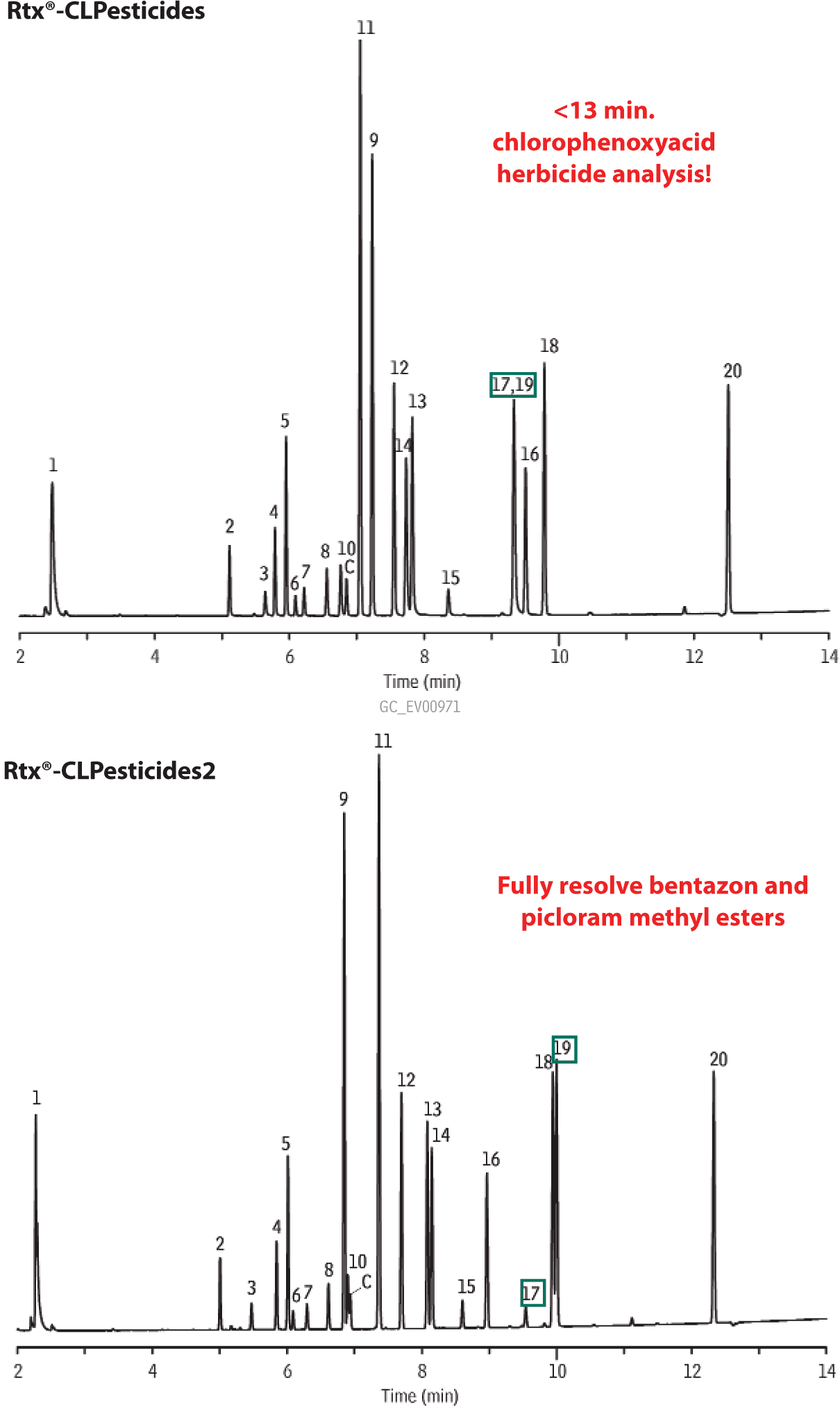
GC_EV00971
Peaks
| Peaks | |
|---|---|
| 1. | Dalapon methyl ester |
| 2. | 3,5-Dichlorobenzoic acid methyl ester (SS) |
| 3. | 4-Nitroanisole |
| 4. | DCAA methyl ester (SS) |
| 5. | Dicamba methyl ester |
| 6. | MCPP methyl ester |
| 7. | MCPA Methyl ester |
| 8. | Dichlorprop, methyl ester |
| 9. | 4,4′-DBOB (IS) |
| 10. | 2,4-D methyl ester |
| Peaks | |
|---|---|
| 11. | Pentachloroanisole |
| 12. | 2,4,5-TP, methyl ester |
| 13. | 2,4,5-T methyl ester |
| 14. | Chloramben, methyl ester |
| 15. | 2,4-DB methyl ester |
| 16. | Dinoseb methyl ester |
| 17. | Bentazon methyl ester |
| 18. | DCPA methyl ester (Chlorthal-dimethyl) |
| 19. | Pichloram methyl ester |
| 20. | Acifluorfen methyl ester |
Conditions
| Columns | Rtx-CLPesticides2 30 m, 0.32 mm ID, 0.25 µm (cat.# 11324) |
|---|---|
| and Rtx-CLPesticides 30 m, 0.32 mm ID, 0.32 µm (cat.# 11141) | |
| using Rxi deactivated guard column 5 m, 0.32 mm ID (cat.# 10039) | |
| with universal “Y” Press-Tight connector (cat.# 20405-261) | |
| Standard/Sample | |
| 200 ng/mL herbicide mix #1 (cat.# 32055) | |
| 1,000 ng/mL dalapon methyl ester (cat.# 32057) | |
| 20,000 ng/mL herbicide mix #3 (cat.# 32059) | |
| 200 ng/mL herbicide mix #4 (cat.# 32062) | |
| 250 ng/mL 4,4′-dibromooctafluorobiphenyl (cat.# 32053) | |
| 400 ng/mL 2,4-dichlorophenyl acetic acid methyl ester (cat.# 32050) | |
| Diluent: | hexane |
| Injection | |
| Inj. Vol.: | 1.0 µL splitless (hold 0.75 min) |
| Liner: | Cyclo double taper (4 mm) |
| Inj. Temp.: | 250 °C |
| Oven | |
| Oven Temp.: | 70 °C (hold 0.5 min) to 190 °C at 25 °C/min (hold 1 min) to 300 °C at 11 °C/min (hold 5 min) |
| Carrier Gas | He, constant pressure |
| Linear Velocity: | 36 cm/sec @ 70 °C |
| Detector | Micro_ECD @ 325 °C |
|---|---|
| Instrument | Agilent/HP6890 GC |
| Notes | Liner cat.# 20895 was used to produce this chromatogram, but it has since been discontinued. We recommend cat.# 20896 [or cat.# 23310] as an alternative. For assistance choosing a replacement for this application, contact Restek Technical Service or your local Restek representative. – – – – – – This chromatogram was obtained using an Agilent micro-ECD. To obtain comparable results, you will need to employ a micro-ECD in addition to confirmational dual columns connected to a 5-meter guard column using a “Y” Press-Tight connector. |