


One of the common issues which arise in laboratories during the summer is moisture in the gas lines. Although I never quite understood how this would happen when using gas cylinders, it does, especially when a manifold system is used, or if the length of tubing from the gas source to the instrument is longer than several feet/meters. Common observations when this happens are:
Unstable instrument detectors (especially TCDs, HIDs, ECDs and mass specs).
Less than ideal chromatography (shifting retention times, unusual peak shapes, etc.).
Unusual activity issues in the injection port and/or ghost peaks.
So what is an inexpensive way to minimize these issues, especially in the summer when many locations experience hot and humid conditions? Install an indicating moisture trap/filter on all gas lines.
So how would you know which trap filter would be best for you laboratory? Ask yourself the following questions:
Q1. What is the gas?
Q2. Is the gas line tubing copper or stainless steel?
Q3. What is the maximum gas flow rate the trap/filter may be subjected to?
Q4. What is the maximum gas pressure the trap/filter may be subjected to?
Here are my suggestions to aid in trap/filter selection based upon the questions listed above:
S1. Generally speaking, the traps/filters we sell are for use with laboratory grade (high purity) inert gases. If you plan to use a Restek trap/filter with a corrosive, flammable or reactive gas, email technical service.
S2. Most use traps/filters containing brass end-fittings with copper tubing and stainless steel end-fittings with stainless steel tubing. For additional information on the topic, I suggest you review the post “I need a fitting, but which one?“
S3. Published flow rates can vary among manufacturers, so make sure you are aware of exactly what a published value represents. For example, is the published flow rate the maximum flow rate the trap/filter can handle, or is it the maximum flow rate in which the trap/filter can effectively clean (scrub) the gas? In the context of this post, what is the maximum gas flow rate through the trap/filter that can effectively remove much of the moisture?
S4. For obvious safety reasons, make sure the published maximum trap/filter pressure is not exceeded.
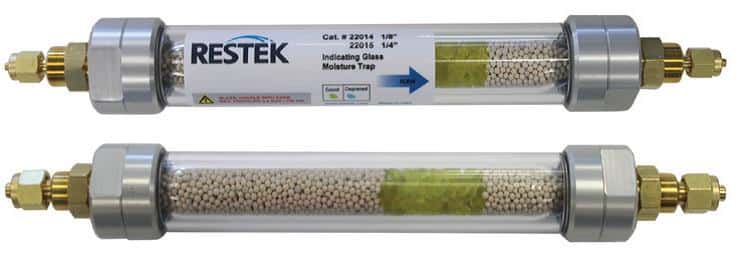
Several of the popular indicating moisture filters are shown below.
Indicating Moisture Traps (Inline)
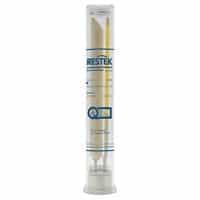
Restek Super Clean Ultra-High Capacity Moisture Filter (needs baseplate)
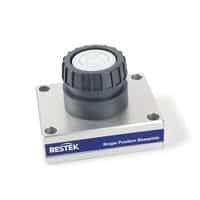
Single position baseplate
Of course, we also sell a wide variety of other filters including non-indicating moisture filters, and others for the removal of oxygen and/or hydrocarbons. You have plenty of choices from Restek.