

Did you know that unintentional polychlorinated biphenyls (PCBs), produced as byproducts in chemical processes, may now rival or even exceed the peak commercial production levels of the 1970s? While environmental policies and monitoring programs focus on legacy PCBs (e.g., Aroclors), these hidden pollutants are slipping through regulatory cracks, evading detection, and possibly accumulating in ecosystems. The unintended generation of these compounds in modern industrial processes remains a largely unaddressed crisis [4].
PCBs are man-made chemicals that were widely used in industrial applications until their production was banned. However, some PCBs are still being unintentionally produced as byproducts in various chemical processes, and their presence is often overlooked in environmental monitoring, remaining either unregulated or undetected. These PCBs have been referred to as inadvertent PCBs; incidental PCBs (i-PCBs); or non-Aroclor PCBs in the literature. Some PCBs, whether intentionally or unintentionally produced, persist in environments where they have the potential to bioaccumulate in the food chain, and may lead to potential health risks for humans and wildlife.
Let’s explore the emerging concern of unintentional PCBs, the challenges in detecting them, and how exploratory gas chromatography techniques can help identify and quantify these elusive compounds even when they coelute with other PCBs.
Commonly reported inadvertent PCBs are PCB 11, PCB 47, PCB 51, and PCB 68. Studies have shown that byproduct PCBs are commonly found in products like polymer resin, paints, pigments, and dyes. For example, tetrachlorobiphenyls, such as PCB 47, PCB 51, and PCB 68, congeners not found in Aroclor mixtures, have been detected in residential air [2]. Also, PCB 11 has been reported in different product samples [1, 6] and commercial paint pigments [5], indicating that these unintentional PCBs are widespread. Furthermore, studies on areas, such as the Portland Harbor, show that byproduct PCBs contribute 6.6% of the total PCB load [4], and Chinese soil and sediments samples show dominance of byproduct PCBs [3,7].
Most PCB monitoring programs focus on legacy PCBs from commercial mixtures using a limited set of indicator congeners (typically the seven indicator PCBs 28, 52, 101, 118, 138, 153, and 180). However, these programs often miss byproduct PCBs, which have different congener profiles and are not captured by traditional analytical methods except in studies that monitor a wider range of PCBs in environmental samples, like comprehensive fingerprinting of samples by evaluating 209 PCB congeners. One of the significant analytical challenges in detecting inadvertent PCBs is their tendency to coelute with other PCB congeners during conventional gas chromatography analysis. This coelution problem remains one of the challenges in the analysis of all 209 PCB congeners in a single analytical run, making it difficult to accurately identify and quantify these compounds, particularly when using methods optimized for legacy PCBs. The consequences of this analytical blind spot are far-reaching, potentially leading to significant underestimation of total PCB burdens in environmental and biological samples.
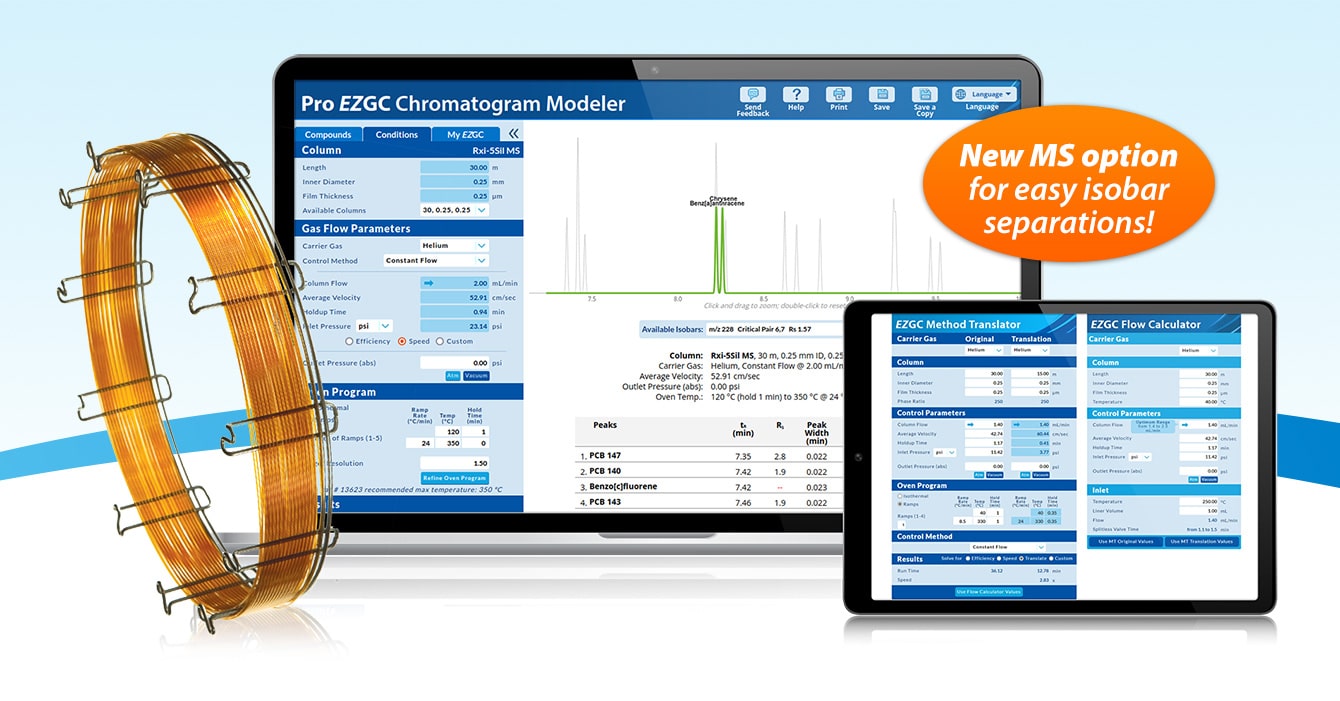
For routine analysis, the detection and quantification of inadvertent PCBs alongside legacy PCBs requires careful selection of the appropriate chromatographic column to achieve optimal separation of these challenging congeners. Restek provides the Pro EZGC platform, which enables researchers to simulate the separation behavior of congeners of interest and recommends optimal columns for specific analytical needs. This powerful tool demonstrates the potential of advanced column technology to uncover hidden sources of PCB contamination that would otherwise remain undetected. Analyzing the full suite of 209 PCB congeners is the gold standard for comprehensive characterization of PCB profiles in environmental samples, representing the most powerful analytical approach for separating and identifying these compounds in complex mixtures. Our comprehensive two-dimensional gas chromatography time-of-flight mass spectrometry (GC×GC-TOFMS) systems are specifically designed to overcome some of the limitations of conventional GC, providing superior separation of PCB congeners even in the most complex matrices. This advanced technology significantly reduces coelution problems and improves detection sensitivity for both legacy and unintentional PCBs.
To fully understand the extent of PCB contamination in our environment, monitoring programs must expand their scope to include all 209 PCB congeners, rather than limiting analysis to a small subset of indicator compounds. This more comprehensive approach will require the implementation of advanced analytical techniques, such as those offered by our GC columns and GC×GC-TOFMS systems, to detect and quantify both legacy and byproduct PCBs accurately. As environmental scientists, it’s our responsibility to stay ahead of pollutants like unintentional PCBs. By leveraging advanced gas chromatography techniques, we can uncover hidden sources of contamination and work toward developing more effective strategies for environmental protection and public health safeguarding.
For researchers looking to detect hidden PCBs in their samples, along with legacy PCBs, our Pro EZGC software serves as an essential first step in method development, helping to identify the optimal column and conditions for specific analytical challenges. With the Restek Pro EZGC Chromatogram Modeler, the resolution of both legacy PCBs and unintended PCBs, along with other congeners that may coelute on conventional columns, can be evaluated. By adopting these more comprehensive analytical approaches as part of routine analysis, we can begin to fully characterize PCB contamination in our environment to aid the development of a more accurate risk assessment that accounts for both legacy and unintentional sources of these persistent pollutants.
References
- City of Spokane, Wastewater Management Department, PCBs in municipal products (revised), City of Spokane, Spokane, WA, 2015, Accessed May 2025. https://static.spokanecity.org/documents/publicworks/wastewater/pcbs/pcbs-in-municipal-products-report-revised-2015-07-21.pdf
- N.J. Herkert, J.C. Jahnke, K.C.Hornbuckle, Emissions of tetrachlorobiphenyls (PCBs 47, 51, and 68) from polymer resin on kitchen cabinets as a non-Aroclor source to residential air, Environ. Sci. Technology 52 (9) (2018) 5154-5160. https://doi.org/10.1021/acs.est.8b00966
- S. Mao, S. Liu, Y. Zhou, Q. An, X. Zhou, Z. Mao, Y. Wu, W. Liu, The occurrence and sources of polychlorinated biphenyls (PCBs) in agricultural soils across China with an emphasis on unintentionally produced PCBs, Environ. Pollut. 271 (2021) 116171. https://doi.org/10.1016/j.envpol.2020.116171
- D. Megson, G.P. Tiktak, S. Shideler, M. Dereviankin, L. Harbicht, C.D. Sandau,. Source apportionment of polychlorinated biphenyls (PCBs) using different receptor models: A case study on sediment from the Portland Harbor Superfund Site (PHSS), Oregon, USA, Sci.Total Environ. 872 (2023) 162231. https://doi.org/10.1016/j.scitotenv.2023.162231
- D. Hu, KC. Hornbuckle, Inadvertent polychlorinated biphenyls in commercial paint pigments. Environ. Sci. Technol., 44 (8) (2010) 2822-2827. https://doi.org/10.1021/es902413k
- K. Vorkamp, An overlooked environmental issue? A review of the inadvertent formation of PCB-11 and other PCB congeners and their occurrence in consumer products and in the environment, Sci.Total Environ. 541 (2016) 1463-1476. https://doi.org/10.1016/j.scitotenv.2015.10.019
- H. Yu, T. Lin, L. Hu, G. Lammel, S. Zhao, X. Sun, X. Wu, Z. Guo, Sources of polychlorinated biphenyls (PCBs) in sediments of the East China marginal seas: role of unintentionally-produced PCBs. Environ. Pollut, 338, (2023) 122707. https://doi.org/10.1016/j.envpol.2023.122707