


Greater efficiency is accomplished primarily by shorter transfer time for solutes traveling into and out of the particles and mobile phase, but it is also enhanced by more uniform particle size, which results in more consistent packing. From a more theoretical viewpoint, the Van Deemter equation is the best approach to explain this phenomenon. Better efficiency is represented here as a shorter plate height (H).
The Van Deemter equation describes the relationship between column flow rate and peak efficiency, referred to as band broadening.
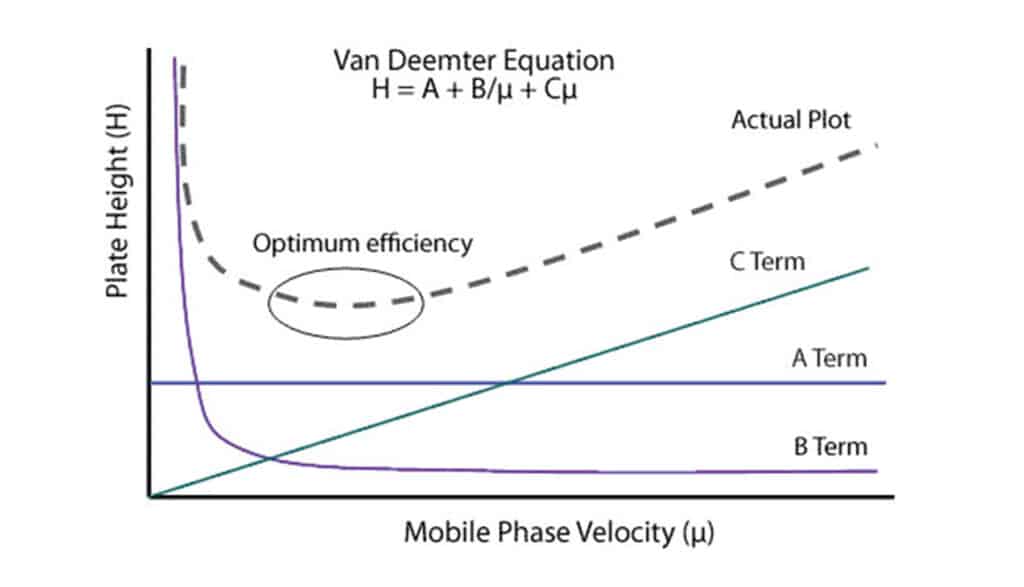
The solid core of SPP silica results in lower values for the A and B terms (eddy diffusion and longitudinal diffusion), and it results in better mass transfer of solutes, translating to lower values for the mass transfer component, the C term. Therefore, a shorter theoretical plate height H and higher efficiency can be achieved at high flow rates. This is also the case for UHPLC particles, but with SPP particles of normal analytical size, the column pressure is not dramatically higher, as is the case for UHPLC. SPP particles are usually also more uniform in shape and result in more consistent packing, which improves overall efficiency as well. All of these factors produce the significant reduction in band broadening that we commonly associate with SPP silica columns.