

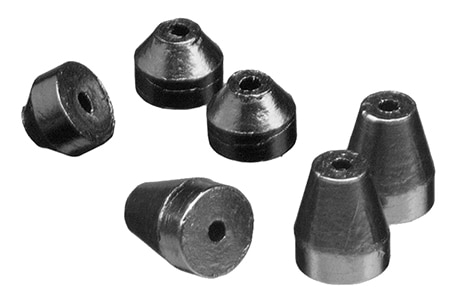
One-piece ferrules are available in two designs: the standard 1⁄16’’ compression type and the short, compact design. Agilent GCs typically use the compact design at the injector and detector, but we always recommend using the 1⁄16’’ compression type ferrule at the detector if you are doing GC-MS analysis. Whichever configuration you select, it is essential that you use the corresponding standard or compact nut.
In addition, ferrules are generally available in three compositions: graphite, Vespel, and Vespel/graphite. Composition is usually a matter of preference, but we recommend Vespel/graphite ferrules for GC-MS because they seal with minimum torque, maintain sealing performance under high pressure and vacuum, and are reusable.
The hole in the ferrule should always have a slightly larger inner diameter (ID) than the column’s outer diameter (OD) so that it can compress and seal around the column. For example, a 0.53 mm ID Restek column, which has an OD of approximately 0.7 mm, would require a ferrule with an ID of 0.8 mm.
For more on ferrule selection, see our blogs on ferrule selection and our GC nut/ferrule compatibility chart. You’ll find specific information there for all the major instrument brands.