



Abstract
Highly sensitive analysis of metanephrines in plasma is critical in the diagnosis and treatment of pheochromocytoma and paraganglioma. Here, a HILIC LC-MS/MS method was developed using a Raptor HILIC-Si column because this approach provides retention of all target compounds in highly organic mobile phases, thus providing the increased sensitivity needed to reach low detection limits. Data from linearity, accuracy, and precision testing demonstrate that accurate results are consistently obtained—even at trace levels—for these important clinical biomarkers.
Introduction
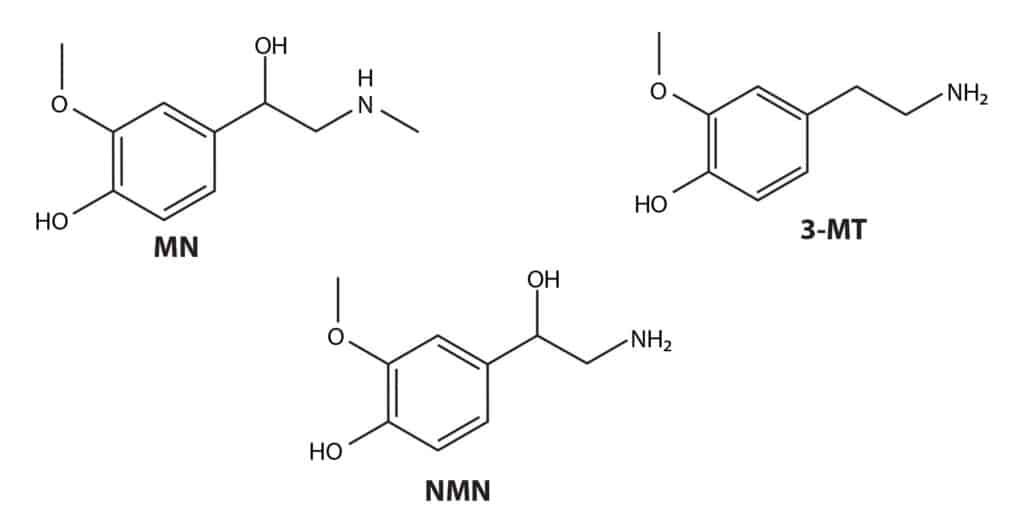
The metanephrines—metanephrine (MN), normetanephrine (NMN), and 3-methoxytyramine (3-MT)—are methylated metabolites of epinephrine, norepinephrine, and dopamine, respectively (Figure 1). These catecholamine metabolites are released from the adrenal medulla and sympathetic nervous cells and are normally maintained at very low concentrations in the bloodstream. Elevated levels of these compounds in circulation can indicate the presence of pheochromocytoma or paraganglioma, so highly sensitive measurement of in vivo concentrations is critical for correct diagnosis, treatment, and long-term patient monitoring.
Trace-level analysis of metanephrines in plasma using typical reversed-phase LC can be difficult due to limited chromatographic retention and lack of sensitivity. As an alternative, we developed an LC-MS/MS method based on hydrophilic interaction liquid chromatography (HILIC) using a Raptor HILIC-Si column. Combined with a simple solid phase extraction (SPE) procedure, an accurate and precise analysis of these important biomarkers can be achieved in a fast, 5-minute analysis time, making this a beneficial assay for high-throughput clinical labs.
Experimental
Sample Preparation
Internal standard (IS) solution was prepared at 4 ng/mL for metanephrine-d3, and at 8 ng/mL for normetanephrine-d3 and 3-methoxytyramine-d4 in methanol. A plasma sample aliquot (200 μL) was mixed with 10 μL of IS solution and 600 μL of 50 mM ammonium acetate. The mixture was loaded onto an EVOLUTE EXPRESS WCX 96-well plate (30 mg) and washed with 1 mL water and 1 mL methanol:acetonitrile (50:50). The elution was performed twice with 0.9 mL of 5% formic acid in methanol:acetonitrile (50:50) and samples were then evaporated to dryness at 55 °C under a gentle stream of nitrogen. Dried extracts were reconstituted with 100 μL of 100 mM ammonium formate in water (pH 3.0):acetonitrile (10:90) and injected (10 μL) for analysis.
Calibration Standards and Quality Control Samples
Charcoal stripped human plasma (BioreclamationIVT) was fortified with metanephrine, normetanephrine, and 3-methoxytyramine to prepare calibration standards and QC samples. The linearity ranges were 0.051-20.28 nmol/L (10-4,000 pg/mL) for metanephrine; 0.14-21.83 nmol/L (24- 4,000 pg/mL) for normetanephrine; and 0.060-23.92 nmol/L (10-4,000 pg/mL) for 3-methoxytyramine. Three QC levels were prepared at 40, 400, and 2,500 pg/mL for all three analytes. The fortified standard and QC samples were prepared using the SPE procedure described above.
LC-MS/MS analysis of metanephrines in plasma was performed on an ACQUITY UPLC instrument coupled with a Waters Xevo TQ-S mass spectrometer. Instrument conditions were as follows and analyte transitions are provided in Table I.
| Analytical column: | Raptor HILIC-Si (2.7 µm, 50 mm x 2.1 mm; cat.# 9310A52) | |
| Mobile phase A: | 100 mM ammonium formate in water, pH 3.0 | |
| Mobile phase B: | Acetonitrile | |
| Gradient | Time (min) | %B |
| 0.00 | 90 | |
| 5.00 | 90 | |
| Flow rate: | 0.3 mL/min | |
| Injection volume: | 10 µL | |
| Column temp.: | 30 °C | |
| Ion mode: | Positive ESI | |
Table I: Analyte Transitions for Plasma Free Metanephrines LC-MS/MS Analysis
| Analyte | Precursor Ion | Product Ion Quantifier | Product Ion Quantifier |
| Metanephrine-d3 | 183.00 | 151.15 | — |
| Metanephrine | 179.94 | 148.22 | 165.01 |
| Normetanephrine-d3 | 169.00 | 136.96 | — |
| Normetanephrine | 166.00 | 134.02 | 121.01 |
| 3-Methoxytyramine-d4 | 155.07 | 122.93 | — |
| 3-Methoxytyramine | 151.00 | 119.00 | 91.02 |
Results and Discussion
Chromatographic Performance
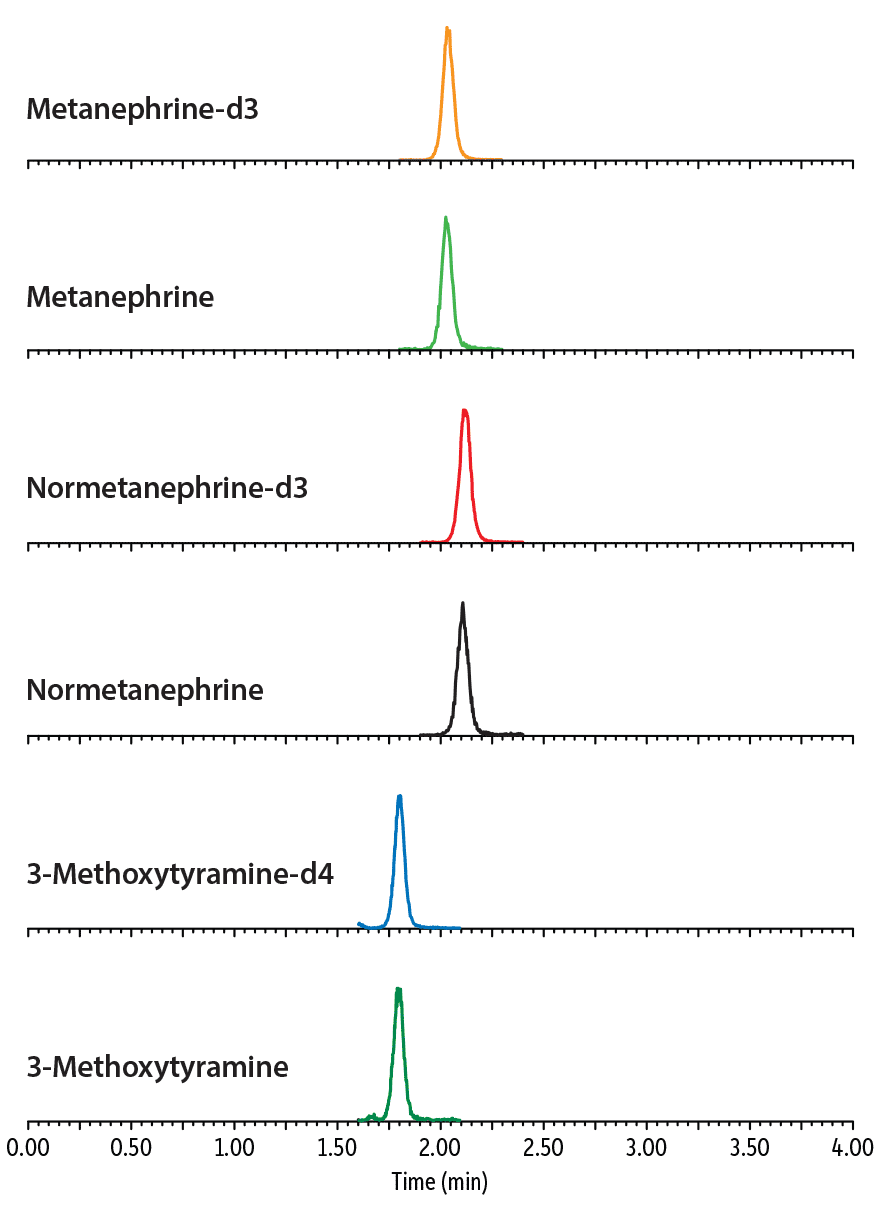
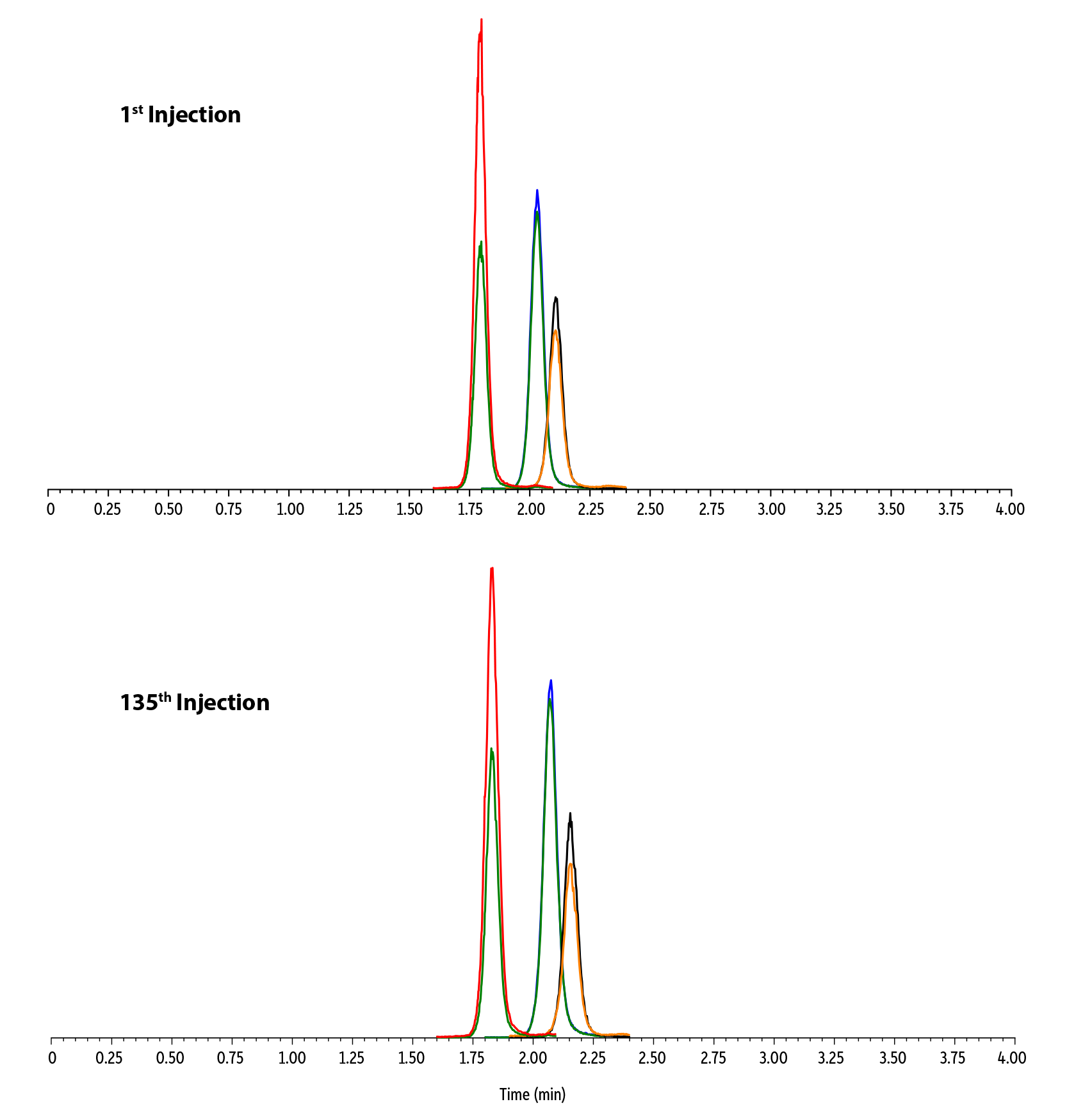
Using a HILIC approach and Raptor HILIC-Si column, good retention was obtained for all analytes. A fast, 5-minute chromatographic analysis (Figure 2) was achieved with injection of reconstituted sample extract. No chromatographic interferences were observed in the analysis of blank plasma samples (Figure 3), indicating that the simple SPE procedure was effective and specific. In addition, the isocratic elution with HILIC showed consistent results over multiple injections indicating that the method was robust (Figure 4).
LC_CF0689
Peaks
| Peaks | tR (min) | Conc. (pg/mL) | Precursor Ion | Product Ion | |
|---|---|---|---|---|---|
| 1. | 3-Methoxytyramine-d4 (IS) | 1.80 | 400 | 155.07 | 122.93 |
| 2. | 3-Methoxytyramine | 1.80 | 50 | 151.00 | 119.00 |
| 3. | Metanephrine-d3 (IS) | 2.03 | 200 | 183.00 | 151.15 |
| 4. | Metanephrine | 2.03 | 50 | 179.94 | 148.22 |
| 5. | Normetanephrine-d3 (IS) | 2.11 | 400 | 169.00 | 136.96 |
| 6. | Normetanephrine | 2.11 | 50 | 166.00 | 134.02 |
Conditions
| Column | Raptor HILIC-Si (cat.# 9310A52) | ||||||||||||
|---|---|---|---|---|---|---|---|---|---|---|---|---|---|
| Dimensions: | 50 mm x 2.1 mm ID | ||||||||||||
| Particle Size: | 2.7 µm | ||||||||||||
| Pore Size: | 90 Å | ||||||||||||
| Temp.: | 30 °C | ||||||||||||
| Standard/Sample | |||||||||||||
| Diluent: | Mobile phase A:mobile phase B (10:90) | ||||||||||||
| Inj. Vol.: | 10 µL | ||||||||||||
| Mobile Phase | |||||||||||||
| A: | Water, 100 mM ammonium formate, pH 3.0 | ||||||||||||
| B: | Acetonitrile | ||||||||||||
|
| Detector | MS/MS |
|---|---|
| Ion Mode: | ESI+ |
| Mode: | MRM |
| Instrument | UHPLC |
| Sample Preparation | Charcoal stripped human plasma was fortified with analytes at 50 pg/mL (0.25, 0.27, and 0.30 nmol/L for metanephrine, normetanephrine, and 3-methoxytyramine, respectively). Internal standard (IS) was prepared at 4 ng/mL for metanephrine-d3 and at 8 ng/mL for normetanephrine-d3 and 3-methoxytyramine-d4 in methanol. The plasma sample (200 μL) was mixed with 10 μL of IS solution and 600 μL of 50 mM ammonium acetate solution. The mixture was loaded in an EVOLUTE EXPRESS WCX 96-well plate (30 mg) and washed with 1 mL water and 1 mL methanol:acetonitrile (50:50). The elution was performed twice with 0.9 mL of 5% formic acid in methanol:acetonitrile (50:50) and evaporated to dryness at 55 °C under a gentle stream of nitrogen. Dried extract was reconstituted with 100 μL of diluent and injected (10 μL) for analysis. |
LC_CF0689
Peaks
| Peaks | tR (min) | Conc. (pg/mL) | Precursor Ion | Product Ion | |
|---|---|---|---|---|---|
| 1. | 3-Methoxytyramine-d4 (IS) | 1.80 | 400 | 155.07 | 122.93 |
| 2. | 3-Methoxytyramine | 1.80 | 50 | 151.00 | 119.00 |
| 3. | Metanephrine-d3 (IS) | 2.03 | 200 | 183.00 | 151.15 |
| 4. | Metanephrine | 2.03 | 50 | 179.94 | 148.22 |
| 5. | Normetanephrine-d3 (IS) | 2.11 | 400 | 169.00 | 136.96 |
| 6. | Normetanephrine | 2.11 | 50 | 166.00 | 134.02 |
Conditions
| Column | Raptor HILIC-Si (cat.# 9310A52) | ||||||||||||
|---|---|---|---|---|---|---|---|---|---|---|---|---|---|
| Dimensions: | 50 mm x 2.1 mm ID | ||||||||||||
| Particle Size: | 2.7 µm | ||||||||||||
| Pore Size: | 90 Å | ||||||||||||
| Temp.: | 30 °C | ||||||||||||
| Standard/Sample | |||||||||||||
| Diluent: | Mobile phase A:mobile phase B (10:90) | ||||||||||||
| Inj. Vol.: | 10 µL | ||||||||||||
| Mobile Phase | |||||||||||||
| A: | Water, 100 mM ammonium formate, pH 3.0 | ||||||||||||
| B: | Acetonitrile | ||||||||||||
|
| Detector | MS/MS |
|---|---|
| Ion Mode: | ESI+ |
| Mode: | MRM |
| Instrument | UHPLC |
| Sample Preparation | Charcoal stripped human plasma was fortified with analytes at 50 pg/mL (0.25, 0.27, and 0.30 nmol/L for metanephrine, normetanephrine, and 3-methoxytyramine, respectively). Internal standard (IS) was prepared at 4 ng/mL for metanephrine-d3 and at 8 ng/mL for normetanephrine-d3 and 3-methoxytyramine-d4 in methanol. The plasma sample (200 μL) was mixed with 10 μL of IS solution and 600 μL of 50 mM ammonium acetate solution. The mixture was loaded in an EVOLUTE EXPRESS WCX 96-well plate (30 mg) and washed with 1 mL water and 1 mL methanol:acetonitrile (50:50). The elution was performed twice with 0.9 mL of 5% formic acid in methanol:acetonitrile (50:50) and evaporated to dryness at 55 °C under a gentle stream of nitrogen. Dried extract was reconstituted with 100 μL of diluent and injected (10 μL) for analysis. |
LC_CF0701
Peaks
| Peaks | Conc. (ng/mL) | Precursor | Product Ion | Product Ion | 1st Injection (tR) | 135th Injection (tR) | |
|---|---|---|---|---|---|---|---|
| 1. | 3-Methoxytyramine | 1 | 151.00 | 119.00 | 91.02 | 1.80 | 1.83 |
| 2. | Metanephrine | 1 | 179.94 | 148.22 | 165.01 | 2.03 | 2.07 |
| 3. | Normetanephrine | 1 | 166.00 | 134.02 | 121.01 | 2.11 | 2.15 |
Conditions
| Column | Raptor HILIC-Si (cat.# 9310A52) | ||||||||||||
|---|---|---|---|---|---|---|---|---|---|---|---|---|---|
| Dimensions: | 50 mm x 2.1 mm ID | ||||||||||||
| Particle Size: | 2.7 µm | ||||||||||||
| Pore Size: | 90 Å | ||||||||||||
| Temp.: | 30 °C | ||||||||||||
| Standard/Sample | |||||||||||||
| Diluent: | Mobile phase A:mobile phase B (10:90) | ||||||||||||
| Conc.: | 1 ng/mL | ||||||||||||
| Inj. Vol.: | 10 µL | ||||||||||||
| Mobile Phase | |||||||||||||
| A: | Water, 100 mM ammonium formate, pH 3.0 | ||||||||||||
| B: | Acetonitrile | ||||||||||||
|
| Detector | MS/MS |
|---|---|
| Ion Mode: | ESI+ |
| Mode: | MRM |
Linearity
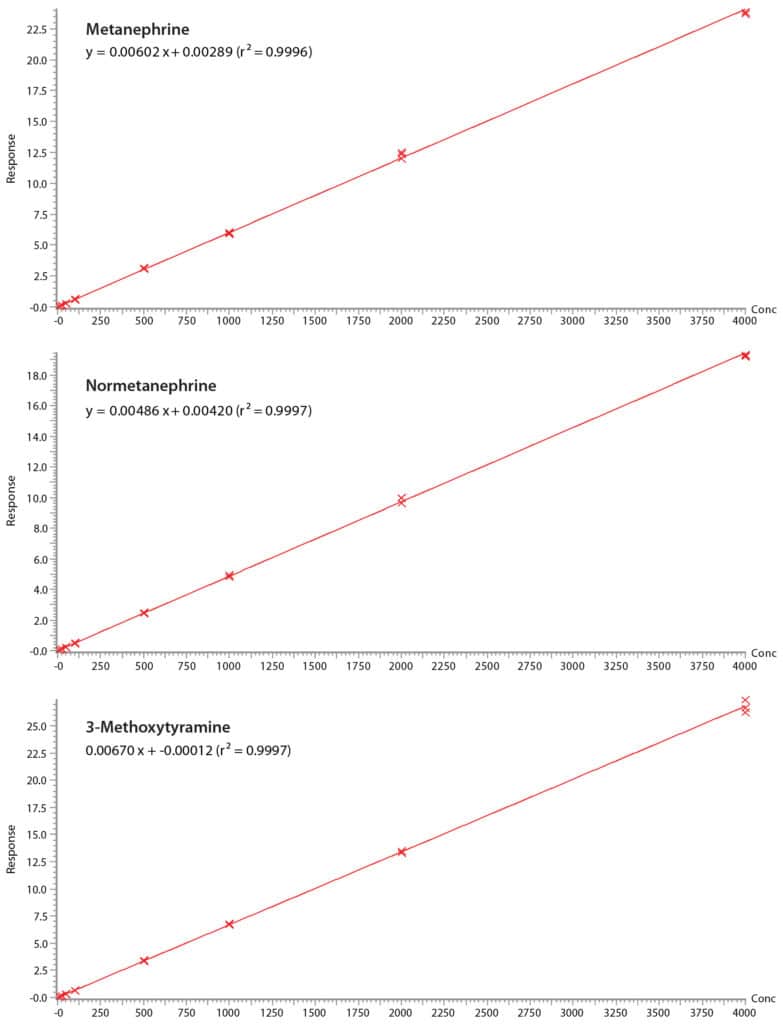
Using 1/x weighted linear regression, all three analytes showed acceptable linearity with r2 values of 0.999 or greater, and deviations of <10% (Figure 5). The established limits of quantitation (LOQ) were 0.051 nmol/L (10 pg/mL), 0.14 nmol/L (24 pg/mL), and 0.060 nmol/L (10 pg/mL) for metanephrine, normetanephrine, and 3-methoxytyramine, respectively.
Accuracy and Precision
Precision and accuracy testing was performed on three different days. Method accuracy was demonstrated by recovery values that were within 5% of the nominal concentration for all QC levels. The %RSD was 0.2-4.5% and 1.1- 4.2% for intraday and interday comparisons, respectively, indicating good method precision (Table II).
Table II: Accuracy and Precision of QC Samples for the Analysis of Metanephrines in Plasma
| Analyte | QC Level 1 (40 pg/mL) | QC Level 2 (400 pg/mL) | QC Level 3 (2,500 pg/mL) | ||||||
| Average Conc. (pg/mL) | Average Accuracy (%) | %RSD | Average Conc. (pg/mL) | Average Accuracy (%) | %RSD | Average Conc. (pg/mL) | Average Accuracy (%) | %RSD | |
| Metanephrine | 39.5 | 98.7 | 3.39 | 411 | 103 | 1.10 | 2,480 | 99.2 | 2.89 |
| Normetanephrine | 39.3 | 98.2 | 4.21 | 401 | 100 | 1.92 | 2,440 | 97.3 | 2.34 |
| 3-Methoxytyramine | 40.0 | 100 | 1.81 | 407 | 102 | 2.07 | 2,470 | 98.9 | 2.02 |
Conclusion
As demonstrated here, using HILIC for the analysis of metanephrines in plasma is a viable approach that provides excellent method performance at clinically relevant concentrations. The Raptor HILIC-Si column ensures good retention of metanephrine, normetanephrine, and 3-methoxytyramine, which is generally difficult to achieve at low detection limits using reversed-phase chromatography. Accurate results were consistently obtained without matrix interference even at trace levels. With a fast, simple sample preparation procedure and 5-minute analysis time, the established method provides a reliable high-throughput assay for the clinical diagnosis of pheochromocytoma and paraganglioma.
Prodotti Menzionati
Autori