
I completed my winter internship at Restek and my main task was to expand the Pro-EZGC libraries. So I created a library for Nitrosamines on the Rxi-1301Sil MS and while acquiring data we noticed a foot on a couple of my peaks.
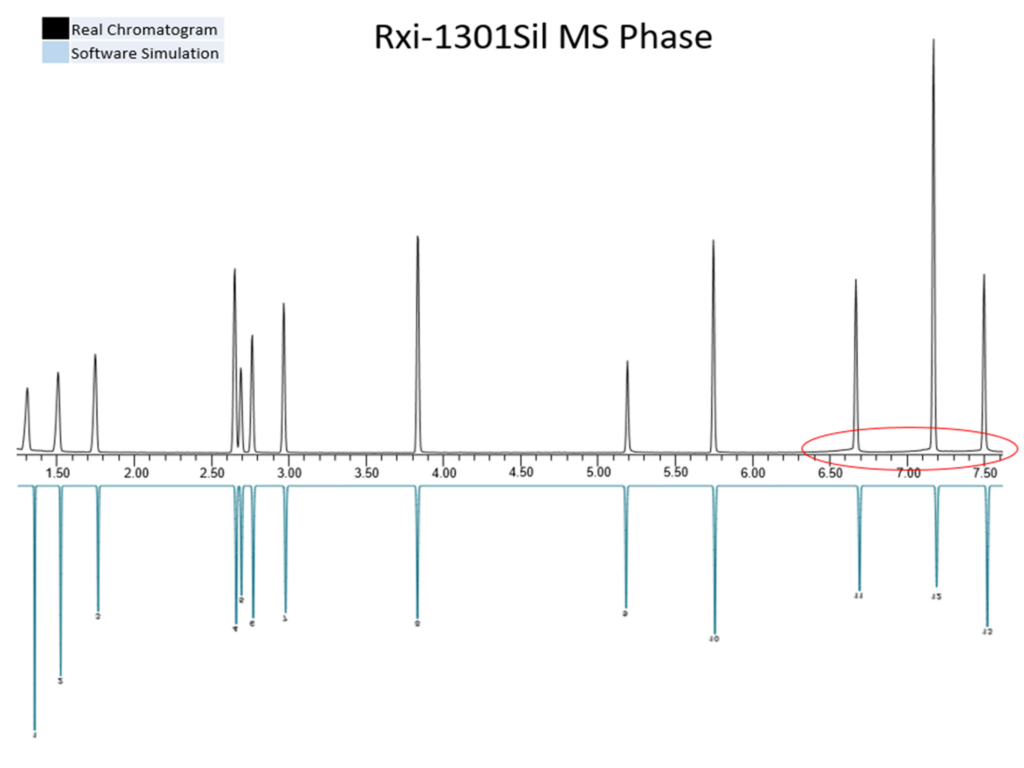
Figure 1: On-column breakdown can be observed for the late eluting nitrosamine compounds as indicated by the foot at the leading edge of the peak.
I attempted to translate the simulation to a column with the same phase but with a thicker film. Since the Rxi-624Sil MS and Rxi-1301Sil MS are the same stationary phase I modeled a run with the Rxi-1301Sil MS Library using the column dimensions of an Rxi-624 Sil MS. As I ran the conditions provided by EZGC we noticed a strange rise of the baseline.
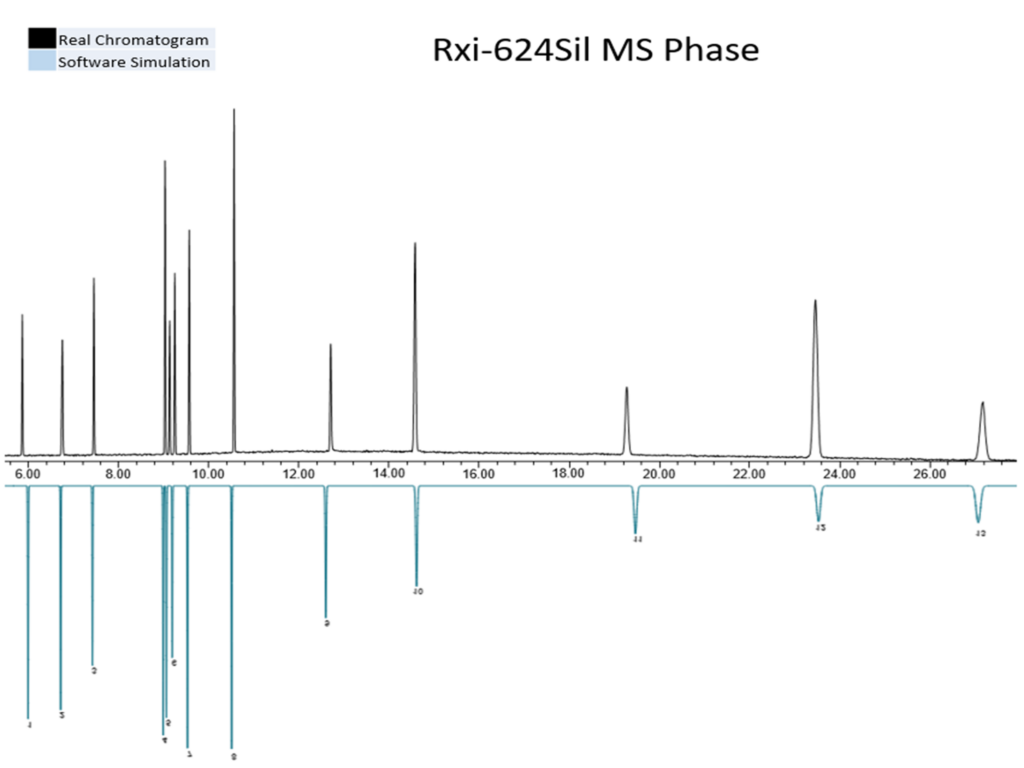
Figure 2: Rise in the baseline is observed which is most likely caused by analyte breakdown on-column. Breakdown components remain in the stationary phase and are observed as carryover.
One of my colleagues immediately suggested that the nitrosamines could break down as a function of elution temperature. In order to test this theory I prepared three different run conditions with different elution temperatures for the late eluting nitrosamines on the Rxi-624 Sil MS:
| Low Temp | Heatrate | Temp. | Holdtime |
|---|---|---|---|
| Start | 35 °C | 1 min. | |
| Ramp | 20 °C/min. | 225 °C | 18 min. |
| Constant Flow | Flowrate: 1.4 mL/min. | ||
| Middle Temp | Heatrate | Temp. | Holdtime |
|---|---|---|---|
| Start | 35 °C | 1 min. | |
| Ramp | 20 °C/min. | 250 °C | 9 min. |
| Constant Flow | Flowrate: 1.4 mL/min. | ||
| High Temp | Heatrate | Temp. | Holdtime |
|---|---|---|---|
| Start | 35 °C | 1 min. | |
| Ramp | 20 °C/min. | 280 °C | 4 min. |
| Constant Flow | Flowrate: 1.4 mL/min. | ||
Figure 3: Adjusting the final hold changes the elution temperature of the last three compounds. If the compound response drops as elution temperature increases it will support our theory of on-column breakdown.
These are the compounds I used (sorted by elution order):
| Name | Abbreviation | |
|---|---|---|
| N-Nitrosodimethylamine | NDMA | |
| N-Nitrosomethylethylamine | NMEA | |
| N-Nitrosodiethylamine | NDEA | |
| N-Nitrosodipropylamine | NDPA | |
| N-Nitrosomorpholine | NMOR | |
| N-Nitrosopyrrolidine | NPYR | |
| N-Nitrosopiperidine | NPIP | |
| N-Nitrosodibutylamine | NDBA | |
| N-Nitrosodiethanolamine | NDELA | |
| N-Nitrosodiphenylamine | NDPhA | |
| N-NitrosoNorNikotine | NNN | |
| N-Nitrosodibenylamine | NDBzA | Peak Labeled as 1 |
| N-Nikotin-NitrosaminoKetone | NNK | Peak Labeled as 2 |
| N-Nitrosodi-iso-propanolamine | NDIPLA | Peak Labeled as 3 |
Figure 4: List of nitrosamines found in the chromatogram where the last three compounds are labeled as 1 2 and 3.
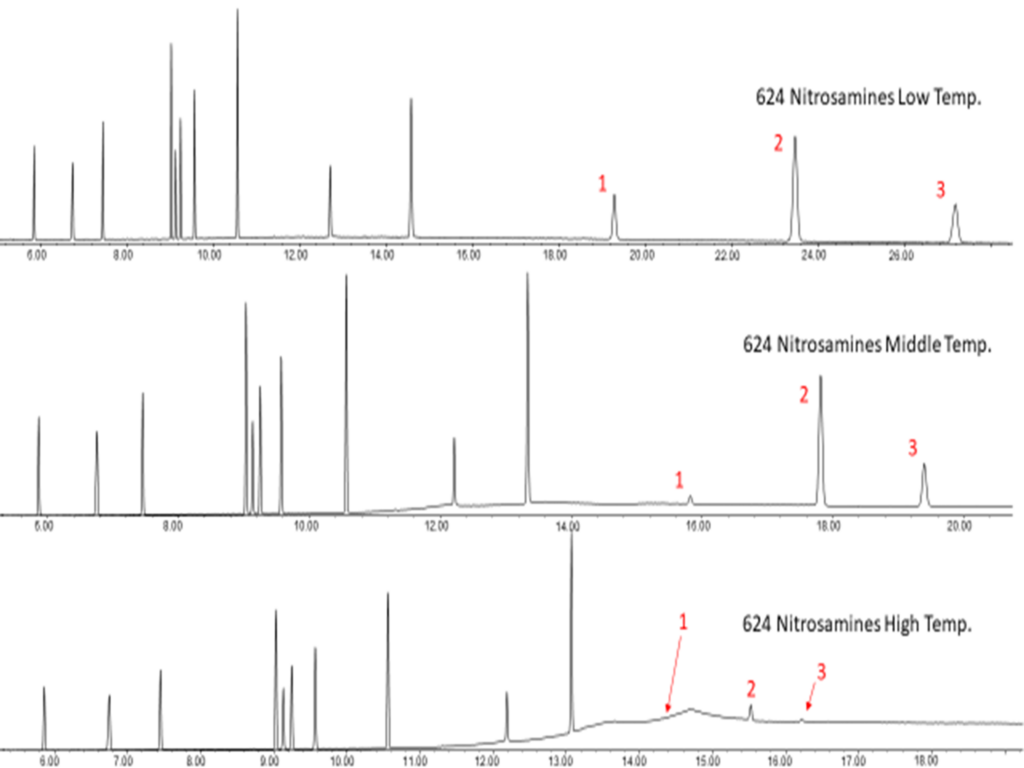
Figure 5: Three chromatograms illustrating the three different programs with increasing elution temperature of the last three nitrosamines. Notice the significant increase in breakdown.
I labeled the last three peaks; the ones that break down appear to have the most activity on-column. Thanks to the MS I was still able to determine the retention times and it became evident that the breakdown increases with higher elution temperature. Was this a general problem with these compounds on this phase or was this specific to the Restek column?
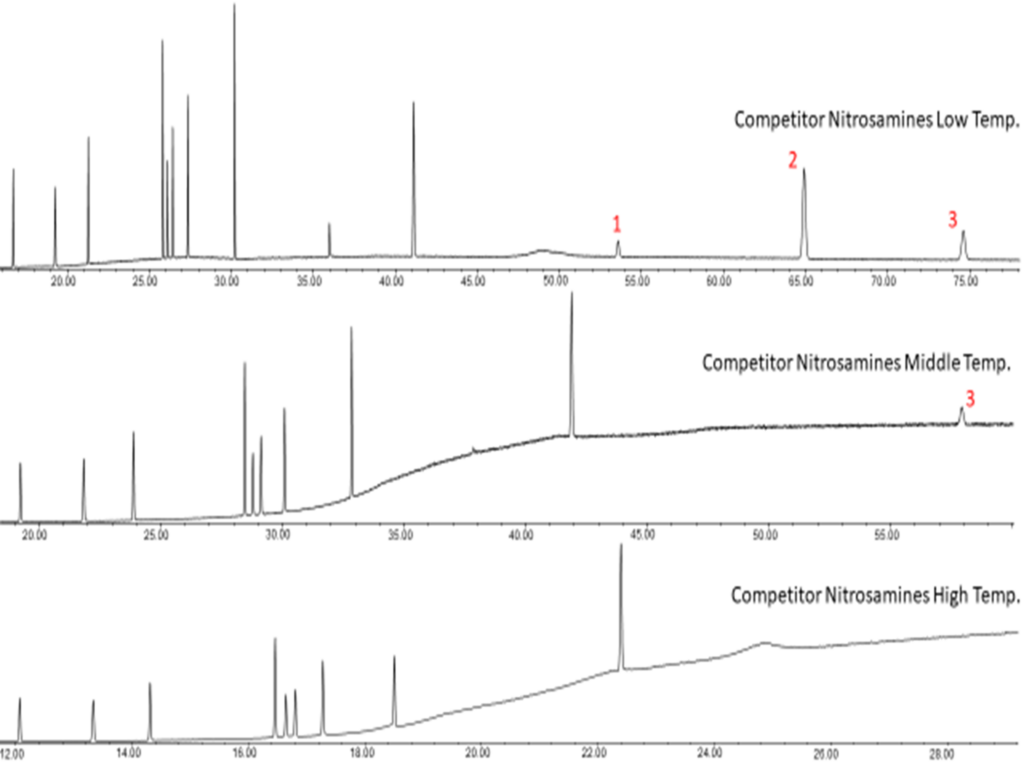
Figure 6: Chromatograms with three different oven conditions. The last three nitrosamines have increasing elution temperatures from top to bottom. These chromatograms were performed on a competitor column to verify the on-column breakdown is most likely related to the cyano stationary phase and not specific to a manufacturer.