



Chromatograms are like fingerprints. If you can “read” chromatograms well, you often can find a plausible cause. In this series, we will show a series of GC-chromatograms that are obtained from users and discuss some potential causes for the phenomena. Then we can move into some solutions for improvement.
Direct injection is often used if low levels of volatile components have to be analyzed in a higher boiling matrix. The main peak will elute later then the components, so we cannot use splitless injection. Direct injection is always a challenge as here a relative big injection-error is made. If the conditions are not optimized, one can get a chromatogram as shown in fig.1. Here the matrix is water which complicates the injection. Important is to minimize the band broadening during injection.
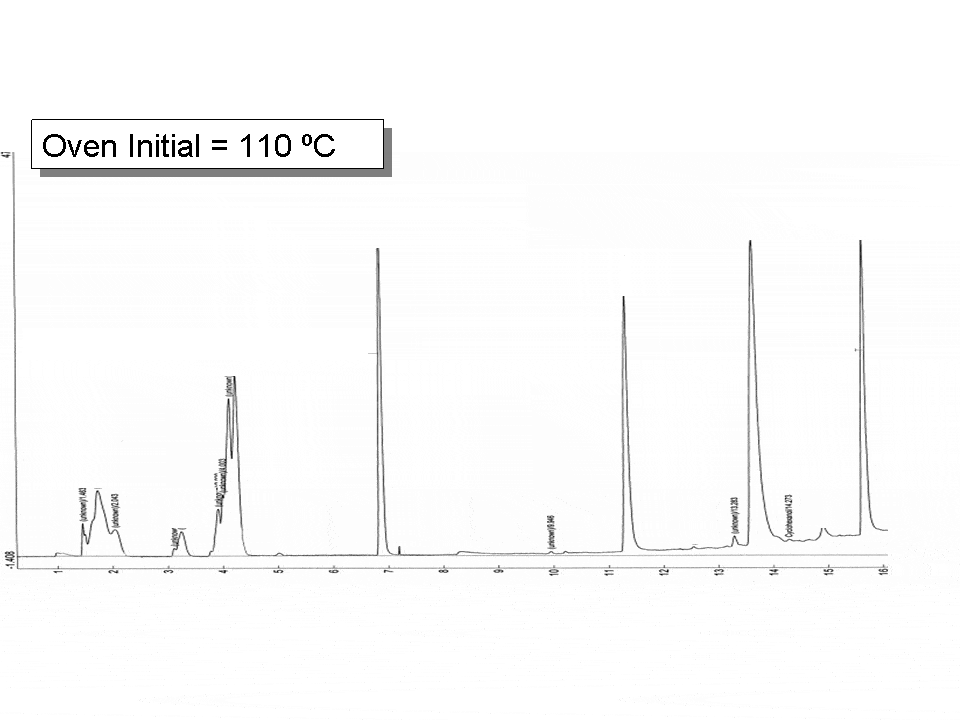
Fig 1 Broadened early eluting peaks due to poor focusing
Conditions for a good direct injection:
- Using smallest injection amount;
- Inject fast;
- Use wide bore columns with high retention;
- Use a uniliner (see fig.2) for most ideal gas path.
- Find the best oven temperature to start the analysis;
See also: “Direct injection.. when do we use this?“
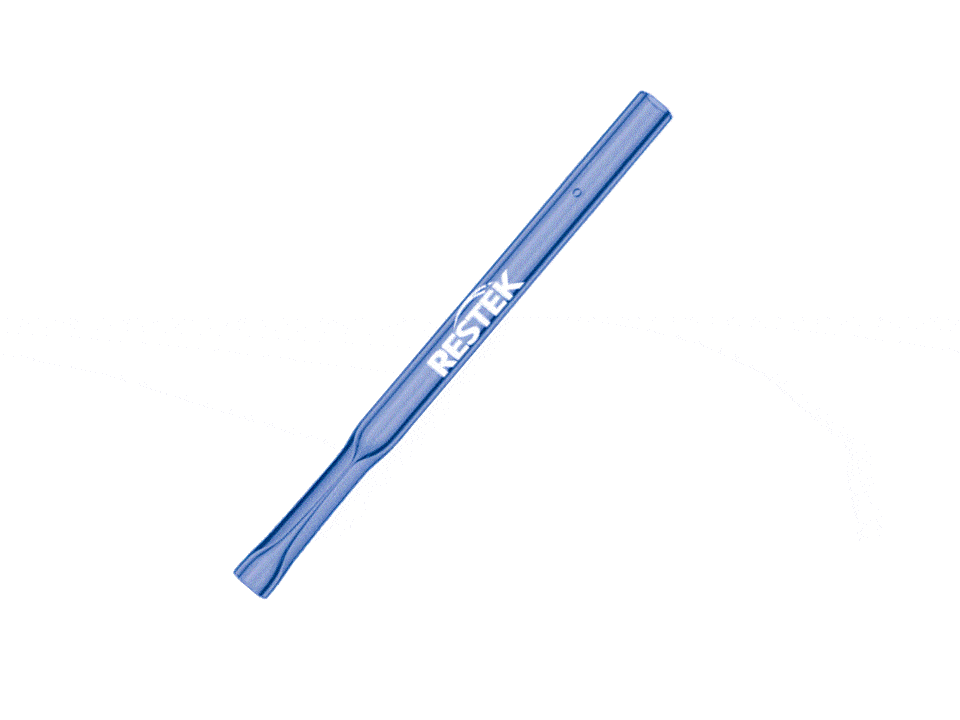
Fig. 2 Uniliner for Direct Injection
To get sufficient focusing of the early eluting compounds one need to find a compromise between initial oven temperature and retention of the stationary phase. Usually high retentive phases (thick films or PLOT’s) will have a good focusing effect, and result in sharp peaks.
The additional advantage is, that the starting temperature can be relative high, so there is reduced risk for the matrix to condense, which helps the chromatography.
Fig. 1 was using a 30m x 0.53mm Rt-Q BOND where oven temperature was 110C for 20 s, followed by a program ballistic to 130ºC, → 250ºC @ 10ºC/min
Under these conditions there is little focusing for volatiles happening which results in broadened peaks. The later eluting peaks are focused and sharp.
By reducing the oven temperature to 80 C and using the same program, the focusing improved significantly, resulting in good peaks for early eluting compounds, see fig. 3.
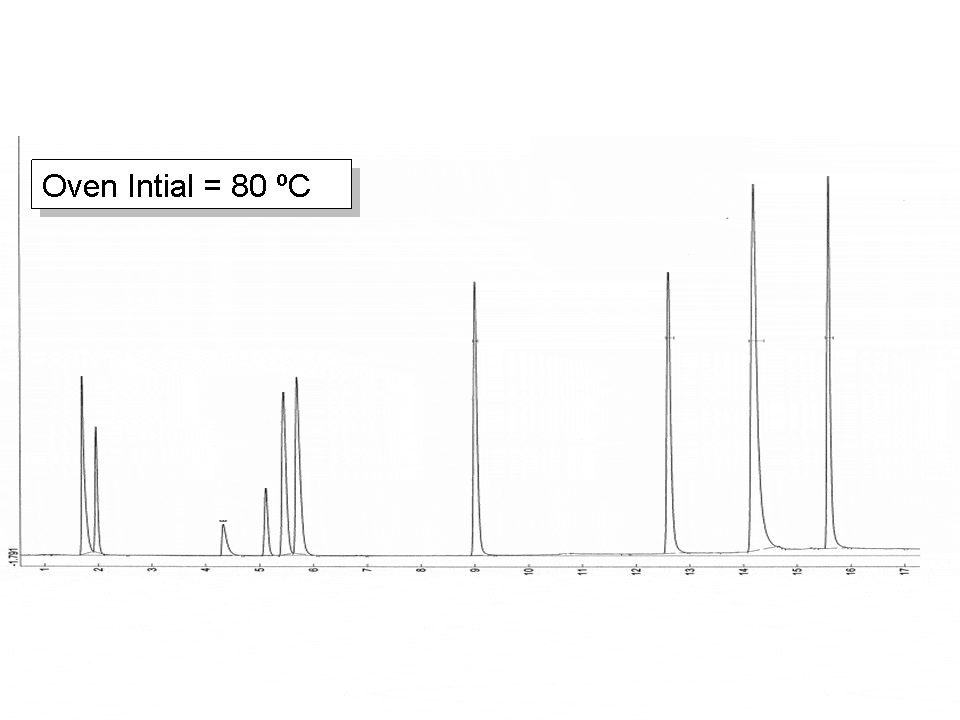
Fig 3 dropping oven temp to 80C makes good focusing possible using water as matrix
By using a divinyl benzene porous polymer, the hydrophobicity also helps to make the water peak move very fast, so it has minimal impact on the retained analytes.
Installation of a column with the uniliner , Fig 2, remains a challenge as this connection is made inside the injection port.
Figure 4 shows an other procedure to install a uniliner.
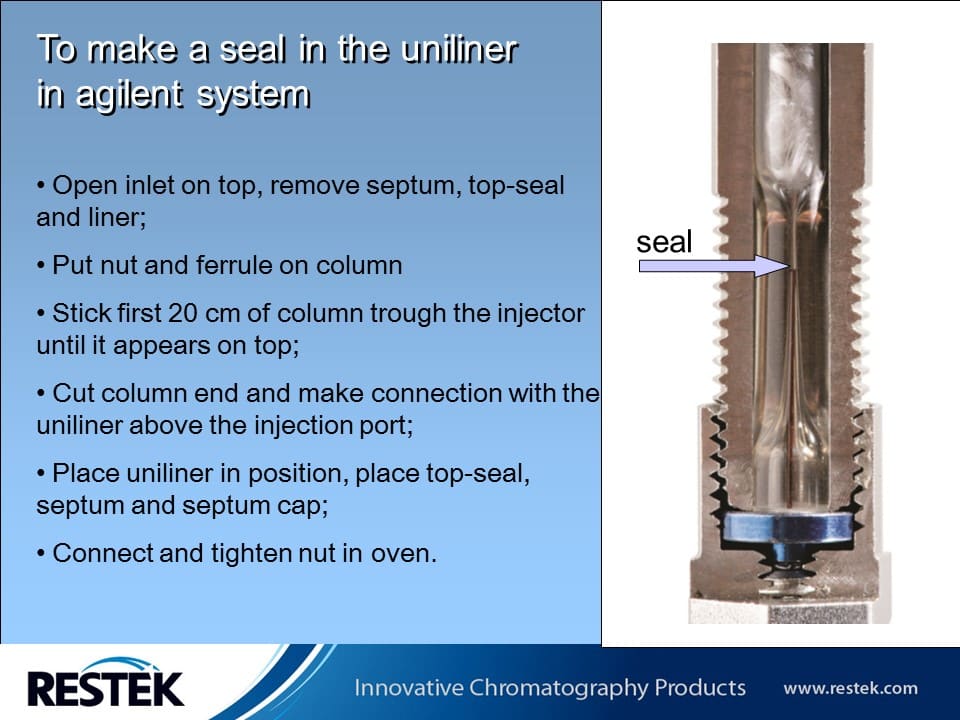
For some systems, like Agilent, the uniliner must have a “hole” on the side of the liner, in order to make the EPC work. This “hole can be on top or on the bottom. For Direct injections, it is preferred to use the hole on the top