


It’s time to dive back into analyzing terpenes! Previously, we looked at two types of sample preparation for analyzing terpenes via HS-Syringe and HS-SPME.
Terpene Analysis Approaches – Part I
Terpene Analysis Approaches – Part II
In my last blog, I showed that HS-SPME outperformed the HS-Syringe when analyzing terpenes. The responses that were obtained for each terpene were improved, especially the sesquiterpenes. In addition, we also saw lower %RSDs for run-to-run variability, which increased my confidence in the HS-SPME technique. So, you are probably wondering, “what’s next?” Now, we are going to expand our work with SPME, but use the fiber in a different mode. Before we used the fiber in HS mode and now we are comparing to Direct Immersion (DI) mode. For those unfamiliar with DI-SPME, this involves completely immersing the fiber phase into the liquid sample so the analytes of interest absorb/adsorb into/onto the fiber (see Figure 1). DI-SPME will stress the fiber more since the phase can swell and is exposed to the sample matrix which could lead to contamination. However, while this can stress the fiber coating more than HS, we will gain a better profile of our sample; especially for analytes that do not easily partition into the gaseous phase of the vial, like our sesquiterpenes.
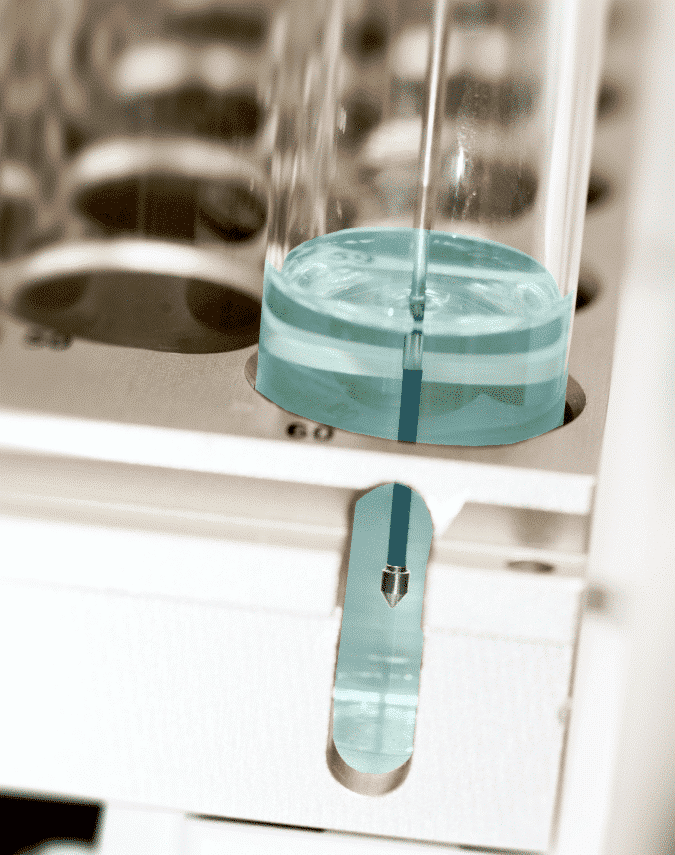
Figure 1. Example of SPME Arrow in Direct Immersion (DI) mode.
Finally, the moment you’ve been waiting for, let’s look at the comparison between HS-SPME and DI-SPME under the same SPME conditions that were used in the previous blogs (see Figure 2).
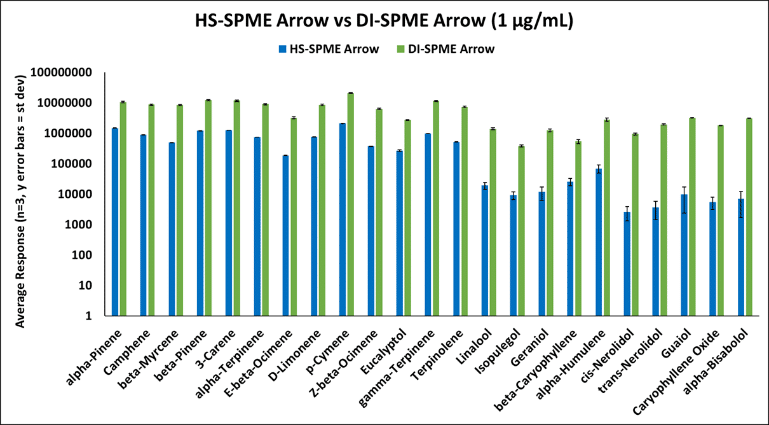
Figure 2. Terpene response comparison between HS-SPME (blue) and DI-SPME (green).
Note that this comparison is on a logarithmic scale. At first glance, it can easily be seen that DI dominates HS when looking at the responses for each compound. If you look closer though, you will notice the error bars that represent the standard deviation over three replicate injections are much better for DI than HS. In HS mode, %RSDs for compound response variation over the three runs were as high as 75%, while they were below 15% for each compound in DI mode. After seeing these results, my mind was made up. Anyone who wants to achieve good results for the sesquiterpenes in their samples should be looking for alternatives to HS since this technique does not produce reliable results when simply analyzing standard samples. This makes sense given the vapor pressures of the later eluting terpenes. Moving to in-matrix analysis for HS will make this even more challenging because we could encounter matrix interactions that lead to analyte suppression! Keep in mind this work was only done with standards in water. In-matrix analysis has yet to be evaluated for DI…or has it!? Better stay tuned for our next installment in this terpene series!