


So let us recap this multi-blog series on relative humidity (RH):
Part I – We learn what is RH and why do we care about it when sampling/analyzing whole air canister samples for volatile organic compounds (VOCs).
Part II – We learn how to calculate the theoretical % RH in a canister.
Part IIIa – We learn how to generate a humidified blank by direct injection of DI water.
Now… time for me to show you (in the following VIDEO) how I prefer to humidify my blanks and standards with the use of our humidification chamber (catalog # 24282) and vacuum/pressure gauge (catalog # 24285):
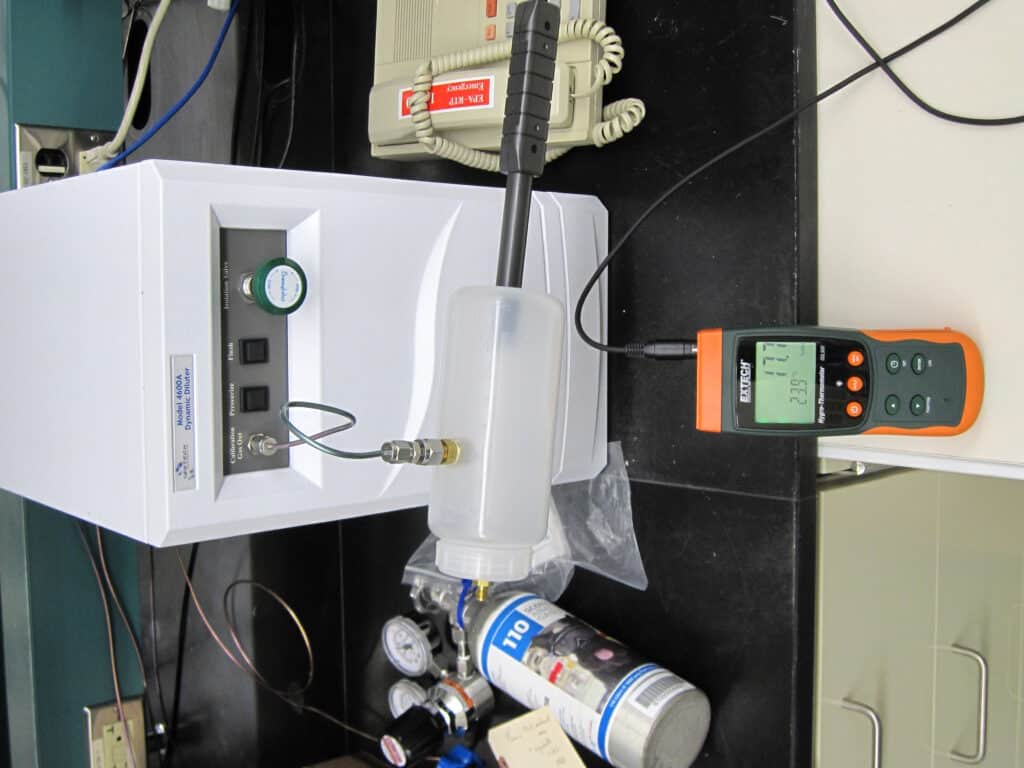
One very important part I left out on the video: Be very careful if you are relying on your dynamic diluter to generate your humidified blanks and/or standards. Some diluters do not even come equipped with a humidification chamber. While other diluters have a humidification chamber; however, the effluent gas stream may not be reaching the RH levels you are trying to achieve. For example: One customer was shocked to see that their gas stream was only reaching 18% RH @ a 1 L/min flow rate and only 12% RH @ a 5 L/min flow rate (see picture below… you should recognize my equilibration chamber and Extech hygrometer). Now… 18% RH may not be that bad… if your samples are coming from the Gobi Desert. However, if you want to obtain higher RH levels with such a diluter you will need to supplement your blanks/standards with a direct shot of DI (as shown in Part IIIa) prior to hooking up to your diluter.
Stay tuned for part IV where I finally show you why I am making such a big deal about RH!