

Recently we have seen a rise in the number of “legal” botanicals on the market. One such psychoactive plant is Kratom, which is becoming a growing public health concern. [1] Not only is this popular because of its stimulant and opioid-like effects but it is also easy to purchase. Due to the lack of federal regulation, kratom products are easily purchased from specialty stores, such as gas stations or vape shops. Our previous blog, Everything You Ever Wanted to Know About Kratom, does a great job of describing kratom and its two commonly found psychoactive substances. As described in the blog, kratom has been used for medicinal purposes for centuries, so why is the federal government getting involved now?
According to the Morbidity and Mortality Weekly Report published by the CDC, from 2015 to 2025, the National Poison Data system data documented an increase of approximately 1,200% in kratom-related exposure reports. [1] This report comes almost a year after the FDA took “a bold step to protect Americans from dangerous, illegal opioids by recommending a scheduling action to control certain 7-hydroxymitragynine (also known as 7-OH) products under the Controlled Substances Act (CSA).” [2]
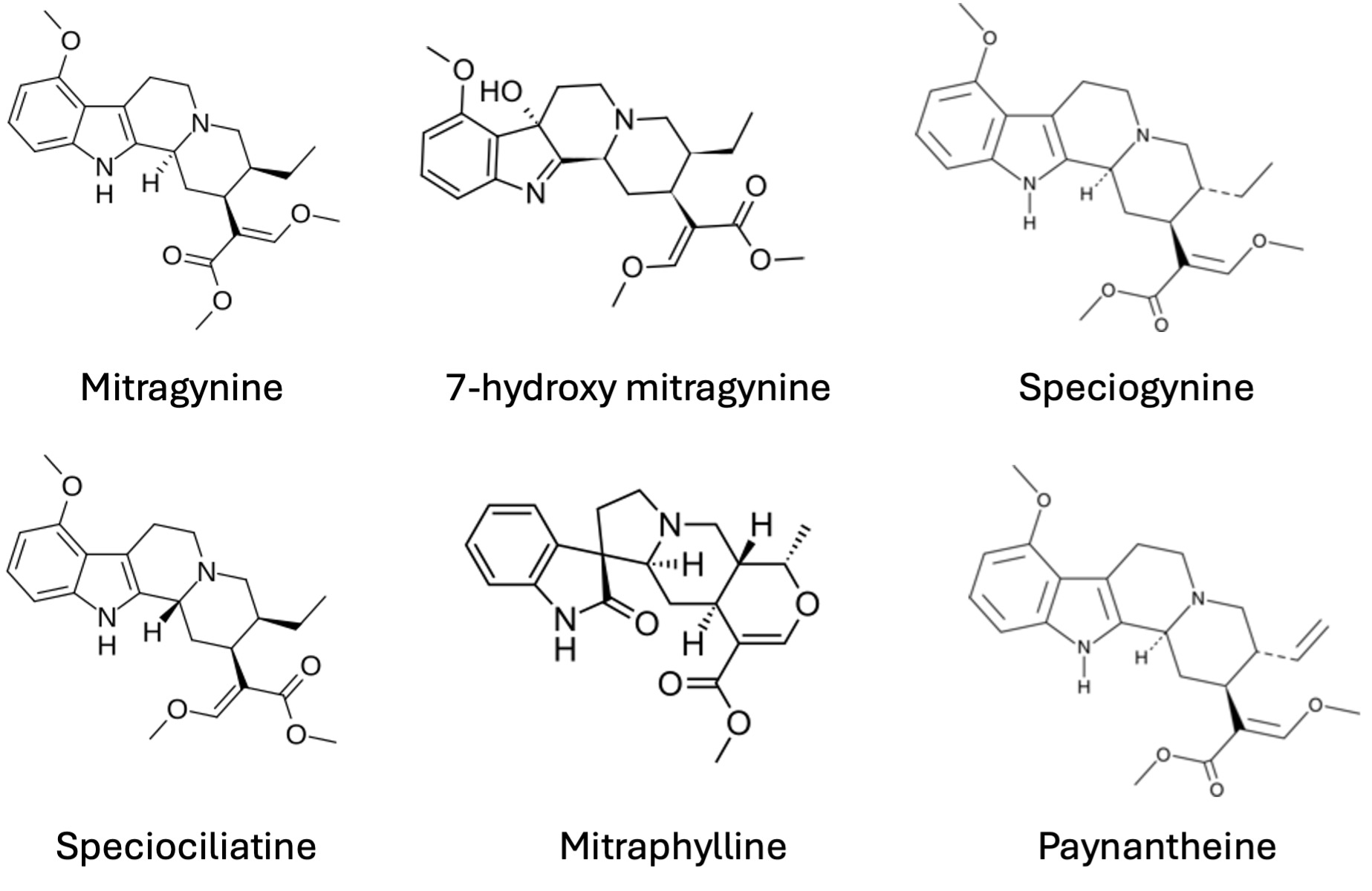
But are 7-OH mitragynine and mitragynine the only two bioactive compounds to monitor? In short, the answer is no. Like many other matrices, just because you’re not monitoring it doesn’t mean it’s not there. Ensuring all analytes are fully resolved is the key to a good method. Depending on the strain of kratom, there are many additional alkaloids that should potentially be monitored. Some additional alkaloids include speciogynine, speciociliatine, mitraphylline, and paynantheine. What are these compounds effects on the body, and what is the best way to monitor them?
What are the compounds functions?
Mitragynine is the primary alkaloid responsible for kratom’s effects. In low doses it acts as a stimulant providing energy and focus. However, at mid-to-high doses, it provides analgesic and anxiolytic (antianxiety) relief. [4] The effects of mitragynine are modulated though opioid receptors, non-opioid receptors, and neurotransmitters, resulting in a complex pharmacological profile. Due to these interactions in the body, it can be habit-forming when used repeatedly. [3]
7-hydroxy mitragynine is 13 times stronger than morphine and 46 times stronger than mitragynine. It is known to be used as a pain reliever. This alkaloid is considered to be fast-acting due to the hydroxy group, this likely contributes to the fast-acting effects it has on the body. [3]
Speciociliatine is typically the second most abundant alkaloid in the kratom plant, often acting as an analgesic, by lowering acetylcholine levels. [3]
Speciogynine can vary in concentration over time as the plant matures. While less potent than mitragynine and 7-OH, it’s thought to play a role in synergistic effects by exhibiting many of the same pharmacological effects as the other compounds present in kratom. [3]
Mitraphylline has significantly less studies around it, but more recently is being studied for its anti-inflammatory properties and anticancer studies. [3]
Paynantheine calms and reduces muscle actively, specifically in the intestinal tract, thereby blocking signals that would normally make the intestine contract. [3]
Paynantheine, speciociliatine, and speciogynine all use a non-opioid pathway making them naloxone insensitive. Meaning, naloxone, often known by its brand name Narcan, cannot stop or reverse this effect. [3] The synergistic effects and lack of effective “antidote” for these compounds readily attribute to an overdose.
How can we analyze them?
The most cost-effective, user-friendly and robust way to monitor these compounds is using High-Performance Liquid Chromatography with Ultraviolet detection (HPLC-UV). A 10-minute isocratic method was developed using Restek’s Force Inert Biphenyl column.
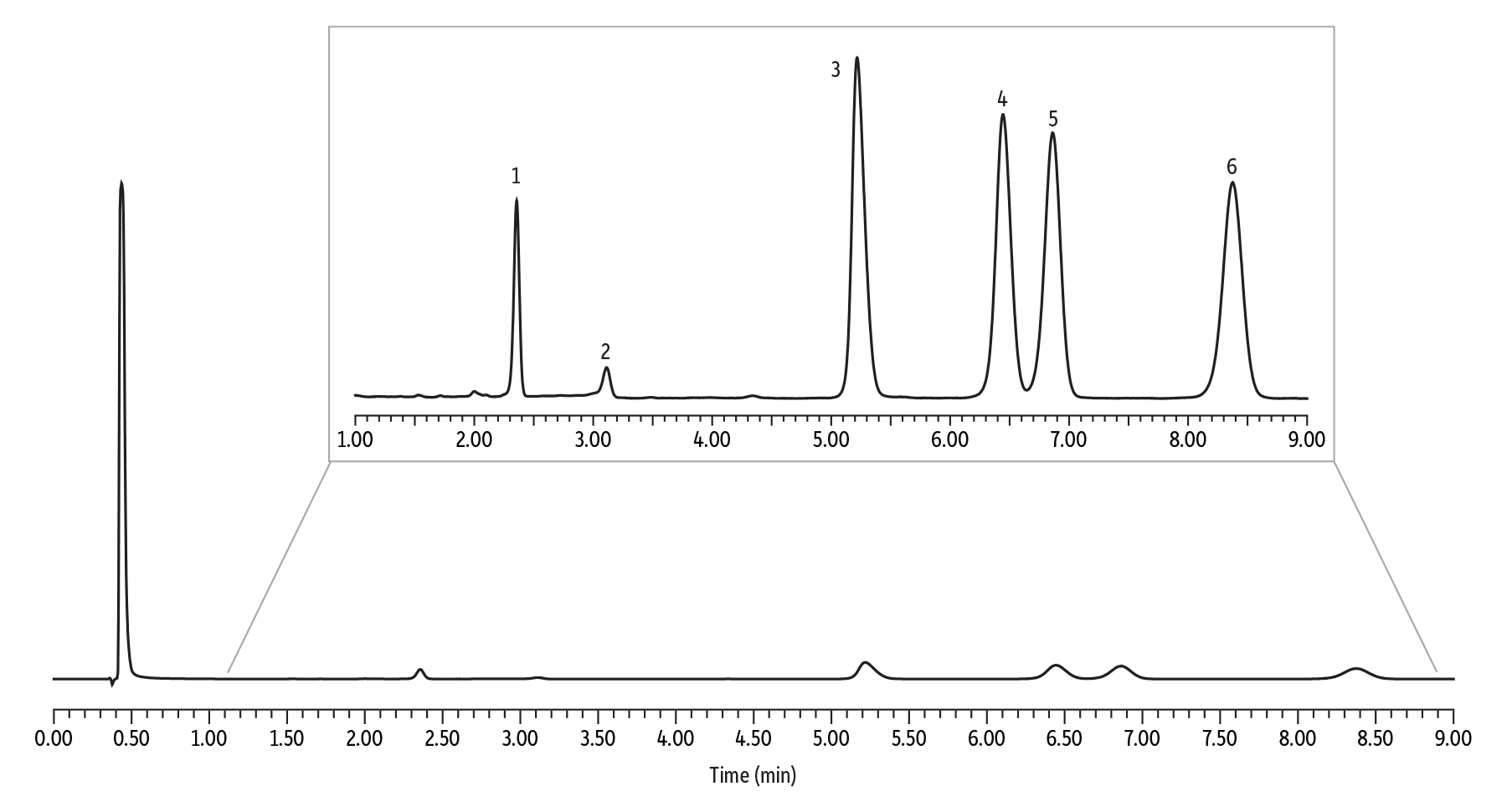
LC_FF0638
Peaks
| Peaks | tR (min) | |
|---|---|---|
| 1. | Mitraphylline | 2.35 |
| 2. | 7-OH Mitragynine | 3.10 |
| 3. | Speciociliatine | 5.13 |
| 4. | Speciogynine | 6.39 |
| 5. | Paynantheine | 6.85 |
| 6. | Mitragynine | 8.35 |
Conditions
| Column | Force Inert Biphenyl (cat.# 962931E-T) | ||||||||||||
|---|---|---|---|---|---|---|---|---|---|---|---|---|---|
| Dimensions: | 100 mm x 3.0 mm ID | ||||||||||||
| Particle Size: | 3 µm | ||||||||||||
| Pore Size: | 100 Å | ||||||||||||
| Temp.: | 40 °C | ||||||||||||
| Standard/Sample | |||||||||||||
| Diluent: | 50:50 Water:acetonitrile | ||||||||||||
| Conc.: | 50 ppm | ||||||||||||
| Inj. Vol.: | 2 µL | ||||||||||||
| Mobile Phase | |||||||||||||
| A: | Water, 20 mM ammonium acetate (pH 6.8) | ||||||||||||
| B: | Acetonitrile | ||||||||||||
|
| Detector | UV-Vis @ 222 nm |
|---|---|
| Flow Cell Size: | 500 nL |
| Instrument | Waters ACQUITY UPLC H-Class |
| Sample Preparation | Standards, 50 ppm, were prepared in a 2.0 mL amber, short-cap vial (cat.# 21142) containing 50:50 water:acetonitrile diluent and capped with a 9 mm short cap (cat.# 24497) |
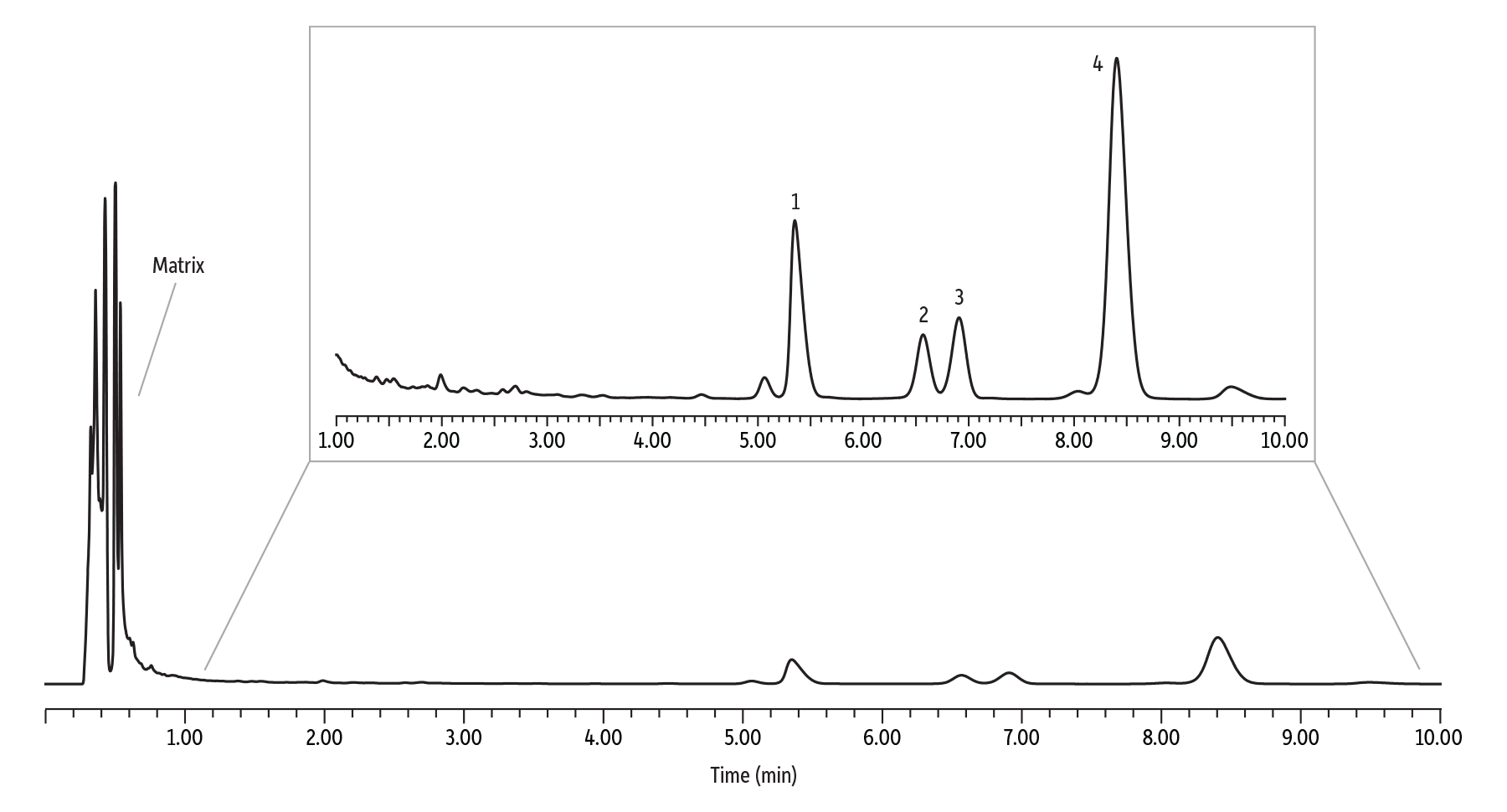
LC_FF0637
Peaks
| Peaks | tR (min) | Conc. (wt.%) | |
|---|---|---|---|
| 1. | Speciociliatine | 5.14 | 3.26 |
| 2. | Speciogynine | 6.41 | 1.38 |
| 3. | Paynantheine | 6.84 | 1.82 |
| 4. | Mitragynine | 8.29 | 9.65 |
Conditions
| Column | Force Inert Biphenyl (cat.# 962931E-T) | ||||||||||||
|---|---|---|---|---|---|---|---|---|---|---|---|---|---|
| Dimensions: | 100 mm x 3.0 mm ID | ||||||||||||
| Particle Size: | 3 µm | ||||||||||||
| Pore Size: | 100 Å | ||||||||||||
| Temp.: | 40 °C | ||||||||||||
| Standard/Sample | Endogenous levels | ||||||||||||
| Diluent: | 50:50 Water:acetonitrile | ||||||||||||
| Inj. Vol.: | 2 µL | ||||||||||||
| Mobile Phase | |||||||||||||
| A: | Water, 20 mM ammonium acetate (pH 6.8) | ||||||||||||
| B: | Acetonitrile | ||||||||||||
|
| Detector | UV-Vis @ 222 nm |
|---|---|
| Flow Cell Size: | 500 nL |
| Instrument | Waters ACQUITY UPLC H-Class |
| Sample Preparation | Kratom powder, 1000 mg, was weighed into a 15 mL centrifuge tube and diluted with 10 mL of a 50:50 mixture of water:methanol. The sample was vortexed for 10 min at 1000 rpm, followed by centrifugation for 5 min at 3000 rpm. A 250 µL sample was aliquoted into a 2.0 mL amber, short-cap vial (cat.# 21142) containing 750 µL of 50:50 water:acetonitrile and capped with a 9 mm short cap (cat.# 24497). |
| Notes | Concentration was calculated using a 5-point calibration curve (5-250 µg/mL) prepared from sourced reference standards. |
Bottom Line
The widespread availability makes the consumption of kratom difficult to control. Products sold in common retail locations, like gas stations or vape shops, may provide a false feeling of safety based upon over-the-counter (OTC) availability, but little is known about dosages and contents since legality is a topic of debate. However, federal and state regulations are constantly changing, and to stay relevant, labs will need to continually adapt to accurately identify the content of kratom products to ensure consumer safety.
References and Resources
- E.B. Towers, Y.T. Thomas, C.P. Holstege, R. Farah, Increases in kratom-related reports to poison centers–National Poison Data System, United States, 2015-2025, Centers for Disease Control and Prevention, Morbidity and Mortality Weekly Report, 75 (11) (2025). https://www.cdc.gov/mmwr/volumes/75/wr/mm7511a1.htm
- U.S. Food and Drug Administration, FDA takes steps to restrict 7-OH opioid products threatening American consumers, FDA News Release, July 29, 2025. https://www.fda.gov/news-events/press-announcements/fda-takes-steps-restrict-7-oh-opioid-products-threatening-american-consumers
- W.C. Prozialeck, J.K. Jivan, S.V. Andurkar, Pharmacology of kratom: An emerging botanical agent with stimulant, analgesic and opioid-like effects, J. Am. Osteopath. Assoc., 112 (12) (2012) 792–799. https://pubmed.ncbi.nlm.nih.gov/23212430/
- Kratom.org., Kratom alkaloids: Explaining kratom’s active ingredients, 2026. https://kratom.org/guides/alkaloids/
- America’s Poison Centers, Health advisory: serious illnesses associated with 7-oh use, August 2024. https://poisoncenters.org/news-alerts/13531044
- Los Angeles County Department of Public Health, Multiple fatal overdoses tied to synthetic kratom compound in Los Angeles county, September 2025. http://publichealth.lacounty.gov/phcommon/public/media/mediapubhpdetail.cfm?prid=5139