





最適化が目指したもの
- 次世代TriMax GCカラムの不活性化による、堅牢で極めてニュートラルなサンプルフローパスの実現
- 最大限の対称性による、酸、塩基、中性を含む幅広い半揮発性化合物のピークテーリング低減および、同定と定量の向上
- 最適化されたGC-MS条件による、メソッド基準を満たすことおよびサンプルスループットの向上

最適化においてRMX-5Sil MSカラムが果たす役割
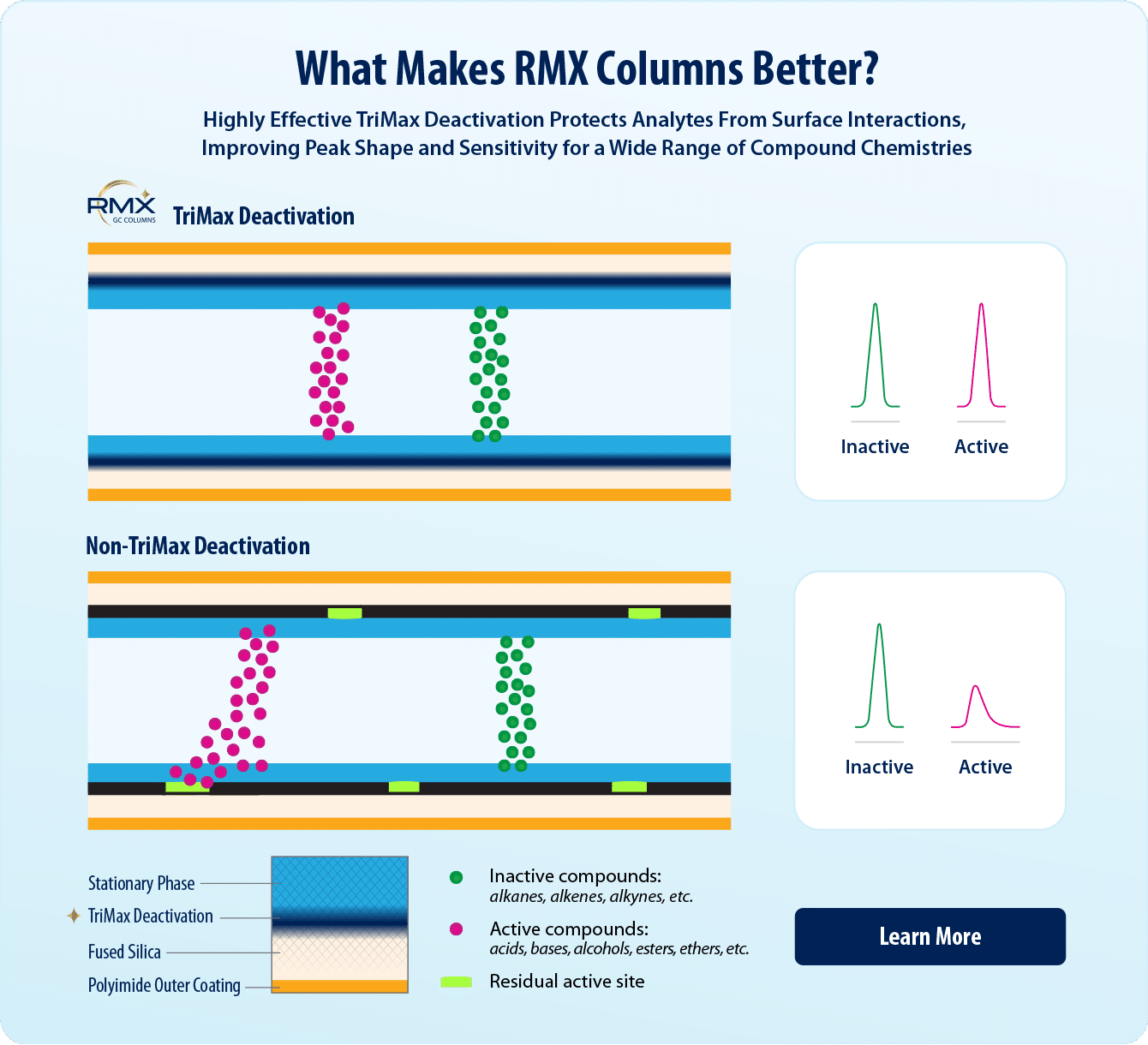
RMX-5Sil MSカラムは、広範囲の半揮発性化合物クラスで幅広い効果を発揮する、非常に不活性な表面を形成する画期的な失活技術を採用しています。本研究では、標準試験法HJ 834-2017のデータ品質基準に照らしてカラムの性能を評価しました。システム適合性、直線性、および回収率に関するメソッド基準は、サンプル分析時間を20分短縮する最適化条件下でも容易に満たされました。
RMX-5Sil MSカラムによる実証実験
半揮発性化合物は、人の健康と環境を守るために世界中でモニタリングされています。分析にはさまざまな検出器が使用されますが、中でもGC-MS法は最も一般的です。中華人民共和国標準試験法HJ 834-2017は、土壌および堆積物サンプル中の半揮発性化合物のGC-MS分析に使用されます。試験室が正確な結果を確実に得られるように、標準試験法HJ 834-2017には、システムの適合性、直線性、回収率などの主要パラメータの基準が規定されています。半揮発性化合物は、反応性化合物を含む幅広い化合物の化学的性質で構成されているため、サンプル流路が非常に不活性であることが不可欠です。フローパス内の活性は、ピーク形状の不良や保持時間のドリフトの原因となり、データ品質の要件を満たすことが難しくなります。
この研究では、非常に不活性なRMX-5Sil MSカラムが標準試験法HJ 834-2017半揮発性化合物分析のデータ品質目標を達成するためにどのように役立つかを実証します。RMX-5Sil MSカラムは、独自のTriMax表面不活性化処理により活性部位(シラノールなど)を除去し、化合物クラスにわたって幅広く効果を発揮します。RMX-5Sil MSカラムは従来の5silポリマーを含有しているため、5silを直接置換することができますが、高中性表面によりさまざまな化合物のピーク形状が改善されるため、データ品質要件を満たすことが容易になります。この研究では、GC-MS半揮発性化合物分析におけるカラムの有効性を実証するだけでなく、ランタイムを短縮し、サンプルスループットを向上させる最適化された装置条件も開発しました。
実証実験の詳細
標準試料およびサンプル調製
多成分の半揮発性化合物標準試料をジクロロメタン中に1、5、10、20、50ppmで調製。内部標準物質とサロゲート標準物質は、各校正標準物質中に40ppmで調製。
分析条件
GC-MSによる半揮発性化合物の分析は、標準試験法HJ 834-2017の条件に従って実施。また、分析時間を短縮するために最適化された条件でも実施。Table I には、両アプローチの分析条件をまとめています。
Table I: GC-MS半揮発性化合物の分析条件
| パラメータ | 標準試験法HJ 834-2017準拠の条件 | 最適化された条件 |
|---|---|---|
| カラム | RMX-5Sil MS, 30 m x 0.25 mm ID x 0.25 µm (cat.# 17323) | RMX-5Sil MS, 30 m x 0.25 mm ID x 0.25 µm (cat.# 17323) |
| 注入 | 1 µL, splitless, 280 °C | 1 µL, splitless, 280 °C |
| キャリヤーガス | Helium at 1 mL/min (constant flow) | Helium at 1 mL/min (constant flow) |
| 昇温 | 35 °C (hold 2 min) to 150 °C at 15 °C/min (hold 5 min) to 290 °C at 3 °C/min (hold 2 min) | 分析を高速化するために昇温条件を変更: 35 °C (hold 1 min) to 290 °C at 8 °C/min to 350 °C at 12 °C/min (hold 5 min) |
| 検出器 | EI; 70 eV; 230 °C source; 150 °C quad; scan 35-450 m/z; solvent delay 5 min; 280 °Ctransfer line | EI; 70 eV; 230 °C source; 150 °C quad; scan 35-450 m/z; solvent delay 2 min; 280 °Ctransfer line |
実証実験の結果および考察
システム適合性
標準試験法HJ 834-2017に従ってDFTPPで装置を調整し、DDTからDDEとDDDへの分解を評価することでシステム適合性を評価しました。DDEとDDDの両方へのDDT分解は1%未満で、15%を超えないという要件は容易に満たされました。
結果の比較が示す分析性能の違い
Figure 1 に示すように、RMX-5Sil MSカラムは、標準試験法HJ 834-2017準拠の条件と最適化されたGC-MS条件の両方で、64種類の監視対象半揮発性化合物、6 種類のサロゲート、および 6 種類の内部標準物質 (合計 76 種類の化合物) について、5 ppm でシャープな対称ピークを示しました。いくつかの共溶出が発生しましたが、これらの化合物はイオンのm/z比によって容易に区別することができました。標準試験法の分析条件下では、良好な結果が得られますが、実行時間が60分を超えるため、分析できるサンプル数が制限されます。最適化された分析条件では、40分という短時間で分析が可能になり、厳しい納期で多くのサンプル分析が必要なハイスループットラボにとって有益です。
Figure 1: 標準試験法HJ 834-2017の分析条件下でのTICクロマトグラム (60分以上)
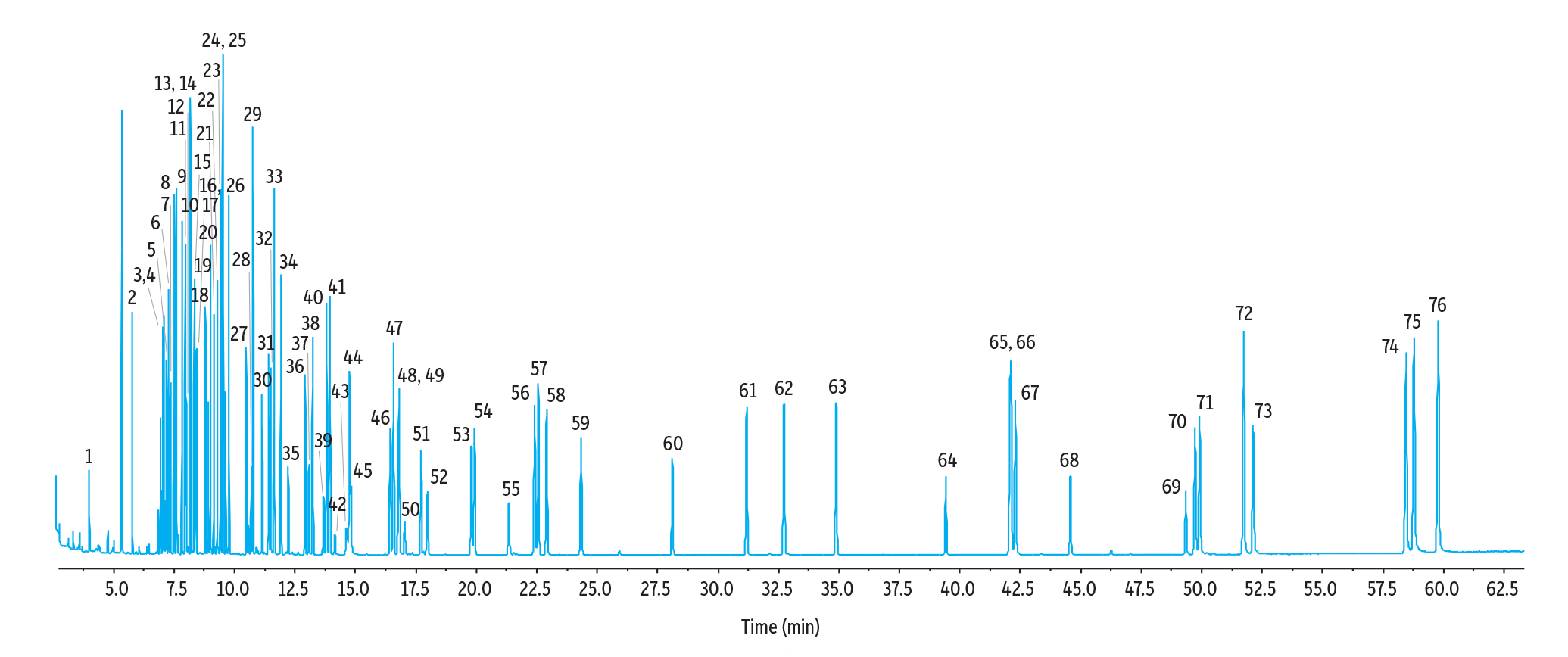
Figure 2: 最適化された分析条件下でのTICクロマトグラム (40分)
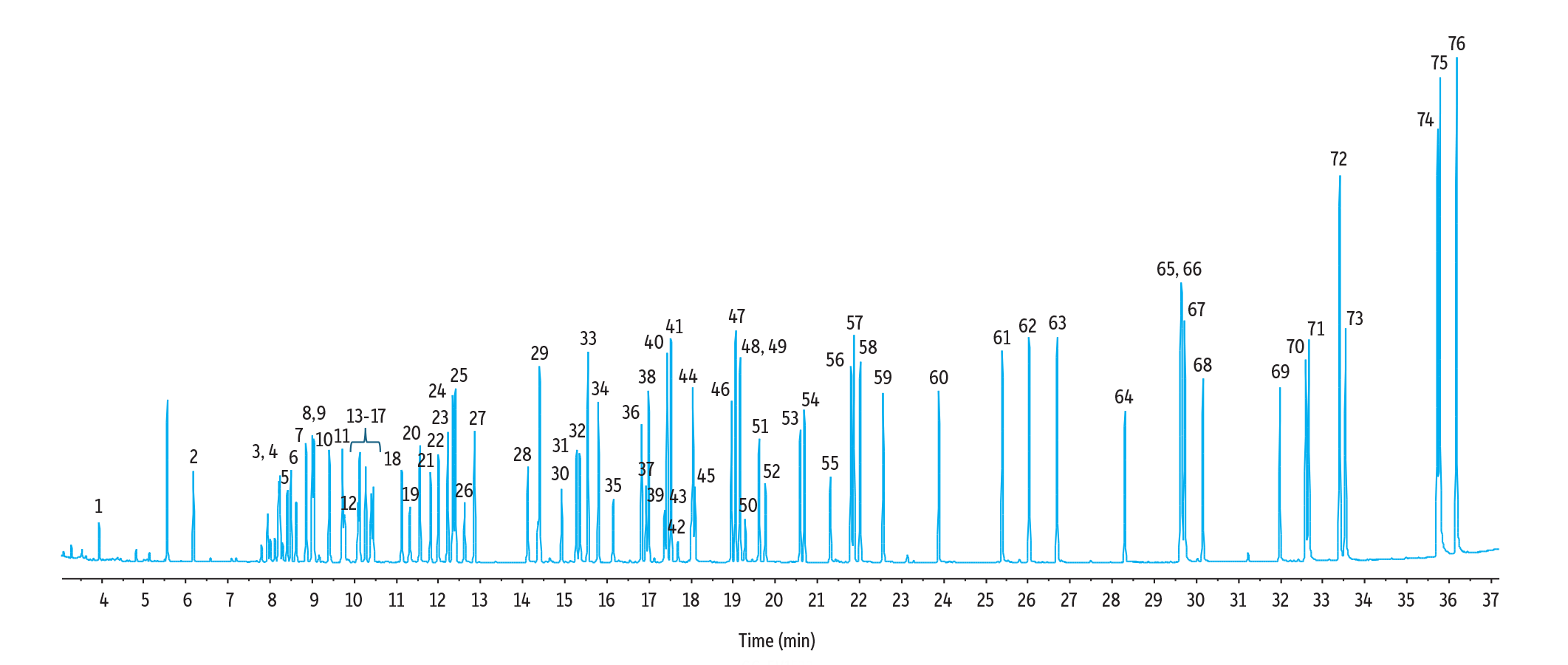
定量分析結果からもわかる高性能
良好なピーク形状によりS/N比が向上するため、低濃度での信頼性の高い積分が可能になり、時間のかかるユーザー介入の必要性が最小限に抑えられます。検量線範囲全体にわたる正確な積分は、困難な反応性化合物であっても、メソッドの性能基準が満たされることを確信させます。メソッドの性能は、直線性(重み付けなし、R>0.990)、相対応答係数(RSD <30%)および中点標準物質の回収率(10 ppmで70~130%の回収率)によって評価されました。
検出限界(LOD)と定量限界(LOQ)はそれぞれ、LOD = 3.3 x 最低検量線点/検量線勾配の標準偏差、LOQ = 10 x 最低検量線点/検量線勾配の標準偏差という一般的に認められた方法で計算し、計算された値はメソッドに記載されているLODおよびLOQ値と比較しました。メソッドの要件では、LODとLOQはサンプル濃度として示されています。この試験ではマトリックスを使用しなかったため、サンプル濃度は理論的なサンプル質量20 g、最終抽出液量1 mLに基づいて抽出液濃度に換算しました(Table II参照)。マトリックスを使用しない場合、カラム性能の差はサンプル調製の有効性から切り離すことができます。
定量分析では、最適化された分析条件を使用してキャリブレーションを実施しました。結果の要約をTable IIに、個々のセミボラチルの値をTable IIIに示します。すべての化合物 (内部標準とサロゲートを除く) は、RRF RSD <30% および R>0.990 の直線性基準に合格しました。RSD値は2.1~22.5%、Rは0.999~1.00の範囲でした。HJ 834では必須ではありませんが、R2もまた評価されました 。この研究では、R2は各化合物で0.995を超え、0.997-1.0の範囲でした 。
Table II: 標準試験法HJ 834-2017 GC-MS半揮発性化合物分析 (最適化された条件)の結果まとめ
| RRF %RSD (<30%) | R2* (>0.990) | R (>0.990) | LOD (Method HJ 834-2017) | LOQ (Method HJ 834-2017) | %Recovery | |
|---|---|---|---|---|---|---|
| 許容範囲内 | 64 | 64 | 64 | 64 | 64 | 64 |
| 許容範囲外 | 0 | 0 | 0 | 0 | 0 | 0 |
| 最高値 | 23% | 1.000 | 1.000 | 0.89 | 2.98 | 109% |
| 最低値 | 2% | 0.997 | 0.999 | 0.02 | 0.05 | 75% |
Table III: 標準試験法HJ 834-2017 GC-MS半揮発性化合物分析 (最適化された条件)の化合物別結果
| 化合物 | RRF %RSD (<30%) | R2* | R | Method HJ 834-2017 LOD (ppm) | Method HJ 834-2017 LOQ (ppm) | LOD (ppm) | LOQ (ppm) | %Recovery of 10 ppm |
|---|---|---|---|---|---|---|---|---|
| Bis(N-methoxy-N-methylamino)methane | 2% | 1.000 | 1.000 | 1.60 | 6.40 | 0.36 | 1.22 | 105% |
| Phenol | 4% | 0.998 | 0.999 | 2.00 | 8.00 | 0.33 | 1.11 | 95% |
| Bis(2-chloroethyl) ether | 3% | 0.999 | 1.000 | 2.00 | 8.00 | 0.17 | 0.58 | 99% |
| Phenol, 2-chloro- | 4% | 0.999 | 0.999 | 2.00 | 8.00 | 0.16 | 0.55 | 96% |
| Benzene, 1,3-dichloro- | 5% | 0.999 | 0.999 | 1.80 | 7.20 | 0.20 | 0.68 | 100% |
| Benzene, 1,4-dichloro- | 5% | 1.000 | 1.000 | 1.20 | 4.80 | 0.19 | 0.62 | 97% |
| Benzene, 1,2-dichloro- | 7% | 1.000 | 1.000 | 1.60 | 6.40 | 0.13 | 0.45 | 96% |
| Phenol, 2-methyl- | 5% | 0.998 | 0.999 | 1.60 | 6.40 | 0.25 | 0.82 | 101% |
| Bis(2-chloro-1-methylethyl) ether | 6% | 0.999 | 0.999 | 1.60 | 6.40 | 0.34 | 1.13 | 104% |
| 1-Propanamine, N-nitroso-N-propyl- | 3% | 1.000 | 1.000 | 2.00 | 8.00 | 0.43 | 1.43 | 109% |
| p-Cresol | 6% | 1.000 | 1.000 | 2.00 | 8.00 | 0.11 | 0.38 | 100% |
| Ethane, hexachloro- | 10% | 1.000 | 1.000 | 2.00 | 8.00 | 0.53 | 1.77 | 97% |
| Benzene, nitro- | 7% | 0.999 | 1.000 | 1.40 | 5.60 | 0.23 | 0.76 | 102% |
| Isophorone | 6% | 1.000 | 1.000 | 2.00 | 8.00 | 0.09 | 0.30 | 99% |
| Phenol, 2-nitro- | 10% | 1.000 | 1.000 | 2.00 | 8.00 | 0.15 | 0.50 | 96% |
| Phenol, 2,3-dimethyl- | 6% | 1.000 | 1.000 | 1.80 | 7.20 | 0.25 | 0.84 | 99% |
| Methane, bis(2-chloroethoxy)- | 5% | 1.000 | 1.000 | 1.40 | 5.60 | 0.09 | 0.31 | 100% |
| Phenol, 2,4-dichloro- | 13% | 1.000 | 1.000 | 4.00 | 16.00 | 0.09 | 0.30 | 98% |
| Benzene, 1,2,4-trichloro- | 11% | 1.000 | 1.000 | 1.80 | 7.20 | 0.16 | 0.54 | 98% |
| Naphthalene | 9% | 0.998 | 0.999 | 1.60 | 6.40 | 0.16 | 0.54 | 99% |
| p-Chloroaniline | 8% | 0.999 | 0.999 | 1.40 | 5.60 | 0.17 | 0.57 | 94% |
| 1,3-Butadiene, 1,1,2,3,4,4-hexachloro- | 5% | 1.000 | 1.000 | 1.40 | 5.60 | 0.29 | 0.98 | 97% |
| Phenol, 2-chloro-5-methyl- | 6% | 1.000 | 1.000 | 1.80 | 7.20 | 0.23 | 0.77 | 93% |
| Naphthalene, 1-methyl- | 10% | 0.999 | 0.999 | 1.80 | 7.20 | 0.07 | 0.22 | 98% |
| Hexachlorocyclopentadiene | 22% | 0.998 | 0.999 | 1.20 | 4.80 | 0.27 | 0.92 | 89% |
| Phenol, 2,4,6-trichloro- | 21% | 0.999 | 1.000 | 1.20 | 4.80 | 0.13 | 0.44 | 92% |
| Phenol, 2,4,5-trichloro- | 21% | 0.999 | 0.999 | 1.60 | 6.40 | 0.27 | 0.91 | 92% |
| Naphthalene, 1-chloro- | 15% | 0.999 | 1.000 | 2.00 | 8.00 | 0.10 | 0.32 | 95% |
| Dimethyl (2-nitroanilino)maleate | 21% | 0.999 | 1.000 | 2.00 | 8.00 | 0.62 | 2.05 | 89% |
| Dimethyl phthalate | 15% | 1.000 | 1.000 | 2.00 | 8.00 | 0.12 | 0.39 | 93% |
| Benzene, 2-methyl-1,3-dinitro- | 20% | 0.998 | 0.999 | 2.00 | 8.00 | 0.56 | 1.87 | 90% |
| Biphenylene | 18% | 1.000 | 1.000 | 2.00 | 8.00 | 0.10 | 0.32 | 99% |
| m-Nitroaniline | 22% | 0.999 | 1.000 | 1.60 | 6.40 | 0.89 | 2.98 | 90% |
| Acenaphthene | 10% | 0.998 | 0.999 | 1.80 | 7.20 | 0.02 | 0.08 | 99% |
| Phenol, 2,4-dinitro- | 16% | 0.997 | 0.999 | 1.40 | 5.60 | 0.69 | 2.32 | 75% |
| Phenol, 4-nitro- | 13% | 1.000 | 1.000 | 1.60 | 7.20 | 0.23 | 0.75 | 85% |
| Dibenzofuran | 14% | 1.000 | 1.000 | 2.00 | 8.00 | 0.09 | 0.29 | 99% |
| Benzene, 1-methyl-2,4-dinitro- | 23% | 1.000 | 1.000 | 2.00 | 8.00 | 0.13 | 0.42 | 91% |
| Diethyl Phthalate | 13% | 1.000 | 1.000 | 2.00 | 8.00 | 0.05 | 0.18 | 96% |
| Fluorene | 15% | 0.999 | 1.000 | 1.80 | 7.20 | 0.04 | 0.14 | 98% |
| Benzene, 1-chloro-4-phenoxy- | 8% | 1.000 | 1.000 | 1.80 | 7.20 | 0.12 | 0.39 | 103% |
| Benzene, 1-chloro-3-phenoxy- | 13% | 1.000 | 1.000 | 4.00 | 16.00 | 0.33 | 1.11 | 95% |
| Phenol, 2-methyl, 4,6-dinitro- | 22% | 0.998 | 0.999 | 1.60 | 6.40 | 0.39 | 1.30 | 103% |
| Azobenzene | 6% | 0.999 | 0.999 | 6.00 | 24.00 | 0.15 | 0.50 | 104% |
| Benzene, 1-bromo-4-phenoxy- | 13% | 1.000 | 1.000 | 2.00 | 8.00 | 0.20 | 0.67 | 95% |
| Benzene, hexachloro- | 8% | 1.000 | 1.000 | 2.00 | 8.00 | 0.02 | 0.07 | 99% |
| Phenol, pentachloro- | 11% | 0.998 | 0.999 | 2.00 | 8.00 | 0.39 | 1.30 | 89% |
| 9H-Fluorene, 9-methylene- | 8% | 0.998 | 0.999 | 2.00 | 8.00 | 0.03 | 0.11 | 101% |
| Anthracene | 13% | 1.000 | 1.000 | 4.00 | 16.00 | 0.03 | 0.09 | 104% |
| Carbazole | 11% | 0.998 | 0.999 | 2.00 | 8.00 | 0.07 | 0.24 | 96% |
| Dibutyl phthalate | 12% | 0.999 | 0.999 | 2.00 | 8.00 | 0.03 | 0.10 | 99% |
| Fluoranthene | 10% | 1.000 | 1.000 | 4.00 | 16.00 | 0.07 | 0.22 | 100% |
| Pyrene | 9% | 1.000 | 1.000 | 2.00 | 8.00 | 0.03 | 0.11 | 101% |
| Benzyl butyl phthalate | 12% | 0.998 | 0.999 | 2.00 | 8.00 | 0.20 | 0.68 | 94% |
| Benz[a]anthracene | 5% | 0.999 | 0.999 | 2.00 | 8.00 | 0.08 | 0.26 | 95% |
| Triphenylene | 7% | 0.999 | 1.000 | 2.00 | 8.00 | 0.13 | 0.42 | 106% |
| Bis(2-ethylhexyl) phthalate | 15% | 1.000 | 1.000 | 4.00 | 16.00 | 0.09 | 0.29 | 102% |
| Phthalic acid, hept-4-yl octyl ester | 18% | 1.000 | 1.000 | 2.00 | 8.00 | 0.02 | 0.05 | 103% |
| Benzo[b]fluoranthene | 17% | 0.999 | 1.000 | 2.00 | 8.00 | 0.09 | 0.31 | 96% |
| Benzo[k]fluoranthene | 16% | 1.000 | 1.000 | 4.00 | 16.00 | 0.09 | 0.32 | 102% |
| Benzo[a]pyrene | 15% | 0.999 | 0.999 | 2.00 | 8.00 | 0.08 | 0.26 | 104% |
| Indeno[1,2,3-cd]pyrene | 11% | 0.999 | 1.000 | 2.00 | 8.00 | 0.05 | 0.18 | 96% |
| Diben[a,h]anthracene | 5% | 0.999 | 0.999 | 2.00 | 8.00 | 0.10 | 0.35 | 107% |
| Benzo[ghi]perylene | 7% | 1.000 | 1.000 | 4.00 | 16.00 | 0.04 | 0.15 | 106% |
検証済みRMX-5Silカラムの実力
この研究では、高不活性なRMX-5Sil MSカラムを使用することによって、幅広い種類の困難な半揮発性化合物に対してメソッドに準拠した結果が得られることを実証しました。カラム表面が不活性であるため、シャープで対称的なピークが得られ、積分が簡素化され、システム適合性、直線性(RRF %RSD およびR2 )、LOD、LOQ、および回収率において優れた結果が得られました。標準試験法HJ 834-2017の要件を満たし、直線性の高い検量線を作成することに加え、今回開発された最適化されたGC-MS条件は、サンプル分析時間を60分から40分に短縮し、ハイスループットなラボでのサンプルスループットの向上を可能にしました。