


Testosterone is a sex hormone involved in male reproductive development and other biological processes. While testosterone is a naturally occurring hormone, it may be used illicitly as a performance enhancing substance due to its anabolic effects. This has led to athletic governing bodies like the World Anti-Doping Agency (WADA) banning the use of exogenous testosterone by athletes. Because testosterone is endogenous, simply quantifying the amount of the analyte present in a sample is not sufficient to determine whether an individual has abused testosterone for doping purposes. Instead, it is suggested to measure the ratio of testosterone to epitestosterone. Epitestosterone is an inactive epimer of testosterone, which differs only in the configuration of the hydroxyl group on carbon 17. Because epitestosterone is naturally produced in equal amounts with testosterone in the body, the ratio of testosterone to epitestosterone (T/E) can be used to determine exogenous testosterone usage.
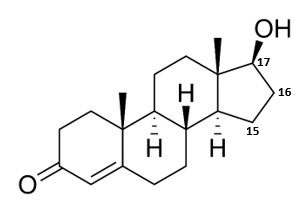
Testosterone
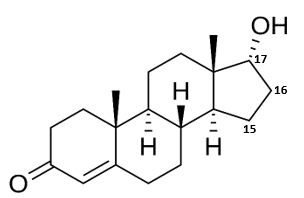
Epitestosterone
Because testosterone and epitestosterone are epimers with the same molecular weight, chromatographic resolution of the compounds is needed for accurate quantitation. While enantiomers (another type of stereoisomer) require chiral stationary phases for separation, epimers can be more easily resolved by traditional LC columns. Biphenyl phase columns, which offer superior selectivity, are an excellent choice for resolving these compounds.
The following method was developed to separate testosterone and epitestosterone in urine. A sample was prepared by spiking both analytes at a concentration of 100 ng/mL in urine, and then diluting it 20X with 20:80 water:methanol (v/v), both with 0.1% formic acid. The method conditions and an example chromatogram are shown below.
| Column | Force Biphenyl 100 x 2.1 mm, 3 µm (cat.#9629312) | ||
| Mobile Phase A | Water,0.1% formic acid | ||
| Mobile Phase B | Methanol, 0.1% formic acid | ||
| Column Temperature | 30°C | ||
| Sample Diluent | 20:80 MPA:MPB (v/v) | ||
| Injection Volume | 3 µL | ||
| Flow Rate | 0.5 mL/min | ||
| Gradient | Time (min) | %A | %B |
| 0.00 | 20 | 80 | |
| 4.00 | 20 | 80 | |
| 4.10 | 0 | 100 | |
| 5.00 | 0 | 100 | |
| 5.10 | 20 | 80 | |
| 6.00 | 20 | 80 | |
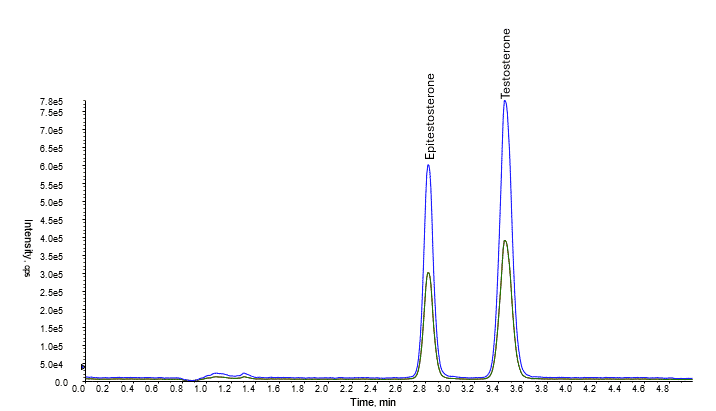
Using these method conditions, epitestosterone and testosterone are well separated in a six-minute runtime. With the epimers fully resolved, these method conditions are a good place to start if you are working on determining T/E levels in urine specimens by LC-MS/MS.