


Life gets a little crazy in the lab; deadlines need to be hit, time is money, and rerunning samples can lead to major roadblocks. Around the scientific community, we strive to do our best and deliver accurate data, but sometimes we unconsciously cut corners or assume that small changes will not lead to big problems. While we often say, “don’t sweat the small stuff,” this blog is here to play devil’s advocate and encourage us to take a moment to think through the small decisions that we make when preparing samples. A lot of effort goes into validating methods, so let’s make sure that we start our workflows off right and consider our best options for pipetting and transferring our samples and standards!
Let’s start by discussing the two main types of pipettes, which include air-displacement and positive-displacement. Do you know which one you should use? This is a good question to ask yourself and the answer to that question starts with your intended application. Let’s break these two types of pipettes down to identify what would be best for you!
Air-Displacement [1]:
- These pipettes have a cushion of air between the sample and the piston of the pipette.
- These pipettes work well for:
- Aqueous samples
- General laboratory use
Positive-Displacement [1]:
- These pipettes do not use an air cushion between the sample and piston within the disposable pipette tip.
- These pipettes work well for:
- Viscous and dense samples (e.g., oils, glycerol, etc.)
- Liquids with high vapor pressures (e.g., methylene chloride, acetone, etc.)
The image below is a great visual of how these pipettes work from Gilson. On the left, you will see the air-displacement style, and on the right, positive-displacement.
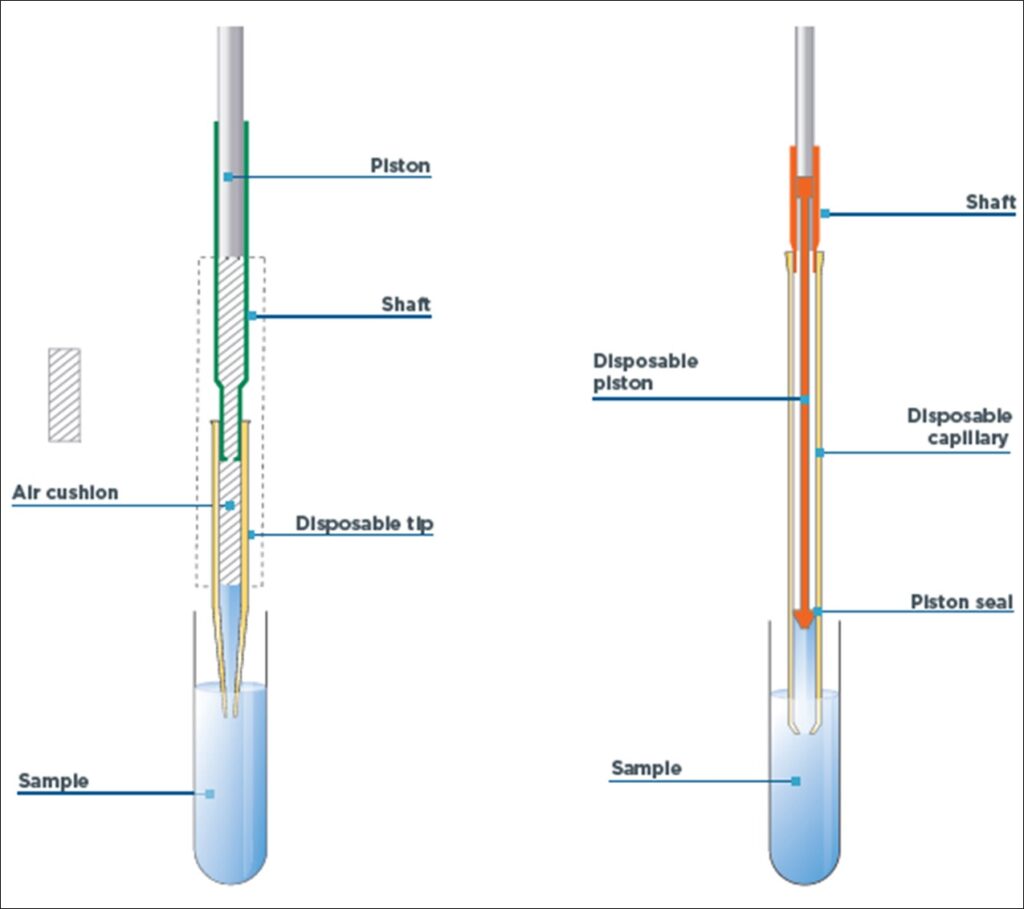
It is important to work the appropriate pipette style, especially when working with tricky analytes, like very volatile compounds (VVOCs). If you were to use an air-displacement pipette for this type of application, you could easily lose analytes during transfer, which would lead to inaccuracies in your calibrations and reporting. Next time you look to improve an existing method or start a new one, think about your sample and analytes of interest. Selecting the correct pipette style could make a huge difference in your data!
References
[1] Gilson, “Guide To Pipetting,” [Online]. Available: https://www.gilson.com/pub/media/docs/GuideToPipettingE.pdf.