



Key Highlights
- GC guard columns protect your analytical column from matrix contaminants, reducing the frequency of maintenance, improving data quality, and keeping your instrument online longer.
- Integrated guard (IG) columns—built seamlessly into the same tubing as the analytical column—eliminate the leak-prone manual connections required by separate guards.
- RMX Integra-Guard columns feature Restek’s proprietary TriMax deactivation, which creates an exceptionally inert, robust surface that outperforms traditional deactivations for sensitive analytes, even after prolonged thermal stress.
Most GC analysts have heard this advice: use a guard column, especially when working with dirty or highly complex sample matrices. But why is this best practice, and which guard column will actually deliver the best results? This article answers both questions using data from a head-to-head comparison of column configurations and deactivation technologies.
A GC guard column is a short segment of deactivated tubing, usually without stationary phase, that is installed at the inlet end of an analytical column. Its job is to intercept nonvolatile sample matrix components, such as oils, fats, particulates, etc., before they can reach the stationary phase. The GC guard column protects the more expensive analytical column from damaging contaminants, thereby extending its lifetime. Then, when it’s time for maintenance, the contaminated guard tubing can be trimmed away without affecting the analytical separation chemistry.
Why Should I Use a GC Guard Column?
Dirty sample matrices are an unavoidable reality for laboratories across many industries. Every injection introduces a small amount of nonvolatile residue into the sample flow path. Without a guard, that residue accumulates on the head of the analytical column, where it interacts with target analytes and degrades performance over time.
The consequences are familiar to any experienced analyst: peak tailing, reduced sensitivity, drifting retention times, and calibration curves that no longer meet linearity requirements. The time and cost required to restore performance by trimming the analytical column, replacing consumables, recalibrating, and verifying the method add up quickly. In high-throughput commercial laboratories, this downtime can be extremely costly.
A guard column addresses all of these problems directly. By capturing contaminants before they reach the analytical phase, an effective GC guard column does the following:
- Improves peak shape and resolution by keeping the flow path clean and preventing matrix components from adsorbing active analytes.
- Maintains sensitivity and linearity for longer by preventing analyte adsorption and protecting the stationary phase from chemical degradation.
- Reduces the frequency of analytical column replacement, keeping instruments running and labs productive.
- Allows maintenance (trimming the guard) without disrupting retention times or requiring updates to MRM windows in the instrument method.
What GC Guard Column Options Are Available?
When choosing a guard column, two key decisions must be made: configuration (separate guard versus integrated guard) and deactivation chemistry. Both have a meaningful impact on whether the guard delivers on its promise to improve data quality, reduce maintenance, and extend analytical column lifetime.
Separate vs. Integrated Guard (IG) Columns
Separate guard columns are standalone pieces of deactivated tubing that must be manually connected to the inlet end of the analytical column using a connector. While they can be effective at capturing contamination, the manual connection introduces several practical complications. The process is time-consuming, the union can be a source of leaks, and ensuring a proper seal requires care and attention. In sensitive systems like GC-MS/MS, even a small leak can damage the column’s stationary phase and significantly degrade sensitivity and peak shape. Separate guards also require ordering and stocking separate parts and matching the inner diameter of the guard to the analytical column, steps that take time and are susceptible to human error.
Integrated guard columns eliminate all of these concerns. Because the guard is manufactured as part of the same capillary tubing as the analytical column, there is no connector, no possibility of leaks, and no need to source matching components. Switching from a separate guard and analytical column setup to an integrated guard format requires no additional hardware and introduces no new connections into the flow path. Not all column manufacturers offer integrated guard columns, but Restek has for years, and RMX Integra-Guard columns are the most recent and most technologically advanced option.
Deactivation Matters
All guard column tubing must be deactivated to prevent the bare fused silica surface from adsorbing and/or degrading active analytes. The quality of that deactivation varies considerably across manufacturers, and it has a direct impact on analytical performance, particularly at low levels, and for challenging compound classes, such as acidic, basic, and phenolic analytes.
Restek’s proprietary TriMax deactivation technology represents a significant advancement over traditional approaches. TriMax technology creates a robust, inert coating interface that resists deterioration under heat and matrix-induced stress [1,2]. The result is a deactivated surface that maintains its inertness over a far longer column lifetime than conventional deactivations and, as shown here, it performs equally well in both analytical and integrated guard column formats.
How Was Performance Evaluated?
To demonstrate the differences between column configurations and deactivation technologies, a study was conducted using 57 acidic, basic, and neutral semivolatiles analyzed by GC-MS/MS. The study compared the following:
- Column configuration: an RMX-5Sil MS with Integra-Guard column versus an RMX-5Sil MS analytical column without a guard.
- Deactivation quality: an RMX-5Sil MS with Integra-Guard column versus a competitor’s integrated guard column of the same format.
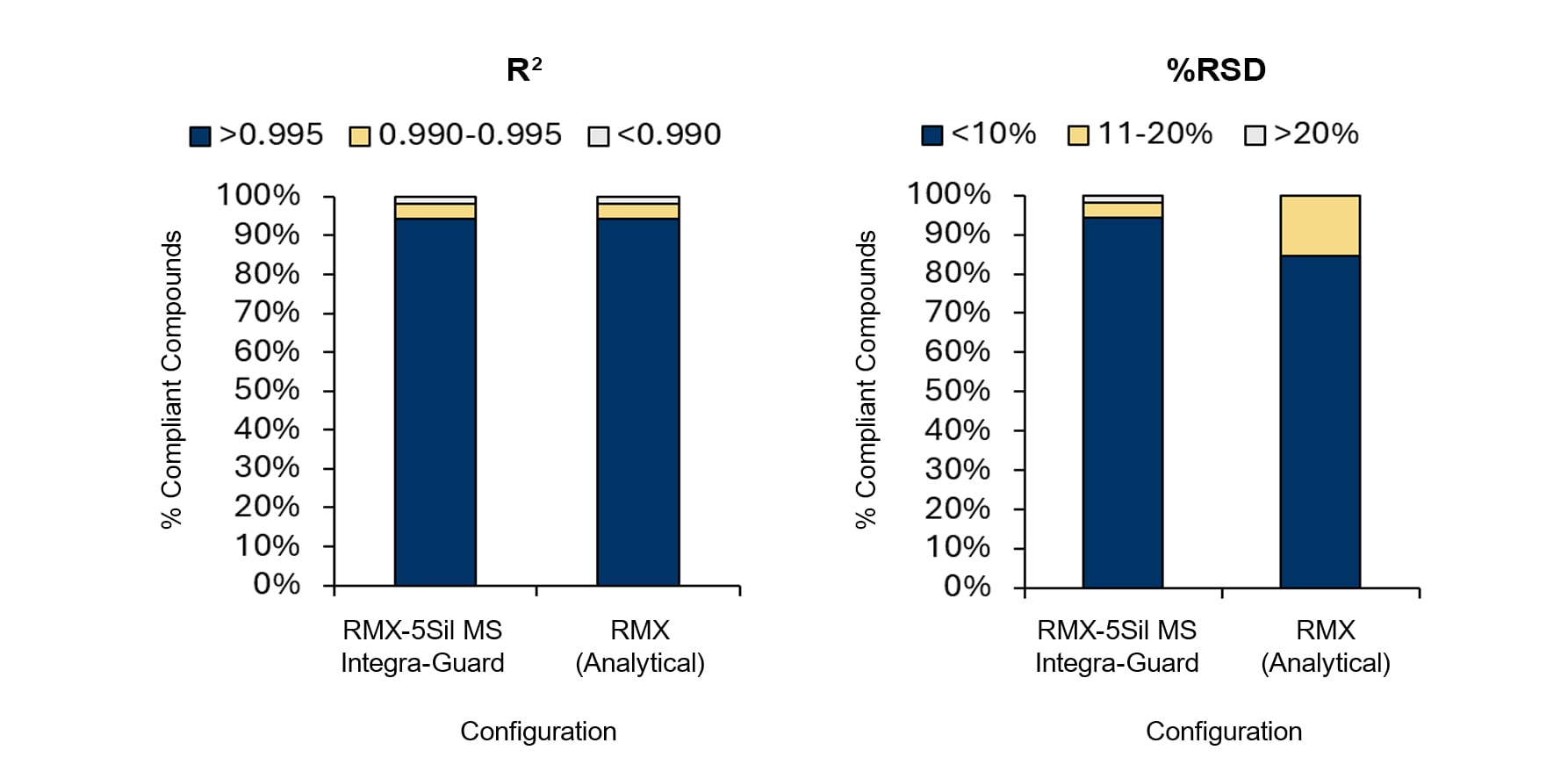
Compounds were calibrated at low levels (0.5–5000 ppb), with a unique calibration range determined for each analyte. The impacts of column configuration and deactivation on linearity and peak shape were assessed, and results were categorized according to the compliance criteria shown in Table I.
Table I: Compliance Criteria
| Metric | Ideal | Acceptable | Poor |
|---|---|---|---|
| RSD | <10% | 11-20% | >20% |
| R² | >0.995 | 0.990-0.995 | <0.990 |
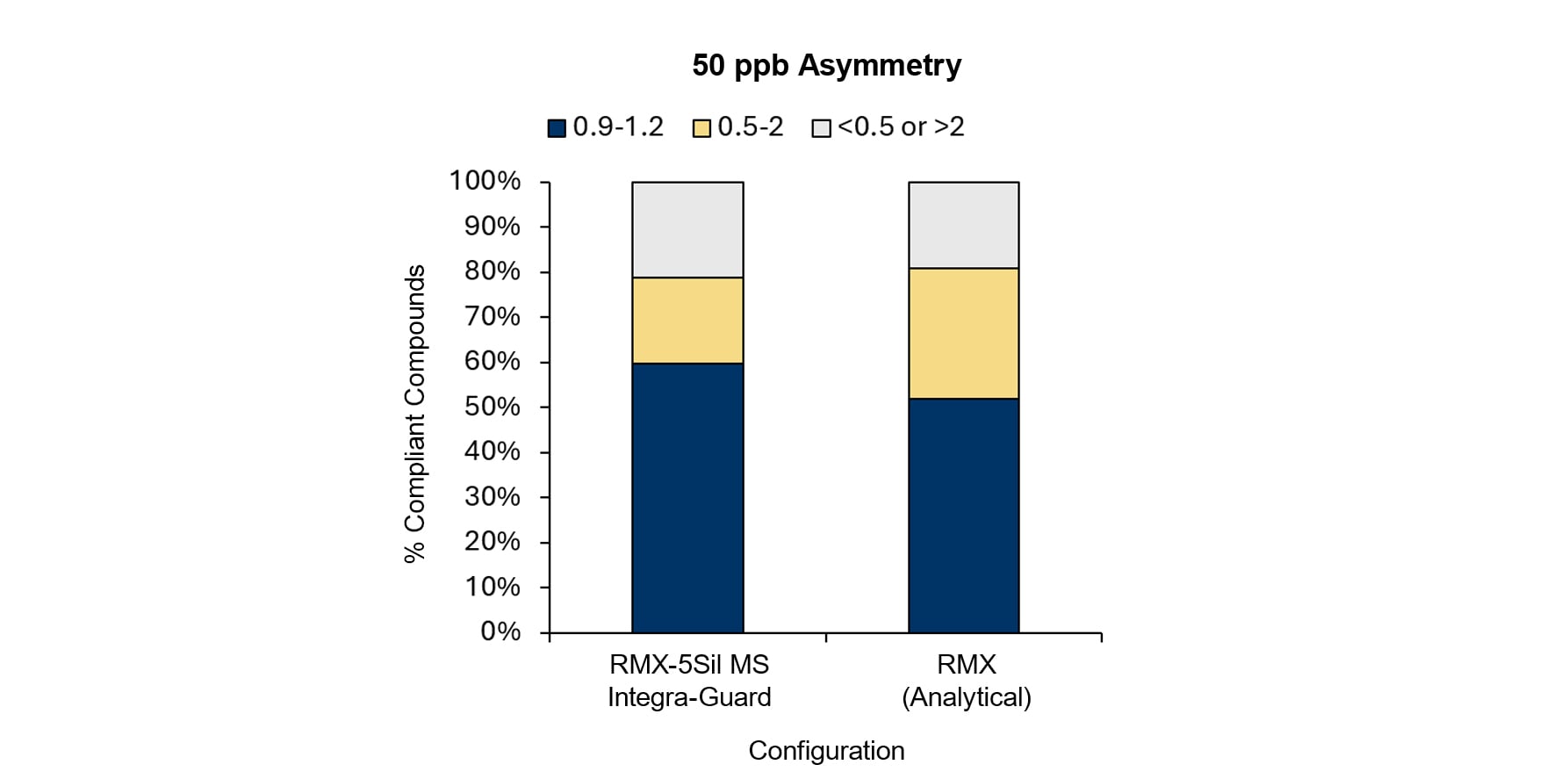
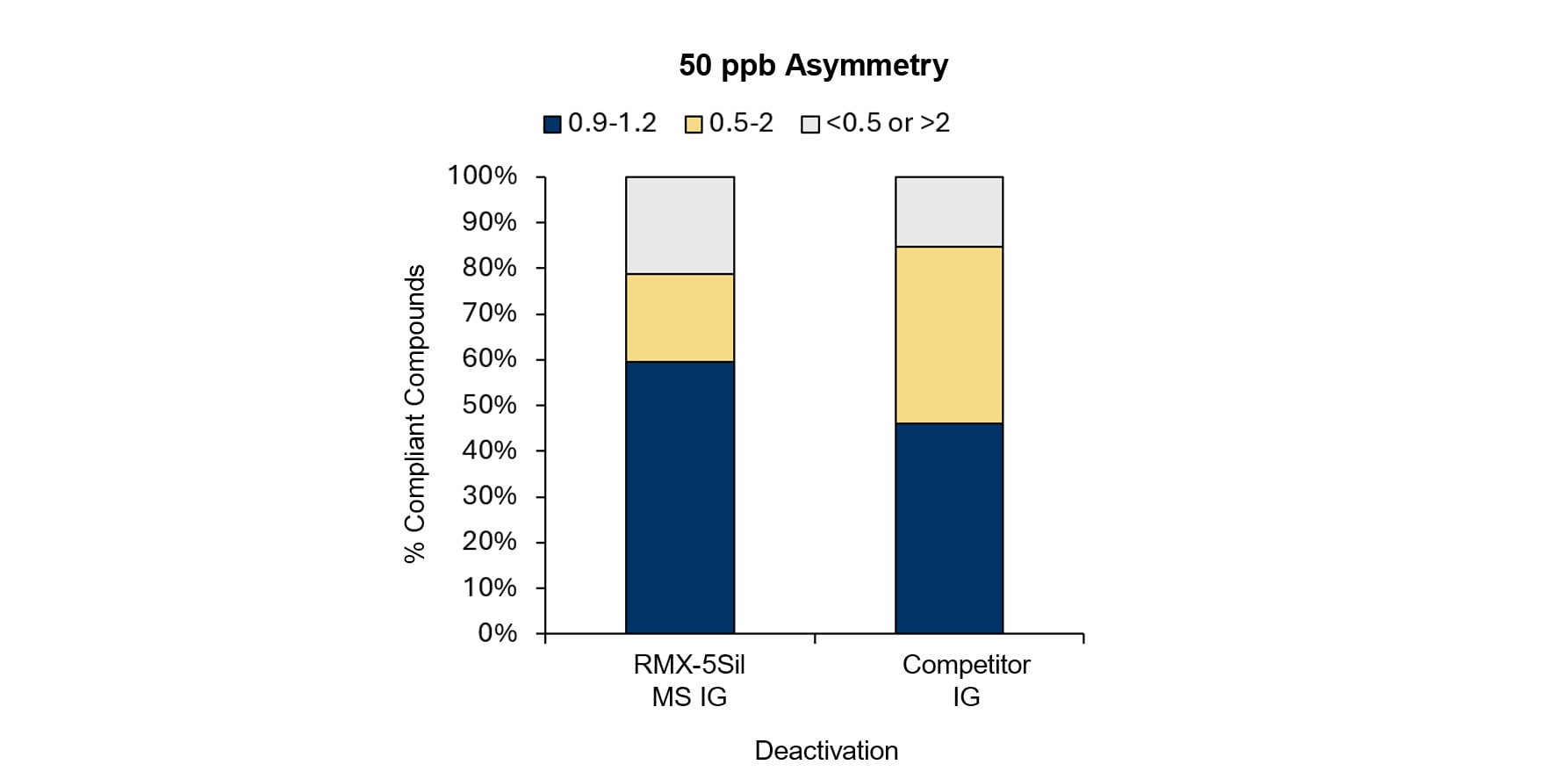
| Asymmetry | 0.9-1.2 | 0.5-0.9, 1.2-2 | <0.5, >2 |
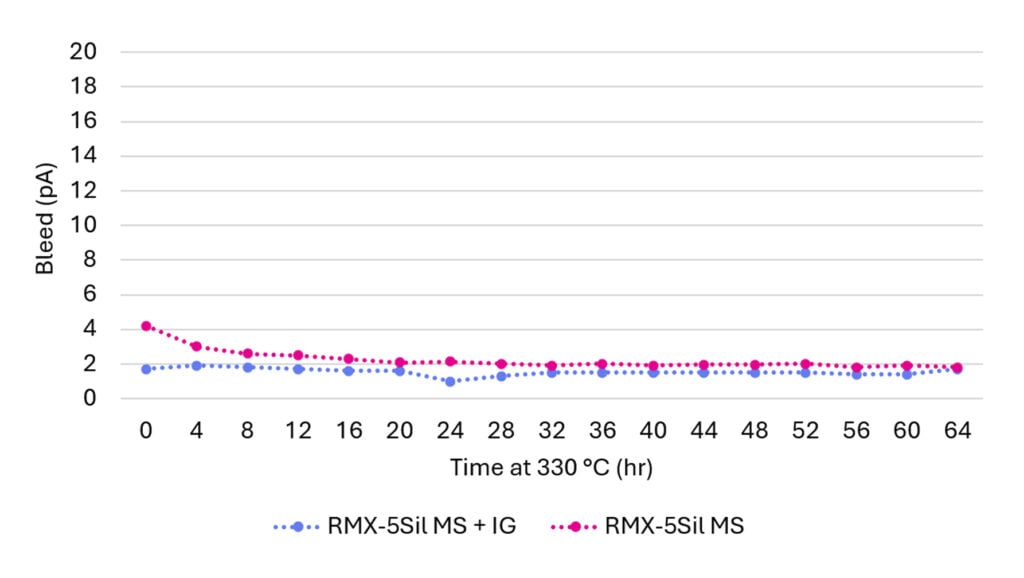
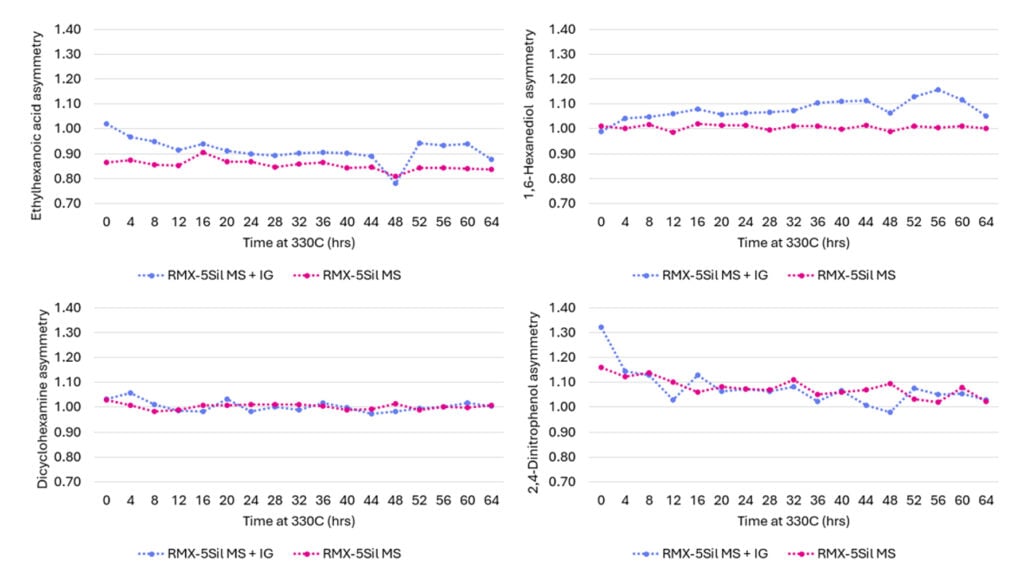
Column lifetime was then assessed using thermal stress testing: both RMX column configurations were exposed to 330 °C in 4-hour intervals for 64 hours total, with intermittent QC testing to monitor changes in bleed and peak asymmetry.
Does an Integrated Guard Affect Analytical Performance?
One of the most common concerns when adopting an integrated guard column is whether the additional 5–10 meters of uncoated tubing will introduce activity that compromises analytical performance. The data show that for RMX Integra-Guard columns with TriMax deactivation, the answer is no.
The RMX-5Sil MS with Integra-Guard column and the RMX-5Sil MS analytical column alone (no guard) produced virtually identical calibration compliance results. More than 90% of the 57 semivolatiles met ideal or acceptable linearity criteria on both formats (Figure 1). Peak asymmetry was also comparable across the full range of acidic, basic, and neutral compounds tested (Figure 2), and comparable results were obtained with both configurations.
This equivalence is a direct result of the highly effective deactivation provided by TriMax technology. The uncoated deactivated guard tubing is just as inert as the coated analytical section, so analytes experience a continuously neutral flow path from injection to detection. In practical terms, this means analysts can adopt an RMX Integra-Guard column with full confidence that method performance will be maintained.
Will All Deactivations Perform the Same?
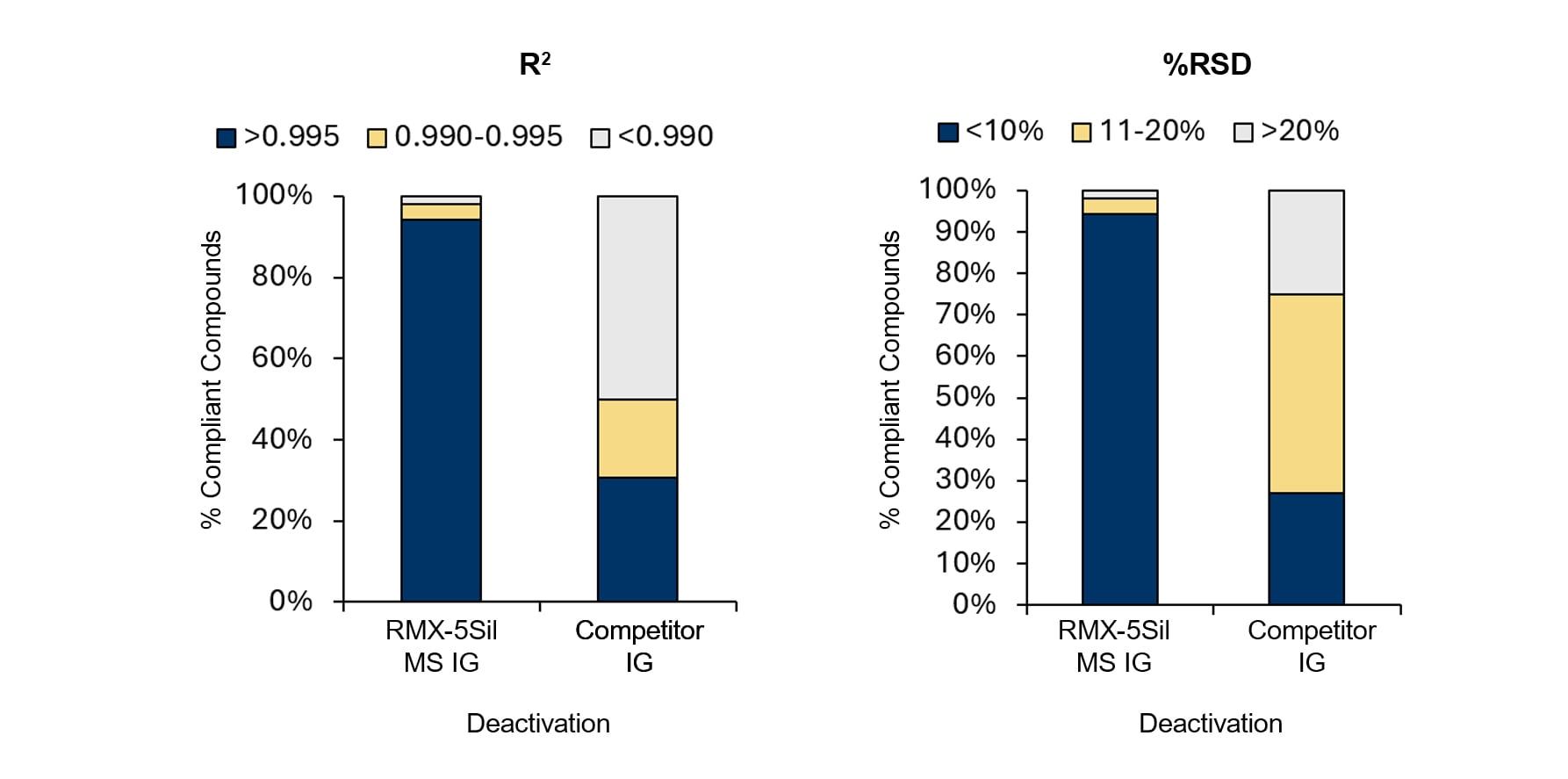
No. This is one of the most important practical findings of the study. When the RMX-5Sil MS with Integra-Guard column was compared to a competitor’s integrated guard column, the differences in performance were dramatic.
On the competitor’s column, only 30% of the semivolatiles tested produced calibration curves in the ideal category. In contrast, on the RMX-5Sil MS Integra-Guard column with TriMax deactivation, >90% of compounds were in the ideal compliance criteria range for calibration linearity (Figure 3). The root cause of the difference is deactivation quality. Traditional deactivation technologies leave residual surface activity on uncoated glass, which causes peak broadening, tailing, and adsorption, especially at low concentrations and for reactive analytes. As shown in Figure 4, the RMX-5Sil MS Integra-Guard column also outperformed the competitor’s integrated guard column in terms of peak shape with more compounds in the ideal range for peak asymmetry.
Will I Get Consistent Performance Under Tough Conditions?
An integrated guard column must not only perform well initially, but it must also maintain that performance over time, through repeated high-temperature conditioning cycles. Our thermal stress study addressed this directly to assess actual performance under real-world conditions.
Both the RMX-5Sil MS analytical column and the RMX-5Sil MS with Integra-Guard column showed consistently low bleed throughout the thermal challenge (Figure 5). No signs of deactivation deterioration were observed in either format, confirming that TriMax chemistry is equally stable with or without stationary phase.
Peak asymmetry of four sensitive probe compounds—ethylhexanoic acid (acid); 1,6-hexanediol (neutral); dicyclohexamine (base); and 2,4-dinitrophenol (phenolic acid)—was monitored throughout the test. Results were remarkably consistent across both column formats. The asymmetry of 1,6-hexanediol showed a slight increase under prolonged thermal stress but remained within the acceptable range throughout testing. Acidic, basic, and phenolic probes all performed well with no significant deterioration (Figure 6).
Critically, no class-specific bias was observed over time for both RMX column formats. Some traditional deactivations preferentially protect one compound class while leaving others vulnerable to surface interaction. The TriMax deactivation showed no such weakness—its balanced inertness is what allows RMX columns to maintain compliant performance even after the thermal stress of real-world use.
One final practical advantage of the RMX Integra-Guard design is worth highlighting: because the guard is deactivated tubing only with no stationary phase, it does not influence analyte separations. Retention times and elution order are unaffected by the presence of the guard, and the guard can be trimmed for maintenance without requiring updates to retention time windows in the instrument method. This is a significant operational advantage in busy laboratories where high sample throughput is essential.
For GC analysts working with difficult matrices, an effective guard column is essential protection for the analytical column and a key tool for maintaining data quality and instrument uptime. But not all guard columns are equal, and the data presented here prove RMX Integra-Guard columns with TriMax deactivation offer superior performance. With their leak-proof format; broadly effective deactivation for acids, bases, and neutrals; and proven thermal stability, RMX Integra-Guard columns are the clear choice for protecting your analytical column, your data, and your productivity.
References
- RMX GC columns brochure, GNBR4923-UNV, Restek Corporation, 2026. https://discover.restek.com/articles/gnbr4923/rmx-gc-columns-unleash-your-performance
- E. Pack, J. Hoisington, C. English, R. Dhandapani, and C. Myers, Comprehensive trace-level semivolatiles analysis by GC-MS/MS (EPA Method 8270E), Application note, EVAN4919-US, Restek Corporation, 2025. https://discover.restek.com/application-notes/evan4919/comprehensive-trace-level-gc-ms-ms-semivolatiles-method-epa-method-8270e
Products Mentioned
Authors