

摘要
PFAS 在环境中的普遍存在使得确保无污染的工作流程至关重要。在本应用说明中,我们证明了 Resprep S-DVB SPE 柱及相关样品制备产品始终不含背景干扰物。此外,PFAS 延迟柱可有效去除仪器中可能存在的任何污染。使用本文介绍的材料和程序,可以稳定满足 EPA 537.1 方法对于清洁度 、准确度和精密度的要求。
引言
由于人们对人体接触及潜在不良健康影响的日益关注,全氟和多氟烷基物质(PFAS)的分析比以往任何时候都更加普遍。它们具有持久性,并在众多行业和各类产品中广泛使用,从不粘厨具、防水衣物和水成膜泡沫
(AFFF)到食品包装涂层,这使得它们基本上成为世界范围内的普遍污染物。因此,土壤、废水、饮用水和其他环境基质以及食品中的 PFAS 测试持续增加。
2020 年,美国 EPA 发布了用于饮用水中 PFAS 分析的方法 537.1 修订版 2 [1]。该方法规定,样品前处理必须使用苯乙烯-二乙烯基苯(S-DVB)SPE柱,且不允许偏离萃取程序。由于背景PFAS污染物可能从样品路径中任 何位置的材料中浸出并干扰目标化合物分析,实验室每次使用新批次耗材时,都必须证明可接受的背景、准确度和精密度结果。除了这种初步验 证,还需要进行常规的空白和质控样品分析以确保持续性能。
在典型的工作流程中,样品会接触到多个表面和物质,每个都可能是PFAS污染的潜在来源。这些来源包括:收集容器、化学药品 、溶剂、流动相、移液器吸头、SPE产品、歧管或自动化系统、管路、过滤器、样品瓶、瓶盖以及LC系统内的组件。即使注意避免使用已知会浸出PFAS(如PTFE)或目标分析物可能附着(如玻璃)的材料,使用清洁、高质量的耗材也将有助于防止因系统适用性不合格而导致的停机。
在此,我们遵循EPA 537.1方法,建立了一种满足严格方法要求的无污染工作流程。虽然此工作流程基于EPA 537.1,但由于 PFAS污染的普遍性,强烈建议对其它PFAS方法[2]进行类似测试以确定是否存在背景PFAS污染。
实验
校准标准品和质控样品:
依照EPA 537.1方法规定,使用PFAS分析物标准品、内标标准品及替代物标准品配制校准标准溶液和实验室加标空白样品。共配制8个浓度水平的标准溶液,其浓度范围为0.2~50 ppb,相当于经样品前处理250倍浓缩后,对应饮用水中原始浓度为 0.8~200 ppt。按照EPA 537.1方法第9.2.2节至第9.2.4节的要求,同步制备了实验室试剂空白(LRB)和实验室加标空白
(LFB)样品。其中,加标浓度为40 ppt的实验室加标空白(LFB)样品用于评估本方法的准确度与精密度 。
样品制备:
向250 mL超纯水( 18.3 MΩ·cm)中加入分析物和替代物标准品,用于制备实验室加标空白(LFB)样品。LFB样品在萃取前存放于聚丙烯容器中。本工作流程所用材料详见表I。
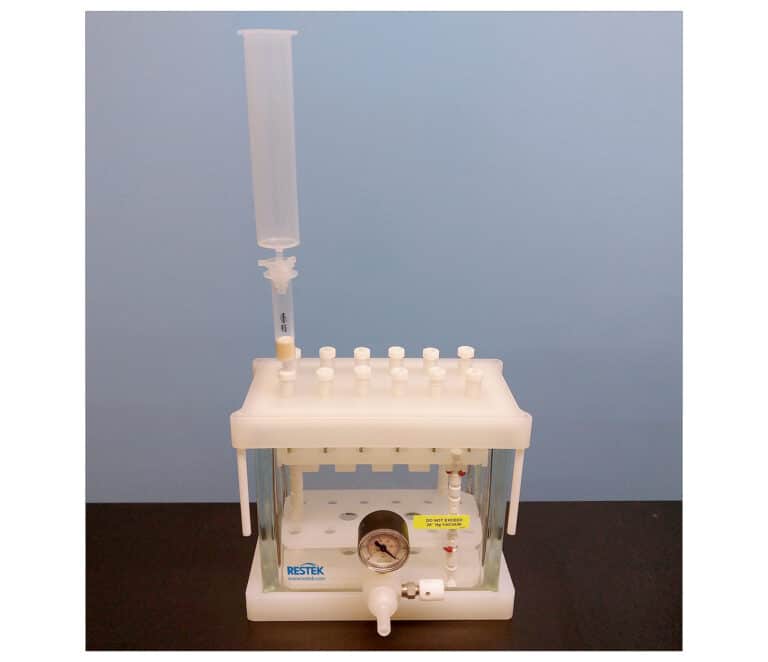
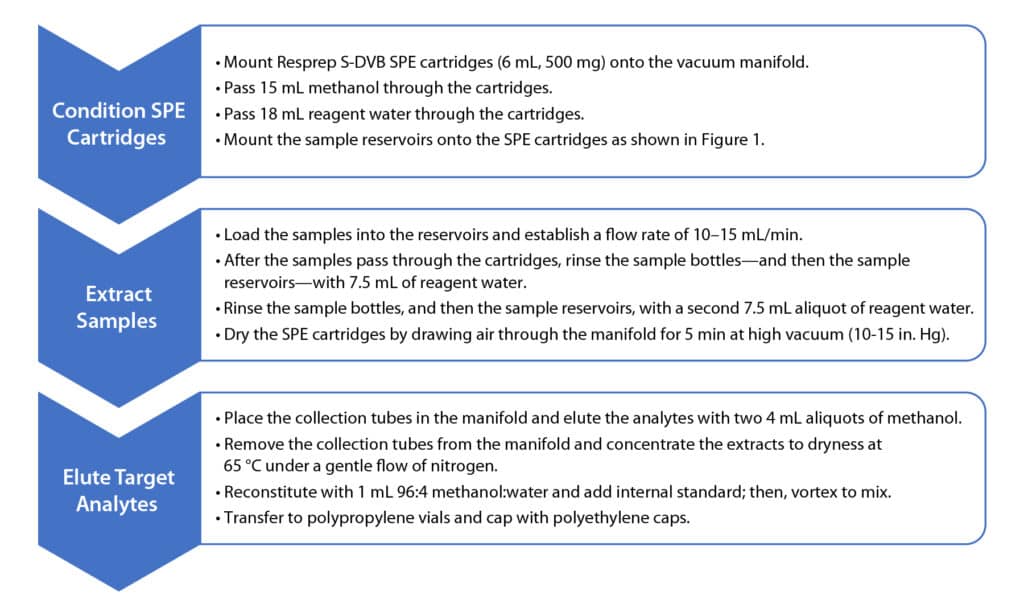
使用Resprep S-DVB SPE小柱(6 mL,500 mg)进行PFAS萃取,该小柱安装于Resprep真空歧管上。SPE小柱依次用15 mL甲醇和18 mL试剂水进行活化,过程中严禁柱床变干。通过适配器将储液器连接至SPE小柱,避免使用PTFE传输管线。如图1所示,使用储液器可更方便地添加样品。完整的样品前处理流程如下所述,并参见图2。
萃取时,流速控制在约10~15 mL/min,整个萃取过程中需特别注意勿使柱床变干。样品全部过柱后,用两份7.5 mL试剂水分别冲洗各样品瓶。冲洗完样品瓶后,再用该淋洗液冲洗各样品储液器,以确保样品中目标PFAS无残留。
萃取完成后,将 SPE 柱(仍置于真空歧管上)通入空气抽干。柱干燥后,将收集管放入歧管中,分别用两份 4 mL 甲醇依次过柱并收集洗脱液。取下收集管,在 65 °C 加热条件下,以氮气流将萃取液浓缩至干。
样品浓缩干后,加入1 mL甲醇-水溶液(96:4)及内标标准品,涡旋混匀。涡旋后,将浓缩液等分转移至聚丙烯样品瓶中 ,盖好聚乙烯瓶盖密封。随后采用 LC-MS/MS 进行分析,该系统配备 PFAS 延迟柱(货号:27854)和 Raptor C18 液相色谱柱 (50mm × 2.1 mm,2.7 µm;货号:9304A52)。方法条件见图 3 和图 4。
表I:EPA 537.1 PFAS分析所用样品前处理耗材
| 描述 | Restek 货号 |
| Resprep S-DVB SPE小柱 (6 mL, 500 mg) | 28937 |
| Resprep真空歧管(12位或24位) | 28298-VM, 28299-VM* |
| 储液器(聚丙烯) | 26015 |
| 连接器(聚丙烯) | 26007 |
*本研究中使用了12位歧管,但两种歧管均可使用,因为SPE小柱不直接接触歧管本体,仅接触两种歧管通用的快速更换一次性内衬。
结果和讨论
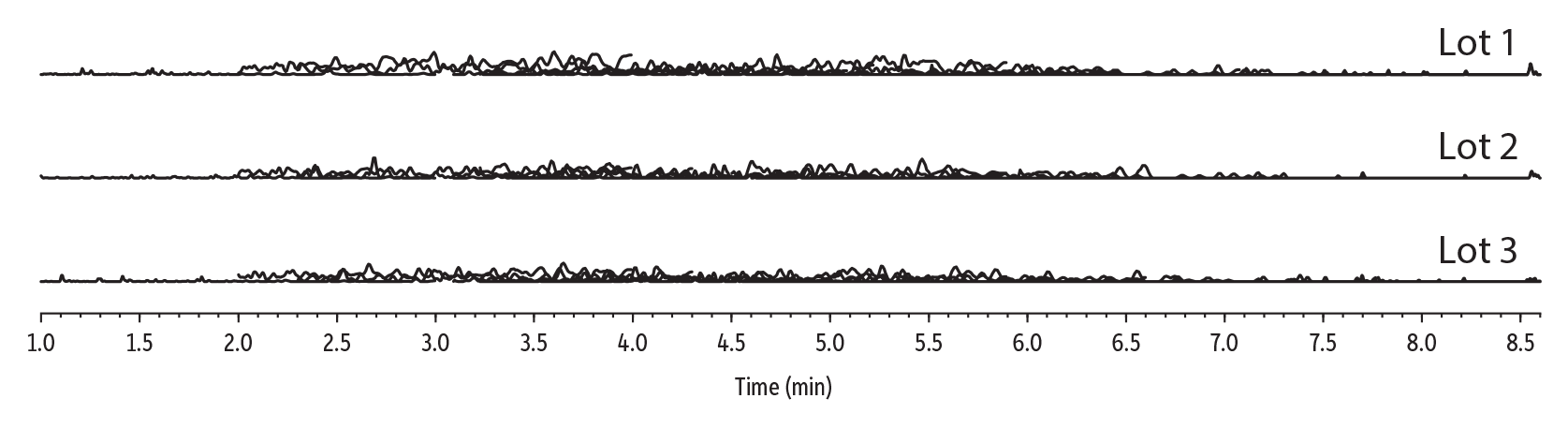
EPA 537.1方法对饮用水中PFAS分析的要求包括:初始验证及持续证明系统背景值较低,且准确度和精密度满足要求,以确保从样品采集到分析的整个工作流程无污染、合格可用。为验证清洁度,根据方法规定,对三个不同批次的Resprep S-DVB SPE小柱分别制备了实验室试剂空白。如图3所示,所有批次均未检出目标分析物,无污染干扰,满足第9.2.2节低系统背景值的要求。各目标化合物的检出限(LOD)为0.2~5 ppt(以信噪比>3定义),定量限(LOQ)为0.5~10 ppt(以信噪比>10定义)。
本实验除证明Resprep S-DVB小柱在多个批次间均具有一致的清洁度外,还证实了表I所列整个样品前处理流程中的其他所有组件(真空歧管系统、样品瓶及瓶盖等)均无干扰性污染物浸出。LC仪器本身也可能引入背景污染,但本分析中未出现此类情况,这是因为LC管路使用了PEEK或不锈钢材质,并加装了PFAS延迟柱。PFAS延迟柱通过捕获LC系统组件中可能浸出的 PFAS,并将其保留至样品分析物完全洗脱之后才释出,从而有效避免干扰。该延迟柱对PFAS的保留能力足够强,即便延长平衡时间,也不会发生穿透[3,4]。
LC_EV0574
Conditions
| Column | Raptor C18 (cat.# 9304A52) | ||||||||||||||||||||
|---|---|---|---|---|---|---|---|---|---|---|---|---|---|---|---|---|---|---|---|---|---|
| Dimensions: | 50 mm x 2.1 mm ID | ||||||||||||||||||||
| Particle Size: | 2.7 µm | ||||||||||||||||||||
| Pore Size: | 90 Å | ||||||||||||||||||||
| Temp.: | 40 °C | ||||||||||||||||||||
| Standard/Sample | |||||||||||||||||||||
| Diluent: | 96:4 Methanol:water | ||||||||||||||||||||
| Conc.: | 0 ng/mL laboratory reagent blank | ||||||||||||||||||||
| Inj. Vol.: | 2 µL | ||||||||||||||||||||
| Mobile Phase | |||||||||||||||||||||
| A: | Water, 5 mM ammonium acetate | ||||||||||||||||||||
| B: | Methanol | ||||||||||||||||||||
|
| Detector | MS/MS |
|---|---|
| Ion Mode: | ESI- |
| Mode: | MRM |
| Instrument | HPLC |
| Sample Preparation | The sample was prepared using Resprep S-DVB SPE cartridges (cat.# 28937) mounted on a Resprep vacuum manifold following the procedure in U.S. EPA Method 537.1. |
| Notes | A PFAS delay column (cat.# 27854) was installed before the injector. |
使用四个浓度为40 ppt的实验室加标空白(LFB)评估方法537.1 PFAS分析的回收率性能。图4为代表性LFB色谱图,结果表明峰效率、选择性和对称性良好。为满足方法对回收率的要求,LFB重复样的精密度值须满足%RSD < 20%,且同一LFB样品的准确度结果须在真实值的±30%以内。表II数据显示,方法精密度和准确度(分别对应方法537.1第9.2.3节和第9.2.4节)的要求很容易满足。良好的回收率表明目标分析物未因吸附在样品路径中的接触表面上而发生损失。
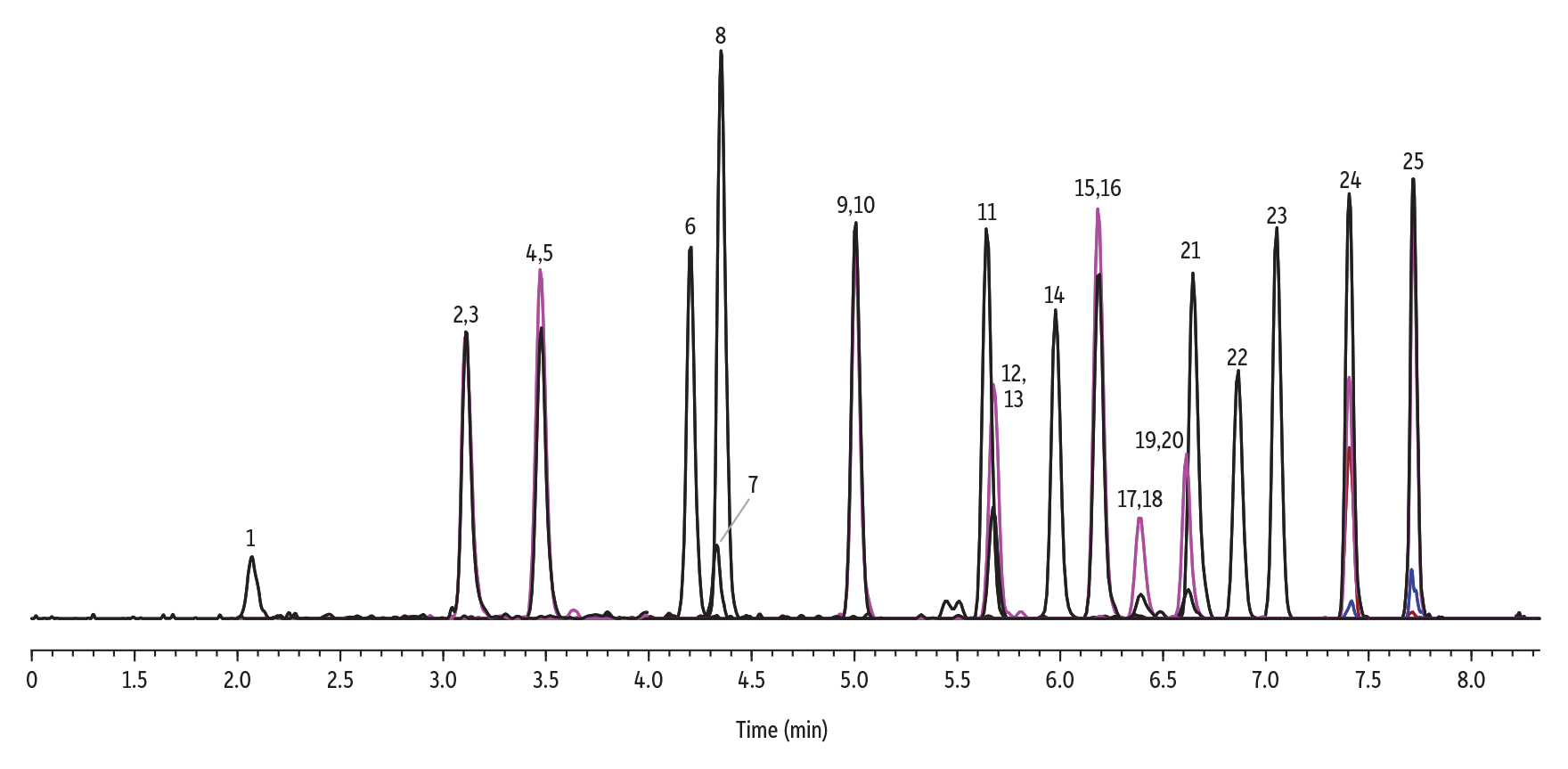
LC_EV0573
Peaks
| Peaks | tR (min) | Conc. (ng/L) | Precursor Ion | Product Ion | |
|---|---|---|---|---|---|
| 1. | Perfluorobutanesulfonic acid (PFBS) | 2.08 | 40 | 299.0 | 80.0 |
| 2. | Perfluoro-n-[1,2-13C2]hexanoic acid (13C2-PFHxA) | 3.11 | 20 | 315.1 | 270.1 |
| 3. | Perfluorohexanoic acid (PFHxA) | 3.11 | 40 | 313.2 | 269.0 |
| 4. | Tetrafluoro-2-heptafluoropropoxy-13C3-propanoic acid (13C3-HFPO-DA) | 3.47 | 20 | 332.1 | 287.3 |
| 5. | Hexafluoropropylene oxide dimer acid (HFPO-DA) | 3.47 | 40 | 328.9 | 284.9 |
| 6. | Perfluoroheptanoic acid (PFHpA) | 4.19 | 40 | 363.2 | 319.2 |
| 7. | Perfluorohexanesulfonic acid (PFHxS) | 4.33 | 40 | 399.2 | 79.9 |
| 8. | 4,8-Dioxa-3H-perfluorononanoic acid (ADONA) | 4.34 | 40 | 376.9 | 251.0 |
| 9. | Perfluoro-[1,2-13C2]octanoic acid (13C2-PFOA) | 5.00 | 20 | 414.9 | 370.0 |
| 10. | Perfluorooctanoic acid (PFOA) | 5.00 | 40 | 413.1 | 369.1 |
| 11. | Perfluorononanoic acid (PFNA) | 5.64 | 40 | 463.1 | 419.0 |
| 12. | Perfluorooctanesulfonic acid (PFOS) | 5.66 | 40 | 499.2 | 80.1 |
| Peaks | tR (min) | Conc. (ng/L) | Precursor Ion | Product Ion | |
|---|---|---|---|---|---|
| 13. | Perfluoro-1-[1,2,3,4-13C4]octanesulfonic acid (13C4-PFOS) | 5.67 | 60 | 503.1 | 80.2 |
| 14. | 9-Chlorohexadecafluoro-3-oxanone-1-sulfonic acid (9Cl-PF3ONS) | 5.97 | 40 | 531.0 | 350.9 |
| 15. | Perfluoro-n-[1,2-13C2]decanoic acid (13C2-PFDA) | 6.18 | 20 | 515.2 | 470.1 |
| 16. | Perfluorodecanoic acid (PFDA) | 6.18 | 40 | 512.9 | 468.9 |
| 17. | N-methyl perfluorooctanesulfonamidoacetic acid (N-MeFOSAA) | 6.38 | 40 | 570.2 | 419.0 |
| 18. | N-deuteriomethylperfluoro-1-octanesulfonamidoacetic acid (d3-N-MeFOSAA) | 6.38 | 80 | 573.1 | 419.1 |
| 19. | N-deuterioethylperfluoro-1-octanesulfonamidoacetic acid (d5-N-EtFOSAA) | 6.61 | 80 | 589.2 | 419.1 |
| 20. | N-ethyl perfluorooctanesulfonamidoacetic acid (N-EtFOSAA) | 6.62 | 40 | 583.8 | 418.9 |
| 21. | Perfluoroundecanoic acid (PFUnA) | 6.64 | 40 | 563.2 | 519.1 |
| 22. | 11-Chloroeicosafluoro-3-oxaundecane-1-sulfonic acid (11Cl-PF3OUdS) | 6.86 | 40 | 630.8 | 451.1 |
| 23. | Perfluorododecanoic acid (PFDoA) | 7.05 | 40 | 613.1 | 569.1 |
| 24. | Perfluorotridecanoic acid (PFTrDA) | 7.40 | 40 | 663.0 | 619.2 |
| 25. | Perfluorotetradecanoic acid (PFTA) | 7.71 | 40 | 713.1 | 669.0 |
Conditions
| Column | Raptor C18 (cat.# 9304A52) | ||||||||||||||||||||
|---|---|---|---|---|---|---|---|---|---|---|---|---|---|---|---|---|---|---|---|---|---|
| Dimensions: | 50 mm x 2.1 mm ID | ||||||||||||||||||||
| Particle Size: | 2.7 µm | ||||||||||||||||||||
| Pore Size: | 90 Å | ||||||||||||||||||||
| Temp.: | 40 °C | ||||||||||||||||||||
| Standard/Sample | |||||||||||||||||||||
| Diluent: | 96:4 Methanol:water | ||||||||||||||||||||
| Conc.: | 5-20 ng/mL in the final solution after sample preparation (equivalent to 20-80 ppt in laboratory reagent water sample prior to extraction) | ||||||||||||||||||||
| Inj. Vol.: | 2 µL | ||||||||||||||||||||
| Mobile Phase | |||||||||||||||||||||
| A: | Water, 5 mM ammonium acetate | ||||||||||||||||||||
| B: | Methanol | ||||||||||||||||||||
|
| Detector | MS/MS |
|---|---|
| Ion Mode: | ESI- |
| Mode: | MRM |
| Instrument | HPLC |
| Sample Preparation | The sample was prepared using Resprep S-DVB SPE cartridges (cat.# 28937) mounted on a Resprep vacuum manifold following the procedure in U.S. EPA Method 537.1. While internal standard concentrations varied, all target analytes were fortified at 40 ppt. |
| Notes | A PFAS delay column (cat.# 27854) was installed before the injector. Want even better performance when analyzing metal-sensitive compounds? Check out Inert LC columns at www.restek.com/inert. |
表II:EPA 537.1 PFAS分析的精密度与准确度结果(n = 4)
| 分析物 | %RSD* | 平均回收率** |
| Perfluorobutanesulfonic acid (PFBS) | 11.9% | 91.1% |
| Perfluorohexanoic acid (PFHxA) | 7.96% | 99.4% |
| Hexafluoropropylene oxide dimer acid (HFPO-DA) | 6.34% | 94.4% |
| Perfluoroheptanoic acid (PFHpA) | 4.19% | 92.7% |
| Perfluorohexanesulfonic acid (PFHxS) | 11.9% | 89.4% |
| 4,8-Dioxa-3H-perfluorononanoic acid (ADONA) | 5.18% | 96.6% |
| Perfluorooctanoic acid (PFOA) | 5.21% | 91.6% |
| Perfluorononanoic acid (PFNA) | 6.79% | 97.2% |
| Perfluorooctanesulfonic acid (PFOS) | 6.78% | 87.8% |
| 9-Chlorohexadecafluoro-3-oxanone-1-sulfonic acid (9Cl-PF3ONS) | 8.59% | 85.1% |
| Perfluorodecanoic acid (PFDA) | 6.96% | 93.6% |
| N-methyl perfluorooctanesulfonamidoacetic acid (N-MeFOSAA) | 10.1% | 82.8% |
| N-ethyl perfluorooctanesulfonamidoacetic acid (N-EtFOSAA) | 16.5% | 106% |
| Perfluoroundecanoic acid (PFUnA) | 2.30% | 97.5% |
| 11-Chloroeicosafluoro-3-oxaundecane-1-sulfonic acid (11Cl-PF3OUdS) | 5.47% | 87.6% |
| Perfluorododecanoic acid (PFDoA) | 5.73% | 99.0% |
| Perfluorotridecanoic acid (PFTrDA) | 12.7% | 89.1% |
| Perfluorotetradecanoic acid (PFTA) | 8.90% | 89.7% |
*%RSD必须<20%。
**回收率必须在真实值的±30%以内。
结论
本研究结果表明,Resprep S-DVB SPE小柱及本工作流程中用于EPA方法537.1 PFAS分析的其他样品前处理产品,始终未检出背景污染物。此外,PFAS延迟柱的使用有效去除了LC仪器中可能存在的任何PFAS背景污染。综上所述,采用本工作流程中的耗材可减少背景干扰污染,从而确保系统验证的可靠性,并获得更准确的分析结果与报告。
引文
- J. Shoemaker and D. Tettenhorst, U.S. EPA Method 537.1 Rev 2., Method 537.1 Determination of selected per- and polyflourinated alkyl substances in drinking water by solid phase extraction and liquid chromatography/tandem mass spectrometry (LC/MS/MS), 2020. https://cfpub.epa.gov/si/si_public_file_download.cfm?p_download_id=539984&Lab=CESER
- Restek Corporation, Product guide for PFAS analysis: a methods-based reference to lab supplies for PFAS testing (EVAR3498-UNV), (2021). https://www.restek.com/articles/product-guide-for-pfas-analysis
- Restek Corporation, Eliminate the impact of instrument-related PFAS interferences by using a delay column, (2019). https://www.restek.com/articles/eliminate-the-impact-of-instrument-related-pfas-interferences-by-using-a-delay-column
- Restek, PFAS Analysis – Why a Delay Column is Important, Video. https://www.restek.com/videos/pfas-analysis-why-a-delay-column-is-important