

我们知道液相色谱柱有多种类型,每种类型都有自己的优势和劣势,具体选择哪种色谱柱取决于您的分析需求。新方法建立之初需要研究不同类型固定相的特征,特别是含有关键峰对时,固定相的选择尤其关键。毒物分析实验室的分析物通常包括滥用药物、治疗药物、非处方药物和酒精代谢物。分析物的极性和结构差异会在很大程度上影响它们与不同固定相的相互作用。
遗憾的是,没有”万能”固定相可以有效地分析毒理学涉及的所有化合物。大多数情况下,方法开发人员需要使用几种不同的固定相来满足对不同分析物的分析需求。要找出适合的色谱柱,您可以逐一尝试或者继续阅读,本文介绍了毒物分析方法开发中应该尝试的固定相类型。
C18 色谱柱
大多数方法开发人员将 C18 色谱柱视为反相色谱中的”通用”或”首选”色谱柱。C18是一种成熟可靠的选择,非常适合分析毒理学中常见的大量/多类分析物。C18 固定相通过疏水作用实现对待测物的保留,所以它们在分析具有不同极性的分析物时是一个不错的选择,但它们对一些芳香族关键异构体的选择性稍差。
当然C18可以分析一些难分离的化合物。甲基苯丙胺和苯丙胺的D型和L型异构体通常需要手性色谱柱才能实现分离,手性柱除了昂贵以外用途也不是很广泛。对于不想用手性柱的实验室,可以按照简单的衍生化方法在标准C18色谱柱上进行分离(图1)。
即使C18无法分离毒理学分析范围内的每种待测物,您的柜子中仍然应该有一支C18备用。
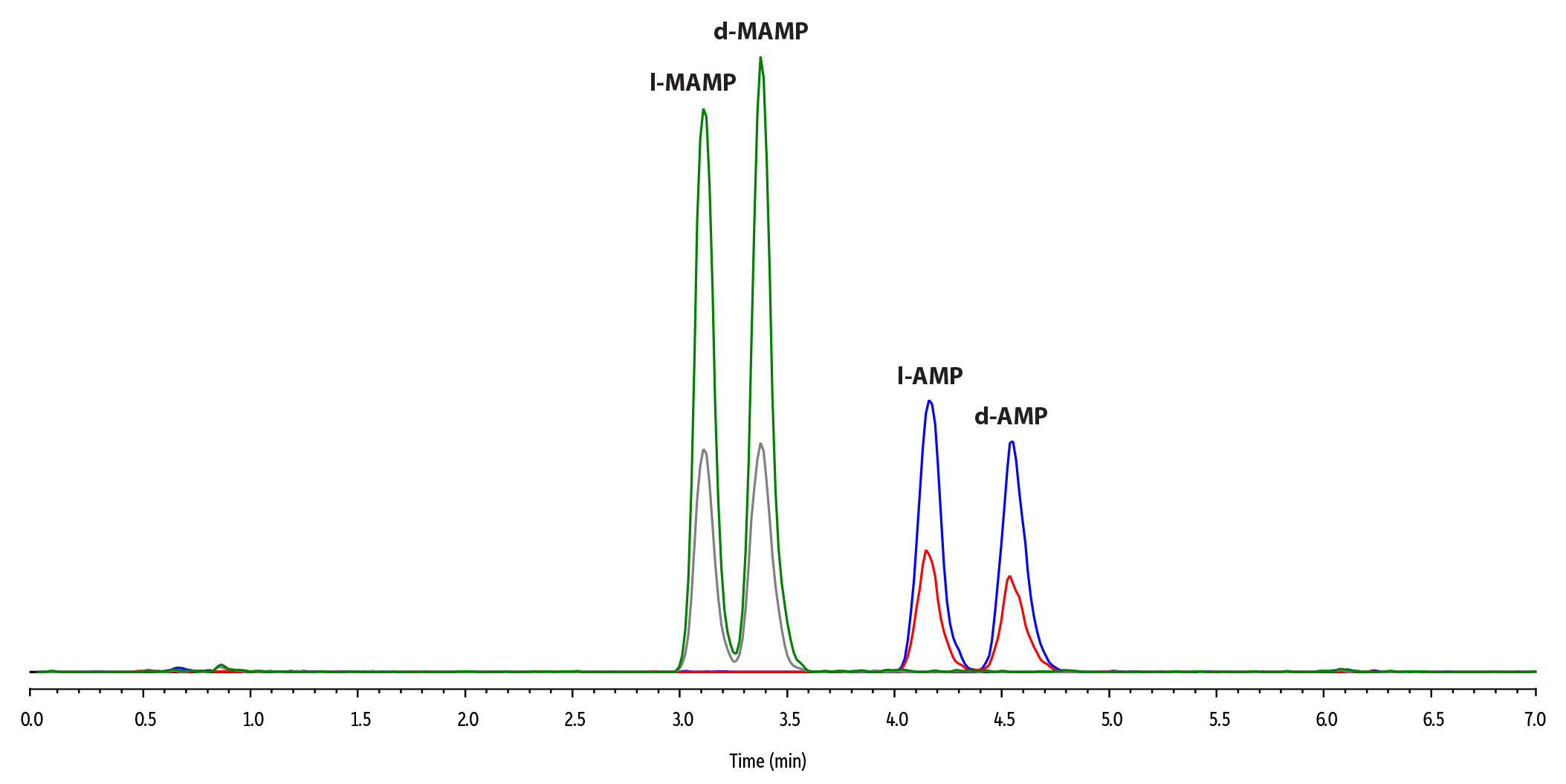
LC_CF0737
Peaks
| Peaks | tR (min) | Precursor Ion | Product Ion 1 | Product Ion 2 | |
|---|---|---|---|---|---|
| 1. | l-Methamphetamine* | 3.11 | 400.3 | 339.0 | 323.8 |
| 2. | d-Methamphetamine* | 3.38 | 400.3 | 339.0 | 323.8 |
| 3. | l-Amphetamine* | 4.16 | 386.1 | 325.0 | 308.0 |
| 4. | d-Amphetamine* | 4.55 | 386.1 | 325.0 | 308.0 |
Conditions
| Column | Raptor C18 (cat.# 9304A12) | ||||||||||||||||||||||||||||
|---|---|---|---|---|---|---|---|---|---|---|---|---|---|---|---|---|---|---|---|---|---|---|---|---|---|---|---|---|---|
| Dimensions: | 100 mm x 2.1 mm ID | ||||||||||||||||||||||||||||
| Particle Size: | 2.7 µm | ||||||||||||||||||||||||||||
| Pore Size: | 90 Å | ||||||||||||||||||||||||||||
| Guard Column: | Raptor C18 EXP guard column cartridge 5 mm, 2.1 mm ID, 2.7 µm (cat.# 9304A0252) | ||||||||||||||||||||||||||||
| Temp.: | 35 °C | ||||||||||||||||||||||||||||
| Standard/Sample | |||||||||||||||||||||||||||||
| Conc.: | 500 ng/mL in urine | ||||||||||||||||||||||||||||
| Inj. Vol.: | 10 µL | ||||||||||||||||||||||||||||
| Mobile Phase | |||||||||||||||||||||||||||||
| A: | 0.1% Formic acid in water | ||||||||||||||||||||||||||||
| B: | 0.1% Formic acid in methanol | ||||||||||||||||||||||||||||
|
| Detector | MS/MS |
|---|---|
| Ion Mode: | ESI- |
| Mode: | MRM |
| Instrument | HPLC |
| Sample Preparation | A 500 ng/mL standard (d- and l-amphetamines and methamphetamines) was prepared in pooled urine. Fifty microliters of the standard was aliquoted into a microcentrifuge tube. Ten microliters of a working internal standard (20 µg/mL (±)-amphetamine-D11 and (±)-methamphetamine-D11 in water) and 20 µL of 1M NaHCO3 was added and vortexed at 3000 rpm for 10 seconds. After vortexing, 100 µL of 0.1% (w/v) Marfey’s reagent (1-fluoro-2-4-dinitrophenyl-5-L-alanine amide) in acetone was added, vortexed, and heated at 45 °C for 1 hour. Samples were allowed to cool to room temperature before the addition of 40 µL of 1M HCl in water. The sample was then vortexed and evaporated to dryness under nitrogen at 45 °C. Samples were reconstituted in 1 mL of 40:60 water:methanol (v/v) and filtered using Thomson SINGLE StEP standard filter vials cat.# 25893 prior to analysis. |
| Notes | Thomson SINGLE StEP standard filter vials cat.# 25893 were used to produce this chromatogram, but have since been discontinued. For assistance choosing a replacement for this application, contact Restek Technical Service or your local Restek representative. |
优势:C18 是一种多功能的成熟固定相,可以分析大量具有不同极性的待测物。
弱点:C18 不具备完全分离药物/滥用药物中许多关键异构体的能力。
Biphenyl 联苯色谱柱
虽然联苯固定相不如C18应用广,但它的确具有自身的优势。它的最大优势是对芳香族化合物具有一定的结构识别能力,这使得它特别擅长分离关键的异构体。这种特性来自联苯官能团与待测物的π电子之间的π-π作用。因甲醇结构中不含π电子,不会干扰待测物与联苯官能团之间的π-π作用,因此当使用联苯柱时应当首选甲醇作为有机相,有助于完全释放联苯的潜力。
联苯固定相可以分离在C18或苯基柱上分离较差的化合物,在某些情况下联苯固定相的增强选择性也有助于最大限度地减少基质干扰(图2)。
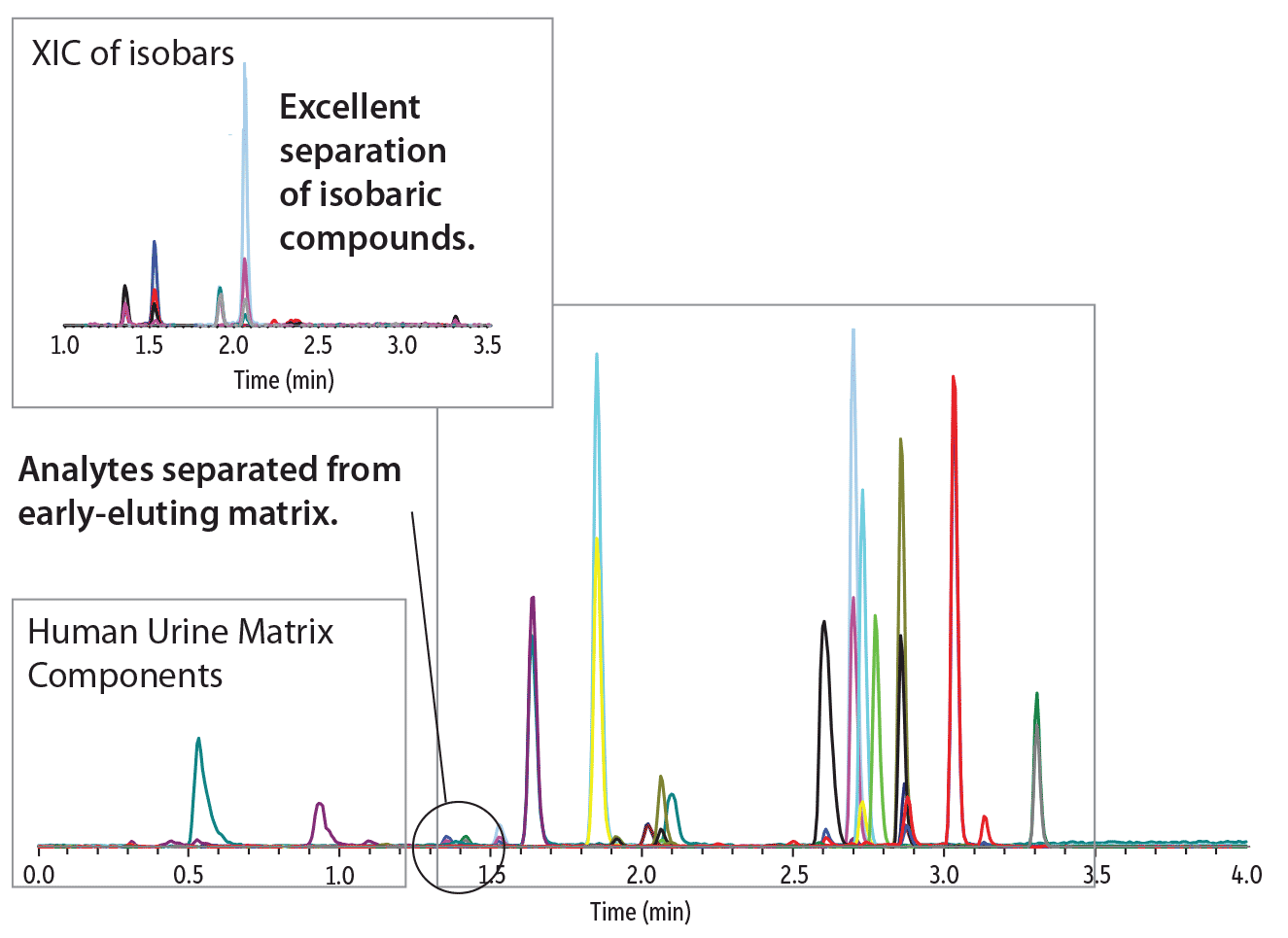
LC_CF0568
Peaks
| Peaks | tR (min) | Precursor ion | Product ion 1 | Product ion 2 | |
|---|---|---|---|---|---|
| 1. | Morphine* | 1.34 | 286.2 | 152.3 | 165.3 |
| 2. | Oxymorphone | 1.40 | 302.1 | 227.3 | 198.2 |
| 3. | Hydromorphone* | 1.52 | 286.1 | 185.3 | 128.2 |
| 4. | Amphetamine | 1.62 | 136.0 | 91.3 | 119.2 |
| 5. | Methamphetamine | 1.84 | 150.0 | 91.2 | 119.3 |
| 6. | Codeine* | 1.91 | 300.2 | 165.4 | 153.2 |
| 7. | Oxycodone | 2.02 | 316.1 | 241.3 | 256.4 |
| 8. | Hydrocodone* | 2.06 | 300.1 | 199.3 | 128.3 |
| 9. | Norbuprenorphine | 2.59 | 414.1 | 83.4 | 101.0 |
| Peaks | tR (min) | Precursor ion | Product ion 1 | Product ion 2 | |
|---|---|---|---|---|---|
| 10. | Meprobamate | 2.61 | 219.0 | 158.4 | 97.2 |
| 11. | Fentanyl | 2.70 | 337.2 | 188.4 | 105.2 |
| 12. | Buprenorphine | 2.70 | 468.3 | 396.4 | 414.5 |
| 13. | Flurazepam | 2.73 | 388.2 | 315.2 | 288.3 |
| 14. | Sufentanil | 2.77 | 387.2 | 238.5 | 111.3 |
| 15. | Methadone | 2.86 | 310.2 | 265.3 | 105.3 |
| 16. | Carisoprodol | 2.87 | 261.2 | 176.3 | 158.1 |
| 17. | Lorazepam | 3.03 | 321.0 | 275.4 | 303.1 |
| 18. | Diazepam | 3.31 | 285.1 | 193.2 | 153.9 |
Conditions
| Column | Raptor Biphenyl (cat.# 9309A5E) | ||||||||||||||||||||||||||||
|---|---|---|---|---|---|---|---|---|---|---|---|---|---|---|---|---|---|---|---|---|---|---|---|---|---|---|---|---|---|
| Dimensions: | 50 mm x 3.0 mm ID | ||||||||||||||||||||||||||||
| Particle Size: | 2.7 µm | ||||||||||||||||||||||||||||
| Temp.: | 30 °C | ||||||||||||||||||||||||||||
| Standard/Sample | |||||||||||||||||||||||||||||
| Diluent: | Urine:mobile phase A:mobile phase B (17:76:7) | ||||||||||||||||||||||||||||
| Conc.: | 10-100 ng/mL | ||||||||||||||||||||||||||||
| Inj. Vol.: | 10 µL | ||||||||||||||||||||||||||||
| Mobile Phase | |||||||||||||||||||||||||||||
| A: | Water + 0.1% formic acid | ||||||||||||||||||||||||||||
| B: | Methanol + 0.1% formic acid | ||||||||||||||||||||||||||||
|
| Detector | AB SCIEX API 4000 MS/MS |
|---|---|
| Ion Source: | TurboIonSpray® |
| Ion Mode: | ESI+ |
| Instrument | API LC-MS/MS |
| Notes | Lorazepam was prepared at 100 ng/mL; all other analytes are 10 ng/mL. |
优势:联苯色谱柱比 C18 和其他苯基柱具有更强的选择性,能够分离关键异构体、较少基质干扰。
弱点:联苯不像 C18 那样常用,因此方法开发过程中可能需要进行更多的自行优化工作。
FluoroPhenyl 氟苯基色谱柱
一般来说,C18和联苯柱组合即可成功分析毒理学检测范围内的化合物。其中一个例外是大麻素异构体的分析。确定大麻使用情况的典型毒理学测试包括分析大麻中的主要精神活性成分Δ9-THC及其两种代谢物11-OH-Δ9-THC和Δ9-THC-COOH。Δ8-THC(Δ9-THC的一种异构体)的出现,使得实验室也必须将这种化合物及其代谢物纳入其测试范围。这份更新的化合物列表包含六种分析物、三对异构体,需要完全分离才能出具准确报告。C18 和联苯色谱柱的选择性不足以充分分离三对异构体,但氟苯基色谱柱对此具有充分的选择性。
正如我们之前所讨论的,C18色谱柱通过疏水作用实现分离,联苯柱的保留原理为π-π作用。除了色散力、形状选择性外,氟苯基柱还有阳离子交换和偶极作用两种保留机理。正是这种多保留机制使氟苯基色谱柱能够实现独特的分离效果。对于需要分析THC异构体的毒理学实验室来说,氟苯基柱是这一艰难分离的必选色谱柱(图3)。
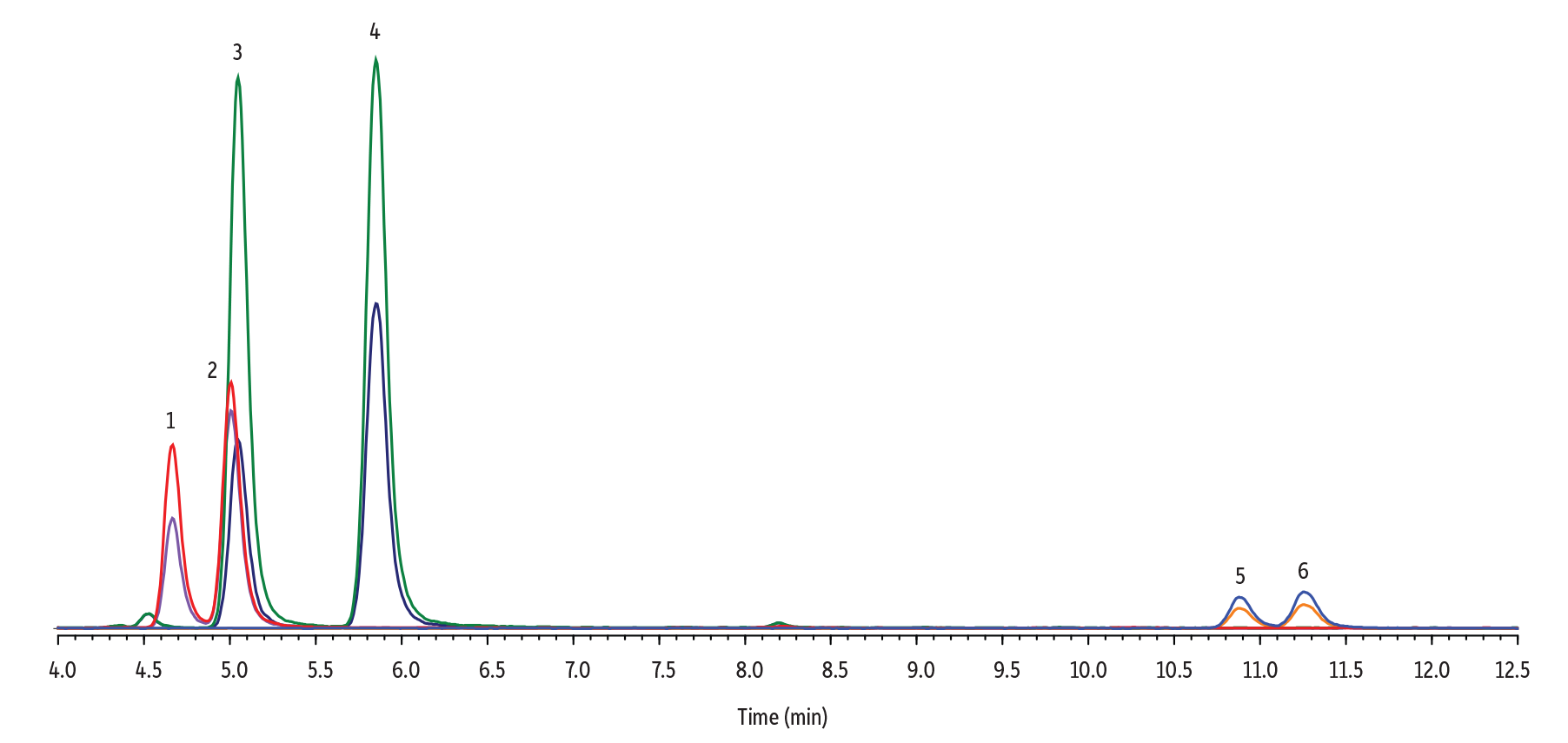
LC_CF0826
Peaks
| Peaks | tR (min) | Conc. (ng/mL) | Precursor | Product 1 | Product 2 | |
|---|---|---|---|---|---|---|
| 1. | 11-OH-Δ8-THC | 4.66 | 50 | 331.0 | 313.0 | 201.1 |
| 2. | 11-OH-Δ9-THC | 5.00 | 50 | 331.0 | 313.0 | 201.1 |
| 3. | Δ8-THC-COOH | 5.04 | 250 | 345.1 | 327.0 | 299.2 |
| 4. | Δ9-THC-COOH | 5.85 | 250 | 345.1 | 327.0 | 299.2 |
| 5. | Δ8-THC | 10.88 | 50 | 315.0 | 193.0 | 123.2 |
| 6. | Δ9-THC | 11.26 | 50 | 315.0 | 193.0 | 123.2 |
Conditions
| Column | Raptor FluoroPhenyl (cat.# 9319A1E) | ||||||||||||||||||||||||||||||||||||
|---|---|---|---|---|---|---|---|---|---|---|---|---|---|---|---|---|---|---|---|---|---|---|---|---|---|---|---|---|---|---|---|---|---|---|---|---|---|
| Dimensions: | 100 mm x 3 mm ID | ||||||||||||||||||||||||||||||||||||
| Particle Size: | 2.7 µm | ||||||||||||||||||||||||||||||||||||
| Pore Size: | 90 Å | ||||||||||||||||||||||||||||||||||||
| Guard Column: | Raptor FluoroPhenyl EXP guard column cartridge 5 mm, 3 mm ID, 2.7 µm (cat.# 9319A0253) | ||||||||||||||||||||||||||||||||||||
| Temp.: | 40 °C | ||||||||||||||||||||||||||||||||||||
| Standard/Sample | |||||||||||||||||||||||||||||||||||||
| Δ8-Tetrahydrocannabinol (Δ8-THC) (cat.# 34090) | |||||||||||||||||||||||||||||||||||||
| Δ9-Tetrahydrocannabinol (Δ9-THC) (cat.# 34067) | |||||||||||||||||||||||||||||||||||||
| (±)11-nor-9-carboxy-Δ-9-THC (Δ9-THC-COOH) (cat.# 34068) | |||||||||||||||||||||||||||||||||||||
| Other compounds obtained separately. | |||||||||||||||||||||||||||||||||||||
| Diluent: | 40:60 Water:methanol, both with 0.1% formic acid (v/v) | ||||||||||||||||||||||||||||||||||||
| Inj. Vol.: | 5 µL | ||||||||||||||||||||||||||||||||||||
| Mobile Phase | |||||||||||||||||||||||||||||||||||||
| A: | Water, 0.1% formic acid | ||||||||||||||||||||||||||||||||||||
| B: | Methanol, 0.1% formic acid | ||||||||||||||||||||||||||||||||||||
| |||||||||||||||||||||||||||||||||||||
| Max Pressure: | 390 bar |
| Detector | Shimadzu 8045 MS/MS |
|---|---|
| Ion Mode: | ESI+ |
| Instrument | Shimadzu Nexera X2 |
| Sample Preparation | Blank blood was spiked across the calibration range. Five hundred microliters of sample was added to a glass test tube. Fifty microliters of internal standard was added to each sample and vortexed. Samples were extracted by LLE. Five hundred microliters of HPLC grade water was added to each tube and vortexed. One hundred microliters of 10% acetic acid was added to each tube and vortexed. Two-and-a-half milliliters of 80:20 hexanes:ethyl acetate was added to each tube, capped, and vortexed until visibly combined. Samples were centrifuged at 2800 rpm for 15 minutes or until the two layers had completely separated. The supernatant was transferred to a clean test tube. Samples were dried down under nitrogen. Samples were reconstituted in 100 μL of 40:60 water:methanol, both with 0.1% formic acid, and vortexed. Samples were transferred to 2 mL short-cap, screw-thread vials (cat.# 21143) with glass vial inserts (cat.# 21776) and capped with short-cap, screw-thread closures (cat.# 24498). |
| Notes | The column was stored in 100% acetonitrile when not in use. |
优势:氟苯基色谱柱具有独特的选择性,可以满足毒理学中THC异构体的分离。
弱点:氟苯基可能需要比C18和联苯更长时间的平衡和再平衡。
EtG/EtS 专用色谱柱
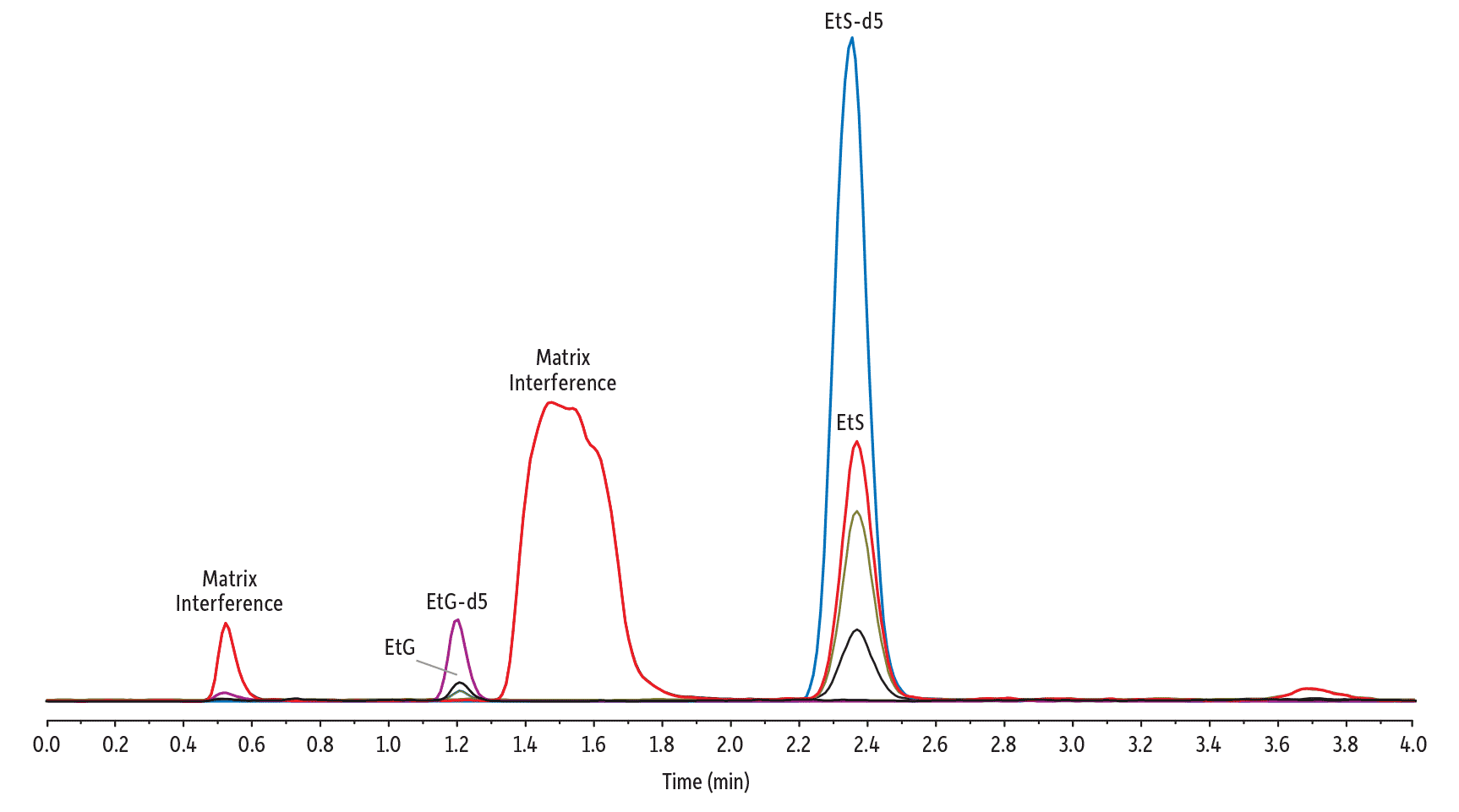
乙基葡糖苷酸(EtG)和硫酸乙酯(EtS)一般作为监测酒精使用的生物标志物。EtG 和 EtS 一般用LC-MS/MS 分析,分析中面临的主要问题有三个,一是目标物极性高保留差;二是目标物与基质干扰物容易共洗脱,容易遇到基质抑制问题;三是运行时间长。Raptor EtG/EtS 色谱柱是 Restek 专门为解决这些痛点而开发的独特固定相。EtG/EtS 色谱柱可为两种化合物提供稳定、一致的保留,并与基质完全分离,避免基质干扰(图4)。
LC_CF0739
Peaks
| Peaks | tR (min) | Conc. (ng/mL) | Precursor Ion | Product Ion | Product Ion | |
|---|---|---|---|---|---|---|
| 1. | Ethyl-β-D-glucuronide-d5 (EtG-d5) | 1.21 | 200 | 226.2 | 85.0 | – |
| 2. | Ethyl-β-D-glucuronide (EtG) | 1.23 | 500 | 221.2 | 75.1 | 85.1 |
| 3. | Ethyl sulfate-d5 (EtS-d5) | 2.36 | 50 | 130.1 | 98.0 | – |
| 4. | Ethyl sulfate (EtS) | 2.38 | 500 | 125.1 | 97.1 | 80.0 |
Conditions
| Column | Raptor EtG/EtS (cat.# 9325A12) | ||||||||||||||||||||
|---|---|---|---|---|---|---|---|---|---|---|---|---|---|---|---|---|---|---|---|---|---|
| Dimensions: | 100 mm x 2.1 mm ID | ||||||||||||||||||||
| Particle Size: | 2.7 µm | ||||||||||||||||||||
| Pore Size: | 90 Å | ||||||||||||||||||||
| Guard Column: | UltraShield UHPLC precolumn filter, 0.2 μm frit (cat.# 25809) | ||||||||||||||||||||
| Temp.: | 35 °C | ||||||||||||||||||||
| Standard/Sample | |||||||||||||||||||||
| Ethyl-β-D-glucuronide-d5 (EtG-d5) (cat.# 34102) | |||||||||||||||||||||
| Ethyl-β-D-glucuronide (EtG) (cat.# 34101) | |||||||||||||||||||||
| Ethyl sulfate-d5 sodium salt (EtS-d5) (cat.# 34104) | |||||||||||||||||||||
| Ethyl sulfate sodium salt (EtS) (cat.# 34103) | |||||||||||||||||||||
| Diluent: | 0.01% Formic acid in water | ||||||||||||||||||||
| Conc.: | 500 ng/mL (40x acetonitrile precipitation sample prep) | ||||||||||||||||||||
| Inj. Vol.: | 10 µL | ||||||||||||||||||||
| Mobile Phase | |||||||||||||||||||||
| A: | 0.01% Formic acid in water | ||||||||||||||||||||
| B: | 0.1% Formic acid in acetonitrile | ||||||||||||||||||||
|
| Detector | MS/MS |
|---|---|
| Ion Source: | Electrospray |
| Ion Mode: | ESI- |
| Mode: | MRM |
| Instrument | HPLC |
| Sample Preparation | A 500 ng/mL standard was prepared in urine. A 50 μL aliquot was mixed with 10 μL of internal standard (20 μg/mL EtG-d5 and 5 μg/mL EtS-d5 in water) and 150 µL of acetonitrile by vortexing at 3000 rpm for 10 seconds and centrifuged at 4300 rpm for 10 minutes at 10 °C. After centrifugation, 100 µL of the supernatant was diluted with 900 µL (40x dilution) of 0.01% formic acid in water. The sample was then vortexed at 3000 rpm for 10 seconds and injected for LC-MS/MS analysis. |
优势:该色谱柱具有独特的选择性,专门用于酒精代谢物分析。
弱点:为获得最佳结果,该色谱柱需要使用基质进行调节。本色谱柱具有特定用途,不适用于分析大量目标化合物。
结束语
毒理学实验室需要分析的化合物一般范围广泛、更新迅速且其化学性质差异巨大。这些化合物中的大多数可以用 C18 和联苯柱实现成功分析,它们具有互补的选择性。然而,THC 异构体和 EtG/EtS 等具有挑战性的分离将需要方法开发人员使用其它色谱柱,如 FluoroPhenyl/氟苯基或 EtG/EtS 专用柱。
为了更好协助方法开发人员建立相应分析方法,Restek提供色谱柱试用服务,关于方法的任何细节问题,欢迎随时联系 Restek 技术团队:4000 815 005。