


摘要
截止2020年底,全球已出现新精神活性物质1047种,其中约450种为近5年新出现的种类。我国已累计发现新精神活性物质9大类317种,近3年新发现50余种。至2024年底我国已列管509种麻醉品和精神物质(包括123种麻醉药品、166种精神药品、220种非药用类麻醉药品和精神药品),整类列管芬太尼类物质、合成大麻素类物质,是世界上列管毒品最多、管制最严的国家。分析检测不断出现的非法合成大麻素及其代谢物,成为一项艰巨且具有挑战性的任务。在此,我们将向大家展示Raptor Biphenyl 联苯核壳柱的良好保留能力和选择性,使用已有分析方法,即可分析更多新型化合物,该方法有助于提高实验室检测效率。
引言
随着各种新型合成大麻素类物质的出现,合成大麻素及代谢物的分析已成为许多法医毒理实验室的常规分析项目。在开发该类化合物分析方法时,需要综合兼顾分析时间、各待测物之间的分离度、方法的稳定性及对新增分析物的容纳能力,这些因素将直接影响方法的有效性和耐用性。Raptor Biphenyl联苯核壳柱结合了核壳颗粒快速分析与联苯固定相高选择性高分辨力,成为大麻素类物质分析的首选色谱柱。我们开发了一种只需简单稀释即可直接进样的分析方法来检测尿液中的合成大麻素及代谢物,这项创新性工作,可在不到7分钟时间内完成29种目标物的分离和检测。
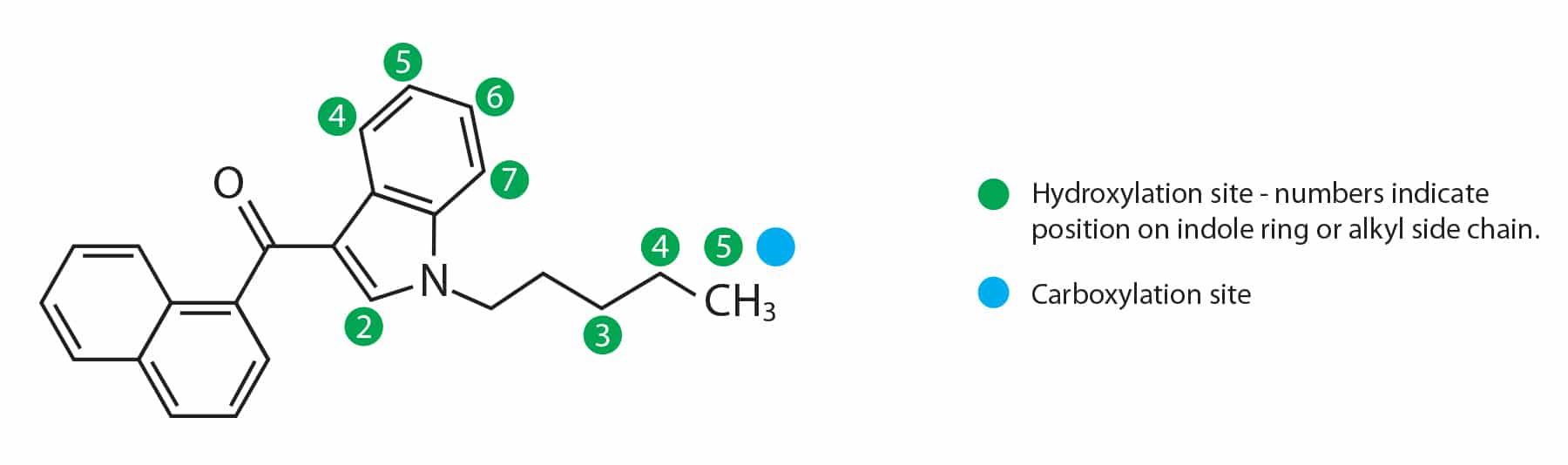
分析合成大麻素时,色谱分离某些无法仅通过MS定性的化合物至关重要。例如:合成大麻素JWH-018和JWH-073及其代谢物必须通过色谱分离,由于母体化合物有多个可用于羟基化的位点(图1),造成它们的单羟基化代谢物存在多个位置异构体。方法中目标化合物种类越多,获得足够分辨率的难度就越大。在此,我们扩展了初始方法,并演示在保证分辨率、避免基质干扰的情况下将新化合物添加到方法中。将新兴化合物添加到原有方法中的意义在于:面临新增化合物的分析需求时,实验室的色谱工作者可以专注于常规样品分析,而无须耗费大量时间和精力开发新方法。
实验
以尿液为溶剂制备样品,分析前,在 0.2μm PVDF Thomson SINGLE StEP 过滤瓶中用水:甲醇(50:50)稀释3倍待用。使用原有方法中的Raptor Biphenyl联苯柱作为分析柱。评估是在配备 Xevo TQ-S 的 Waters ACQUITY UPLC I-Class,和配备 SCIEX API 4500 MS/MS 的Shimadzu Nexera UHPLC 上进行的。两种系统都使用多反应监测(MRM)扫描模式,离子化方式为ESI+。仪器条件如下,图中提供了原始目标物和其它感兴趣的新添加化合物两个分析物类别。
| 分析柱: | Raptor Biphenyl (2.7 μm, 50 mm x 3.0 mm; 货号9309A5E) |
| 保护柱: | Raptor Biphenyl EXP 保护柱芯 (2.7 μm, 5 mm x 3.0 mm;货号9309A0253) |
| 流动相 A: | 水(0.1%甲酸) |
| 流动相 B: | 乙腈(0.1%甲酸) |
| 梯度 | T时间 (min) %B |
| 0.00 25 | |
| 1.00 25 | |
| 5.00 95 | |
| 5.50 95 | |
| 5.51 25 | |
| 7.00 25 | |
| 流速: | 0.6 mL/min |
| 进样量: | 2 µL |
| 柱温: | 30 °C |
| 离子化方式: | ESI+ |
结果与讨论
今天,实验室面临着一项艰巨的任务,即跟上非法制药商为规避检测而生产的不断新增的合成大麻素类物质。此前,我们建立了一种检测尿液中17种合成大麻素、12种代谢物和5种内标(浓度水平5ng/mL)的分析方法。由于Raptor Biphenyl联苯色谱柱独特的选择性和保留能力,该方法在5分钟的循环时间和7分钟的总分析时间内实现了异构体的完全分离。并且与主要基质干扰物有良好分离,避免了基质干扰(图2)。
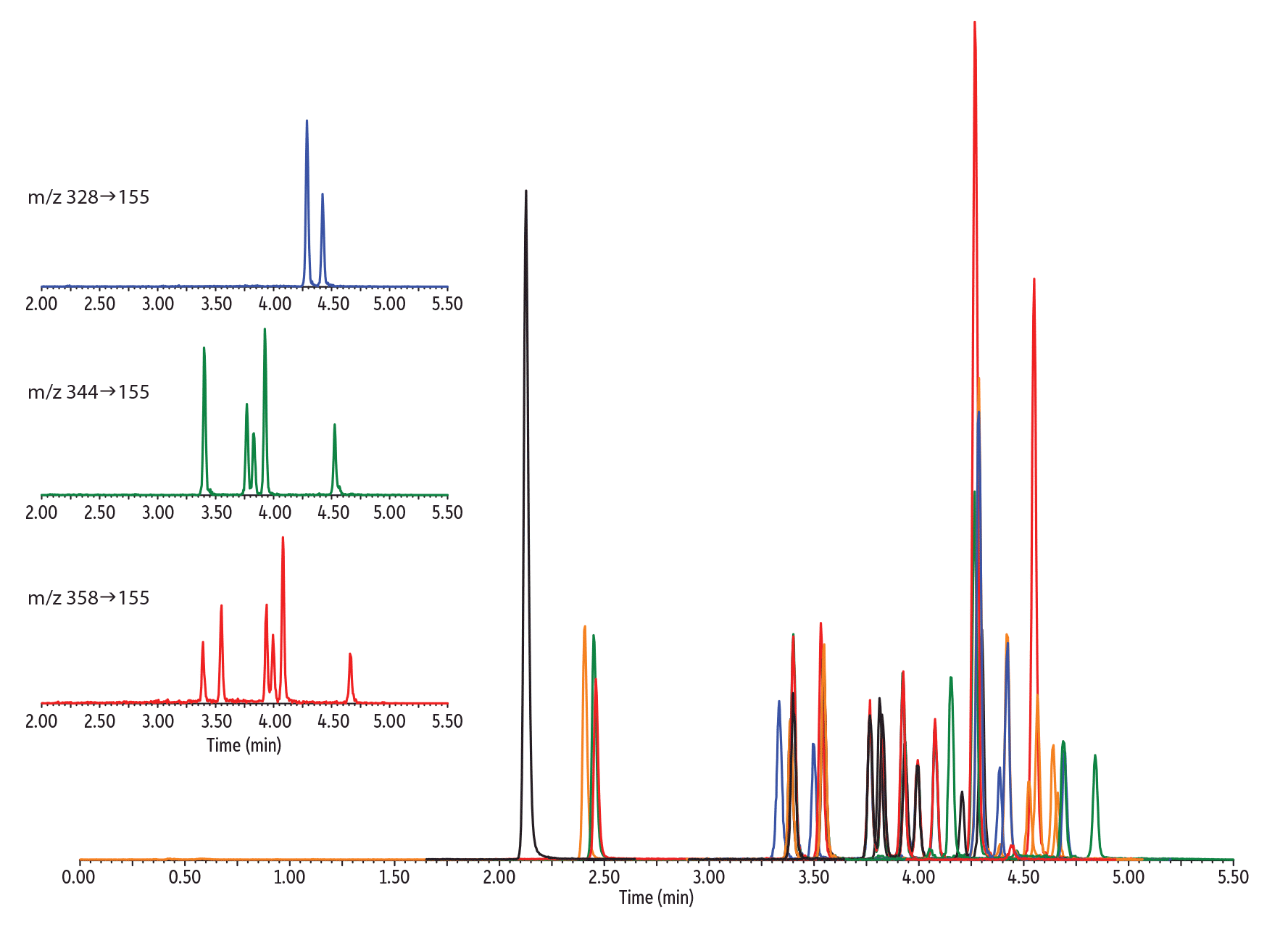
LC_CF0613
Peaks
| Peaks | tR (min) | Precursor Ion | Quantifier Product Ion | Qualifier Product Ion | |
|---|---|---|---|---|---|
| 1. | Pravadoline | 2.15 | 379.29 | 135.04 | 114.16 |
| 2. | AM2233 | 2.44 | 459.25 | 112.2 | 98.15 |
| 3. | JWH-200-d5 | 2.47 | 390.34 | 155.07 | NA |
| 4. | JWH-200 | 2.48 | 385.28 | 155.07 | 114.16 |
| 5. | WIN 55, 212 | 3.34 | 427.29 | 155.07 | 127.14 |
| 6. | JWH-073 N-butanoic acid | 3.39 | 358.27 | 155.08 | 127.11 |
| 7. | JWH-073 4-hydroxybutyl | 3.4 | 344.24 | 155.09 | 127.09 |
| 8. | JWH-018 N-pentanoic acid | 3.49 | 372.18 | 155.08 | 127.14 |
| 9. | JWH-018 5-hydroxypentyl-d5 | 3.54 | 363.5 | 155.08 | NA |
| 10. | JWH-018 5-hydroxypentyl | 3.55 | 358.27 | 155.08 | 127.11 |
| 11. | JWH-073 6-hydroxyindole | 3.77 | 344.24 | 155.09 | 127.09 |
| 12. | JWH-073 5-hydroxyindole-d7 | 3.81 | 351.21 | 155.07 | NA |
| 13. | JWH-073 5-hydroxyindole | 3.83 | 344.24 | 155.09 | 127.09 |
| 14. | JWH-073 7-hydroxyindole | 3.92 | 344.24 | 155.09 | 127.09 |
| 15. | JWH-018 6-hydroxyindole | 3.94 | 358.27 | 155.08 | 127.11 |
| 16. | JWH-018 5-hydroxyindole | 3.99 | 358.27 | 155.08 | 127.11 |
| 17. | JWH-018 7-hydroxyindole | 4.08 | 358.27 | 155.08 | 127.11 |
| Peaks | tR (min) | Precursor Ion | Quantifier Product Ion | Qualifier Product Ion | |
|---|---|---|---|---|---|
| 18. | RCS-4 | 4.15 | 322.27 | 135.12 | 77.09 |
| 19. | XLR-11 | 4.21 | 330.25 | 232.17 | 125.1 |
| 20. | JWH-015-d7 | 4.27 | 335.28 | 155.07 | NA |
| 21. | JWH-250 | 4.27 | 336.28 | 121.12 | 91.07 |
| 22. | JWH-015 | 4.29 | 328.26 | 155.07 | 127.13 |
| 23. | AM2201 | 4.30 | 360.26 | 155.07 | 127.14 |
| 24. | JWH-203 | 4.39 | 340.23 | 188.18 | 125.09 |
| 25. | JWH-073 | 4.42 | 328.26 | 155.07 | 127.13 |
| 26. | UR-144 | 4.44 | 312.32 | 214.17 | 125.1 |
| 27. | JWH-073 4-hydroxyindole | 4.53 | 344.24 | 155.09 | 127.09 |
| 28. | JWH-018-d9 | 4.55 | 351.34 | 155.07 | NA |
| 29. | JWH-018 | 4.57 | 342.27 | 155.08 | 127.11 |
| 30. | JWH-081 | 4.64 | 372.28 | 185.12 | 157.09 |
| 31. | JWH-018 4-hydroxyindole | 4.66 | 358.27 | 155.08 | 127.11 |
| 32. | JWH-122 | 4.69 | 356.29 | 169.12 | 141.11 |
| 33. | JWH-019 | 4.70 | 356.29 | 155.07 | 127.1 |
| 34. | JWH-210 | 4.84 | 370.31 | 183.12 | 153.26 |
Conditions
| Column | Raptor Biphenyl (cat.# 9309A5E) | ||||||||||||||||||||||||||||
|---|---|---|---|---|---|---|---|---|---|---|---|---|---|---|---|---|---|---|---|---|---|---|---|---|---|---|---|---|---|
| Dimensions: | 50 mm x 3.0 mm ID | ||||||||||||||||||||||||||||
| Particle Size: | 2.7 µm | ||||||||||||||||||||||||||||
| Guard Column: | Raptor Biphenyl EXP guard column cartridge 5.0 mm, 3.0 mm ID, 2.7 µm (cat.# 9309A0253) | ||||||||||||||||||||||||||||
| Temp.: | 30 °C | ||||||||||||||||||||||||||||
| Standard/Sample | |||||||||||||||||||||||||||||
| Conc.: | 5 ng/mL standard was prepared in urine and diluted 3x with 50:50 methanol:water | ||||||||||||||||||||||||||||
| Inj. Vol.: | 2 µL | ||||||||||||||||||||||||||||
| Mobile Phase | |||||||||||||||||||||||||||||
| A: | 0.1% Formic acid in water | ||||||||||||||||||||||||||||
| B: | 0.1% Formic acid in acetonitrile | ||||||||||||||||||||||||||||
|
| Detector | MS/MS |
|---|---|
| Ion Mode: | ESI+ |
| Mode: | MRM |
| Instrument | UHPLC |
为了确定是否可以在原始方法中添加新待测物,在与既定方法相同的条件下分析了五种补充合成大麻素和丹参素A(一种精神药物萜类化合物)。这些新兴药物在人尿中以 50 ng/mL 制备并稀释(如图 3 所示)。Raptor 联苯色谱柱具有出色的保留能力,可将目标化合物与早期洗脱基质干扰分离。此外,所有六种新兴药物都在梯度内完成洗脱,并且彼此分离良好。原始药物列表和新兴药物列表的叠加色谱图表明,新药物化合物可以轻松添加到现有方法中,而无需更换分析柱、调整流动相或梯度洗脱程序(图4)。
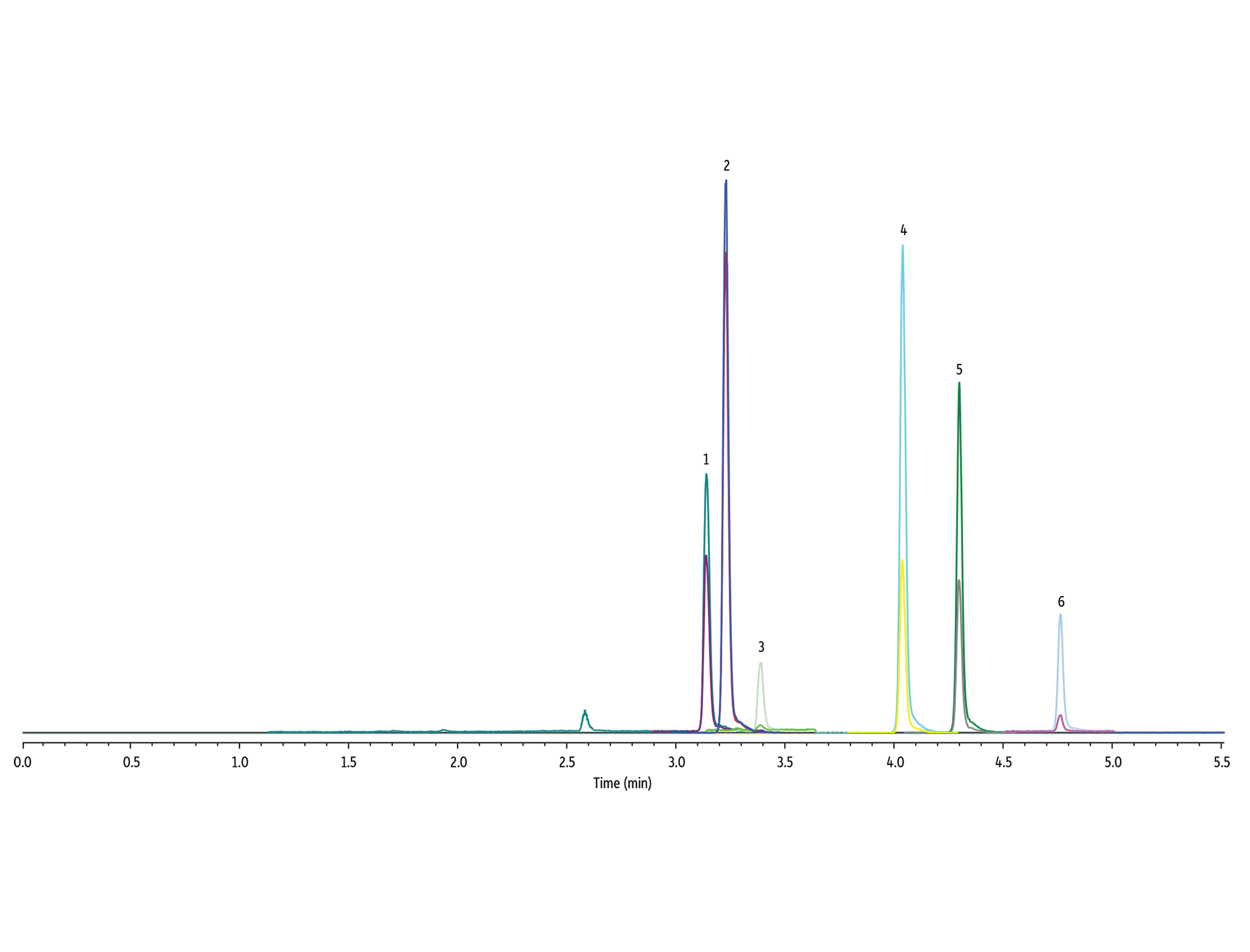
LC_CF0668
Peaks
| Peaks | tR (min) | Precursor Ion | Product Ion | Product Ion | |
|---|---|---|---|---|---|
| 1. | AB-FUBINACA | 3.15 | 369.0 | 253.0 | 109.1 |
| 2. | AB-PINACA | 3.23 | 331.2 | 215.0 | 286.1 |
| 3. | Salvinorin A | 3.39 | 433.1 | 373.0 | 91.1 |
| 4. | 5F-PB-22 | 4.04 | 377.2 | 232.1 | 143.9 |
| 5. | PB-22 | 4.30 | 359.2 | 214.0 | 144.0 |
| 6. | APINACA (AKB-48) | 4.76 | 366.3 | 135.1 | 93.1 |
Conditions
| Column | Raptor Biphenyl (cat.# 9309A5E) | ||||||||||||||||||||||||||||
|---|---|---|---|---|---|---|---|---|---|---|---|---|---|---|---|---|---|---|---|---|---|---|---|---|---|---|---|---|---|
| Dimensions: | 50 mm x 3.0 mm ID | ||||||||||||||||||||||||||||
| Particle Size: | 2.7 µm | ||||||||||||||||||||||||||||
| Pore Size: | 90 Å | ||||||||||||||||||||||||||||
| Guard Column: | Raptor Biphenyl EXP guard column cartridge 5 mm, 3 mm ID, 2.7 µm (cat.# 9309A0253) | ||||||||||||||||||||||||||||
| Temp.: | 30 °C | ||||||||||||||||||||||||||||
| Standard/Sample | |||||||||||||||||||||||||||||
| Conc.: | 50 ng/mL in human urine and diluted 3x in a 0.2 μm PVDF Thomson SINGLE StEP filter vial with 50:50 water:methanol | ||||||||||||||||||||||||||||
| Inj. Vol.: | 2 µL | ||||||||||||||||||||||||||||
| Mobile Phase | |||||||||||||||||||||||||||||
| A: | 0.1% Formic acid in water | ||||||||||||||||||||||||||||
| B: | 0.1% Formic acid in acetonitrile | ||||||||||||||||||||||||||||
| |||||||||||||||||||||||||||||
| Max Pressure: | 400 bar |
| Detector | MS/MS |
|---|---|
| Ion Mode: | ESI+ |
| Mode: | Scheduled MRM |
| Instrument | UHPLC |
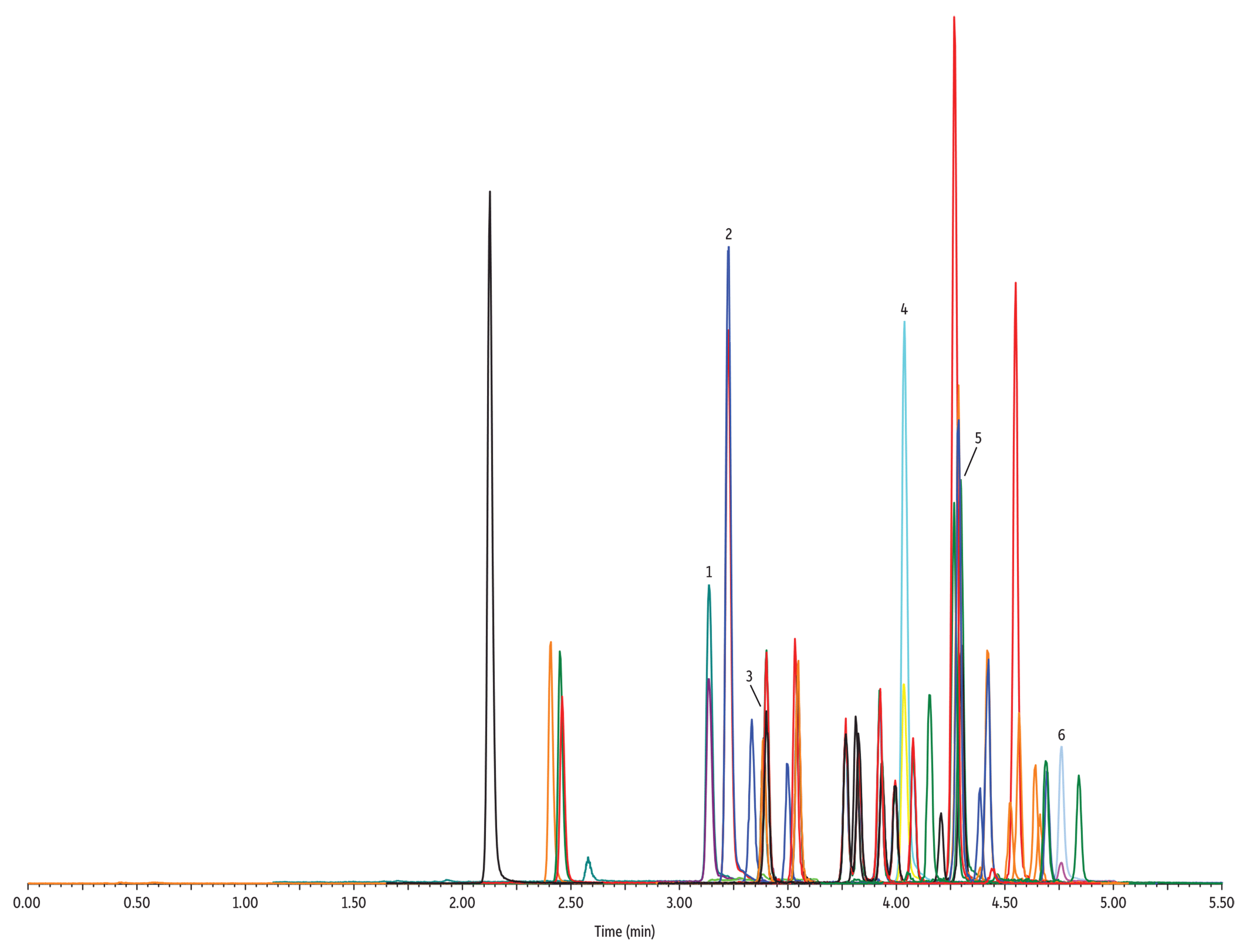
LC_CF0669
Peaks
| Peaks | tR (min) | Precursor Ion | Product Ion | Product Ion | |
|---|---|---|---|---|---|
| 1. | AB-FUBINACA | 3.15 | 369.0 | 253.0 | 109.1 |
| 2. | AB-PINACA | 3.23 | 331.2 | 215.0 | 286.1 |
| 3. | Salvinorin A | 3.39 | 433.1 | 373.0 | 91.1 |
| 4. | 5F-PB-22 | 4.04 | 377.2 | 232.1 | 143.9 |
| 5. | PB-22 | 4.30 | 359.2 | 214.0 | 144.0 |
| 6. | APINACA (AKB-48) | 4.76 | 366.3 | 135.1 | 93.1 |
Conditions
| Column | Raptor Biphenyl (cat.# 9309A5E) | ||||||||||||||||||||||||||||
|---|---|---|---|---|---|---|---|---|---|---|---|---|---|---|---|---|---|---|---|---|---|---|---|---|---|---|---|---|---|
| Dimensions: | 50 mm x 3.0 mm ID | ||||||||||||||||||||||||||||
| Particle Size: | 2.7 µm | ||||||||||||||||||||||||||||
| Pore Size: | 90 Å | ||||||||||||||||||||||||||||
| Guard Column: | Raptor Biphenyl EXP guard column cartridge 5 mm, 3 mm ID, 2.7 µm (cat.# 9309A0253) | ||||||||||||||||||||||||||||
| Temp.: | 30 °C | ||||||||||||||||||||||||||||
| Standard/Sample | |||||||||||||||||||||||||||||
| Inj. Vol.: | 2 µL | ||||||||||||||||||||||||||||
| Mobile Phase | |||||||||||||||||||||||||||||
| A: | 0.1% Formic acid in water | ||||||||||||||||||||||||||||
| B: | 0.1% Formic acid in acetonitrile | ||||||||||||||||||||||||||||
| |||||||||||||||||||||||||||||
| Max Pressure: | 400 bar |
| Detector | MS/MS |
|---|---|
| Ion Mode: | ESI+ |
| Mode: | Scheduled MRM |
| Instrument | UHPLC |
这里使用的方法,可以同时分析新兴药物和合成大麻素关键化合物,包括JWH-018和JWH-073及其代谢物。值得注意的是:从结果可以看出,与使用5 μm全多孔颗粒色谱柱相比(图5和图6),Raptor Biphenyl 核壳柱所用分析时间更短。也就是说:与传统的全多孔硅胶颗粒色谱柱相比,使用 Raptor Biphenyl 核壳色谱柱可在更短的时间内更好地分离更多化合物(包括异构体和新兴化合物),从而提高实验室样品分析通量。
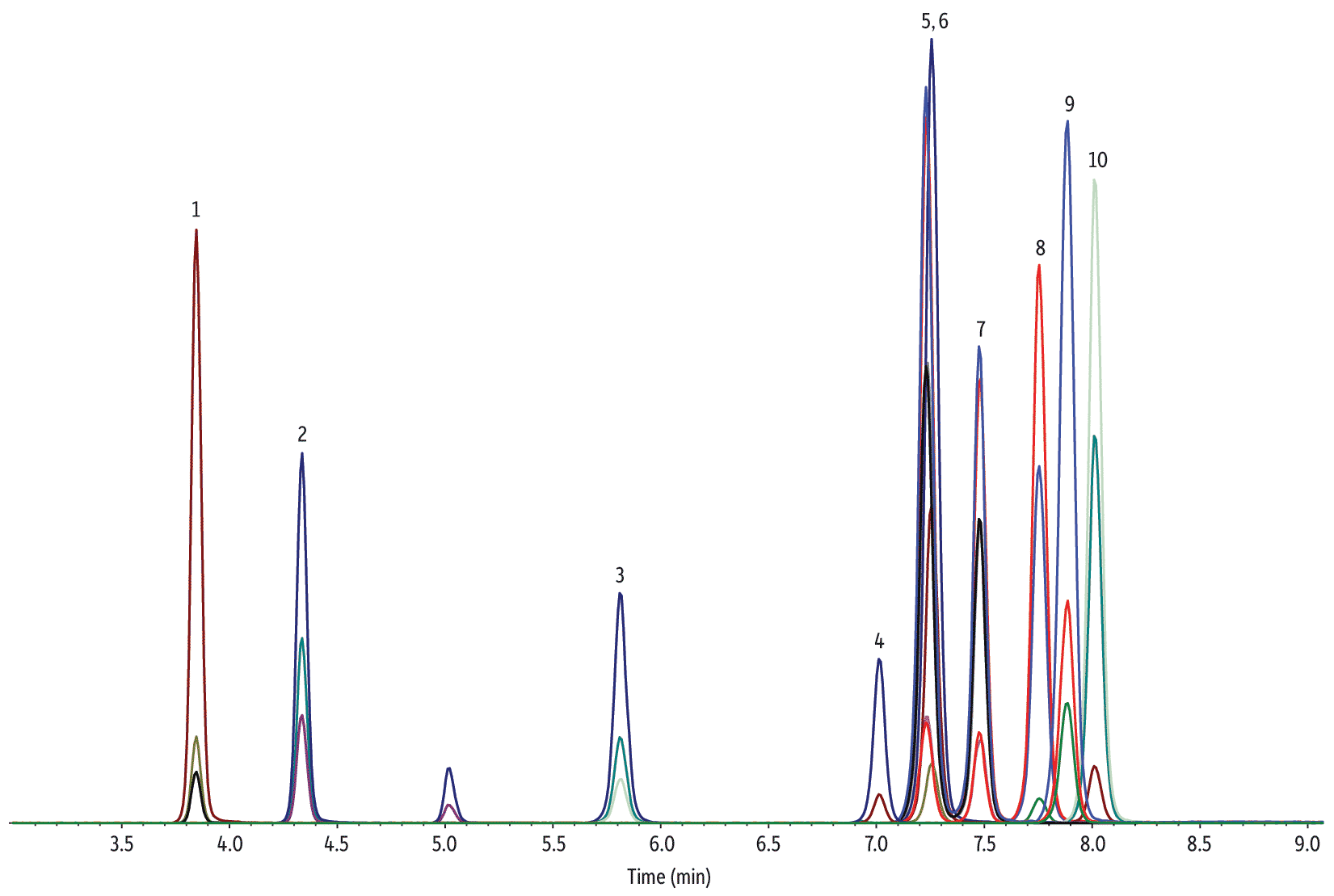
LC_CF0526
Peaks
| Peaks | tR (min) | MRM1 | MRM2 | MRM3 | |
|---|---|---|---|---|---|
| 1. | WIN 48098 | 3.85 | 379.2/135.2 | 379.2/114.3 | 379.2/107.3 |
| 2. | JWH-200 | 4.34 | 385.3/114.0 | 385.3/127.0 | 385.3/155.0 |
| 3. | WIN 55212-2 | 5.81 | 427.2/155.1 | 427.2/127.1 | 427.2/100.1 |
| 4. | AM-694 | 7.01 | 436.1/309.1 | 436.1/231.2 | — |
| 5. | JWH-015 | 7.23 | 328.3/155.1 | 328.3/200.1 | 328.3/200.1 |
| 6. | JWH-250 | 7.25 | 336.3/121.1 | 336.3/91.0 | 336.3/144.0 |
| 7. | JWH-073 | 7.48 | 328.2/127.1 | 328.2/155.2 | 328.2/199.9 |
| 8. | JWH-018 | 7.75 | 342.3/127.1 | 342.3/155.1 | 342.3/144.9 |
| 9. | JWH-081 | 7.88 | 372.2/185.2 | 372.2/157.1 | 372.2/144.1 |
| 10. | JWH-019 | 8.01 | 356.3/127.2 | 356.3/155.0 | 356.3/144.2 |
Conditions
| Column | Ultra Biphenyl (cat.# 9109552) | ||||||||||||||||||||
|---|---|---|---|---|---|---|---|---|---|---|---|---|---|---|---|---|---|---|---|---|---|
| Dimensions: | 50 mm x 2.1 mm ID | ||||||||||||||||||||
| Particle Size: | 5 µm | ||||||||||||||||||||
| Pore Size: | 100 Å | ||||||||||||||||||||
| Temp.: | 40 °C | ||||||||||||||||||||
| Standard/Sample | |||||||||||||||||||||
| Diluent: | Methanol | ||||||||||||||||||||
| Conc.: | 50 ng/mL | ||||||||||||||||||||
| Inj. Vol.: | 5 µL | ||||||||||||||||||||
| Mobile Phase | |||||||||||||||||||||
| A: | Water + 0.1% formic acid | ||||||||||||||||||||
| B: | Acetonitrile + 0.1% formic acid | ||||||||||||||||||||
|
| Detector | AB SCIEX API 4000 MS/MS |
|---|---|
| Model #: | API 4000 |
| Ion Source: | TurboIonSpray® |
| Ion Mode: | ESI+ |
| Ion Spray Voltage: | 3000 kV |
| Curtain Gas: | 40 psi (275.8 kPa) |
| Gas 1: | 40 psi (275.8 kPa) |
| Gas 2: | 40 psi (275.8 kPa) |
| Source Temp.: | 600 °C |
| Mode: | MRM |
| Dwell Time: | 10 ms |
| Instrument | Applied Biosystems/MDS Sciex LC-MS/MS System |
| Acknowledgement | Special thanks to Paul Kennedy and Cayman Chemical for standards. |
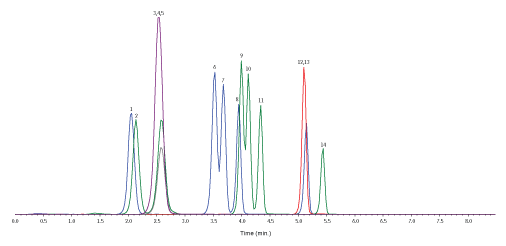
LC_CF0531
Peaks
| Peaks | tR (min) | MRM1 | MRM2 | MRM3 | |
|---|---|---|---|---|---|
| 1. | JWH-073 4-hydroxybutyl | 2.05 | 344.1/155.1 | 344.1/127.2 | 344.1/144.0 |
| 2. | JWH-073 N-butanoic acid | 2.13 | 358.1/155.1 | 358.1/127.3 | 358.1/144.1 |
| 3. | JWH-018 N-pentanoic acid-d4 (IS) | 2.54 | 376.1/155.2 | 376.1/230.4 | 376.1/248.3 |
| 4. | JWH-018 N-pentanoic acid | 2.58 | 372.1/155.2 | 372.1/127.1 | 372.1/144.1 |
| 5. | JWH-018 5-hydroxypentyl | 2.58 | 358.1/155.2 | 358.1/127.1 | 358.1/230.3 |
| 6. | JWH-073 6-hydroxyindole | 3.52 | 344.1/155.2 | 344.1/127.1 | 344.1/145.1 |
| 7. | JWH-073 5-hydroxyindole | 3.68 | 344.1/155.2 | 344.1/127.1 | 344.1/160.0 |
| Peaks | tR (min) | MRM1 | MRM2 | MRM3 | |
|---|---|---|---|---|---|
| 8. | JWH-073 7-hydroxyindole | 3.95 | 344.2/155.1 | 344.2/127.1 | 344.2/216.3 |
| 9. | JWH-018 6-hydroxyindole | 4.00 | 358.1/155.1 | 358.1/127.2 | 358.1/145.2 |
| 10. | JWH-018 5-hydroxyindole | 4.12 | 358.1/155.1 | 358.1/127.2 | 358.1/160.2 |
| 11. | JWH-018 7-hydroxyindole | 4.34 | 358.1/155.1 | 358.1/127.1 | 358.1/230.3 |
| 12. | JWH-073 4-hydroxyindole-d7 (IS) | 5.10 | 351.3/127.0 | 351.3/223.0 | 351.3/155.0 |
| 13. | JWH-073 4-hydroxyindole | 5.14 | 344.1/155.2 | 344.1/127.2 | 344.1/160.0 |
| 14. | JWH-018 4-hydroxyindole | 5.44 | 358.1/155.2 | 358.1/230.2 | 358.1/127.1 |
Conditions
| Column | Ultra Biphenyl (cat.# 9109552) | ||||||||||||||||||||||||||||||||
|---|---|---|---|---|---|---|---|---|---|---|---|---|---|---|---|---|---|---|---|---|---|---|---|---|---|---|---|---|---|---|---|---|---|
| Dimensions: | 50 mm x 2.1 mm ID | ||||||||||||||||||||||||||||||||
| Particle Size: | 5 µm | ||||||||||||||||||||||||||||||||
| Pore Size: | 100 Å | ||||||||||||||||||||||||||||||||
| Temp.: | 25 °C | ||||||||||||||||||||||||||||||||
| Standard/Sample | |||||||||||||||||||||||||||||||||
| Diluent: | 50:50 Mobile phase | ||||||||||||||||||||||||||||||||
| Conc.: | 50 ng/mL extracted spiked sample | ||||||||||||||||||||||||||||||||
| Inj. Vol.: | 10 µL | ||||||||||||||||||||||||||||||||
| Mobile Phase | |||||||||||||||||||||||||||||||||
| A: | Water + 0.05% acetic acid (pH approx. 3.4) | ||||||||||||||||||||||||||||||||
| B: | Acetonitrile + 0.05% acetic acid | ||||||||||||||||||||||||||||||||
|
| Detector | API 4000 |
|---|---|
| Model #: | API 4000 |
| Ion Source: | TurboIonSpray® |
| Ion Mode: | ESI+ |
| Ion Spray Voltage: | 3 kV |
| Curtain Gas: | 40 psi (275.8 kPa) |
| Gas 1: | 40 psi (275.8 kPa) |
| Gas 2: | 40 psi (275.8 kPa) |
| Interface Temp.: | 600 °C |
| Mode: | MRM |
| Dwell Time: | 30 ms |
| Instrument | API LC-MS/MS |
| Sample Preparation | 1) Spike 1 mL blank urine sample with analytes and internal standards. 2) Hydrolyze sample: – Add 1 mL solution of beta-glucuronidase from keyhole limpet (Sigma-Aldrich cat.# G8132). Solution is prepared at a concentration of 5000 Fishman units/mL in 100 mM ammonium acetate buffer (pH = 5.0). – Incubate at 60 °C for 3 hours. 3) Extract sample on 6 mL, 500 mg C18 high-load end-capped Resprep SPE cartridge cat.# 24052: – Add 1 mL 5 mM ammonium acetate + 0.1% acetic acid (pH = 4.2) to sample. – Condition cartridge with 3x 1 mL acetonitrile. – Condition cartridge with 3x 1 mL 5 mM ammonium acetate + 0.1% acetic acid. – Apply sample and allow to pass through under gravity. – Rinse with 3x 1 mL 5 mM ammonium acetate + 0.1% acetic acid. – Dry cartridge with vacuum for 10 minutes. – Elute with 3 mL acetonitrile followed by 3 mL butyl chloride. 4) Concentrate sample: – Evaporate sample to dryness under nitrogen at 40 °C. – Reconstitute in 0.5 mL water + 0.05% acetic acid:acetonitrile + 0.05% acetic acid (50:50). |
| Notes | Resprep SPE cartridge cat.# 24052 was used to produce this chromatogram, but has since been discontinued. For assistance choosing a replacement for this application, contact Restek Technical Service or your local Restek representative. – – – – – – Since multiple transitions are shared between analytes, only 5 transitions are shown to simplify viewing. The transitions shown are: 344.1/155.1 (blue trace), 358.1/155.1 (green trace), 372.1/155.2 (grey trace), 376.1/155.2 (purple trace – internal standard), 351.3/127.0 (red trace – internal standard). CAD Gas was set to 4 psi. For 1 ng/mL calibration level, see chromatogram LC_CF0530. For 500 ng/mL calibration level, see chromatogram LC_CF0532. |
| Acknowledgement | Special thanks to Cayman Chemical for reference standards. |
结论
因需要在分析测试服务中添加新的化合物,造成分析合成大麻素及其代谢物的实验室面临着越来越大的压力。虽然可以通过开发新方法来满足这一需求,但在现有方法中添加新的待测物可以节省时间和资源。如上所示,可以看到Raptor Biphenyl联苯核壳柱在分析该类物质中的优势;由于该色谱柱具有高保留性和选择性特性,仅需 5 分钟即可分析 35 种待测物(包括异构体和新兴化合物)。