


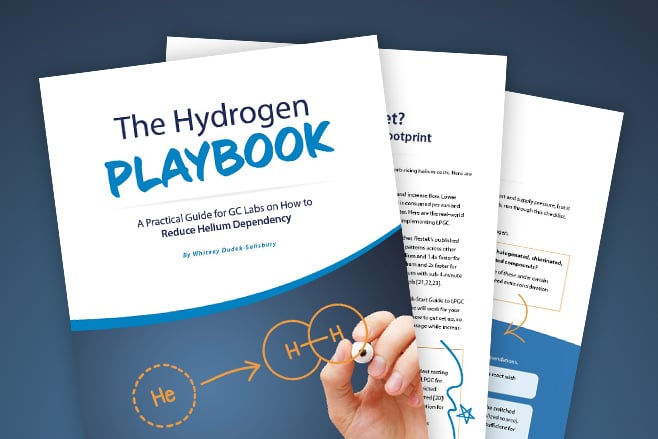
The Hydrogen Playbook:
A Practical Guide for GC Labs
The current helium shortage has created major pain points for GC labs that aren’t going away anytime soon. Hydrogen is the leading alternative to helium as a GC carrier gas because it runs most separations faster at equivalent resolution, can be generated safely on-site instead of needing to be purchased, and works with most common detectors. This guide is about how to switch to hydrogen carrier gas, so you save money, speed up sample analysis, and reduce your dependency on the volatile helium market.
5
global helium shortages since the early 2000s, three in the last eight years [1].
2x
or even higher price increases experienced by some markets [2].
45%
of normal volume, that’s how far suppliers have cut some allocations [3].
What’s Inside?
A real-world plan for moving your methods off helium where you can and cutting consumption where you can’t.
- Why is hydrogen the best alternative?
Generating your own carrier gas, engineering safety in, and the throughput case for switching. - Is hydrogen right for you?
A three-part compatibility check across your methods, your detectors, and your facility. - Ready to convert?
Here’s how. Assessing methods, choosing a generator, and translating conditions with free EZGC software. - Not ready for hydrogen yet?
What to do right now to cut helium use for methods that have to stay on it.
Complete the form to the right to gain instant access!
Frequently Asked Questions
Can you use hydrogen as a carrier gas with GC–MS?
Yes, with some caveats. Most modern MS systems can run hydrogen if the pumping system can handle the higher flow, although ion trap instruments generally cannot. Expect to check for sensitivity loss and spectral shifts on some compounds and to requalify library matches as well as retention times. Always check with your instrument manufacturer for any required or recommended changes (e.g., specialized sources) before switching a method to hydrogen.
Is hydrogen carrier gas safe in a lab?
Hydrogen is a flammable gas, so it requires engineered controls: hydrogen sensors with alarms, adequate ventilation, stainless steel rather than copper tubing, and a flashback arrestor on the line. Most labs use an on-site generator instead of cylinders, which keeps the stored volume small enough that a leak can’t easily reach the explosive limit. Generators also include important safety features, such as leak sensors and automatic shutoff capabilities that can prevent gas buildup by turning the generator off.
How much faster is hydrogen than helium?
Hydrogen’s optimal linear velocity is higher than helium’s, and its van Deemter curve stays flat across a much wider velocity range, so you can run analyses faster without losing resolution. Documented conversions have cut run times by 30–50%; one detailed hydrocarbon analysis went from 146 minutes to 71. Actual gains depend on your column and whether you are running an isothermal or temperature-programmed method.
Do I need a new column to switch to hydrogen?
Not always. Many GC methods convert on the existing column by recalculating the flow and the oven program. However, for GC-MS work, methods on larger bore columns (e.g., 0.25 mm ID or greater) will need to be converted to smaller bore columns (e.g., 0.18 or 0.15 mm ID) to manage the vacuum-outlet pressure drop and to maintain sensitivity. You can explore different column dimensions and even stationary phases without setting foot in the lab using Restek’s free EZGC method translation and chromatogram modeling software.
References
- Peak Scientific, Helium shortage 5.0. April 21, 2026, https://www.peakscientific.com/discover/news/helium-shortage-50/ (accessed September 25, 2026).
- ChemAnalyst, Helium price trend and forecast in top 10 leading countries worldwide. June 2026, https://www.chemanalyst.com/Pricing-data/bulk-helium-1100 (accessed September 25, 2026).
- T. Taylor, Not another helium crisis!, LCGC Int. June 9, 2022, https://www.chromatographyonline.com/view/-not-another-helium-crisis- (accessed September 25, 2026).
Download the Free Playbook!
Complete this form to gain instant access.