

摘要
由于全氟和多氟烷基物质(PFAS)在日常用品中广泛应用,导致这些化合物在环境中不断累积。由于这些化合物普遍存在于水源和土壤等环境介质中,它们正通过多种途径进入供人类消费的食品中。乳制品牛奶便是可能受PFAS等环境污染物影响的食品之一,因此建立全面、稳定且准确的检测方法十分重要。本研究开发了一种灵敏可靠的LC-MS/MS方法,用于测定牛奶中的PFAS,检测限低至0.01 μg/kg。
引言
全氟和多氟烷基物质(PFAS)是一类用途广泛的人造有机化合物,应用于众多产品和领域。碳-氟键非常稳定,使得这类化合物在环境中不易降解。因此,在饮用水、土壤、废水、食品和生物基质中均已检出此类化合物。接触PFAS可能导致多种潜在不良健康影响,包括胆固醇水平升高、出生体重下降、疫苗抗体反应降低、肾癌和睾丸癌、妊娠高血压(先兆子痫)以及肝酶改变等[1]。由于食品已被确认为PFAS的暴露途径之一,因此建立稳健、可靠且灵敏的方法来监测供人类消费食品中的这些化合物至关重要。
全球超过60亿人消费乳制品牛奶和奶制品[2],因此监测这些产品中的PFAS污染势在必行。欧洲食品安全局(EFSA)评估了四种PFAS,它们占下限暴露量的一半:全氟辛烷磺酸(PFOS)、全氟辛酸(PFOA)、全氟己烷磺酸(PFHxS)和全氟壬酸(PFNA)。研究发现,幼儿和儿童的暴露量高出两倍[3],这可能源于他们摄入牛奶及其他相关食品。EFSA建议将这四种PFAS的暴露量限制在每周每公斤体重不超过4.4ng[3]。在美国,缅因州农业保护和林业部(DACF)将牛奶中PFOS的行动阈值设定为210ng/L(即0.21 μg/kg)[4]。
本研究建立了一种采用LC-MS/MS分析牛奶中PFAS的方法,涵盖EFSA评估的四种PFAS以及欧盟饲料和食品中卤化持久性有机污染物(POPs)参考实验室(EURL)指导文件中列出的其他24种化合物。该指导文件规定,EFSA所确定的牛奶中四种PFAS分析物的定量限(LOQ)须低至≤0.01 μg/kg [5]。本实验采用该目标LOQ,并应用于全部28种PFAS。该分析的一个潜在难点在于共提取物(如胆汁酸)的存在。胆汁酸(牛磺熊去氧胆酸(TUDCA)、牛磺鹅去氧胆酸(TCDCA)和牛磺去氧胆酸(TDCA))在生物源性样品中可能以高浓度存在,且与PFOS具有相同的质量跃迁。为准确定量PFOS,需在样品前处理过程中去除胆汁酸,或通过色谱方法将其与PFOS分离。在本应用中,开发了一种用于分析牛奶中28种PFAS的工作流程。样品前处理采用QuEChERS法结合dSPE(分散固相萃取)进行。该工作流程对EFSA评估的四种PFAS分析取得了优异的结果,并且对大多数目标化合物均表现出良好的方法准确度和精密度。
实验部分
色谱方法
采用 Waters ACQUITY Premier 系统,配备 Waters XEVO TQ Absolute 三重四极杆质谱仪,进行牛奶中 PFAS 的 LC-MS/MS 分析。需要注意的是,在混合器与进样器之间安装了一根 PFAS 延迟柱,以防止进样器上游可能存在的 PFAS 污染与样品中的PFAS 共洗脱。方法条件如下:
色谱柱:
- 分析柱: Force C18, 50 mm x 2.1 mm, 3 μm (货号9634352)
- 保护柱芯: Force C18 EXP, 5 mm x 2.1 mm (货号 963450252)
PFAS延迟柱, 50 mm x 2.1 mm, 5 μm (货号 27854)
进样量: 5 µL
流动相 A: 水含5 mM 乙酸铵
流动相 B: 甲醇 : 乙腈 (50:50)
流速: 0.6 mL/min
柱温: 50 °C
梯度:
| 时间 (min) | %B |
| 0.00 | 5 |
| 3.00 | 40 |
| 9.00 | 70 |
| 9.50 | 95 |
| 10.50 | 100 |
| 11.00 | 100 |
| 11.01 | 5 |
| 13.00 | 5 |
离子化方式: ESI-
扫描模式: 时间分段MRM
样品与标准品制备
所有产品和溶剂在使用前均经PFAS污染检测。牛奶样品为当地采购,包括减脂牛奶(样品1)、脱脂牛奶(样品2)和低脂牛奶(样品3)。称取10克牛奶样品于50 mL离心管(货号25846)中,分别添加0.01或0.05 μg/kg的加标水平。向样品中加入同位素标记内标至0.1 μg/kg,短暂涡旋混匀。加入乙腈(10 mL)、甲酸(150 μL)和Q-sep QuEChERS萃取盐包(货号25847),涡旋约30秒。将样品转移至振荡器上振荡10分钟,随后以4200 rpm离心5分钟。取上清液分装至含900 mg MgSO₄、300 mg PSA、150 mg GCB的Q-sep QuEChERS dSPE 15 mL离心管(货号26126)中,涡旋约30秒,再以4200 rpm离心5分钟。取上清液(6 mL)分装至洁净的15 mL离心管中,于35 °C下使用氮吹蒸发仪吹干90分钟。样品用甲醇:水(60:40)(400 μL)复溶,涡旋约30秒,以4200 rpm离心5分钟。取上清液分装至聚丙烯样品瓶(货号23243)中,用聚乙烯螺口盖(货号23244)密封,进样5 μL进行分析。
工作校准标准品使用Restek的PFAS 28种校准标准品(货号30734)制备,其他PFAS标准品单独获取。将标准品分装至聚丙烯液相样品瓶中,用60:40的甲醇:水稀释至浓度为0.03–50 ng/mL。每条校准曲线包含七个或八个浓度水平,具体取决于分析物的灵敏度。内标以1.5 ng/mL的浓度加标至校准标准品中。定量采用溶剂校准结合同位素稀释法进行。各目标分析物的MRM离子对及其对应使用的同位素内标列于表I。
表 I:用于 LC-MS/MS 分析牛奶中 PFAS 的母离子、子离子和同位素标记内标
| 化合物 | 母离子 1 | 子离子 1 | 母离子 2 | 子离子 2 | 内标 |
|---|---|---|---|---|---|
| PFBA | 212.94 | 168.89 | NA | NA | M4PFBA |
| PFPeA | 262.93 | 218.89 | NA | NA | M5PFPeA |
| PFHxA | 313.10 | 119.03 | 313.10 | 268.88 | M5PFHxA |
| PFHpA | 363.16 | 169.06 | 363.16 | 319.09 | M4PFHpA |
| PFOA | 413.10 | 168.90 | 413.10 | 368.96 | M8PFOA |
| PFNA | 463.10 | 219.02 | 463.10 | 419.01 | M9PFNA |
| PFDA | 513.17 | 219.06 | 513.17 | 469.16 | M6PFDA |
| PFUnDA | 562.78 | 268.82 | 562.78 | 518.80 | M7-PFUnDA |
| PFDoA | 612.52 | 318.90 | 612.52 | 568.80 | M2-PFDoA |
| PFTrDA | 662.78 | 168.87 | 662.78 | 618.74 | M2-PFTeDA |
| PFTeDA | 712.78 | 168.87 | 712.78 | 668.74 | M2-PFTeDA |
| PFBS | 298.97 | 79.97 | 298.97 | 98.89 | M3PFBS |
| PFPeS | 349.10 | 79.98 | 349.10 | 98.98 | M5PFHxA |
| PFHxS | 398.80 | 79.82 | 398.80 | 98.82 | M3PFHxS |
| PFHpS | 448.78 | 79.82 | 448.78 | 98.82 | M9PFNA |
| PFOS | 498.78 | 79.89 | 498.78 | 98.82 | M8PFOS |
| PFNS | 548.65 | 79.89 | 548.65 | 98.82 | M7-PFUnDA |
| PFDS | 598.78 | 98.82 | 598.79 | 79.89 | M2-PFDoA |
| PFUnDS | 648.65 | 79.88 | 648.65 | 98.82 | M2-PFDoA |
| PFTrDS | 748.59 | 79.88 | 748.90 | 98.88 | M2-PFTeDA |
| PFDoS | 698.71 | 79.89 | 698.71 | 98.88 | M2-PFTeDA |
| FOSA | 497.75 | 77.87 | 497.75 | 477.76 | M7-PFUnDA |
| ADONA | 376.90 | 84.97 | 376.90 | 250.93 | M4PFHpA |
| HFPO-Da | 284.87 | 168.89 | 284.87 | 184.83 | M5PFHxA |
| 9Cl-PF3ONS | 530.78 | 350.85 | 532.84 | 352.78 | M7-PFUnDA |
| 11Cl-PF3OUdS | 630.71 | 450.81 | 632.71 | 452.81 | M2-PFDoA |
| Capstone A | 526.90 | 180.96 | 526.90 | 506.91 | M9PFNA |
| Capstone B | 568.81 | 548.85 | 568.81 | 548.90 | M9PFNA |
结果与讨论
色谱分离性能
在分析组织样品中的PFAS时,通常存在胆汁酸干扰的问题。牛磺脱氧胆酸(TDCA)是一种在肝脏中形成的内源性胆汁酸,可以在生物样品中被高浓度检测到。这种化合物与牛磺酸去氧胆酸(TUDCA) 和牛磺酸鹅去氧胆酸 (TCDCA) 一起,都与PFOS具有相同的MRM离子对(499→80),并且也可能干扰FOSA。因此,要么需要从样品中去除胆汁酸,要么需要将其与受影响的化合物实现色谱分离。从样品中选择性地去除胆汁酸而不影响目标分析物是非常具有挑战的;因此,本文采用将胆汁酸与目标待测物色谱分离的方式分析牛奶样品中的PFAS。
我们对甲醇和乙腈均作为有机流动相进行了测试。首先采用快速梯度对甲醇进行测试,结果表明使用该有机流动相需要投入更多的资源进行方法开发,才能有望解决干扰问题。使用乙腈时,在快速梯度条件下,三种胆汁酸均能轻松与PFOS实现分离,但部分PFAS的灵敏度相比使用甲醇时有所降低。因此,我们采用了两种有机改性剂的50:50混合溶液,该比例在保证良好灵敏度的同时,也能实现胆汁酸与PFOS的良好分离。用于牛奶中PFAS分析的最终LC-MS/MS方法即使用甲醇和乙腈的50:50混合溶液作为有机流动相,具体条件见图1。
下图:使用相同色谱条件分析的三种胆汁酸的色谱图。
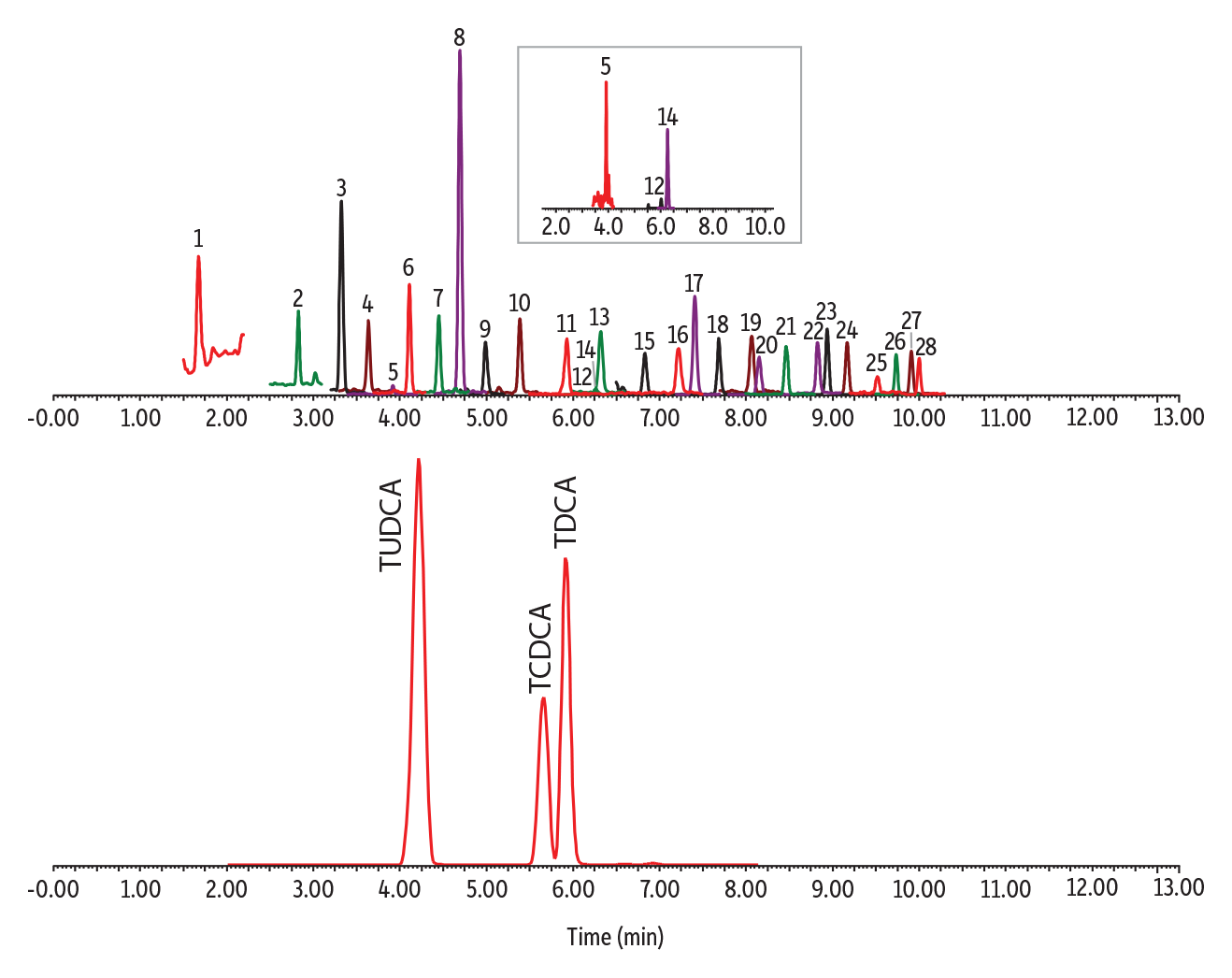
LC_FF0630
Peaks
| Peaks | Precursor Ion 1 | Product Ion | |
|---|---|---|---|
| 1. | Perfluorobutanoic acid (PFBA) | 212.94 | 168.89 |
| 2. | Perfluoropentanoic acid (PFPeA) | 262.93 | 218.89 |
| 3. | Perfluorobutane sulfonic acid (PFBS) | 298.96 | 79.97 |
| 4. | Perfluorohexanoic acid (PFHxA) | 313.09 | 119.03 |
| 5. | Hexafluoropropylene oxide dimer acid (HFPO-DA) | 284.86 | 168.88 |
| 6. | Perfluoropentane sulfonic acid (PFPeS) | 349.10 | 79.98 |
| 7. | Perfluoroheptanoic acid (PFHpA) | 363.15 | 169.06 |
| 8. | <a class="cmpd_link" title="View compound information for Ammonium 4,8-dioxa-3H-perfluorononanoate (ADONA)” title=”View compound information for Ammonium 4,8-dioxa-3H-perfluorononanoate (ADONA)” href=”https://ez.restek.com/compound/view/en/919005-14-4/Ammonium 4,8-dioxa-3H-perfluorononanoate”>Ammonium 4,8-dioxa-3H-perfluorononanoate (ADONA) | 376.90 | 84.97 |
| 9. | Perfluorohexane sulfonic acid (PFHxS) | 398.80 | 79.82 |
| 10. | Perfluorooctanoic acid (PFOA) | 413.09 | 168.90 |
| 11. | Perfluoroheptane sulfonic acid (PFHpS) | 448.78 | 79.82 |
| 12. | <a class="cmpd_link" title="View compound information for 1-Propanaminium, N-(carboxymethyl)-N,N-dimethyl-3-[[(3,3,4,4,5,5,6,6,7,7,8,8,8-tridecafluorooctyl)sulfonyl]amino]-, hydroxide (Capstone B)” title=”View compound information for 1-Propanaminium, N-(carboxymethyl)-N,N-dimethyl-3-[[(3,3,4,4,5,5,6,6,7,7,8,8,8-tridecafluorooctyl)sulfonyl]amino]-, hydroxide (Capstone B)” href=”https://ez.restek.com/compound/view/en/34455-29-3/1-Propanaminium, N-(carboxymethyl)-N,N-dimethyl-3-[[(3,3,4,4,5,5,6,6,7,7,8,8,8-tridecafluorooctyl)sulfonyl]amino]-, hydroxide”>1-Propanaminium, N-(carboxymethyl)-N,N-dimethyl-3-[[(3,3,4,4,5,5,6,6,7,7,8,8,8-tridecafluorooctyl)sulfonyl]amino]-, hydroxide (Capstone B) | 568.81 | 548.85 |
| 13. | Perfluorononanoic acid (PFNA) | 463.09 | 219.01 |
| 14. | <a class="cmpd_link" title="View compound information for 1-Propanaminium, N,N-dimethyl-N-oxide-3-[[(3,3,4,4,5,5,6,6,7,7,8,8,8-tridecafluorooctyl)sulfonyl]amino]-, hydroxide (Capstone A)” title=”View compound information for 1-Propanaminium, N,N-dimethyl-N-oxide-3-[[(3,3,4,4,5,5,6,6,7,7,8,8,8-tridecafluorooctyl)sulfonyl]amino]-, hydroxide (Capstone A)” href=”https://ez.restek.com/compound/view/en/80475-32-7/1-Propanaminium, N,N-dimethyl-N-oxide-3-[[(3,3,4,4,5,5,6,6,7,7,8,8,8-tridecafluorooctyl)sulfonyl]amino]-, hydroxide”>1-Propanaminium, N,N-dimethyl-N-oxide-3-[[(3,3,4,4,5,5,6,6,7,7,8,8,8-tridecafluorooctyl)sulfonyl]amino]-, hydroxide (Capstone A) | 526.90 | 180.96 |
| Peaks | Precursor Ion 1 | Product Ion | |
|---|---|---|---|
| 15. | Perfluorooctane sulfonic acid (PFOS) | 498.78 | 79.89 |
| 16. | Perfluorodecanoic acid (PFDA) | 513.16 | 219.06 |
| 17. | 9-chlorohexadecafluoro-3-oxanonane-1-sulfonic acid (9Cl-PF3ONS) | 530.77 | 350.85 |
| 18. | Perfluorononane sulfonic acid (PFNS) | 548.65 | 79.89 |
| 19. | Perfluoroundecanoic acid (PFUnA) | 562.78 | 268.82 |
| 20. | Perfluorooctane sulfonic acid (FOSA) | 497.75 | 77.87 |
| 21. | Perfluorodecane sulfonic acid (PFDS) | 598.78 | 98.82 |
| 22. | Perfluorododecanoic acid (PFDoA) | 612.52 | 318.90 |
| 23. | 11-chloroeicosafluoro-3-oxaundecane-1sulfonic acid (11Cl-PF3OUdS) | 630.71 | 450.81 |
| 24. | Perfluoroundecane sulfonic acid (PFUnDS) | 648.65 | 79.88 |
| 25. | Perfluorotridecanoic acid (PFTrDA) | 662.78 | 168.87 |
| 26. | Perfluorododecane sulfonic acid (PFDoS) | 698.71 | 79.89 |
| 27. | Perfluorotetradecanoic acid (PFTeDA) | 712.78 | 168.87 |
| 28. | Perfluorotridecane sulfonic acid (PFTrDS) | 748.59 | 79.88 |
Conditions
| Column | Force C18 (cat.# 9634352) | ||||||||||||||||||||||||||||||||||||
|---|---|---|---|---|---|---|---|---|---|---|---|---|---|---|---|---|---|---|---|---|---|---|---|---|---|---|---|---|---|---|---|---|---|---|---|---|---|
| Dimensions: | 50 mm x 2.1 mm ID | ||||||||||||||||||||||||||||||||||||
| Particle Size: | 3 µm | ||||||||||||||||||||||||||||||||||||
| Pore Size: | 100 Å | ||||||||||||||||||||||||||||||||||||
| Guard Column: | Force EXP C18 guard cartridge 5 mm, 2.1 mm ID (cat.# 963450252) | ||||||||||||||||||||||||||||||||||||
| Temp.: | 50 °C | ||||||||||||||||||||||||||||||||||||
| Standard/Sample | |||||||||||||||||||||||||||||||||||||
| PFAS 28 calibration standard (cat.# 30734) | |||||||||||||||||||||||||||||||||||||
| Other standards obtained externally. | |||||||||||||||||||||||||||||||||||||
| Diluent: | Methanol:water (60:40) | ||||||||||||||||||||||||||||||||||||
| Conc.: | Analytes spiked at 0.01 μg/kg in milk | ||||||||||||||||||||||||||||||||||||
| Inj. Vol.: | 5 µL | ||||||||||||||||||||||||||||||||||||
| Mobile Phase | |||||||||||||||||||||||||||||||||||||
| A: | Water, 5 mM ammonium acetate | ||||||||||||||||||||||||||||||||||||
| B: | Methanol:acetonitrile (50:50) | ||||||||||||||||||||||||||||||||||||
| |||||||||||||||||||||||||||||||||||||
| Max Pressure: | 360 bar |
| Detector | Waters Xevo TQ Absolute |
|---|---|
| Ion Mode: | ESI- |
| Mode: | MRM |
| Instrument | Waters ACQUITY Premier |
| Sample Preparation | Ten grams of milk were weighed into a 50 mL centrifuge tube (cat.# 25846) and fortified at 0.01 μg/kg. Isotopically labeled internal standards (50 μL) were spiked into the sample and briefly vortexed. Acetonitrile (10 mL); formic acid (150 μL); and a Q-sep QuEChERS extraction salt packet (cat.# 25847) were added to the sample and vortexed for ~30 seconds. The samples were transferred to a shaker table and shaken for 10 minutes. The samples were then centrifuged for 5 minutes at 4200 rpm. The supernatant was aliquoted into a Q-sep QuEChERS dSPE 15 mL centrifuge tube containing 900 mg MgSO4; 300 mg PSA; and 150 mg GCB (cat.# 26126) and then vortexed for ~30 seconds followed by centrifuging for 5 minutes at 4200 rpm. The supernatant was aliquoted (6 mL) into a clean 15 mL centrifuge tube and dried down at 35 °C for 90 minutes using a Biotage TurboVap. The samples were reconstituted in methanol:water 60:40 (400 μL); vortexed for ~30 seconds; and centrifuged for 5 minutes at 4200 rpm. The supernatant was aliquoted into a polypropylene vial (cat.# 23243) and capped with a polyethylene screw cap (cat.# 23244) and 5 μL was injected for analysis. |
| Notes | A PFAS delay column (cat.# 27854) was installed before the injector. |
线性、准确性和精密度
在0.03/0.1–50 ng/mL的范围内对七或八种不同浓度进行校准。为了评估线性度,使用了 1/x 加权。所有化合物的 R2 值均≥0.991,证明了良好的线性(表 III)。
取三种牛奶样品,并以 1X目标LOQ和5X目标 LOQ 水平(分别为 0.01 μg/kg 和 0.05 μg/kg)进行强化。空白样品一式两份制备,一式三份进行分析。牛奶样品一式三份制备,一式三份进行分析。在空白样品中检测到的分析物在表 II 和表 III 中用星号标明,并从强化样品中减去产生的分析物水平。EFSA 评估的所有四种 PFAS 在 LOQ 加标水平上均获得了优异的回收率。0.01μg/kg 浓度时回收率为 101–112%,%RSD 为 3.81–16.6%,表现出优异的精密度(表 II)。
表II:EFSA评估的四种PFAS在0.01 μg/kg加标水平下的回收率(%)及相对标准偏差(%RSD)
| 平均回收率 (%RSD) n=9 | |||
|---|---|---|---|
| 样品 1 | 样品 2 | 样品 3 | |
| PFOA* | 108 (5.09) | 102 (6.21) | 105 (7.74) |
| PFNA | 112 (7.97) | 106 (8.19) | 101 (16.6) |
| PFHxS | 112 (5.93) | 106 (7.25) | 106 (12.8) |
| PFOS* | 109 (7.25) | 109 (3.81) | 102 (6.72) |
*I 空白样品中检出这些分析物的本底水平,已从加标样品的测定结果中扣除。
本次实验监测的28种PFAS中,大多数化合物均获得了可接受的回收率,在80–120%范围内。部分长链 PFAS 表现出较低的回收率,即 PFTrDA、PFTeDA、PFUnDS、PFTrDS、PFDoS、FOSA和Capstone B,这些化合物含有8-13个碳。在样品2(脱脂牛奶)中未观察到低回收率,表明其他样品中脂肪的存在可能对这类化合物的回收率产生了不利影响。全部28种PFAS的线性范围、R²值、回收率(%)及相对标准偏差(%RSD)汇总见表III。
表 III: 牛奶中的线性、准确性和精度
| 化合物 | 线性范围 (ng/mL) | 回收率(RSD百分比)n=9 | |||||||
|---|---|---|---|---|---|---|---|---|---|
| 样品 1 | 样品 2 | 样品 3 | |||||||
| 低 | 高 | R2 | 0.01 µg/kg | 0.05 µg/kg | 0.01 µg/kg | 0.05 µg/kg | 0.01 µg/kg | 0.05 µg/kg | |
| PFBA* | 0.1 | 50 | 0.996 | 90.1 (4.81) | 105 (7.06) | 103 (8.61) | 116 (2.91) | 115 (11.5) | 116 (4.95) |
| PFPeA | 0.1 | 50 | 0.996 | 105 (7.89) | 110 (5.45) | 102 (6.72) | 111 (2.55) | 107 (10.8) | 114 (2.80) |
| PFHxA | 0.1 | 50 | 0.996 | 114 (10.6) | 113 (5.13) | 104 (8.11) | 112 (5.49) | 118 (11.3) | 113 (6.11) |
| PFHpA | 0.03 | 50 | 0.997 | 117 (5.09) | 112 (7.31) | 108 (7.14) | 115 (2.69) | 111 (16.2) | 118 (4.21) |
| PFOA* | 0.1 | 50 | 0.995 | 108 (5.09) | 109 (4.62) | 102 (6.21) | 113 (2.56) | 105 (7.74) | 113 (3.28) |
| PFNA | 0.03 | 50 | 0.996 | 112 (7.97) | 109 (2.63) | 106 (8.19) | 110 (3.81) | 101 (16.6) | 101 (10.4) |
| PFDA | 0.03 | 50 | 0.997 | 111 (9.02) | 113 (5.55) | 107 (6.08) | 112 (4.13) | 112 (7.38) | 115 (3.26) |
| PFUnDA | 0.03 | 50 | 0.992 | 104 (7.52) | 109 (11.6) | 103 (10.9) | 107 (7.57) | 109 (8.90) | 110 (4.54) |
| PFDoA | 0.03 | 50 | 0.997 | 110 (7.57) | 109 (4.34) | 102 (6.72) | 112 (2.76) | 108 (9.77) | 114 (2.45) |
| PFTrDA | 0.03 | 50 | 0.999 | 75.9 (12.5) | 65.8 (7.68) | 86.7 (8.95) | 73.3 (8.64) | 71.8 (11.0) | 68.8 (12.2) |
| PFTeDA | 0.03 | 50 | 0.997 | 83.2 (14.5) | 83.8 (12.4) | 103 (6.91) | 109 (8.95) | 74.1 (17.2) | 78.4 (11.3) |
| PFBS* | 0.1 | 50 | 0.995 | 106 (11.9) | 109 (11.4) | 110 (11.2) | 112 (5.21) | 103 (7.18) | 109 (5.32) |
| PFPeS | 0.1 | 50 | 0.996 | 113 (6.32) | 119 (5.78) | 105 (6.19) | 113 (4.87) | 114 (8.03) | 115 (5.08) |
| PFHxS | 0.03 | 50 | 0.996 | 112 (5.93) | 114 (5.29) | 106 (7.25) | 111 (3.59) | 106 (12.8) | 113 (3.92) |
| PFHpS | 0.03 | 50 | 0.995 | 117 (5.14) | 121 (9.15) | 112 (5.57) | 116 (3.81) | 121 (5.04) | 119 (5.32) |
| PFOS* | 0.1 | 50 | 0.995 | 109 (7.25) | 110 (7.21) | 109 (3.81) | 113(4.03) | 102 (6.72) | 107 (4.62) |
| PFNS | 0.03 | 50 | 0.999 | 114 (17.1) | 88.5 (18.1) | 110 (11.5) | 90.1 (15.4) | 103 (15.5) | 84.3 (19.9) |
| PFDS | 0.03 | 50 | 0.997 | 92.6 (11.7) | 95.8 (6.01) | 101 (7.31) | 100 (9.33) | 99.2 (12.3) | 102 (11.8) |
| PFUnDS | 0.03 | 50 | 0.997 | 74.2 (9.48) | 95.5 (9.11) | 100 (9.94) | 113 (9.25) | 81.4 (20.7) | 104 (12.7) |
| PFTrDS | 0.03 | 50 | 0.994 | 67.9 (15.6) | 46.2 (9.53) | 88.1 (14.1) | 95.5 (10.6) | 43.2 (15.1) | 55.5 (6.04) |
| PFDoS | 0.03 | 50 | 0.997 | 55.6 (9.8) | 59.6 (8.22) | 96.3 (10.0) | 103 (9.33) | 62.1 (11.5) | 73.9 (7.29) |
| FOSA | 0.1 | 50 | 0.992 | 60.8 (12.6) | 59.4 (10.2) | 92.6 (8.16) | 95.5 (9.41) | 87.1 (15.3) | 84.0 (12.5) |
| ADONA | 0.03 | 50 | 0.996 | 111 (7.17) | 109 (7.91) | 93.8 (11.3) | 98.9 (4.52) | 93.8 (9.54) | 104 (6.00) |
| HFPO-Da | 0.1 | 50 | 0.996 | 106 (13.7) | 110 (7.69) | 111 (15.4) | 114 (12.7) | 125 (9.00) | 124 (4.31) |
| 9Cl-PF3ONS | 0.03 | 50 | 0.992 | 94.5 (3.37) | 99.3 (8.09) | 96.6 (10.3) | 98.9 (7.64) | 102 (12.8) | 106 (6.08) |
| 11Cl-PF3OUdS | 0.03 | 50 | 0.997 | 93.5 (6.74) | 97.8 (6.78) | 103 (12.2) | 114 (10.0) | 97.7 (11.2) | 102 (13.1) |
| Capstone A | 0.1 | 50 | 0.991 | 120 (12.1) | 126 (9.27) | 102 (16.5) | 108 (7.34) | 119 (6.44) | 114 (5.06) |
| Capstone B | 0.1 | 50 | 0.992 | 92.1 (11.6) | 68.3 (10.9) | 85.1 (15.2) | 71.7 (8.24) | 84.6 (15.3) | 71.4 (10.6) |
*这些分析物的空白样品中存在产生的水平,并从强化样品中扣除。
图2汇总了采用该LC-MS/MS方法分析牛奶样品中全部28种PFAS的结果。在0.01 μg/kg加标水平下,样品1中82%的分析物回收率处于80–120%范围内;样品2中100%的分析物达到该范围;样品3中79%的分析物达到该范围。除PFUnDS外,所有分析物的%RSD值均≤20%。

结论
该工作流程为采用LC-MS/MS分析牛奶中28种PFAS提供了一种简便可靠的方法。该方法能有效将目标分析物与具有相同质量跃迁的胆汁酸干扰物进行分离。通过采用QuEChERS提取和dSPE净化,样品前处理快速简便,该工作流程非常适合高通量PFAS检测实验室。结果表明,EFSA评估的四种PFAS均获得了优异的结果,且大多数其他分析物的结果均可接受。部分长链PFAS的回收率偏低,这可能与牛奶样品中脂肪的存在有关。尽管这些化合物的回收率较低,但该方法的精密度仍在可接受范围内。本方法可轻松应用于实验室,以可靠地监测乳制品牛奶中的PFAS污染。
参考文献
- Agency for Toxic Substances and Disease Registry. PFAS information for clinicians. Fact sheet. January 2024. https://www.atsdr.cdc.gov/pfas/docs/PFAS-info-for-clinicians-508.pdf
- Food and Agricultural Organization of the United Nations. Gateway to diary production and products. 2024. https://www.fao.org/dairy-production-products/en
- D. Schrenk, et al., Risk to human health related to the presence of perfluoroalkyl substances in food, EFSA J 18, (9) 2020. https://efsa.onlinelibrary.wiley.com/doi/10.2903/j.efsa.2020.6223
- Maine Department of Agriculture, Conservation, & Forestry. PFAS response. 202. https://www.maine.gov/dacf/ag/pfas/pfas-response.shtml
- European Union Reference Laboratory for Halogenated Persistent Organic Pollutants in Feed and Food. Guidance document on analytical parameters for the determination of per- and polyfluoroalkyl substances (PFAS) in food and feed. Version 1.2. May 2022. https://eurl-pops.eu/news/guidance-document-pfas/guidance-document-pfas
相关产品

您的PFAS分析需要帮助吗?
从方法选择到产品推荐,Restek PFAS 专家助您应对复杂分析流程,获得准确、可靠的分析结果。