


如果您所在实验室开展全氟烷基和多氟烷基物质(PFAS)的测试工作,那您一定知道,随着我们对这类“永久性化学物质”的普遍性、持久性和潜在健康风险的更多了解,人们对这类化合物的兴趣正在不断增长。随之对快速、准确和精确分析这类化合物的需求也在扩大。这些需求正推动更好分析方法的出现,而液相色谱柱的选择是构建方法的基础。随着越来越多的PFAS化合物被列入管控清单,特别是对超短链PFAS化合物的关注,新方法的建立变得尤为重要。在这里,我们将与大家探讨如何根据PFAS目标待测去选择合适的液相色谱柱。
固定相类型和规格的选择
确定您将研究的PFAS化合物范围,对于色谱柱固定相的选择最为重要。选择对目标待测物有良好保留的固定相是方法建立的第一步。
短链及以上 PFAS
当涉及到短链PFAS(C4-C6)及以上物质时,我们对不同类型色谱柱对比后发现,C18是最佳选择。随着PFAS分子上的烷基链变长,这些链与C18配体之间的相互作用增加,为保留和分离提供了很好的机制。因为保留能力足够强,因此可以使用相对较短的窄内径色谱柱快速有效地分离目标化合物。图1展示的是用RaptorC18,2.7 μm,50×2.1mm色谱柱在不到8分钟(总分析时间为10分钟)时间内轻松分离目标化合物,而且满足EPA537.1饮用水测试标准的要求。

LC_EV0560
Peaks
| Peaks | tR (min) | Conc. (ng/mL) | Precursor Ion | Product Ion | |
|---|---|---|---|---|---|
| 1. | Perfluorobutanesulfonic acid (PFBS) | 2.06 | 10 | 298.8 | 79.9 |
| 2. | Perfluoro-n-[1,2-13C2]hexanoic acid (13C2-PFHxA) | 3.03 | 5 | 314.9 | 270.0 |
| 3. | Perfluorohexanoic acid (PFHxA) | 3.04 | 5 | 312.9 | 268.7 |
| 4. | Tetrafluoro-2-heptafluoropropoxy-13C3-propanoic acid (13C3-HFPO-DA) | 3.36 | 5 | 286.8 | 168.7 |
| 5. | Hexafluoropropylene oxide dimer acid (HFPO-DA) | 3.38 | 5 | 285.0 | 168.9 |
| 6. | Perfluoroheptanoic acid (PFHpA) | 4.09 | 5 | 362.8 | 318.8 |
| 7. | Perfluorohexanesulfonic acid (PFHxS) | 4.22 | 10 | 398.8 | 79.9 |
| 8. | 4,8-Dioxa-3H-perfluorononanoic acid (ADONA) | 4.24 | 5 | 376.9 | 250.7 |
| 9. | Perfluoro-[1,2-13C2]octanoic acid (13C2-PFOA) | 4.88 | 5 | 415.0 | 370.0 |
| 10. | Perfluorooctanoic acid (PFOA) | 4.90 | 5 | 413.1 | 368.9 |
| 11. | Perfluorononanoic acid (PFNA) | 5.54 | 5 | 462.9 | 418.9 |
| 12. | Perfluoro-1-[1,2,3,4-13C4]octanesulfonic acid (13C4-PFOS) | 5.57 | 10 | 503.0 | 80.0 |
| Peaks | tR (min) | Conc. (ng/mL) | Precursor Ion | Product Ion | |
|---|---|---|---|---|---|
| 13. | Perfluorooctanesulfonic acid (PFOS) | 5.58 | 10 | 498.9 | 80.0 |
| 14. | 9-Chlorohexadecafluoro-3-oxanone-1-sulfonic acid (9Cl-PF3ONS) | 5.88 | 5 | 530.8 | 350.7 |
| 15. | Perfluoro-n-[1,2-13C2]decanoic acid (13C2-PFDA) | 6.08 | 5 | 514.9 | 469.9 |
| 16. | Perfluorodecanoic acid (PFDA) | 6.08 | 5 | 512.9 | 469.0 |
| 17. | N-deuteriomethylperfluoro-1-octanesulfonamidoacetic acid (d3-NMeFOSAA) | 6.28 | 10 | 572.9 | 418.8 |
| 18. | N-methyl perfluorooctanesulfonamidoacetic acid (NMeFOSAA) | 6.30 | 10 | 569.8 | 418.8 |
| 19. | N-deuterioethylperfluoro-1-octanesulfonamidoacetic acid (d5-NEtFOSAA) | 6.51 | 10 | 588.9 | 418.8 |
| 20. | N-ethyl perfluorooctanesulfonamidoacetic acid (NEtFOSAA) | 6.52 | 10 | 583.8 | 418.8 |
| 21. | Perfluoroundecanoic acid (PFUnA) | 6.55 | 5 | 562.9 | 518.8 |
| 22. | 11-chloroeicosafluoro-3-oxaundecane-1-sulfonic acid (11Cl-PF3OUdS) | 6.77 | 5 | 630.7 | 451.0 |
| 23. | Perfluorododecanoic acid (PFDoA) | 6.95 | 5 | 612.7 | 568.9 |
| 24. | Perfluorotridecanoic acid (PFTrDA) | 7.30 | 5 | 662.7 | 618.8 |
| 25. | Perfluorotetradecanoic acid (PFTA) | 7.60 | 5 | 712.7 | 668.7 |
Conditions
| Column | Raptor C18 (cat.# 9304A52) | ||||||||||||||||||||
|---|---|---|---|---|---|---|---|---|---|---|---|---|---|---|---|---|---|---|---|---|---|
| Dimensions: | 50 mm x 2.1 mm ID | ||||||||||||||||||||
| Particle Size: | 2.7 µm | ||||||||||||||||||||
| Pore Size: | 90 Å | ||||||||||||||||||||
| Temp.: | 40 °C | ||||||||||||||||||||
| Standard/Sample | |||||||||||||||||||||
| Diluent: | 96:4 Methanol:water | ||||||||||||||||||||
| Conc.: | 5-10 ng/mL | ||||||||||||||||||||
| Inj. Vol.: | 2 µL | ||||||||||||||||||||
| Mobile Phase | |||||||||||||||||||||
| A: | Water, 5 mM ammonium acetate | ||||||||||||||||||||
| B: | Methanol | ||||||||||||||||||||
|
| Detector | MS/MS |
|---|---|
| Ion Mode: | ESI- |
| Mode: | MRM |
| Instrument | HPLC |
| Notes | Want even better performance when analyzing metal-sensitive compounds? Check out Inert LC columns at www.restek.com/inert. |
超短链 PFAS
当 C8 PFAS 被禁用后,其它较短链的PFAS化合物被作为替代物使用。随着受关注PFAS清单化合物增加,C4 PFAS甚至“超短链”的(C2和C3)正受到越来越多的关注。随着碳链的缩短,PFAS化合物的极性明显增加,导致其在以疏水作用为主的C18色谱柱上的保留越来越弱。
对于全氟丙酸(PFPrA)和全氟丙磺酸(PFPrS)等C3 PFAS化合物,当选择合适的规格时,C18色谱柱仍然可以工作。如图2所示, Raptor C18,100 x 3 mm显示了出色的性能,可以在11分钟时间内快速分析包含C3长度的PFAS类化合物。
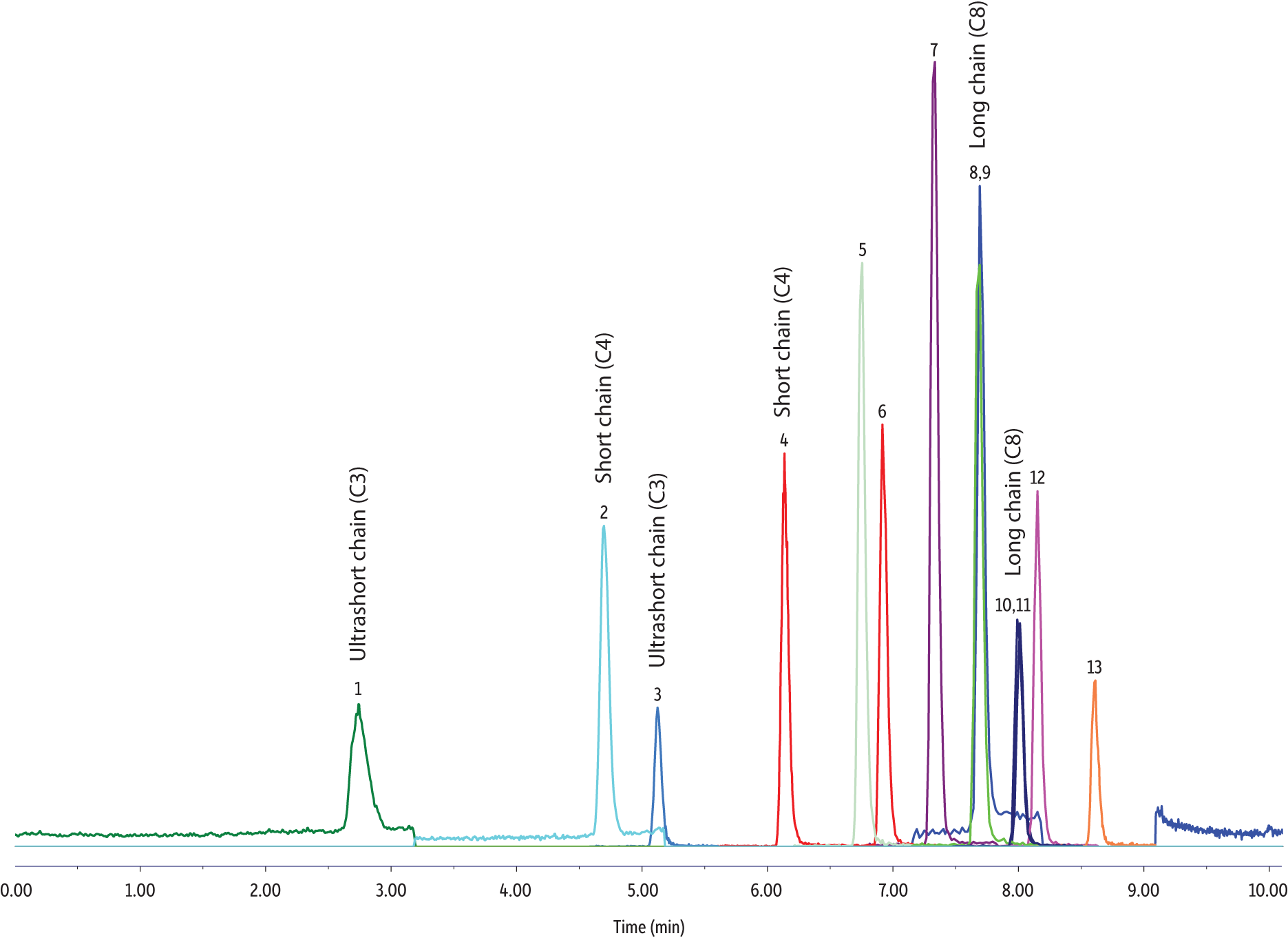
LC_EV0555
Peaks
| Peaks | tR (min) | Conc. (ng/L) | Precursor Ion | Product Ion | |
|---|---|---|---|---|---|
| 1. | Perfluoropropanoic acid (PFPrA) | 2.74 | 80 | 162.9 | 119.0 |
| 2. | Perfluorobutanoic acid (PFBA) | 4.69 | 80 | 212.8 | 169.0 |
| 3. | Perfluoropropanesulfonic acid (PFPrS) | 5.13 | 80 | 248.8 | 79.6 |
| 4. | Perfluorobutanesulfonic acid (PFBS) | 6.14 | 80 | 298.8 | 79.9 |
| 5. | Perfluoro-n-[1,2-13C2]hexanoic acid (13C2-PFHxA) | 6.75 | 50 | 314.9 | 270.0 |
| 6. | Hexafluoropropylene oxide-dimer acid (HFPO-DA) | 6.92 | 80 | 285.0 | 168.9 |
| Peaks | tR (min) | Conc. (ng/L) | Precursor Ion | Product Ion | |
|---|---|---|---|---|---|
| 7. | Ammonium 4,8-dioxa-3H-perfluorononanoate (ADONA) | 7.33 | 80 | 376.9 | 250.7 |
| 8. | Perfluorooctanoic acid (PFOA) | 7.70 | 80 | 413.1 | 368.9 |
| 9. | Perfluoro-[1,2-13C2]octanoic acid (13C2-PFOA) | 7.70 | 50 | 415.0 | 370.0 |
| 10. | Perfluorooctanesulfonic acid (PFOS) | 8.01 | 80 | 498.8 | 80.0 |
| 11. | Perfluoro-[1,2,3,4-13C4]octanesulfonic acid (13C4-PFOS) | 8.01 | 50 | 503.0 | 80.0 |
| 12. | 9-Chlorohexadecafluoro-3-oxanonane-1-sulfonate (9Cl-PF3ONS) | 8.15 | 80 | 530.8 | 350.7 |
| 13. | 11-Chloroeicosafluoro-3-oxanonane-1-sulfonate (11Cl-PF3OUdS) | 8.61 | 80 | 630.7 | 451.0 |
Conditions
| Column | Raptor C18 (cat.# 9304A1E) | ||||||||||||||||||||||||
|---|---|---|---|---|---|---|---|---|---|---|---|---|---|---|---|---|---|---|---|---|---|---|---|---|---|
| Dimensions: | 100 mm x 3 mm ID | ||||||||||||||||||||||||
| Particle Size: | 2.7 µm | ||||||||||||||||||||||||
| Pore Size: | 90 Å | ||||||||||||||||||||||||
| Temp.: | 40 °C | ||||||||||||||||||||||||
| Standard/Sample | |||||||||||||||||||||||||
| Conc.: | 80 ppt | ||||||||||||||||||||||||
| Inj. Vol.: | 10 µL | ||||||||||||||||||||||||
| Mobile Phase | |||||||||||||||||||||||||
| A: | Water, 5 mM ammonium acetate | ||||||||||||||||||||||||
| B: | Methanol | ||||||||||||||||||||||||
|
| Detector | MS/MS |
|---|---|
| Ion Mode: | ESI- |
| Mode: | MRM |
| Instrument | UHPLC |
| Sample Preparation | In a polypropylene vial, 250 µL of reagent water (fortified at 80 ppt) was mixed with 250 µL of 40:60 reagent water:methanol and 5 µL of internal standard solution (5 ng/mL of 13C2-PFHxA, 13C2-PFOA, 13C4-PFOS in methanol). The vial was capped with a polyethylene cap prior to analysis. |
| Notes | A PFAS delay column (cat.# 27854) was installed between the pump mixer and the injector. Want even better performance when analyzing metal-sensitive compounds? Check out Inert LC columns at www.restek.com/inert. |
如果最终C2 PFAS(如三氟乙酸)被列入监管化合物清单,则需要选择专门针对极性化合物的固定相类型。从以疏水作用为保留机理的C18柱转换到以离子交换和HILIC分离模式的Raptor Polar X柱,从而实现对超短链PFAS的充分保留。除超短链PFAS外,Raptor Polar X柱还能够在同一分析中保留和分离短链、传统PFAS及替代化合物,提供最全面的PFAS方法方法,详见图3。
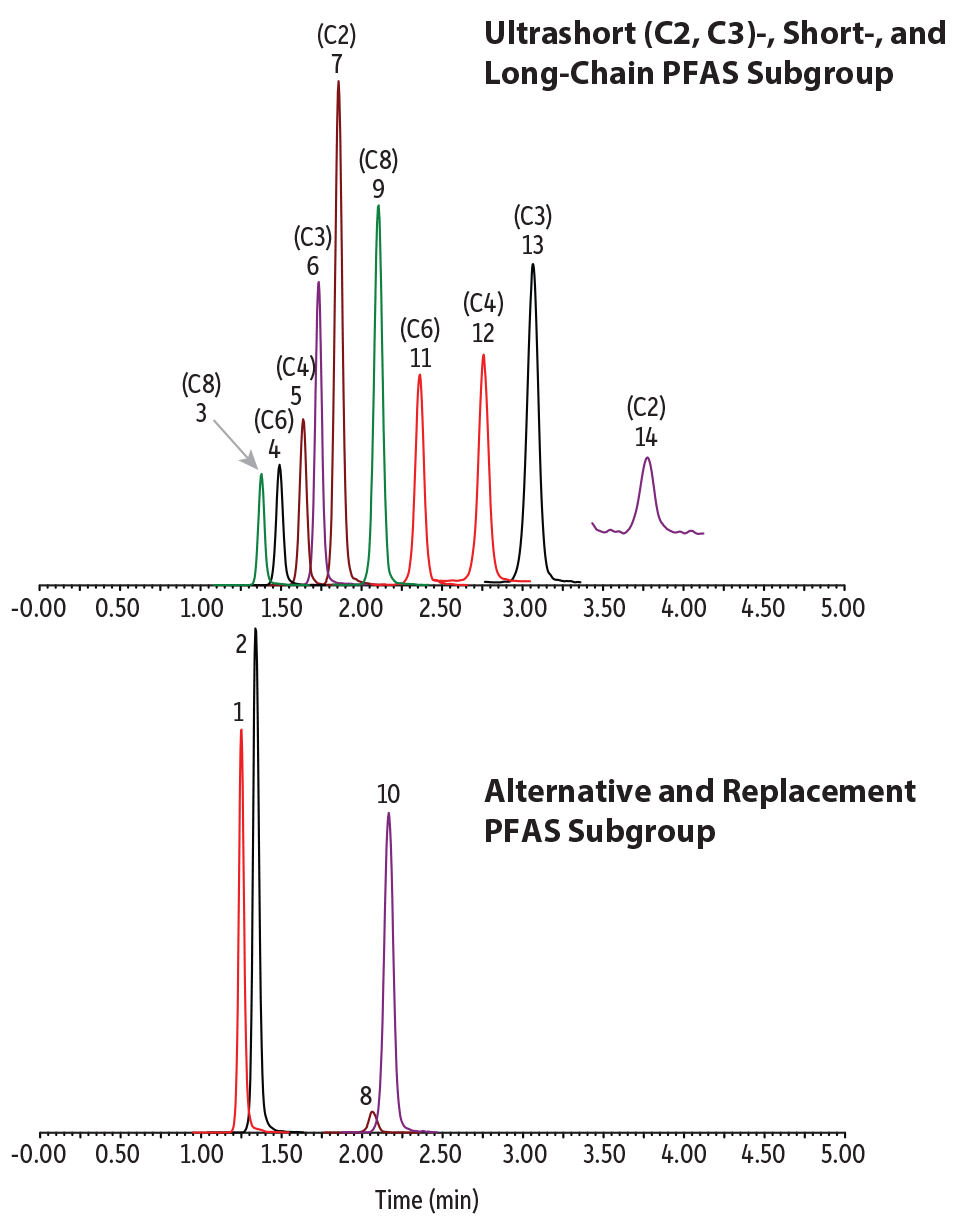
LC_EV0569
Peaks
| Peaks | tR (min) | Conc. (ng/L) | Precursor Ion | Product Ion | |
|---|---|---|---|---|---|
| 1. | 11-Chloroeicosafluoro-3-oxanonane-1-sulfonate (11CL-PF3OUdS) | 1.25 | 400 | 630.78 | 450.80 |
| 2. | 9-Chlorohexadecafluoro-3-oxanonane-1-sulfonate (9Cl-PF3ONS) | 1.34 | 400 | 530.78 | 350.85 |
| 3. | Perfluorooctanesulfonic acid (PFOS) | 1.38 | 400 | 498.84 | 79.97 |
| 4. | Perfluorohexanesulfonic acid (PFHxS) | 1.49 | 400 | 398.90 | 79.97 |
| 5. | Perfluorobutanesulfonic acid (PFBS) | 1.64 | 400 | 298.97 | 79.97 |
| 6. | Perfluoropropanesulfonic acid (PFPrS) | 1.73 | 400 | 248.97 | 79.98 |
| 7. | Perfluoroethanesulfonic acid (PFEtS) | 1.86 | 400 | 198.98 | 79.92 |
| Peaks | tR (min) | Conc. (ng/L) | Precursor Ion | Product Ion | |
|---|---|---|---|---|---|
| 8. | Hexafluoropropylene oxide dimer acid (HFPO-DA) | 2.06 | 400 | 284.97 | 168.92 |
| 9. | Perfluorooctanoic acid (PFOA) | 2.11 | 400 | 412.90 | 368.91 |
| 10. | Ammonium 4,8-dioxa-3H-perfluorononanoate (ADONA) | 2.15 | 400 | 376.90 | 250.93 |
| 11. | Perfluorohexanoic acid (PFHxA) | 2.36 | 400 | 312.97 | 268.90 |
| 12. | Perfluorobutanoic acid (PFBA) | 2.76 | 400 | 212.97 | 168.97 |
| 13. | Perfluoropropionic acid (PFPrA) | 3.06 | 400 | 163.03 | 119.01 |
| 14. | Trifluoroacetic acid (TFA) | 3.77 | 400 | 113.03 | 69.01 |
Conditions
| Column | Raptor Polar X (cat.# 9311A52) | ||||||||||||
|---|---|---|---|---|---|---|---|---|---|---|---|---|---|
| Dimensions: | 50 mm x 2.1 mm ID | ||||||||||||
| Particle Size: | 2.7 µm | ||||||||||||
| Temp.: | 40 °C | ||||||||||||
| Standard/Sample | |||||||||||||
| Diluent: | 50:50 Water:methanol | ||||||||||||
| Conc.: | 400 ng/L | ||||||||||||
| Inj. Vol.: | 10 µL | ||||||||||||
| Mobile Phase | |||||||||||||
| A: | Water, 10 mM ammonium formate, 0.05% formic acid | ||||||||||||
| B: | 60:40 Acetonitrile:methanol, 0.05% formic acid | ||||||||||||
|
| Detector | MS/MS |
|---|---|
| Ion Mode: | ESI- |
| Mode: | MRM |
| Instrument | UHPLC |
| Notes | To achieve more stable and robust performance with Polar X columns, the recommended LC conditions have changed from those that were used here. The new recommended conditions are an aqueous mobile phase (mobile phase A) consisting of 5 mM or 10 mM ammonium formate with 0.1% formic acid in water and an organic mobile phase (mobile phase B) of 100% acetonitrile. Higher ammonium formate concentrations will result in reduced analyte retention. Therefore, laboratories can optimize retention by adjusting both the ammonium formate concentration and the flow rate to best meet their analytical requirements. In addition, it is recommended that labs evaluate different isocratic conditions by varying the amount of mobile phase B between 70% and 85% acetonitrile. This approach can help labs identify the most suitable separation conditions for their specific target analytes and sample matrices of interest. |
色谱柱粒径和颗粒类型的选择
除了色谱柱类型和柱尺寸外,还必须考虑粒径和颗粒类型。总体来说,Raptor 系列中使用的2.7μm的核壳颗粒(SPP)是首选。使用核壳颗粒装填的色谱柱进行PFAS分析时可产生与亚2μm全多孔颗粒(FPP)相媲美的色谱柱效,而无需承受亚2μm颗粒相应的高压,无论是使用UHPLC还是HPLC仪器,都可以实现快速、高效的分析。
然而,仪器配置的不同,或多或少会影响粒径和颗粒类型的选择。例如,使用传统HPLC仪器并经常使用5μm全多孔颗粒色谱柱的实验室可能会对核壳柱所提供的改善感到惊讶,无论颗粒大小。使用核壳颗粒色谱柱时,在大多数HPLC仪器可承受的压力范围内,您可以很容易地看到分离效率的提高和更好的峰形。对于许多希望不支付UHPLC仪器资金成本的前提下提高分析效率和样品检测通量。
对于那些已经使用UHPLC仪器的实验室来说,粒径的选择,特别是核壳颗粒色谱柱对分析效率和分析速度的影响较小。图4展示了在UHPLC系统中使用三支不同粒径Raptor核壳柱对一组PFAS化合物分析时的对比情况。尽管根据一般色谱原理,1.8μm颗粒柱的峰最窄,但观察到的5μm和1.8μm柱的效率差异并不显著。然而,在实现这些非常相似的结果时产生的背压差异很大,粒径5和2.7μm的色谱柱所产生的压力在传统HPLC仪器承受范围内。使用填充核壳颗粒的色谱柱分析PFAS类化合物,您可以在无需承受UHPLC压力的情况下获得UHPLC性能。
50mmx2.1mm)
1.8 µm Raptor C18
6500–8000 psi
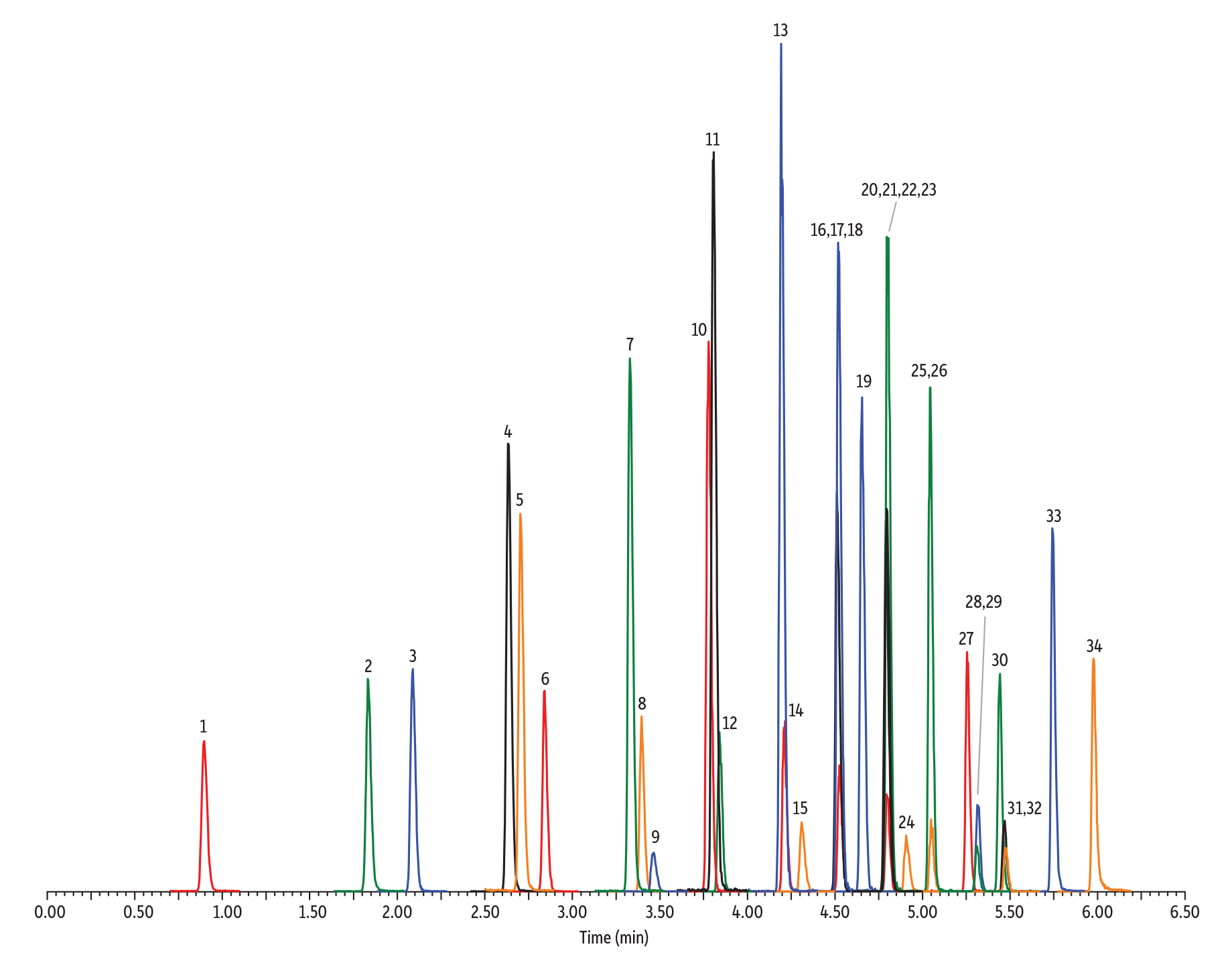
2.7 µm Raptor C18
4000–5500 psi
5 µm Raptor C18
2000–3500 psi
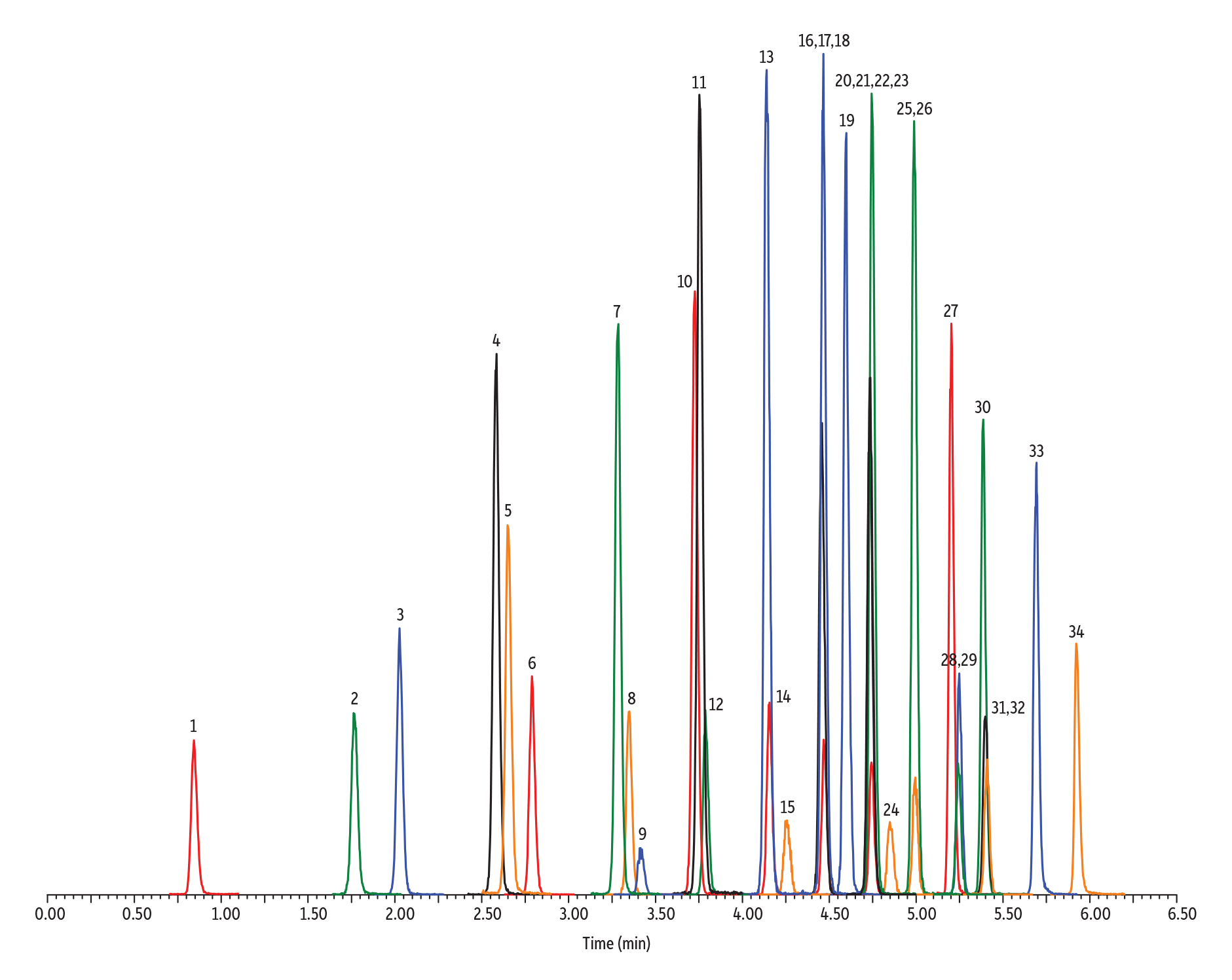
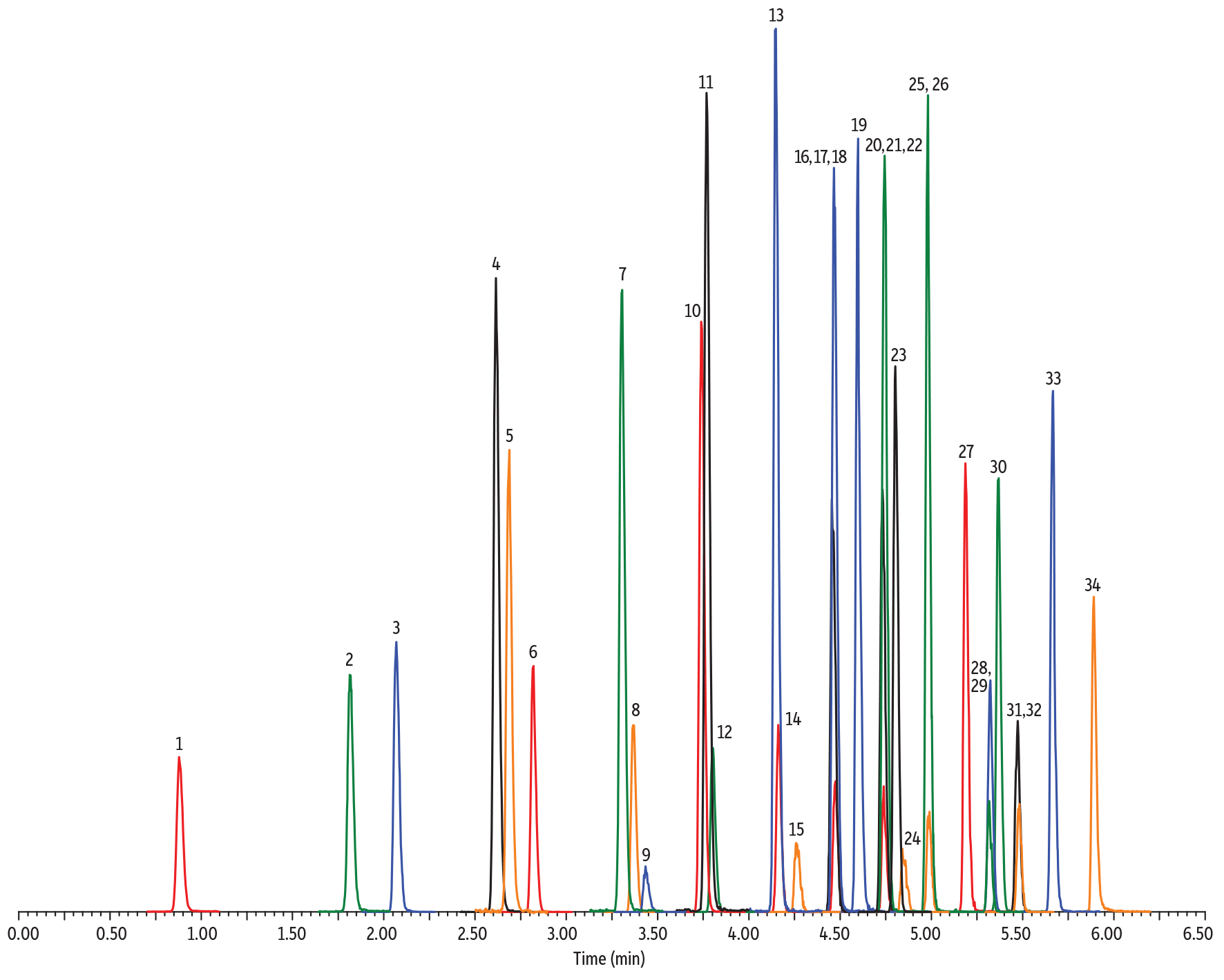
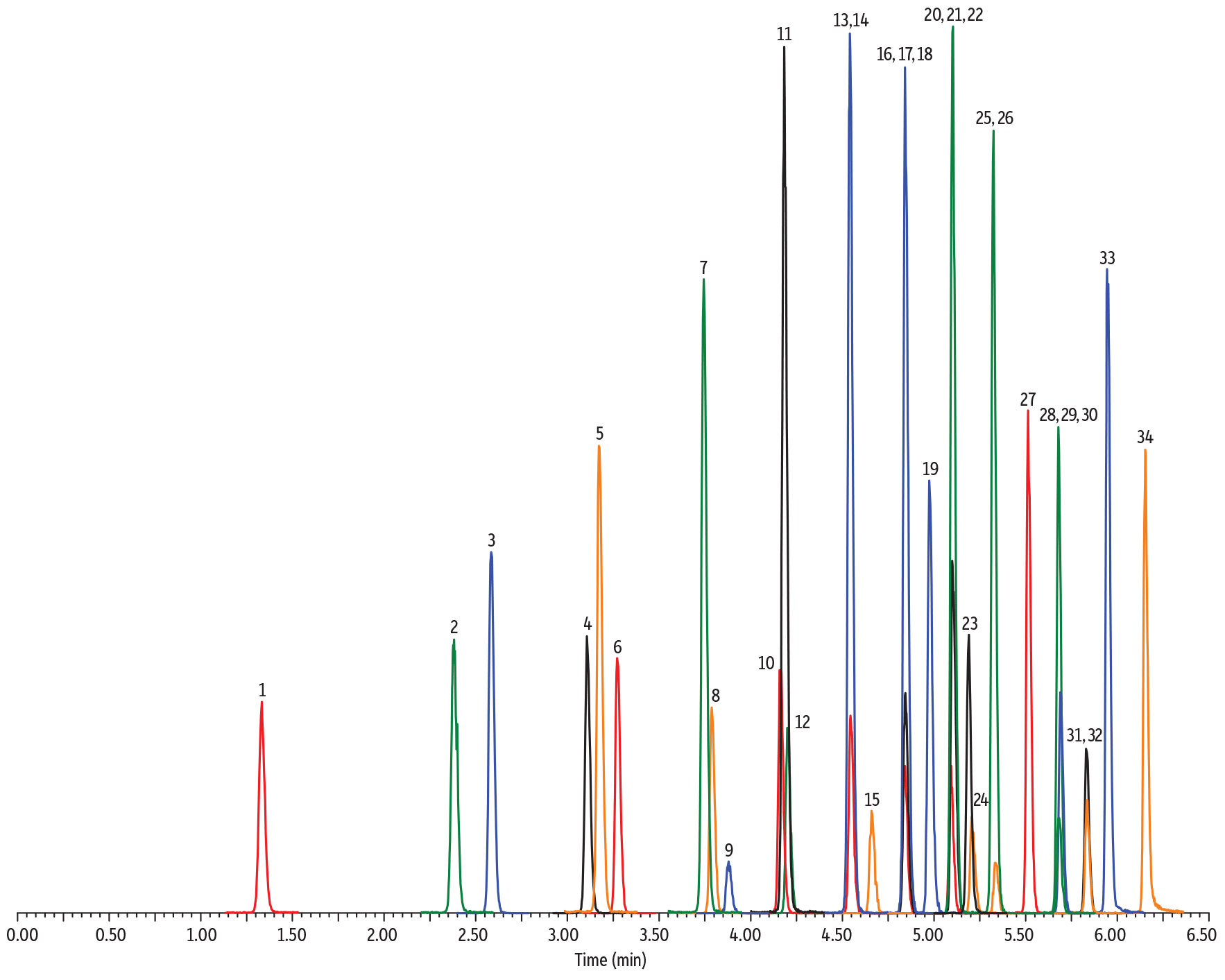
在保持尽可能低的仪器背压的同时,提高分析效率(通常表现比较短的运行时间)方面,装填核壳颗粒的液相色谱柱显然是赢家。然而,许多长期使用全多孔色谱柱的实验室可能更愿意继续使用这类色谱柱。当然,全多孔色谱柱可成功分析PFAS类化合物。与同粒径的核壳柱(RaptorC18)相比,全多孔色谱柱(如ForceC18)的比表面积和碳载量较高,可提高PFAS的保留效果(图5)。
1.8 µm Raptor C18
6500–8000 psi
1.8 µm Force C18
7550–9250 psi
结论
在选择适用于分析PFAS的色谱柱时,2.7μm Raptor核壳柱即可与UHPLC也可与HPLC仪器兼容,可以提供出色的分辨率、较短的运行时间。
固定相的选择取决于所监测的PFAS范围,Raptor C18色谱柱是C3及以上链长PFAS的绝佳选择。
对于同时分析包括超短链(C2-C3)、传统中长链及PFAS替代物的最佳选择是Raptor Polar X。
请注意,对于使用Raptor C18色谱柱的痕量级分析,可以通过添加PFAS延迟色谱柱来避免假阳性或检测值偏高。使用PFAS延迟柱将消除与仪器相关的背景PFAS污染物,这些污染物可能与样品分析物共洗脱。
相关产品

您的PFAS分析需要帮助吗?
从方法选择到产品推荐,Restek PFAS 专家助您应对复杂分析流程,获得准确、可靠的分析结果。