
Food safety laboratories are under pressure from every direction. Regulatory bodies are tightening maximum residue limits, the chlorinated-solvent ban has upended sample extraction workflows, and pesticide lists now run to 700 compounds or more. Meanwhile, turnaround time expectations are measured in hours, not days.
The question is no longer whether GC-MS/MS can detect trace pesticides—modern triple-quad instruments have solved that. The real bottleneck is whether the GC column and inlet components can hold up through thousands of injections of the messiest food matrices imaginable.
In this fireside chat, Restek’s Ramkumar Dhandapani discusses the changing landscape and current challenges of food safety testing with Dr. Alexander Zahm and Laura Schütz of Eurofins laboratory in Germany.
Our Guest Experts in Pesticides Analysis from Eurofins Dr. Specht Express Testing & Inspection GmbH

Welcome!
Ramkumar: Thank you for joining me today to share your insights about pesticides analysis. To start, would you introduce us to your lab and tell us a bit about your work?
Alexander: Certainly, I am the Managing Director at Eurofins Dr. Specht in Germany. We operate as a high-throughput accredited contract laboratory specializing in multiresidue pesticide analysis. We analyze hundreds of QuEChERS extracts from extremely difficult matrices under tight deadlines every week, so we cannot afford downtime.
My perspective here is that of someone who needs technology to perform in the real world—not just in a controlled demonstration. When we evaluate a new GC column, the question is always: does it hold up under the conditions we actually work in?
Laura: While Dr. Zahm provides the laboratory management perspective, my role is hands-on at the bench—designing and running the experiments, analyzing the data, and working out what it means for our routine pesticide analysis workflows. My job is to close the gap between what a GC column technology promises under controlled conditions and what it actually delivers when you push it hard under working lab conditions.
Industry Concerns
Ramkumar: You both are at the forefront of food safety testing. What are the biggest analytical challenges you face with pesticides analysis today?
Alexander: The first and most fundamental challenge is the sheer breadth of what we’re asked to detect. A modern consolidated pesticides method covers more than 700 compounds, including polar, nonpolar, acidic, basic, and neutral classes all in one run. For GC specifically, our lab handles more than 300 analytes per sequence. That diversity is brutally demanding on any single GC column chemistry.
In addition, matrix contamination is a very significant concern because when it causes performance criteria to fail, downtime for maintenance is required and that means sample analysis grinds to a halt. With modern GC-MS/MS instruments, sensitivity is no longer the primary concern. Matrix robustness has become the true bottleneck in routine pesticides analysis.
Laura: I’d add the operational dimension. We’re expected to deliver results within hours in some cases. Instrument downtime is simply not acceptable. So, when a column degrades faster than expected, or when recoveries drift out of acceptance criteria after 80 injections, you’re not just facing a scientific problem, you’re facing a scheduling crisis. Every reanalysis you trigger from bad peak shapes or low recoveries costs you time you don’t have.
Ramkumar: That’s very interesting, can you expand on why matrix robustness is such a problem? Modern GC-MS/MS instruments have extraordinary sensitivity, so where do things break down?
Alexander: With single-quadrupole systems from ten or fifteen years ago, reaching a 10 ppb LOQ was a genuine struggle, but today’s GC triple-quad instruments have solved the sensitivity question. The problem now is what happens between your sample vial and the ion source. Every injection deposits matrix components (fatty acids, pigments, phospholipids, sugars, etc.) into the inlet liner, onto the column head, and over time into the ion source itself. These matrix components accumulate, and they change the effective surface chemistry of everything the analytes touch. Recovery drifts, peak shapes deteriorate, and a calibration that was valid on injection 1 is no longer valid on injection 100. And because the degradation is gradual, it’s insidious, and you may not notice until results fall outside acceptance windows and trigger costly reruns.
Laura: That is why we were interested in evaluating the RMX-5Sil MS column ourselves, to see if the novel RMX GC column technology built on TriMax deactivation would result in greater resistance to matrix-related performance degradation.
In our experiments, degradation manifests most visibly with highly active analytes like deltamethrin and chlorpyrifos. When we compared deltamethrin recovery on our routine column across six liner changes in the same sequence, it varied by more than 30%. On the RMX column, results for the same compound were within a much tighter, acceptable range. For chlorpyrifos, at least two results on the routine column would have required reanalysis under our QC criteria. On the RMX column, all values were within specification. Every prevented reanalysis is significant—it represents real time and cost savings.
Real-World Results
Ramkumar: Can you tell me more about your experiments? I’m interested to hear how the RMX GC column technology performed under real-world testing conditions.
Alexander: Sure, we ran a direct head-to-head comparison between the RMX-5Sil MS column and our existing routine column under identical conditions. The GC-MS/MS total ion chromatogram told an immediate story: the RMX column had a much more stable baseline and far lower column bleed at later retention times, where challenging high-boiling pesticides elute.
In addition, for compounds that interact with active sites, such as those containing pi bonds, like sumithrin, the routine column produced broad, tailing peaks. However, on the RMX column, those same peaks were narrow and symmetric, even after multiple liner changes. That consistency is what enables reliable quantitation in a regulated environment.
Laura: To elaborate further on the experiments, for each column, we ran a set of matrix samples and a QC check, then we changed the inlet liner and continued the sequence. We did this six times and then compared results after each liner change to the initial results with the first liner to detect any changes in column performance. This design allowed us to assess the robustness of the new RMX GC column technology and compare it to our routine column.
Our study covered more than 350 pesticides, including known difficult analytes. We also deliberately chose challenging matrices, such as rice, to represent real-world sample testing. Under these conditions, our usual column lasts about three months and roughly 1000 injections with column cutting occurring every 80-90 injections. With the RMX column, we reached 1500 injections and were able to extend the maintenance interval to 90-100 injections, which was a tremendous improvement that directly impacts lab productivity.
Ramkumar: You mentioned rice as a particularly difficult matrix in your testing. What makes it so hard?
Alexander: Rice seems simple, but it is deceptively complex, particularly brown rice, which contains lipids, pigments, and shell-derived matrix components that aren’t fully removed during QuEChERS extraction. In addition, the starch fraction is largely insoluble in acetonitrile, so it tends to stay out of the extract, which is actually favorable. But the soluble fraction that does extract includes carbohydrates that can caramelize in the inlet at high temperature, depositing carbon on the liner and column head. Over time, this creates additional active sites exactly where your analytes are most vulnerable. To combat this, you can use an aggressive cleanup using PSA sorbent combined with a column system that includes a guard column.
Laura: For our work, we used an RMX-5Sil MS with Integra-Guard column because the guard column is actually integrated into the same tubing as the analytical column, therefore you can avoid a manual connection that is prone to leaking. With this setup, you can trim the contaminated column head without disrupting your validated retention time windows. I’d also like to point out that, due to the TriMax deactivation, the column surface resists accumulation of matrix-derived contamination in a way that conventional deactivations cannot fully match.
Technology Impact
Ramkumar: In your experience, how does the performance of TriMax technology differ from conventional column deactivation?
Alexander: Traditional deactivation chemistries use general industrial silylating agents that are not specifically engineered for GC conditions. They leave active silanol sites exposed, which at trace concentrations cause adsorption of sensitive analytes. TriMax technology is Restek’s proprietary reagent and process designed from the ground up specifically for GC capillary deactivation. It is used in all RMX columns and rather than being simply a surface treatment, it creates a seamless three-dimensional array of bonding, cross-linking, and deactivation simultaneously. The result is a pristine, dense surface with minimal residue and no exposed reactive sites.
Critically, the cross-linking also makes the stationary phase structurally more resilient. In our lab, we have found that it resists degradation when the column is stressed by high matrix loads over thousands of injections. In addition, we have seen that RMX columns behave in an unbiased way toward acids, bases, and neutrals alike, which is exactly what you need when your method spans 300-plus chemically diverse pesticides.
Ramkumar: Your point about the wide range of pesticide chemistries encountered in food testing makes me think about method consolidation. How does the trend towards method consolidation change what labs require from GC column technology?
Alexander: Twenty years ago, a laboratory might run organophosphates on one column and method, organochlorines on another, and volatile pesticides on a third. Each method was optimized for a narrow chemical class. Consolidation means putting all of that on one column and running more than 300 GC-amenable pesticides in a single sequence. The efficiency gains are real: one extraction, one injection, one set of results, and faster turnaround.
But, the column has to handle polar analytes, nonpolar analytes, thermally labile compounds, and everything in between without bias. A column that performs well for organochlorines but tails for organophosphate esters is not adequate for a consolidated method. This is precisely why the unbiased performance that RMX columns deliver—equivalent recovery for acids, bases, and neutrals—is essential rather than merely desirable for modern food testing.
Laura: To give you a real-world example, our GC multiresidue method currently covers 350 to 380 pesticides that include a very wide range of compound types and many difficult analytes. The challenge isn’t just running them all—it’s maintaining consistent quantitation for all of them simultaneously, in challenging matrices, over hundreds of injections. The RMX-5Sil MS column’s performance stability across that full scope is what makes method consolidation viable at scale.
Ramkumar: Earlier, you mentioned using an integrated guard column, but I understand the RMX column you use also has an integrated MS transfer line. What benefits did you see from this dual format?
Alexander: GC column architecture is just as important as column chemistry. In food pesticides analysis, the inlet and column head take the brunt of matrix contamination. The Integra-Guard format is a seamlessly integrated guard column contained in the same tubing as the analytical column—there’s no manual connection, no dead volume, no potential leak point. When the guard becomes contaminated, you simply trim it. Crucially, column trimming does not change the retention time windows for analytes. That means no method revalidation and no recalibration from scratch. In a lab running 200 to 300 analytes in dozens of samples per day, that’s an enormous time savings!
The Integra-transfer line solves a different problem—bleed from the transfer line itself into the MS ion source. Transfer lines are maintained at 300-310 °C. If there’s a stationary phase present at that temperature, it bleeds continuously into your mass spec source. The Integra-transfer line uses TriMax-deactivated tubing with no stationary phase, so bleed is dramatically reduced. Less source contamination means less frequent source cleaning, lower chemical noise, and better signal-to-noise ratios for trace analytes.
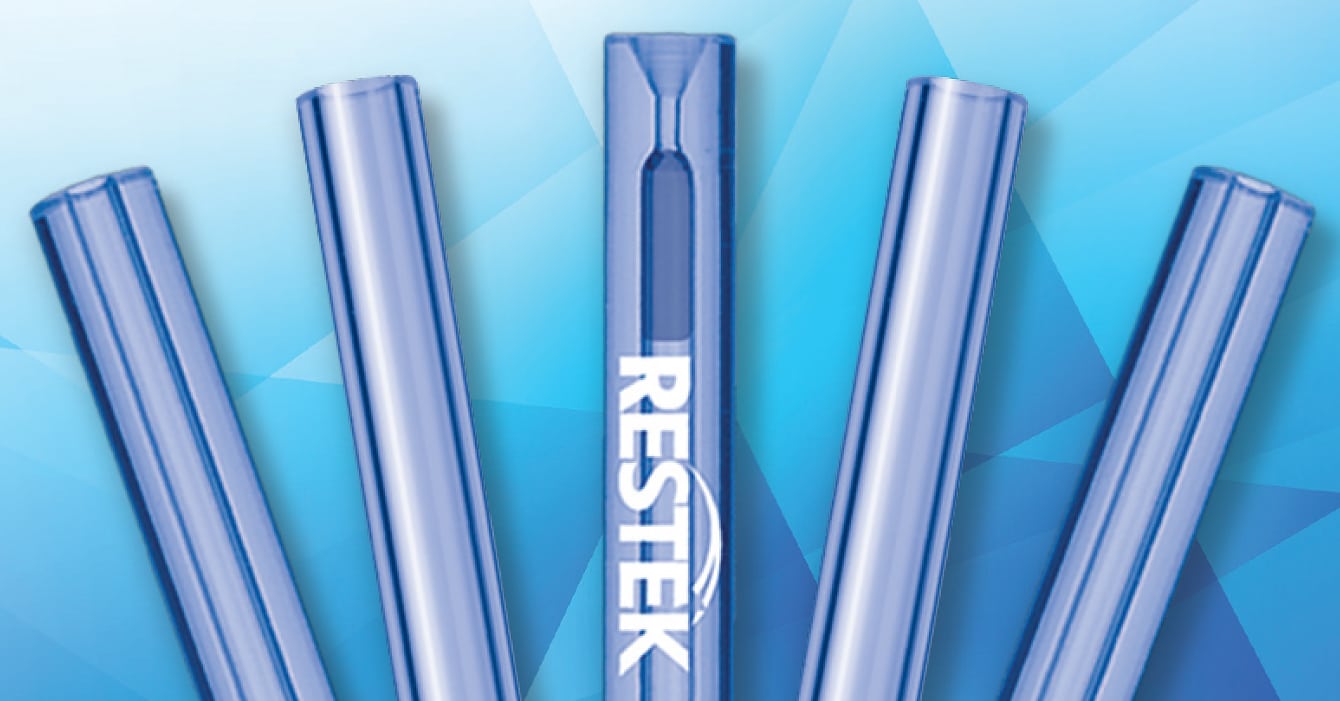
The dual format RMX-5Sil MS column with Integra-Guard and Integra-transfer line combines both, so you get an integrated guard column and transfer line in a single part number, with no external connections anywhere in the flow path.
Ramkumar: We’ve discussed the importance of GC column technology at length, but you’ve also mentioned the GC inlet, so I’d like to close by asking you about inlet liners. What impact do they have on pesticides analysis?
Alexander: The inlet liner is critical, it is the first place your sample contacts the analytical system, and it’s at a very high temperature, typically 250 to 280 °C for splitless pesticide injections. That thermal energy combined with any reactive surface chemistry will degrade the most sensitive analytes before they ever reach the column. Active silanol groups in a poorly deactivated liner will form hydrogen bonds with phenolic pesticides. Basic analytes like benzimidazoles can adsorb irreversibly. You inject what you think is a known concentration and a fraction of it never makes it through the inlet.
To prevent analyte degradation, we use Topaz liners because they have been proven to be highly inert and use a premium siliconized deactivation that extends to the glass wool as well. With Topaz liners, we see very low levels of breakdown for endrin and DDT, two benchmark active compounds that are traditionally used to assess inlet inertness. Beyond deactivation chemistry, liner geometry should be selected based on the injection mode. Using a liner with glass wool in the center for split injections or a baffle design for splitless injections help ensure proper vapor focusing.
Laura: We used Topaz baffled liners paired with the RMX-5Sil MS column throughout our testing. What the liner data showed was consistent protection of the most active compounds across the full liner lifetime. When we extended maintenance intervals from six to eight liners to really stress the system, the combination of the RMX column and highly inert Topaz liner continued to produce acceptable recoveries for the majority of our target pesticides.
The inlet liner and GC column really work synergistically—you can have an excellent column, but if the liner is degrading your most active compounds before they even reach the column, your data quality suffers regardless. GC columns and liners have to be optimized as a system because they both affect recovery of your target analytes.
Ramkumar: Thank you both so much for joining me today for a fascinating discussion!
Curious about more ways RMX columns can help?
Take the next step and see how everything discussed here—the RMX column with TriMax technology, Topaz liners, and the Integra-Guard formats—can improve your workflow. Use the resources below to go deeper.