


The Rtx-225 is a versatile column with unique selectivity for low-boiling-point compounds. The cyano-phenyl composition of this phase limits the maximum operating temperature to <240°C.
To help figure out if this column will work for your analytes of interest, a new residual solvents library has been added to EZGC, containing compounds from all three solvent classes designated by the USP and ICH 1,2 (Table 1).
Table 1: Residual solvents included in the Rtx-225 EZGC library.
|
Chemical: |
CAS (#) |
Class (#) |
|
Benzene |
71-43-2 |
1 |
|
Chloroform |
67-66-3 |
1 |
|
Trichloroethene |
79-01-6 |
1 |
|
1,4-Dioxane |
123-91-1 |
2 |
|
Chlorobenzene |
108-90-7 |
2 |
|
cis-1,2-Dichloroethene (Z) |
156-59-2 |
2 |
|
Cyclohexane |
110-82-7 |
2 |
|
Ethylbenzene |
100-41-4 |
2 |
|
m/p-Xylene |
108-38-3 |
2 |
|
Methylcyclohexane |
108-87-2 |
2 |
|
o-Xylene |
95-47-6 |
2 |
|
Tetrahydrofuran |
109-99-9 |
2 |
|
Toluene |
108-88-3 |
2 |
|
trans-1,2-Dichloroethene (E) |
156-60-5 |
2 |
|
1-Butanol |
71-36-3 |
3 |
|
1-Pentanol |
71-41-0 |
3 |
|
1-Propanol |
71-23-8 |
3 |
|
2-Butanol (sec-butyl alcohol) |
78-92-2 |
3 |
|
2-Butanone (MEK) |
78-93-3 |
3 |
|
2-Propanol (isopropanol) |
67-63-0 |
3 |
|
3-Methyl-1-butanol (isoamyl alcohol) |
123-51-3 |
3 |
|
4-Methyl-2-pentanone (MIBK) |
108-10-1 |
3 |
|
Butyl acetate |
123-86-4 |
3 |
|
Diethyl ether (ethyl ether) |
60-29-7 |
3 |
|
Ethanol |
64-17-5 |
3 |
|
Ethyl acetate |
141-78-6 |
3 |
|
Ethyl formate |
109-94-4 |
3 |
|
Isobutanol (2-methyl-1-propanol) |
78-83-1 |
3 |
|
Isobutyl acetate (acetic acid 2-methylpropyl ester) |
108-21-4 |
3 |
|
Isopropyl acetate (acetic acid, 1-methylethyl ester) |
108-21-4 |
3 |
|
Methyl acetate |
79-20-9 |
3 |
|
Methyl-tert-butyl ether (MTBE) |
1634-04-4 |
3 |
|
Propyl acetate |
109-60-4 |
3 |
Using EZGC, we were able to build a method that could separate 25 of the 33 compounds in under 5 minutes (Figure 1).
Figure 1: EZGC method predictions for separation of class 1-3 residual solvents.
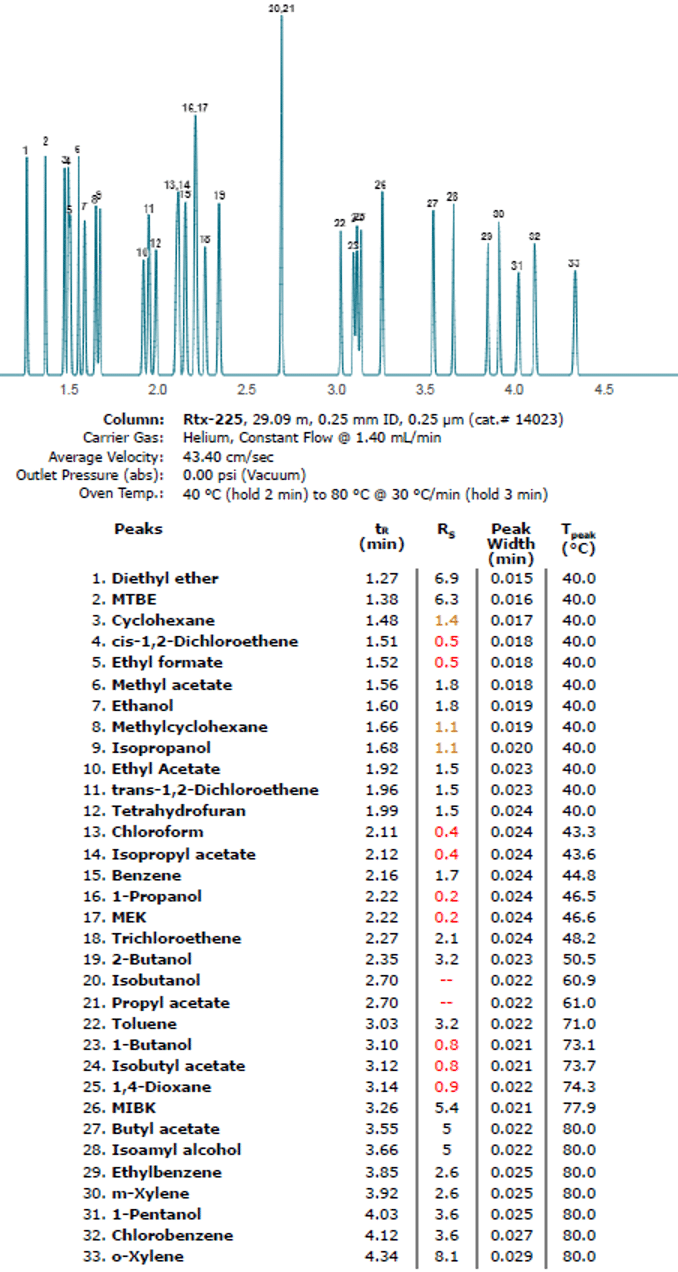
Our column was measured to be 29.09m. We used an inlet temperature of 250oC, Topaz straight inlet liner with wool (cat#23300), and a 400:1 split injection. The standards used were cat# 36004 (class 1), 36217 (class 2), 36013 (class 3).
Even though we had quite a few coelutions, the use of a mass-spectrometers helped to identify individual peaks for all 33 compounds. If you are also using a mass-spectrometer, the EZGC chromatogram modeler can help you to select unique ions differentiating co-eluting peaks, saving valuable trial-and-error time.
For further reading:
- Impurities: Guideline for Residual Solvents Q3C(R8). International council for harmonisation of technical requirements for pharmaceuticals for human use April 22, 2021.
- <467> RESIDUAL SOLVENTS. United States Pharmacopia March 23, 2007.