


Welcome to the newest blog series that totally stinks! In this series we’re going to look at different approaches for analyzing terpenes in cannabis. To quickly brief those who may not be familiar with terpenes, this class of compounds is responsible for many of the flavors and aromas in cannabis. Not only are cannabis growers and manufacturers interested in terpene content though; researchers also have interest in cannabis terpenes because of their potential therapeutic benefits. It is important to classify terpenes in cannabis to better understand the Entourage Effect. This term refers to the synergistic interactions between cannabinoids and terpenes with respect to physical ailments.1
A common approach to analyzing these compounds is by static headspace (HS) – gas chromatography (GC) – mass spectrometry (MS). This can either be done with a HS Autosampler or a gas-tight syringe, but today, we are going to compare this technique to solid phase microextraction (SPME) with the SPME Arrow. For our initial comparison, we diluted our Terpene Standard Mix 1 & 2 (cat# 34095 & 34096) to 1 µg/mL, added 1 mL of this to a 20 mL HS vial, then analyzed samples via HS-Syringe-GC-MS and HS-SPME-GC-MS. You’ll notice that the parameters are very different for each approach, because we used the optimal parameters for each technique.
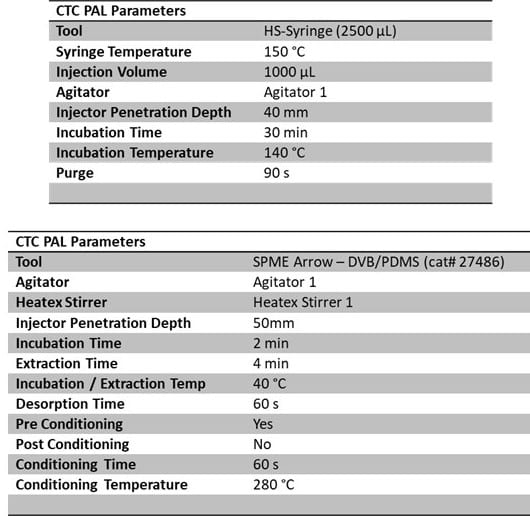
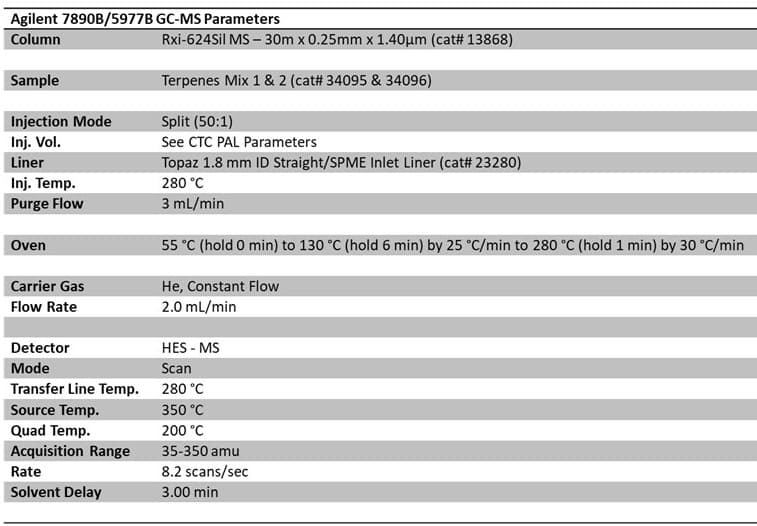
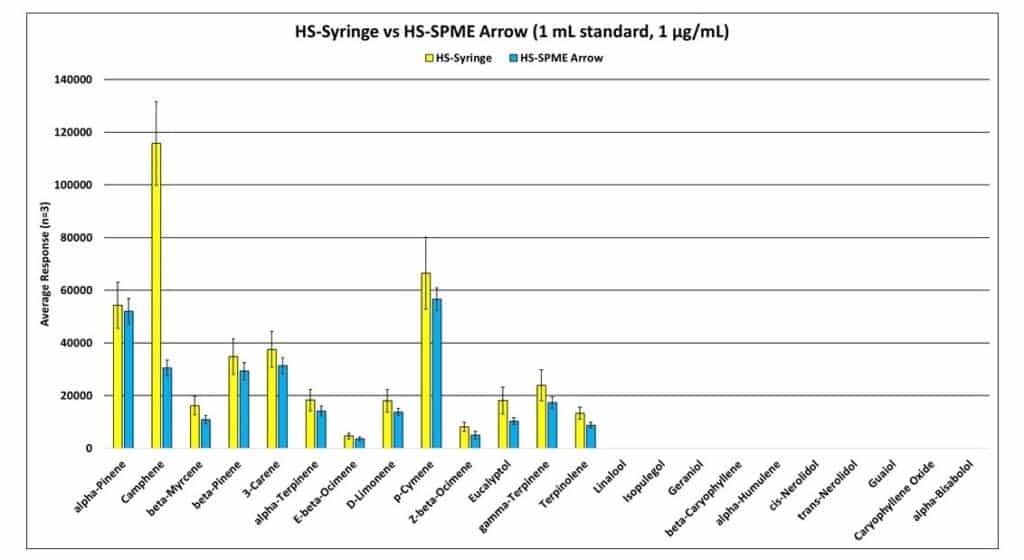
Figure. Analysis of 23 component terpene standard.
Results from each approach can be seen above. As you can tell from the data collected, both approaches were far from awesome. We were only able to identify 13 of the 23 terpenes in the standard. You’ll notice that we were able to collect data for many of the monoterpenes, but not so much for the sesquiterpenes. For the compounds that were able to be identified; the HS-Syringe performed slightly better than the HS-SPME Arrow. However, the HS-SPME Arrow had better % RSDs than the HS-Syringe. So, why were we only able to identify 13 of the 23 terpenes and how can we improve this? Tune in next time!
- Russo, E. B. (2011), Taming THC: potential cannabis synergy and phytocannabinoid‐terpenoid entourage effects. British Journal of Pharmacology, 163: 1344-1364.