



Abstract
The method herein provides a robust and accurate analysis of the two most predominant phosphatidylethanol (PEth) homologues in whole blood using a simple protein precipitation. PEth compounds are prone to carryover, and steps were taken when developing the chromatographic gradient to eliminate it using Restek’s C8 column. The analytical method achieves baseline separation between the two compounds, detection limits down to 10 ng/mL, and no carryover.
Introduction
Phosphatidylethanol (PEth) is a group of phospholipids exclusively formed in cell membranes when in the presence of ethanol. As such, these compounds are adequate biomarkers for alcohol use, having a much longer half-life than ethanol in blood, and can be used to distinguish drinking patterns with a window of detection from 2-4 weeks. Among the multiple homologues of these compounds, PEth 16:0/18:1 (palmitic acid/oleic acid-POPEth), is the predominant compound (approximately 37% of total PEth) while the second most abundant PEth compound is 16:0/18:2 (palmitic acid/linoleic acid – PLPEth) which accounts for 25% of total PEth in blood [1]. In this application, a workflow was developed for the quantitative analysis of POPEth and PLPEth that uses a simple sample preparation protocol followed by LC-MS/MS analysis.
Experimental
Bovine blood was used as a surrogate matrix to ensure POPEth- and PLPEth-free blood. Bovine blood was fortified with POPEth and PLPEth to prepare calibration standards and QC samples. The linearity ranges were 10-1000 ng/mL, and three QC levels were prepared at 15, 100, and 500 ng/mL in whole blood. The fortified samples and QC samples were subjected to the following sample preparation procedure.
Sample Preparation
This sample preparation procedure follows the protocol outlined by RedHot Diagnostics. 50 µL of whole blood was mixed with 50 µL of internal standard (50 ng/mL) and 150 µL of 4:1 isopropyl alcohol:tetrahydrofuran. The mixture was vortexed for approximately 20 seconds and centrifuged for 10 minutes at 4300 rpm. The supernatant was transferred to an LC vial (cat.# 21143) with a vial insert (cat.# 21776), capped (cat.# 24498), and injected onto the LC-MS/MS instrument.
Instrument Conditions
LC-MS/MS analysis of PEth in whole blood was performed on a Shimadzu 8060 LC-MS/MS system. The method conditions are outlined in Table I and the analyte transitions are provided in Table II.
Table I: Method Conditions
| Analytical Column: | Raptor C8 50 x 2.1 mm, 2.7 µm (cat.# 9303A52) | ||
| Guard Column: | Raptor C8 EXP Guard Column Cartridge 5 x 2.1 mm, 2.7 µm (cat.# 9303A0252) | ||
| Injection Volume: | 5 µL | ||
| Column Temperature: | 30 ⁰C | ||
| Ion Mode: | ESI- | ||
| Mobile Phase A: | Water, 5 mM ammonium acetate | ||
| Mobile Phase B: | Acetonitrile:IPA 90:10 | ||
| Gradient: | Time | Flow Rate | %B |
| 0.00 | 0.6 | 70 | |
| 2.50 | 0.6 | 90 | |
| 3.00 | 0.6 | 95 | |
| 3.01 | 1.0 | 95 | |
| 3.50 | 1.0 | 100 | |
| 3.51 | 0.6 | 70 | |
| 5.00 | 0.6 | 70 | |
Table II: Analyte Transitions
| Compound | Precursor Ion | Product Ion 1 | Product Ion 2 |
| PEth 16:0/18:2-d5 (POPEth) | 704.50 | 279.35 | – |
| PEth 16:0/18:2 (POPEth) | 699.50 | 279.25 | 255.15 |
| PEth 16:0/18:1-d5 (PLPEth) | 706.50 | 281.15 | – |
| PEth 16:0/18:1 (PLPEth) | 701.00 | 281.15 | 255.20 |
Results and Discussion
Chromatographic Performance
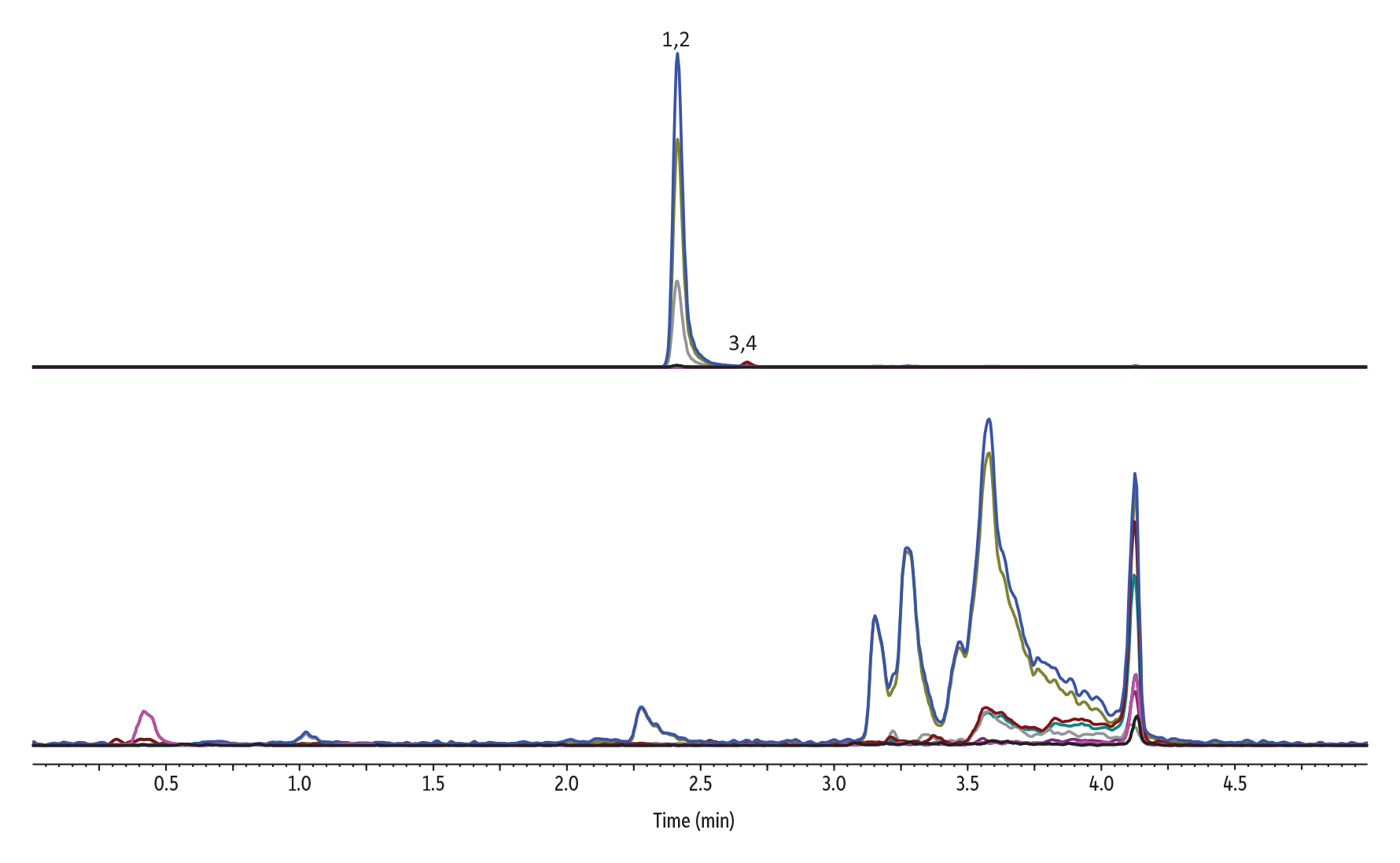
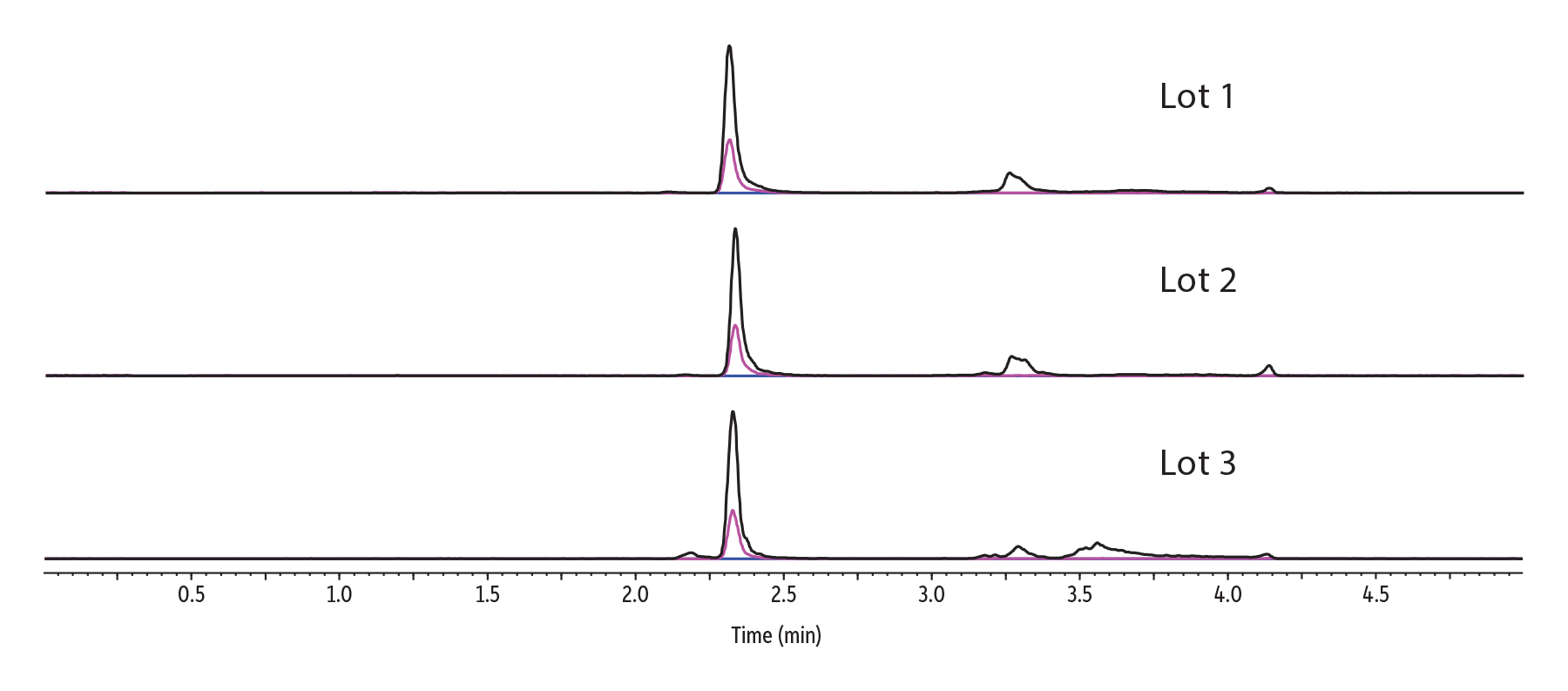
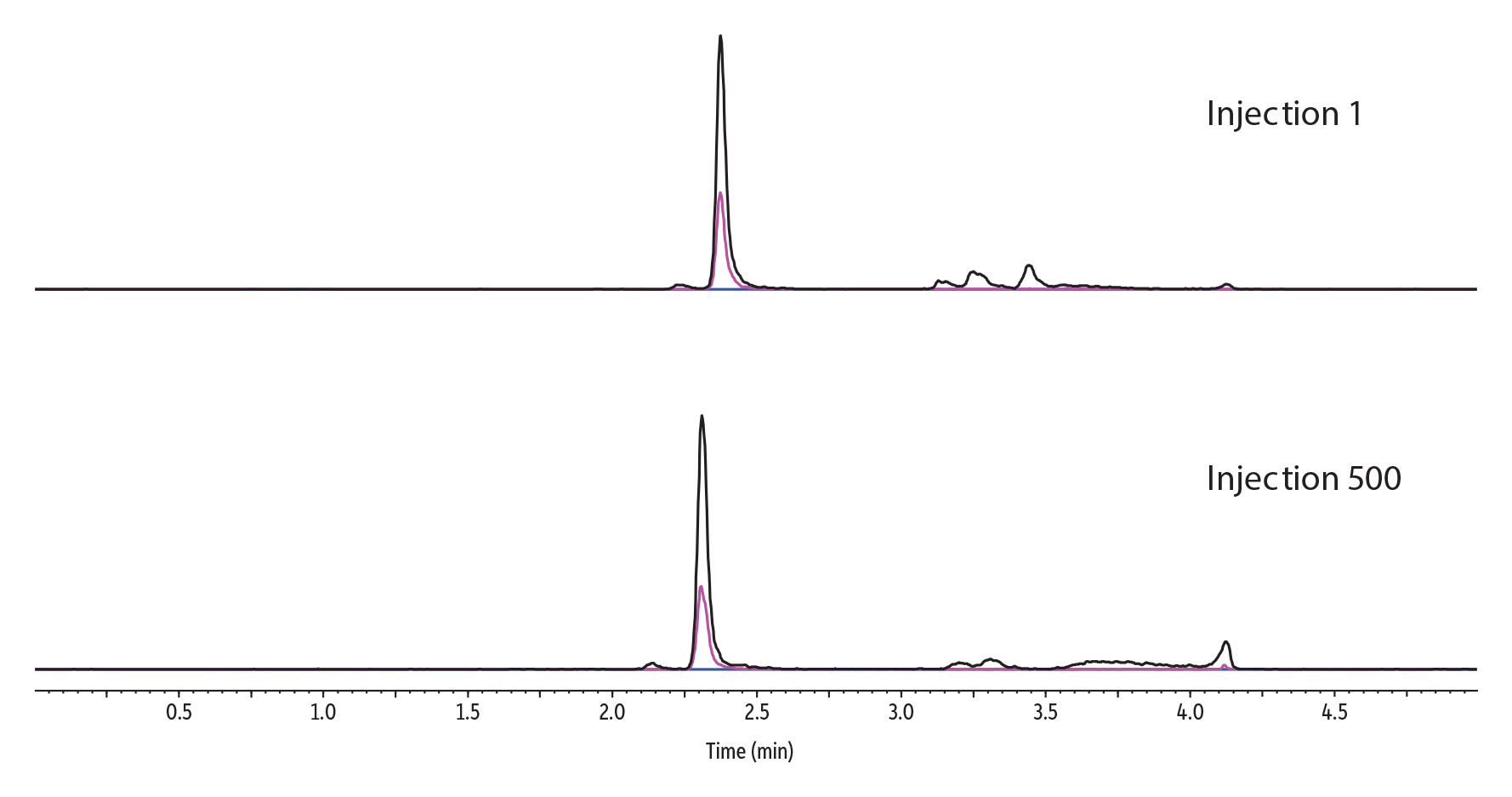
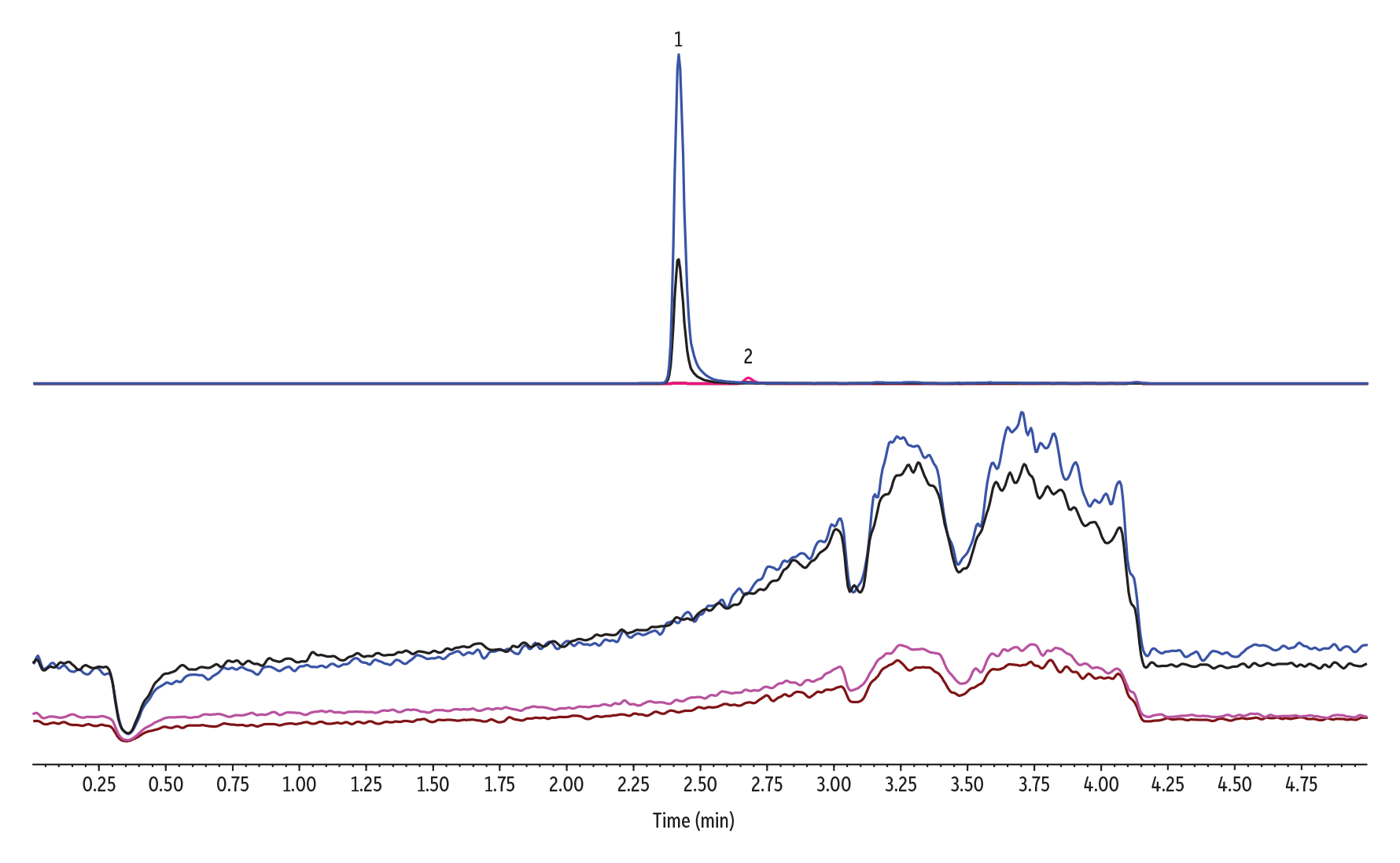
The specific and sensitive analysis of PEth 16:0/18:1 and 16:0/18:2 was achieved using a Raptor C8 column. No carryover was observed from the analysis of blank blood injected immediately after the highest concentration standard (Figure 1). Consistent chromatographic performance was observed across three different lots of columns (Figure II and Table 3) and across 500 consecutive injections (Figure 2 and Table III) demonstrating exceptional robustness of the method. Ion suppression was assessed by a 500 ppb infusion of POPEth and PLPEth post-column while simultaneously injecting whole bovine blood blank extract on the analytical column while running the analytical method. The chromatogram from these experiments is overlaid with an injection of a blood sample spiked at 1000 ng/mL to show both analytes do not elute within a matrix suppression or enhancement zone (Figure 4).
LC_CF0823
Peaks
| Peaks | tR (min) | Precursor Ion | Product Ion 1 | Product Ion 2 | |
|---|---|---|---|---|---|
| 1. | Phosphatidylethanol 16:0/18:2 | 2.37 | 699.50 | 279.25 | 255.15 |
| 2. | Phosphatidylethanol 16:0/18:2-d5 | 2.37 | 704.50 | 279.35 | – |
| 3. | Phosphatidylethanol 16:0/18:1 | 2.63 | 701.00 | 281.25 | 255.20 |
| 4. | Phosphatidylethanol 16:0/18:1-d5 | 2.63 | 706.50 | 281.15 | – |
Conditions
| Column | Raptor C8 (cat.# 9303A52) | ||||||||||||||||||||||||||||||||
|---|---|---|---|---|---|---|---|---|---|---|---|---|---|---|---|---|---|---|---|---|---|---|---|---|---|---|---|---|---|---|---|---|---|
| Dimensions: | 50 mm x 2.1 mm ID | ||||||||||||||||||||||||||||||||
| Particle Size: | 2.7 µm | ||||||||||||||||||||||||||||||||
| Pore Size: | 90 Å | ||||||||||||||||||||||||||||||||
| Guard Column: | Raptor C8 EXP guard column cartridge 5 mm, 2.1 mm ID, 2.7 µm (cat.# 9303A0252) | ||||||||||||||||||||||||||||||||
| Temp.: | 30 °C | ||||||||||||||||||||||||||||||||
| Standard/Sample | |||||||||||||||||||||||||||||||||
| Diluent: | 4:1 2-propanol:tetrahydrofuran | ||||||||||||||||||||||||||||||||
| Conc.: | 1000 ng/mL in whole blood | ||||||||||||||||||||||||||||||||
| Inj. Vol.: | 5 µL | ||||||||||||||||||||||||||||||||
| Mobile Phase | |||||||||||||||||||||||||||||||||
| A: | 5 mM Ammonium acetate, water | ||||||||||||||||||||||||||||||||
| B: | 90:10 Acetonitrile:2-propanol | ||||||||||||||||||||||||||||||||
| |||||||||||||||||||||||||||||||||
| Max Pressure: | 210 bar |
| Detector | Shimadzu 8060 MS/MS |
|---|---|
| Ion Source: | Electrospray |
| Ion Mode: | ESI- |
| Mode: | MRM |
| Instrument | Shimadzu Nexera X2 |
| Sample Preparation | Procedure provided by RedHot Diagnostics: The fortified blood sample (50 µL) was mixed with 50 µL of internal standard and 150 µL of 4:1 2-propanol:tetrahydrofuran. The mixture was vortexed for 20 seconds and centrifuged for 10 minutes at 4300 rpm. The supernatant was aliquoted to a 2 mL screw-thread vial (cat.# 21143) with a glass insert (cat.# 21776) and capped with short-cap, screw-vial closure (cat.# 24498). Five microliters was injected for analysis. |
LC_CF0825
Peaks
| Peaks | Precursor Ion | Product Ion 1 | Product Ion 2 | |
|---|---|---|---|---|
| 1. | Phosphatidylethanol 16:0/18:2 | 699.50 | 279.25 | 255.15 |
Table III: Lot-to-Lot Reproducibility
| Lot 1 | Lot 2 | Lot 3 | % Difference | ± % Difference | |
| PEth 16:0/18:2-d5 (POPEth) | 2.33 | 2.33 | 2.61 | 0.57 | 0.29 |
| PEth 16:0/18:2 (POPEth) | 2.33 | 2.33 | 2.61 | 0.57 | 0.29 |
| PEth 16:0/18:1-d5 (PLPEth) | 2.63 | 2.66 | 2.67 | 0.98 | 0.49 |
| PEth 16:0/18:1 (PLPEth) | 2.63 | 2.66 | 2.66 | 0.80 | 0.40 |
LC_CF0824
Peaks
| Peaks | Precursor Ion | Product Ion 1 | Product Ion 2 | |
|---|---|---|---|---|
| 1. | Phosphatidylethanol 16:0/18:2 | 699.50 | 279.25 | 255.15 |
Table IV: Lifetime Study of Raptor C8 Column
| Injection 1 Retention Time (min) | Injection 500 Retention Time (min) | % Difference | ± % Difference | |
| PEth 16:0/18:2-d5 (POPEth) | 2.38 | 2.30 | 2.15 | 1.08 |
| PEth 16:0/18:2 (POPEth) 2.38 | 2.38 | 2.31 | 2.07 | 1.03 |
| PEth 16:0/18:1-d5 (PLPEth) | 2.64 | 2.58 | 1.53 | 0.76 |
| PEth 16:0/18:1 (PLPEth) | 2.64 | 2.58 | 1.52 | 0.76 |
LC_CF0822
Peaks
| Peaks | tR (min) | Precursor Ion | Product Ion 1 | Product Ion 2 | |
|---|---|---|---|---|---|
| 1. | Phosphatidylethanol 16:0/18:2 | 2.37 | 699.50 | 279.25 | 255.15 |
| 2. | Phosphatidylethanol 16:0/18:1 | 2.63 | 701.00 | 281.25 | 255.20 |
Linearity
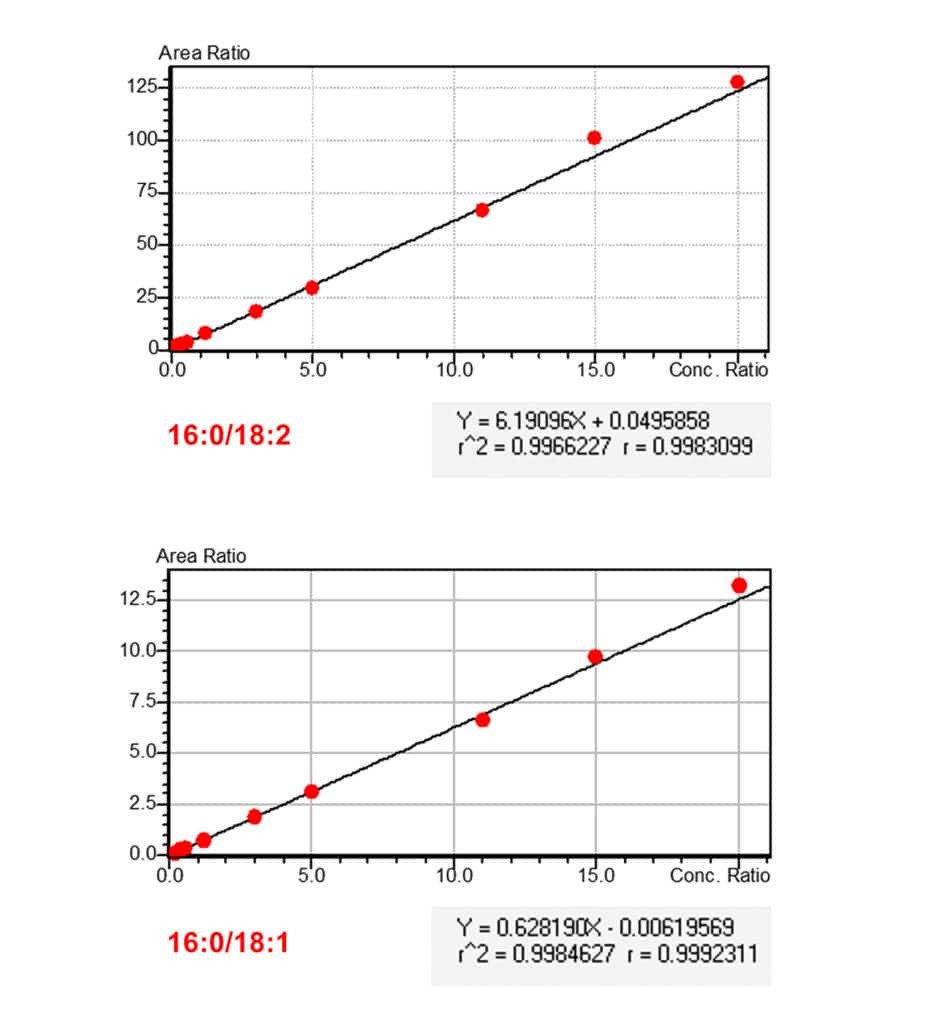
A weight of 1/x linear regression was used for calibration of the compounds and showed acceptable linearity with R2 values of 0.996 or greater. The established limit of quantitation was 10 ng/mL in whole blood.
Accuracy and Precision
Accuracy and precision were assessed over three days. The accuracy of the method was determined by the evaluation at low, medium, and high spiked levels, and the values were all within 10% of the nominal concentration of all QC levels. The %RSD was 1.93–14.2% and 0.310–4.64% for intra- and inter-day, respectively, indicating acceptable method precision. A summary of accuracy and precision can be seen in Table V.
Table V: Accuracy and Precision of Raptor C8 Column
| Low QC (15 ng/mL in blood) | Mid QC (100 ng/mL in blood) | High QC (500 ng/mL in blood) | ||||
| Average Accuracy (%) | Precision (%RSD) | Average Accuracy (%) | Precision (%RSD) | Average Accuracy (%) | Precision (%RSD) | |
| PEth- 16:0/18:1 (POPEth) | 95.6 | 11.6 | 101 | 14.2 | 110 | 10.8 |
| PEth- 16:0/18:2 (PLPEth) | 94.3 | 4.61 | 96.7 | 2.07 | 102 | 1.93 |
Conclusion
The method developed within provides a straightforward protocol for the analysis of POPEth and PLPEth in whole blood using a Raptor C8 column. This workflow provides accurate and reproducible results with a simple protein precipitation procedure making it suitable for a low-cost, high-throughput analysis to monitor alcohol consumption.
Acknowledgements
The authors would like to thank RedHot Diagnostics for providing their collaboration efforts with the sample preparation procedure.
References
- A. Helander, Y. Zheng, Molecular species of the alcohol biomarker phosphatidylethanol in human blood measured by LC-MS, Clin Chem. 55 ( 7) (2009) 1395-405. https://doi.org/10.1373/clinchem.2008.120923
This method has been developed for research use only; it is not suitable for use in diagnostic procedures without further evaluation.