


- 高惰性保持校准通过和样品运行。
- 临界物质对分离效果出色,从而提高分析准确度。
- 柱间性能一致。
- 色谱柱寿命长 。
Our Rxi-SVOCms column was named Best New Separations Product of the Year in the SelectScience Scientists’ Choice Awards
Restek 新型 Rxi-SVOCms 色谱柱,专为半挥发物分析而设计,可确保性能一致,保持校准通过的时间更长,因此在需要重新校准仪器或更换色谱柱之前可以运行更多样品。色谱柱采用新型聚合物和去活化学品,惰性高,具有严格控制的选择性,对各种分析物(酸性、碱性和中性)的分析性能卓越。
Rxi-SVOCms 色谱柱经过专门调整,可改善挑战性 SVOC(如五氯苯酚、吡啶和联苯胺)的峰形,并可确保难分析的多环芳烃 (PAH) 的分离度更优。如图 1 所示,即使是最麻烦的反应性分析物,也能获得高度对称的峰形和良好的响应。此外,对于苯并[b]荧蒽和苯并[k]荧蒽这些必须进行色谱分离的同重多环芳烃以及茚并[1,2,3-cd]芘和二苯并[a,h]蒽也可获得出色的分离度(≥85% 峰谷)。
对于因色谱柱性能变化、频繁校准失败和色谱柱寿命短而拖慢工作节奏的环保行业化学家,改用坚固耐用的 Rxi-SVOCms 色谱柱可确保在更长时间内满足数据要求,并最大限度减少停工时间。
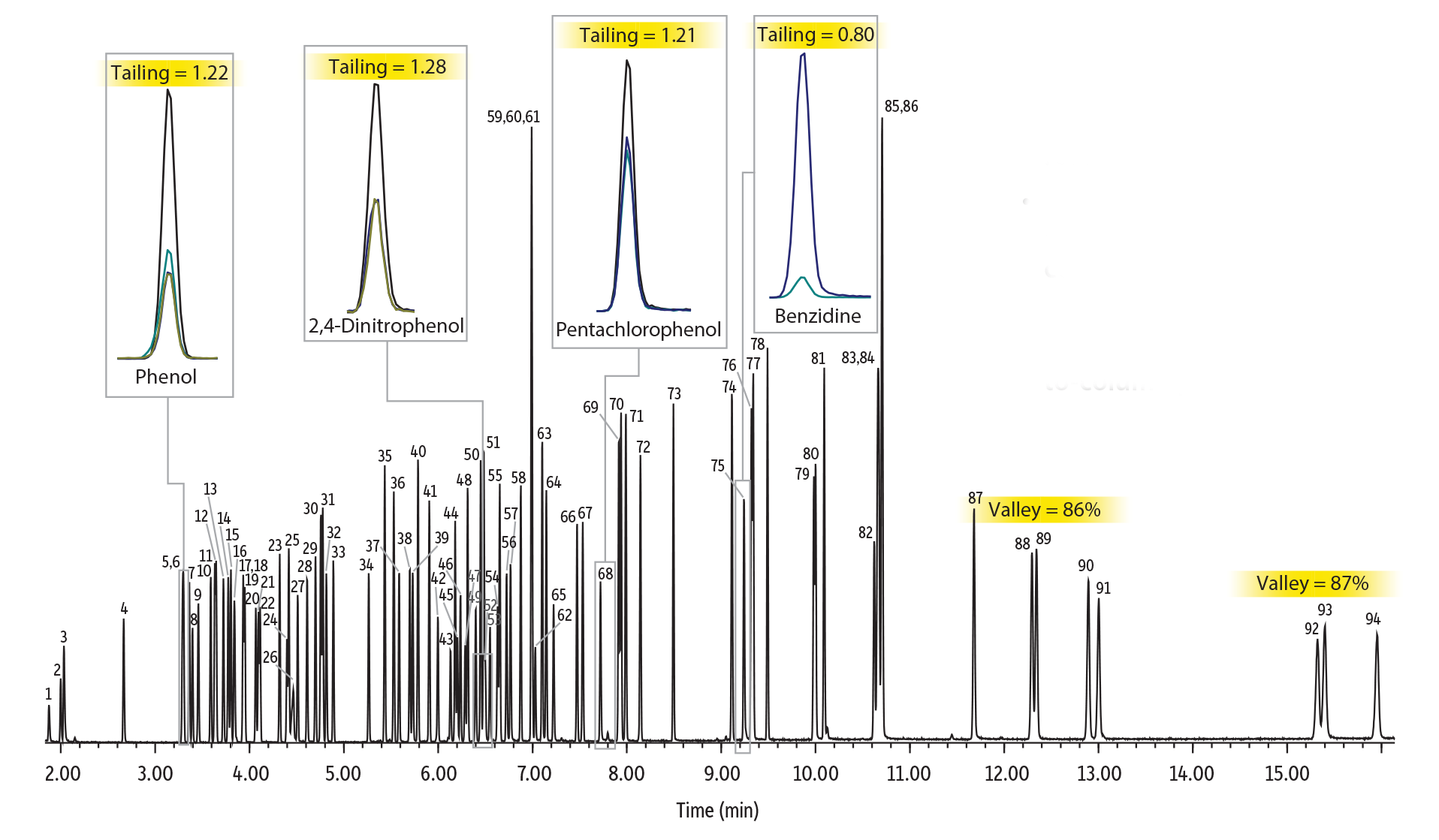
GC_EV1604
Peaks
| Peaks | tR (min) | |
|---|---|---|
| 1. | (IS) 1,4-Dioxane-d8 | 1.87 |
| 2. | <a class="cmpd_link" title="View compound information for N-Nitrosodimethylamine” title=”View compound information for N-Nitrosodimethylamine” href=”https://ez.restek.com/compound/view/en/62-75-9/N-Nitrosodimethylamine”>N-Nitrosodimethylamine | 2.00 |
| 3. | Pyridine | 2.03 |
| 4. | (SS) 2-Fluorophenol | 2.67 |
| 5. | (SS) Phenol-d6 | 3.29 |
| 6. | Phenol | 3.30 |
| 7. | Aniline | 3.36 |
| 8. | Bis(2-chloroethyl) ether | 3.40 |
| 9. | 2-Chlorophenol | 3.46 |
| 10. | 1,3-Dichlorobenzene | 3.59 |
| 11. | (IS) 1,4-Dichlorobenzene-D4 | 3.63 |
| 12. | 1,4-Dichlorobenzene | 3.65 |
| 13. | Benzyl alcohol | 3.72 |
| 14. | 1,2-Dichlorobenzene | 3.78 |
| 15. | 2-Methylphenol | 3.80 |
| 16. | Bis(2-Chloroisopropyl)ether | 3.84 |
| 17. | 4-Methylphenol | 3.93 |
| 18. | 3-Methylphenol | 3.93 |
| 19. | <a class="cmpd_link" title="View compound information for N-Nitrosodi-N-propylamine” title=”View compound information for N-Nitrosodi-N-propylamine” href=”https://ez.restek.com/compound/view/en/621-64-7/N-Nitrosodi-N-propylamine”>N-Nitrosodi-N-propylamine | 3.95 |
| 20. | Hexachloroethane | 4.07 |
| 21. | (SS) Nitrobenzene-D5 | 4.10 |
| 22. | Nitrobenzene | 4.11 |
| 23. | Isophorone | 4.32 |
| 24. | 2-Nitrophenol | 4.40 |
| 25. | 2,4-Dimethylphenol | 4.42 |
| 26. | Benzoic acid | 4.46 |
| 27. | Bis(2-chloroethoxy)methane | 4.51 |
| 28. | 2,4-Dichlorophenol | 4.61 |
| 29. | 1,2,4-Trichlorobenzene | 4.70 |
| 30. | (IS) Naphthalene-D8 | 4.76 |
| 31. | Naphthalene | 4.78 |
| Peaks | tR (min) | |
|---|---|---|
| 32. | 4-Chloroaniline | 4.82 |
| 33. | Hexachlorobutadiene | 4.89 |
| 34. | 4-Chloro-3-methylphenol | 5.26 |
| 35. | 2-Methylnaphthalene | 5.43 |
| 36. | 1-Methylnaphthalene | 5.53 |
| 37. | Hexachlorocyclopentadiene | 5.59 |
| 38. | 2,4,6-Trichlorophenol | 5.70 |
| 39. | 2,4,5-Trichlorophenol | 5.73 |
| 40. | (SS) 2-Fluorobiphenyl | 5.79 |
| 41. | 2-Chloronaphthalene | 5.91 |
| 42. | 2-Nitroaniline | 6.00 |
| 43. | 1,4-Dinitrobenzene | 6.13 |
| 44. | Dimethyl phthalate | 6.18 |
| 45. | 1,3-Dinitrobenzene | 6.20 |
| 46. | 2,6-Dinitrotoluene | 6.24 |
| 47. | 1,2-Dinitrobenzene | 6.29 |
| 48. | Acenaphthylene | 6.31 |
| 49. | 3-Nitroaniline | 6.40 |
| 50. | (IS) Acenaphthene-D10 | 6.45 |
| 51. | Acenaphthene | 6.48 |
| 52. | 2,4-Dinitrophenol | 6.50 |
| 53. | 4-Nitrophenol | 6.55 |
| 54. | 2,4-Dinitrotoluene | 6.63 |
| 55. | Dibenzofuran | 6.65 |
| 56. | 2,3,5,6-Tetrachlorophenol | 6.73 |
| 57. | 2,3,4,6-Tetrachlorophenol | 6.77 |
| 58. | Diethyl phthalate | 6.88 |
| 59. | 4-Chlorophenyl phenyl ether | 6.99 |
| 60. | Fluorene | 6.99 |
| 61. | 4-Nitroaniline | 7.00 |
| 62. | 4,6-Dinitro-2-methylphenol | 7.03 |
| Peaks | tR (min) | |
|---|---|---|
| 63. | <a class="cmpd_link" title="View compound information for N-Nitrosodiphenylamine” title=”View compound information for N-Nitrosodiphenylamine” href=”https://ez.restek.com/compound/view/en/86-30-6/N-Nitrosodiphenylamine”>N-Nitrosodiphenylamine | 7.10 |
| 64. | <a class="cmpd_link" title="View compound information for N,N-Diphenylhydrazine” title=”View compound information for N,N-Diphenylhydrazine” href=”https://ez.restek.com/compound/view/en/530-50-7/N,N-Diphenylhydrazine”>N,N-Diphenylhydrazine | 7.15 |
| 65. | (SS) 2,4,6-Tribromophenol | 7.23 |
| 66. | 4-Bromophenyl phenyl ether | 7.47 |
| 67. | Hexachlorobenzene | 7.53 |
| 68. | Pentachlorophenol | 7.72 |
| 69. | (IS) Phenanthrene-D10 | 7.92 |
| 70. | Phenanthrene | 7.94 |
| 71. | Anthracene | 7.99 |
| 72. | Carbazole | 8.15 |
| 73. | di-n-Butyl phthalate | 8.49 |
| 74. | Fluoranthene | 9.12 |
| 75. | Benzidine | 9.24 |
| 76. | (SS) Pyrene-D10 | 9.32 |
| 77. | Pyrene | 9.34 |
| 78. | (SS) p-Terphenyl-d14 | 9.49 |
| 79. | 3,3′-Dimethylbenzidine | 9.98 |
| 80. | Butyl benzyl phthalate | 10.00 |
| 81. | Bis(2-ethylhexyl) adipate | 10.09 |
| 82. | 3,3′-Dichlorobenzidine | 10.62 |
| 83. | Benz[a]anthracene | 10.66 |
| 84. | (IS) Chrysene-D12 | 10.67 |
| 85. | Chrysene | 10.71 |
| 86. | Bis(2-ethylhexyl) phthalate | 10.71 |
| 87. | Di-n-octyl phthalate | 11.68 |
| 88. | Benzo[b]fluoranthene | 12.30 |
| 89. | Benzo[k]fluoranthene | 12.34 |
| 90. | Benzo[a]pyrene | 12.89 |
| 91. | (IS) Perylene-D12 | 13.00 |
| 92. | Indeno[1,2,3-cd]pyrene | 15.32 |
| 93. | Dibenz[a,h]anthracene | 15.40 |
| 94. | Benzo[ghi]perylene | 15.95 |
Conditions
| Column | Rxi-SVOCms, 30 m, 0.25 mm ID, 0.25 µm (cat.# 16623) |
|---|---|
| Standard/Sample | |
| 8270 MegaMix standard (cat.# 31850) | |
| 8270 Benzidines mix (cat.# 31852) | |
| Benzoic acid (cat.# 31879) | |
| Revised SV internal standard mix (cat.# 31886) | |
| Revised B/N surrogate mix (cat.# 31888) | |
| Acid surrogate mix (cat.# 31063) | |
| Diluent: | Dichloromethane |
| Conc.: | 20 µg/mL |
| Injection | |
| Inj. Vol.: | 1 µL split (split ratio 10:1) |
| Liner: | Topaz 4.0 mm ID single taper inlet liner with wool (cat.# 23303) |
| Inj. Temp.: | 250 °C |
| Split Vent Flow Rate: | 12 mL/min |
| Oven | |
| Oven Temp.: | 60 °C (hold 0.5 min) to 285 °C at 25 °C/min to 305 °C at 3 °C/min to 330 °C at 20 °C/min (hold 5 min) |
| Carrier Gas | He, constant flow |
| Flow Rate: | 1.2 mL/min |
| Detector | MS | ||||||||
|---|---|---|---|---|---|---|---|---|---|
| Mode: | Scan | ||||||||
| Scan Program: | |||||||||
| |||||||||
| Transfer Line Temp.: | 280 °C | ||||||||
| Analyzer Type: | Quadrupole | ||||||||
| Source Type: | Inert | ||||||||
| Drawout Plate: | 6 mm ID | ||||||||
| Source Temp.: | 330 °C | ||||||||
| Quad Temp.: | 180 °C | ||||||||
| Electron Energy: | 70 eV | ||||||||
| Tune Type: | DFTPP | ||||||||
| Ionization Mode: | EI | ||||||||
| Instrument | Agilent 7890A GC & 5975C MSD | ||||||||
| Sample Preparation | Samples were aliquoted into amber 2 mL, 9 mm short-cap, screw-thread vials (cat.# 21143) containing glass Big Mouth inserts (cat.# 21782) and sealed with 2.0 mL, 9 mm short-cap, screw-vial closures (cat.# 23842). | ||||||||
稳定校准提高样品通量
校准失败意味着生产率损失,因为必须暂停样品分析以进行耗时的维护和重新校准。Rxi-SVOCms 色谱柱惰性增强,可克服这一缺
点。如表 I 所示,考虑所有化合物和色谱柱,可得六个色谱柱初始校准的平均响应因子 %RSD 仅为 6%。响应因子 %RSD 极低且一致,
可确保校准通过持续时间更长,在需要重新校准之前能运行更多样品。如图 2 所示,即使分析不同浓度的吡啶和五氯苯酚也可
观察到一致的峰形和保留时间,这些化合物容易出现问题,在非高惰性色谱柱上往往会拖尾并常难以达到校准标准。
表 I:性能稳定意味着重新校准次数更少,有更多的时间可用于运行样品,从而提高了实验室生产率。绿色表示通过初始校准(n = 6 个色谱柱)。
| Compound | Calibration Range (µg/mL) | Average %RSD of Response Factors |
| N-Nitrosodimethylamine | 1 – 120 | 4.70% |
| Pyridine | 1 – 120 | 6.10% |
| (SS) 2-Fluorophenol | 1 – 120 | 1.70% |
| (SS) Phenol-d6 | 1 – 120 | 2.10% |
| Phenol | 1 – 120 | 3.20% |
| Aniline | 1 – 120 | 3.10% |
| Bis(2-chloroethyl)ether | 1 – 120 | 2.40% |
| 2-chlorophenol | 1 – 120 | 2.80% |
| 1,3-dichlorobenzene | 1 – 120 | 2.60% |
| 1,4-Dichlorobenzene | 1 – 120 | 2.10% |
| Benzyl alcohol | 1 – 120 | 3.30% |
| 1,2-Dichlorobenzene | 1 – 120 | 2.70% |
| 2-Methylphenol | 1 – 120 | 3.30% |
| Bis(2-chloroisopropyl)ether | 1 – 120 | 2.40% |
| 4-Methylphenol/3-methylphenol | 1 – 120 | 3.30% |
| N-nitroso-di-n-propylamine | 1 – 120 | 3.80% |
| Hexachloroethane | 1 – 120 | 3.00% |
| (SS) Nitrobenzene-D5 | 1 – 120 | 1.60% |
| Nitrobenzene | 1 – 120 | 2.60% |
| Isophorone | 1 – 120 | 3.40% |
| 2-Nitrophenol | 1 – 120 | 7.00% |
| 2,4-Dimethylphenol | 1 – 120 | 3.70% |
| Benzoic acid | 2.5 – 120 | 25.00% |
| Bis(2-chloroethoxy)methane | 1 – 120 | 3.60% |
| 2,4-Dichlorophenol | 1 – 120 | 4.10% |
| 1,2,4-Trichlorobenzene | 1 – 120 | 2.80% |
| Naphthalene | 1 – 120 | 3.20% |
| 4-Chloroaniline | 1 – 120 | 3.90% |
| Hexachlorobutadiene | 1 – 120 | 3.70% |
| 4-Chloro-3-methylphenol | 1 – 120 | 4.40% |
| 2-Methylnaphthalene | 1 – 120 | 3.40% |
| 1-Methylnaphthalene | 1 – 120 | 3.60% |
| Hexachlorocyclopentadiene | 1 – 120 | 6.90% |
| 2,4,6-Trichlorophenol | 1 – 120 | 5.90% |
| 2,4,5-Trichlorophenol | 1 – 120 | 6.20% |
| (SS) 2-Fluorobiphenyl | 1 – 120 | 1.10% |
| 2-Chloronaphthalene | 1 – 120 | 2.80% |
| 2-Nitroaniline | 1 – 120 | 7.80% |
| 1,4-Dinitrobenzene | 1 – 120 | 11.10% |
| Dimethyl phthalate | 1 – 120 | 3.40% |
| 1,3-Dinitrobenzene | 1 – 120 | 10.80% |
| 2,6-Dinitrotoluene | 1 – 120 | 7.80% |
| Acenaphthylene | 1 – 120 | 4.10% |
| 1,2-Dinitrobenzene | 1 – 120 | 8.10% |
| 3-Nitroaniline | 1 – 120 | 5.80% |
| Acenaphthene | 1 – 120 | 3.30% |
| 2,4-Dinitrophenol | 2.5 – 120 | 17.30% |
| 4-Nitrophenol | 1 – 120 | 7.90% |
| Dibenzofuran | 1 – 120 | 3.50% |
| 2,4-Dinitrotoluene | 1 – 120 | 11.60% |
| 2,3,5,6-Tetrachlorophenol | 1 – 120 | 10.40% |
| 2,3,4,6-Tetrachlorophenol | 1 – 120 | 7.30% |
| Diethyl phthalate | 1 – 120 | 4.50% |
| 4-Chlorophenyl phenyl ether | 1 – 120 | 3.60% |
| Fluorene | 1 – 120 | 4.40% |
| 4-Nitroaniline | 1 – 120 | 9.10% |
| 4,6-Dinitro-2-methylphenol | 2.5 – 120 | 15.10% |
| N-nitrosodiphenylamine | 1 – 120 | 4.60% |
| Diphenylhydrazine | 1 – 120 | 4.60% |
| (SS) 2,4,6-Tribromophenol | 1 – 120 | 5.50% |
| 4-Bromophenyl phenyl ether | 1 – 120 | 5.50% |
| Hexachlorobenzene | 1 – 120 | 4.30% |
| Pentachlorophenol | 1 – 120 | 10.60% |
| Phenanthrene | 1 – 120 | 3.70% |
| Anthracene | 1 – 120 | 4.80% |
| Carbazole | 1 – 120 | 5.30% |
| di-n-Butyl phthalate | 1 – 120 | 7.90% |
| Fluoranthene | 1 – 120 | 5.10% |
| Benzidine | 1 – 120 | 9.30% |
| (SS) Pyrene-D10 | 1 – 120 | 1.50% |
| Pyrene | 1 – 120 | 4.30% |
| (SS) p-Terphenyl-d14 | 1 – 120 | 1.80% |
| 3,3′-Dimethylbenzidine | 1 – 120 | 9.50% |
| Butyl benzyl phthalate | 1 – 120 | 8.60% |
| Bis(2-ethylhexyl)adipate | 1 – 120 | 10.50% |
| 3,3′-Dichlorobenzidine | 1 – 120 | 8.50% |
| Benz[a]anthracene | 1 – 120 | 3.20% |
| Chrysene | 1 – 120 | 3.70% |
| Bis(2-ethylhexyl)phthalate | 1 – 120 | 10.40% |
| Di-n-octyl phthalate | 1 – 120 | 13.20% |
| Benzo[b]fluoranthene | 1 – 120 | 5.60% |
| Benzo[k]fluoranthene | 1 – 120 | 4.90% |
| Benzo[a]pyrene | 1 – 120 | 6.30% |
| Indeno[123-cd]pyrene | 1 – 120 | 7.20% |
| Dibenz[a,h]anthracene | 1 – 120 | 7.50% |
| Benzo[ghi]perylene | 1 – 120 | 6.40% |
| Average %RSD: | 6.00% |
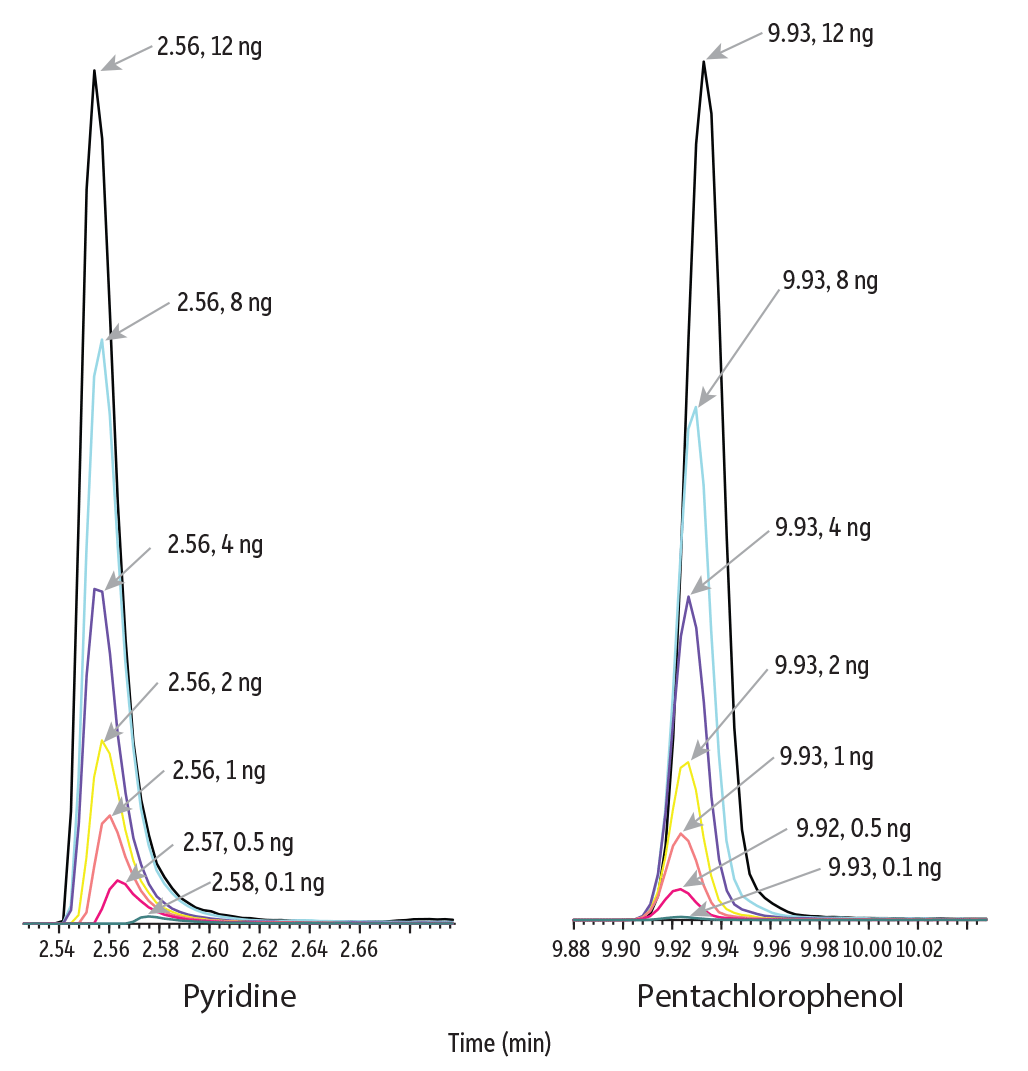
GC_EV1605
Peaks
| Peaks | |
|---|---|
| 1. | Pyridine |
| 2. | Pentachlorophenol |
Conditions
| Column | Rxi-SVOCms, 30 m, 0.25 mm ID, 0.25 µm (cat.# 16623) |
|---|---|
| Injection | |
| Inj. Vol.: | 1 µL split (split ratio 10:1) |
| Liner: | Topaz 4.0 mm ID single taper inlet liner with wool (cat.# 23303) |
| Inj. Temp.: | 250 °C |
| Split Vent Flow Rate: | 12 mL/min |
| Oven | |
| Oven Temp.: | 40 °C (hold 0.5 min) to 280 °C at 20 °C/min to 330 °C at 6 °C/min (hold 4 min) |
| Carrier Gas | He, constant flow |
| Flow Rate: | 1.2 mL/min |
| Detector | MS |
|---|---|
| Mode: | Scan |
| Transfer Line Temp.: | 280 °C |
| Analyzer Type: | Quadrupole |
| Source Type: | Extractor |
| Extractor Lens: | 6 mm ID |
| Source Temp.: | 330 °C |
| Quad Temp.: | 150 °C |
| Electron Energy: | 70 eV |
| Solvent Delay Time: | 1.55 min |
| Tune Type: | DFTPP |
| Ionization Mode: | EI |
| Instrument | Agilent 7890A GC & 5975C MSD |
| Sample Preparation | Samples were aliquoted into amber 2 mL, 9 mm short-cap, screw-thread vials (cat.# 21143) containing glass Big Mouth inserts (cat.# 21782) and sealed with 2.0 mL, 9 mm short-cap, screw-vial closures (cat.# 23842). |
Rxi-SVOCms 色谱柱坚固耐用、寿命长,可轻松恢复性能
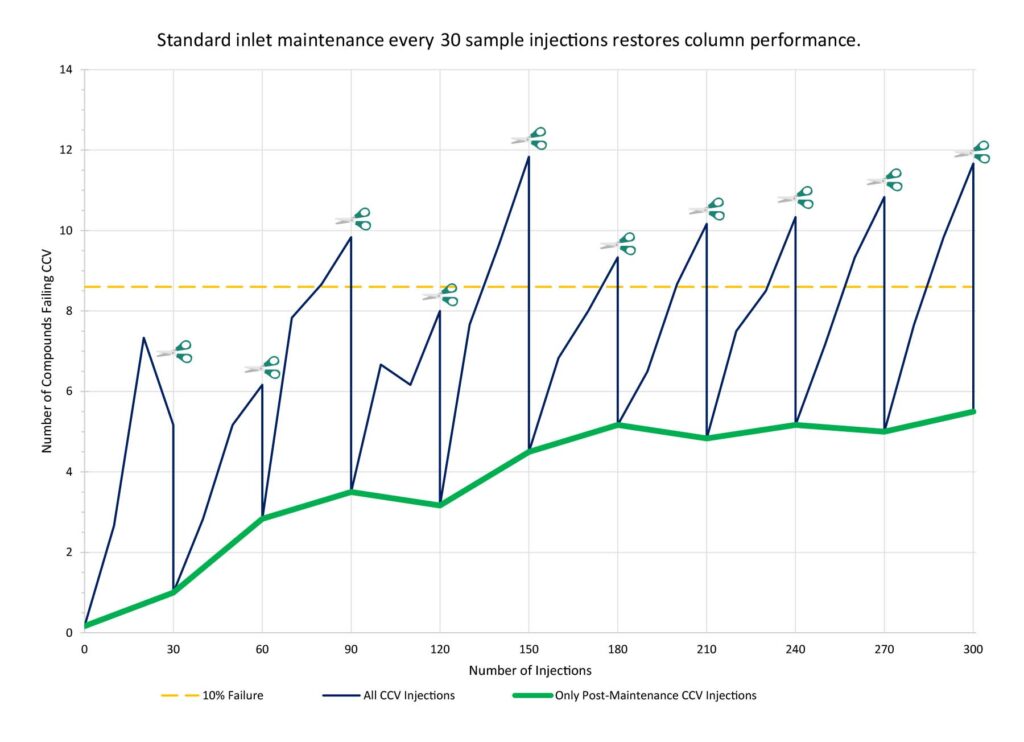
高度复杂的环境样品的组分积累是一项常规挑战,但这不一定是色谱柱无法逾越的障碍。柱化学成分的改进确保了即使在非常苛刻的条件下也能保持 Rxi-SVOCms 色谱柱性能持久。在图 3 中,我们给色谱柱重复进样脏样品,监测校准性能,并在每 30 次进样后切断受污染部分。即使在 300 次进样后,也可通过快速切割色谱柱轻松恢复性能,其中只有不到 10% 的化合物未能通过切割后校准检查证明了这一点。通过简单的日常维护即能恢复性能,这意味着可分析更多的样品、减少停机时间和色谱柱更换次数。
耐用性测试实验设计(300 个样品)
每天进样 30 次柴油微粒提取物 (NIST SRM 1975),每 10 次进样后运行一次持续校准验证 (CCV)。每日第三次 CCV 后,切割色谱柱,更换衬管、隔垫和进样口分流平板。这一步骤序列重复 10 天,且在第二个色谱柱上重复整个实验。
- 蓝线 涵盖所有 CCV 进样,并展示了由于样品基质污染导致性能先受损(如预期的那样),后经维护完全恢复。
- 绿线仅描绘了维护后 CCV 进样,展示了校准性能的稳定性。
制造时保持各色谱柱性能一致
从专有聚合物化学到最终 QC 测试,Rxi-SVOCms 色谱柱的每个制造流程都经过严格控制和严格测试。因此,色谱柱的柱间性能非常一致,您可通过安装的每根色谱柱获得相同的色谱。Rxi-SVOCms 色谱柱还具有保留时间稳定(即使是 2,4-二硝基苯酚这种经常出现问题的活性化合物也是如此)以及柱流失极低的特点(图 4)。
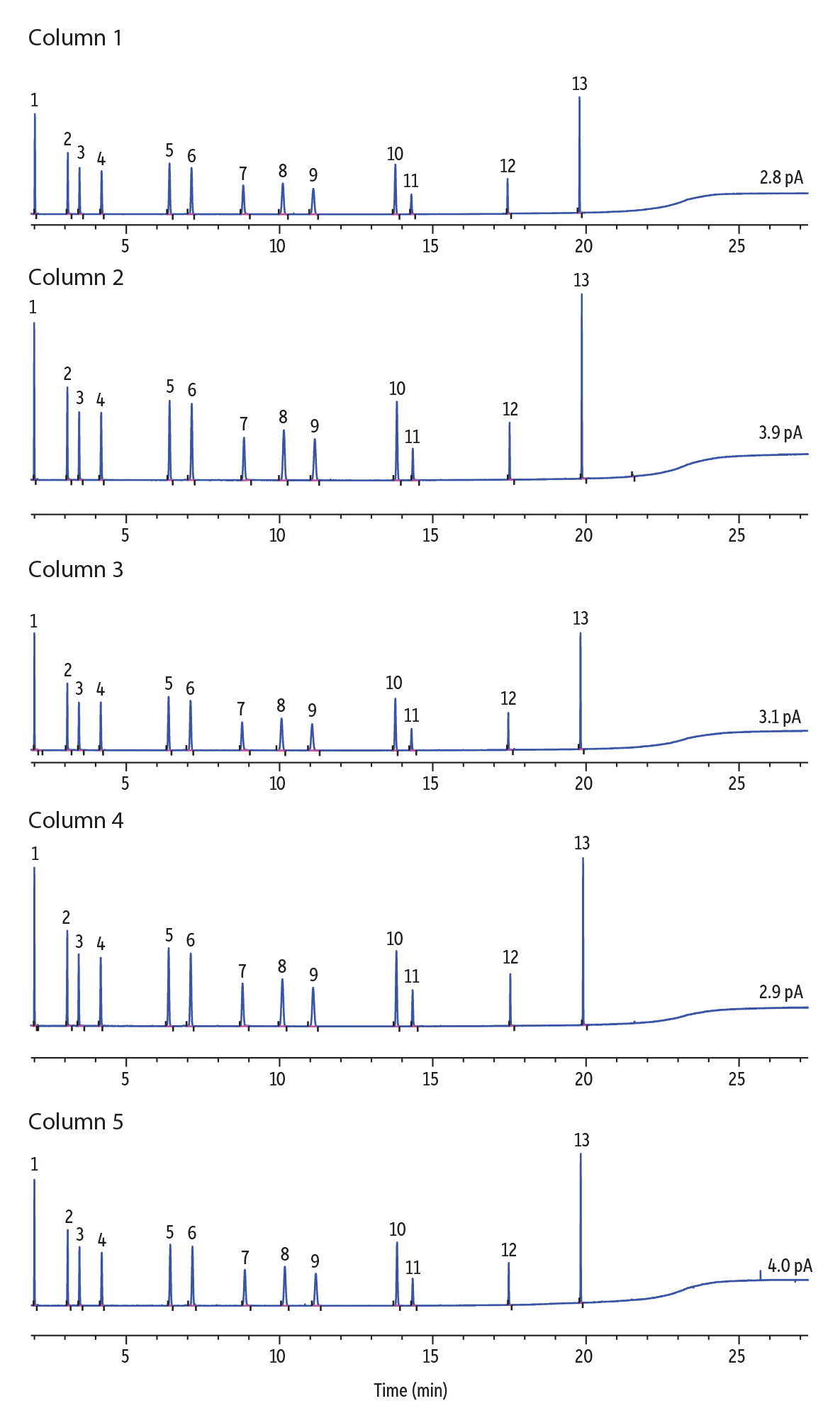
GC_GN1215
Peaks
| Peaks | |
|---|---|
| 1. | 4-Picoline |
| 2. | 2-Ethylhexanoic acid |
| 3. | 1,6-Hexanediol |
| 4. | 4-Chlorophenol |
| 5. | n-Tridecane |
| 6. | 1-Methylnaphthalene |
| Peaks | |
|---|---|
| 7. | 1-Undecanol |
| 8. | n-Tetradecane |
| 9. | Dicyclohexylamine |
| 10. | Acenaphthene-d10 |
| 11. | 2,4-Dinitrophenol |
| 12. | Pentachlorophenol |
| 13. | Benzidine |
Conditions
| Column | Rxi-SVOCms, 30 m, 0.25 mm ID, 0.25 µm (cat.# 16623) |
|---|---|
| Standard/Sample | Low-level activity test mix |
| Diluent: | Dichloromethane |
| Conc.: | 200 µg/mL |
| Injection | |
| Inj. Vol.: | 1 µL split (split ratio 200:1) |
| Liner: | Topaz 4.0 mm ID Precision inlet liner with wool (cat.# 23305) |
| Inj. Temp.: | 250 °C |
| Split Vent Flow Rate: | 236 mL/min |
| Oven | |
| Oven Temp.: | 125 °C (hold 12.5 min) to 340 °C at 20 °C/min (hold 4 min) |
| Carrier Gas | He, constant flow |
| Linear Velocity: | 32 cm/sec @ 125 °C |
| Dead Time: | 1.5885 min @ 125 °C |
| Detector | FID @ 350 °C |
|---|---|
| Make-up Gas Flow Rate: | 40 mL/min |
| Make-up Gas Type: | N2 |
| Hydrogen flow: | 40 mL/min |
| Air flow: | 400 mL/min |
| Data Rate: | 50 Hz |
| Instrument | Agilent 7890B GC |
| Sample Preparation | Samples were aliquoted into amber 2 mL, 9 mm short-cap, screw-thread vials (cat.# 21143) containing glass Big Mouth inserts (cat.# 21782) and sealed with 2.0 mL, 9 mm short-cap, screw-vial closures (cat.# 23842). |
可靠分离具有挑战性的环境 PAH 化合物
多环芳烃 (PAH) 是使用半挥发物方法过程中最难分离的一些化合物。要实现准确报告痕量结果,色谱柱需要具有高度选择性且柱效高,这样才能够可靠分离紧密洗脱的化合物。如图 5 所示,Rxi-SVOCms 色谱柱优化分离了 23 种优先污染物,(包括苯并[b]荧蒽和苯并[k]荧蒽),它们须进行色谱分离才能实现单独报告。
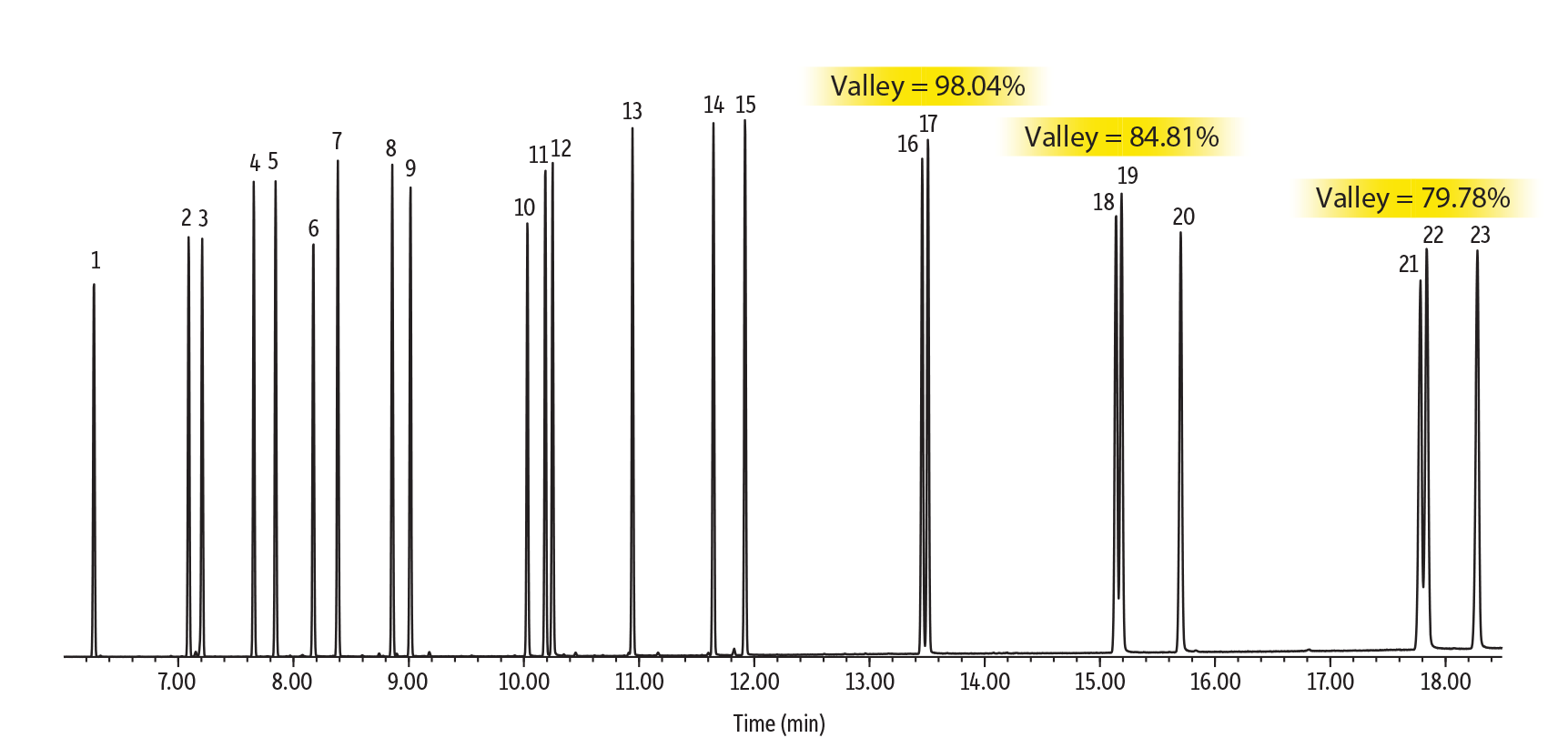
GC_EV1609
Peaks
| Peaks | tR (min) | |
|---|---|---|
| 1. | Naphthalene | 6.27 |
| 2. | 2-Methylnaphthalene | 7.09 |
| 3. | 1-Methylnaphthalene | 7.20 |
| 4. | Biphenyl | 7.65 |
| 5. | 2,6-Dimethylnaphthalene | 7.84 |
| 6. | Acenaphthylene | 8.17 |
| 7. | Acenaphthene | 8.38 |
| 8. | 2,3,5-Trimethylnaphthalene | 8.85 |
| 9. | Fluorene | 9.01 |
| 10. | Dibenzothiophene | 10.02 |
| 11. | Phenanthrene | 10.18 |
| Peaks | tR (min) | |
|---|---|---|
| 12. | Anthracene | 10.24 |
| 13. | 1-Methylphenanthrene | 10.94 |
| 14. | Fluoranthene | 11.64 |
| 15. | Pyrene | 11.91 |
| 16. | Benz[a]anthracene | 13.45 |
| 17. | Chrysene | 13.50 |
| 18. | Benzo[b]fluoranthene | 15.13 |
| 19. | Benzo[k]fluoranthene | 15.18 |
| 20. | Benzo[a]pyrene | 15.69 |
| 21. | Indeno[1,2,3-cd]pyrene | 17.77 |
| 22. | Dibenz[a,h]anthracene | 17.82 |
| 23. | Benzo[ghi]perylene | 18.26 |
Conditions
| Column | Rxi-SVOCms, 30 m, 0.25 mm ID, 0.25 µm (cat.# 16623) |
|---|---|
| Standard/Sample | Custom PAH SIM standard |
| Diluent: | Dichloromethane |
| Conc.: | 40 µg/mL |
| Injection | |
| Inj. Vol.: | 1 µL split (split ratio 20:1) |
| Liner: | Topaz 4.0 mm ID single taper inlet liner with wool (cat.# 23303) |
| Inj. Temp.: | 250 °C |
| Split Vent Flow Rate: | 24 mL/min |
| Oven | |
| Oven Temp.: | 40 °C (hold 0.5 min) to 280 °C at 20 °C/min to 330 °C at 6 °C/min (hold 4 min) |
| Carrier Gas | He, constant flow |
| Flow Rate: | 1.2 mL/min |
| Detector | MS | ||||||||||||||||||||||||||||||||||||||||||||||||||||||||||||||||
|---|---|---|---|---|---|---|---|---|---|---|---|---|---|---|---|---|---|---|---|---|---|---|---|---|---|---|---|---|---|---|---|---|---|---|---|---|---|---|---|---|---|---|---|---|---|---|---|---|---|---|---|---|---|---|---|---|---|---|---|---|---|---|---|---|---|
| Mode: | SIM | ||||||||||||||||||||||||||||||||||||||||||||||||||||||||||||||||
| SIM Program: | |||||||||||||||||||||||||||||||||||||||||||||||||||||||||||||||||
| |||||||||||||||||||||||||||||||||||||||||||||||||||||||||||||||||
| Transfer Line Temp.: | 280 °C | ||||||||||||||||||||||||||||||||||||||||||||||||||||||||||||||||
| Analyzer Type: | Quadrupole | ||||||||||||||||||||||||||||||||||||||||||||||||||||||||||||||||
| Source Type: | Extractor | ||||||||||||||||||||||||||||||||||||||||||||||||||||||||||||||||
| Extractor Lens: | 6 mm ID | ||||||||||||||||||||||||||||||||||||||||||||||||||||||||||||||||
| Source Temp.: | 330 °C | ||||||||||||||||||||||||||||||||||||||||||||||||||||||||||||||||
| Quad Temp.: | 150 °C | ||||||||||||||||||||||||||||||||||||||||||||||||||||||||||||||||
| Tune Type: | DFTPP | ||||||||||||||||||||||||||||||||||||||||||||||||||||||||||||||||
| Ionization Mode: | EI | ||||||||||||||||||||||||||||||||||||||||||||||||||||||||||||||||
| Instrument | Agilent 7890B GC & 5977A MSD | ||||||||||||||||||||||||||||||||||||||||||||||||||||||||||||||||
| Sample Preparation | 200 ppm standard diluted 5x, then analyzed at 20:1 split. Samples were aliquoted into amber 2 mL, 9 mm short-cap, screw-thread vials (cat.# 21143) containing glass Big Mouth inserts (cat.# 21782) and sealed with 2.0 mL, 9 mm short-cap, screw-vial closures (cat.# 23842). | ||||||||||||||||||||||||||||||||||||||||||||||||||||||||||||||||