



Chromatograms are like fingerprints. If you can “read” chromatograms well, you often can find a plausible cause. In this series, we will show a series of GC-chromatograms that are obtained from users and discuss some potential causes for the phenomena. Then we can move into some solutions for improvement.
A chromatographer having a challenge, shared a chromatogram as shown in fig. 1 .
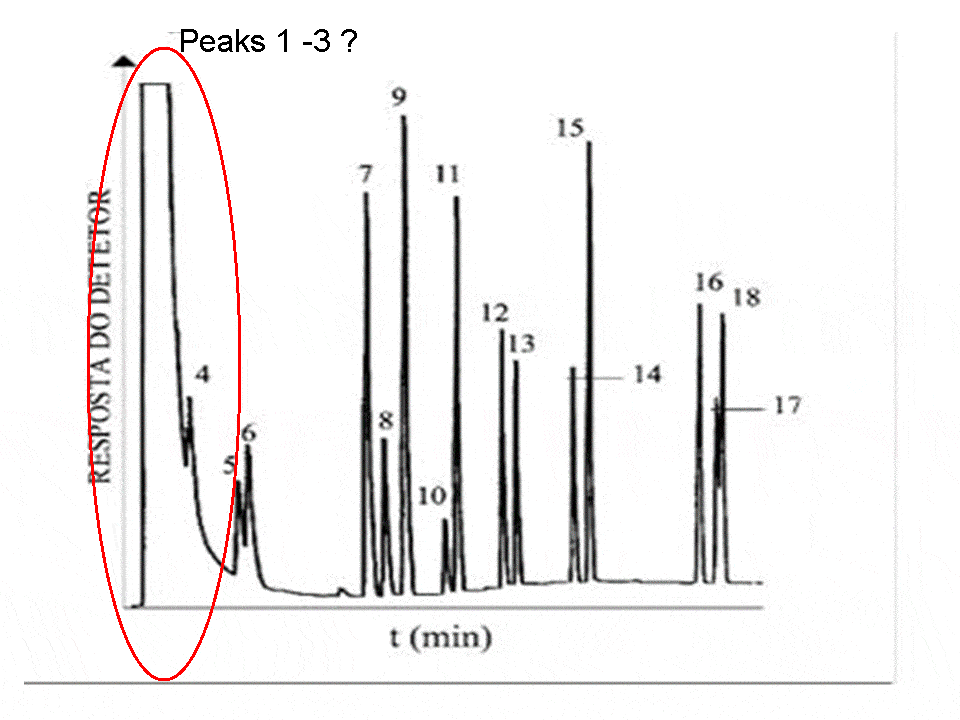
Fig.1 Chromatogram showing strong solvent tail. Peaks 1-3 are not separated: Peak 4 elutes on a skimmed base line.
The sample contained 17 components, but the first 4 components did elute within or on the tail of the solvent, making quantification impossible or inaccurate.
Usually when the solvent is tailing, there is an injection challenge or there is dead volume involved. For instance, we discussed dead volume in a previous blog, where column coupling was done, see: What do Chromatograms tell us? Peak Shape: Tailing solvent peak
There are however several other conditions that cause solvent peak tailing.
The most obvious ones are: “column installed not correctly” and “injection temperature too low”.
Other factors could be:
- Split-line blocked (check if split-flows are indeed correct);
- Too large injection volume for liner used (calculate volume of expanded solvent and compare with liner volume). For splitless, we recommend 4mm liners an for split ideally you use a 2mm ID, but 4 mm will work also if components are not too volatile.
- Polarity of solvent used: if a very polar solvent is used, like methanol, it will always show some tailing, which will cause the tailing solvent peak.
Injection conditions also need to be considered. If splitless injection is used, the injection time needs to be optimized. Solvent peak has to show up as a sharp broad band” (like the trunk of a tree). Also make sure you start the oven 20C below the boiling point of the solvent.
In split injection, the split flow may be set too low, or the evaporation needs to be improved. One can use Restek Premium Liners for the best evaporation.
If all of this is optimized, we also can also choose a different column for the separation.
To generate more retention for the volatile components, a thicker film is the most easy way to get the volatile components out of the solvent. For most phases a thicker film is available. The other effect is, that also later eluting components will have a higher retention. Oven programming needs to go higher. Roughly one can expect elution temperatures to be approximate 15C higher when the film thickness increases a factor 2. Higher elution temperatures may affect S/N, especially if the columns starts to bleed. Lucky with the new generation phases (like Rxi), the columns can be used up to 350C and bleed is a minor issue.
One can also try to start at a lower temperature to increase the retention for the first components.
Lastly, another stationary phase can be selected for the target analytes. This however, will immediately impact the retention times and relative positions of all components, so validation will take extra time.
With special thanks to Denise Domingos da Silvo from Works at Federal University of Campina Grande, for sharing the challenge.