



A little follow up on the interesting topic that was blogged by Alan. I promised to add a few comments on column selection as I have had several questions of this nature.
In general in gas analysis, you need to use columns with high retention. So only thick-film liquid phases like Rtx-1 or adsorption (PLOT) columns are to be considered. Additionally the columns need to have a high degree of inertness. For liquid phases this is generally not an issue, but for PLOT columns, this depends on the material used. Alumina is only usable for hydrocarbons and a series of halogenated compounds. Silica and Carbon also have limitations, although for sulfur gases, silica does show quite promising.
The most inert materials that combine retention and inertness are the porous polymers. These materials are available as packed and also as PLOT column. One of the most inert and stable porous polymer PLOT columns is the Rt-U-BOND. This column elutes H2S as a symmetrical peak (fig 1). Even SO2 peak shape at 100 ppm is very good (fig.2). Such columns are ideal candidates for analyzing compounds like arsine and phosphine.
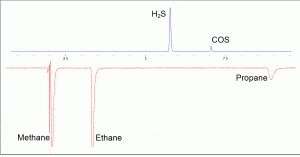
Fig.1 H2S and COS at 1 ppm in natural gas on a Rt U-BOND. Note the symmetry of H2S
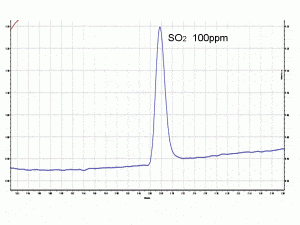
Fig.2 Peak shape of 100 ppm SO2 on a Rt U-BOND.
Special thanks to Mark Vermunt from Interscience, The Netherlands, for sharing the chromatogram
Porous polymers can also be packed in a 0.53mm MXT. For high inertness a Hayesep D can be considered. Such MXT columns are also Siltek deactivated and have a relative small column surface, resulting in minimal adsorption. Because of the diameter, one can also use such 0.53mm ID columns in normal inlets designed for split/splitless. Specific advantage of the packed column, is that they offer highest possible retention, which is beneficial for the volatile gases. They operate with low flow rate, about 1-2 ml/min.
Sometimes the analytes are so reactive that the oven temperature has to be as low as possible. Here the thick-films Rtx-1 are interesting. For instance analyzing chlorine or thionyl chlorides, can be done using 7 microns Rtx-1 on 0.53mm fused silica. Often 0.53mm columns are used because injection is done with sample loops, often using direct injection. Proper column connections are essential as peaks still elute relative fast and injection error can compromise the efficiency.