


Chiral capillary GC has proven to be a convenient method for characterizing essential oils and differentiating natural flavors from those of synthetic origin. Chiral compounds from natural origins usually exist as one predominant optical isomer. Also, the inspection of enantiomeric ratios can characterize regional differences between oils. Sometimes a result of processing, the presence of racemic pairs (one-to-one ratios of each enantiomer) most often indicates adulteration or unnatural origin.
Since most chiral compounds naturally exist as one predominant isomer, resolution is more challenging, especially for components in higher concentrations. For primary constituents in essential oils, it is preferable to select a chiral column that provides a resolution factor value greater than two to overcome possible loss of resolution.
Lemon Oil
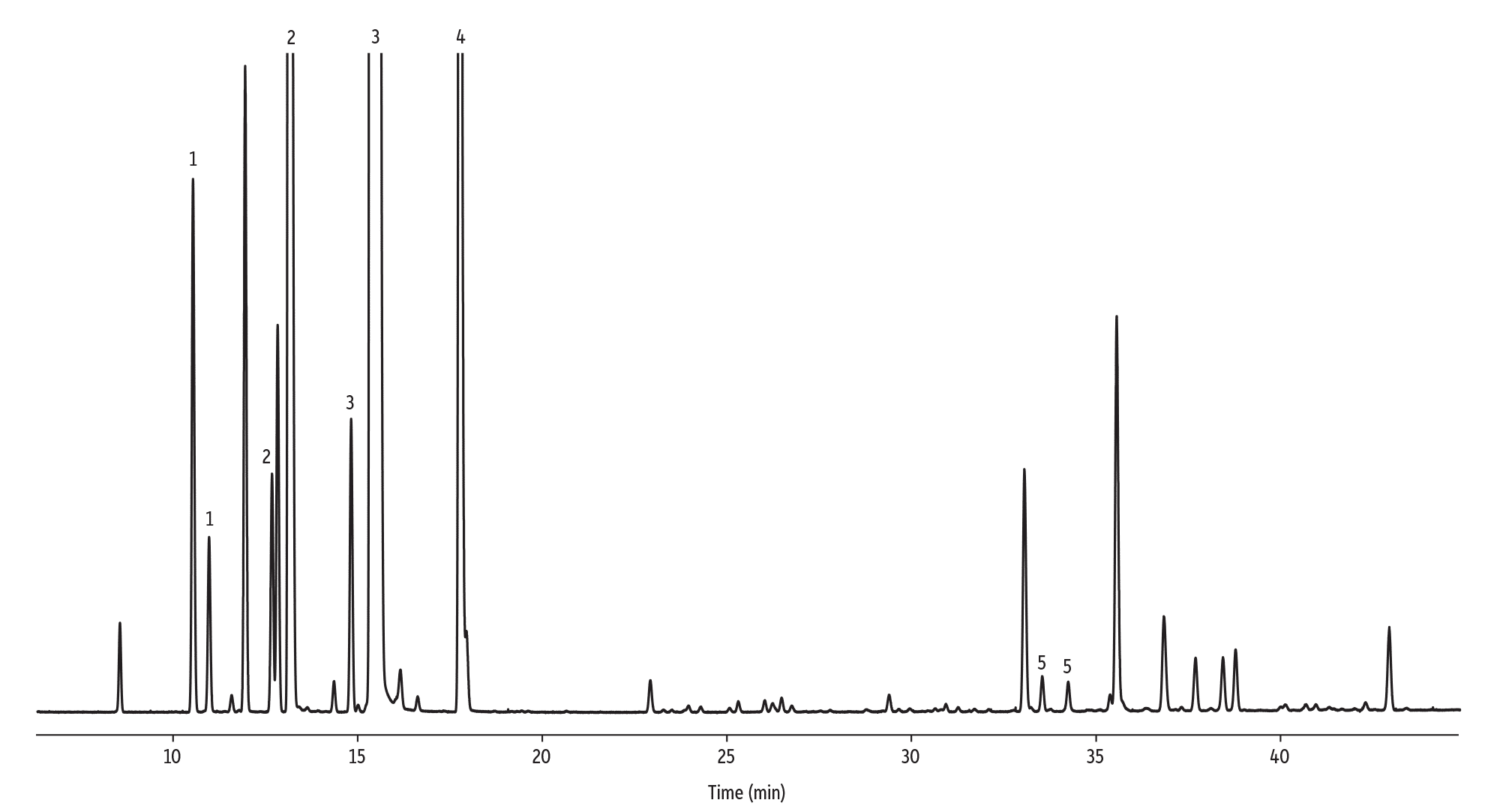
The Rt-βDEXsm is the optimum column for obtaining chiral profiles of Lemon and other citrus oils since it provides enantiomeric separation for the main terpene constituents like α- and β-pinenes, and limonene.
| Peaks | tR 1 | tR 2 | |
|---|---|---|---|
| 1. | α-Pinene (±) | 10.544 | 10.980 |
| 2. | β-Pinene (±) | 12.681 | 13.136 |
| 3. | Limonene (L, D) | 14.826 | 15.342 |
| 4. | γ-Terpinene | 17.764 | – |
| 5. | α-Terpineol (±) | 33.546 | 34.248 |
Figure 1: Lemon oil on Rt-βDEXsm, GC_FF1353
Rosemary Oil
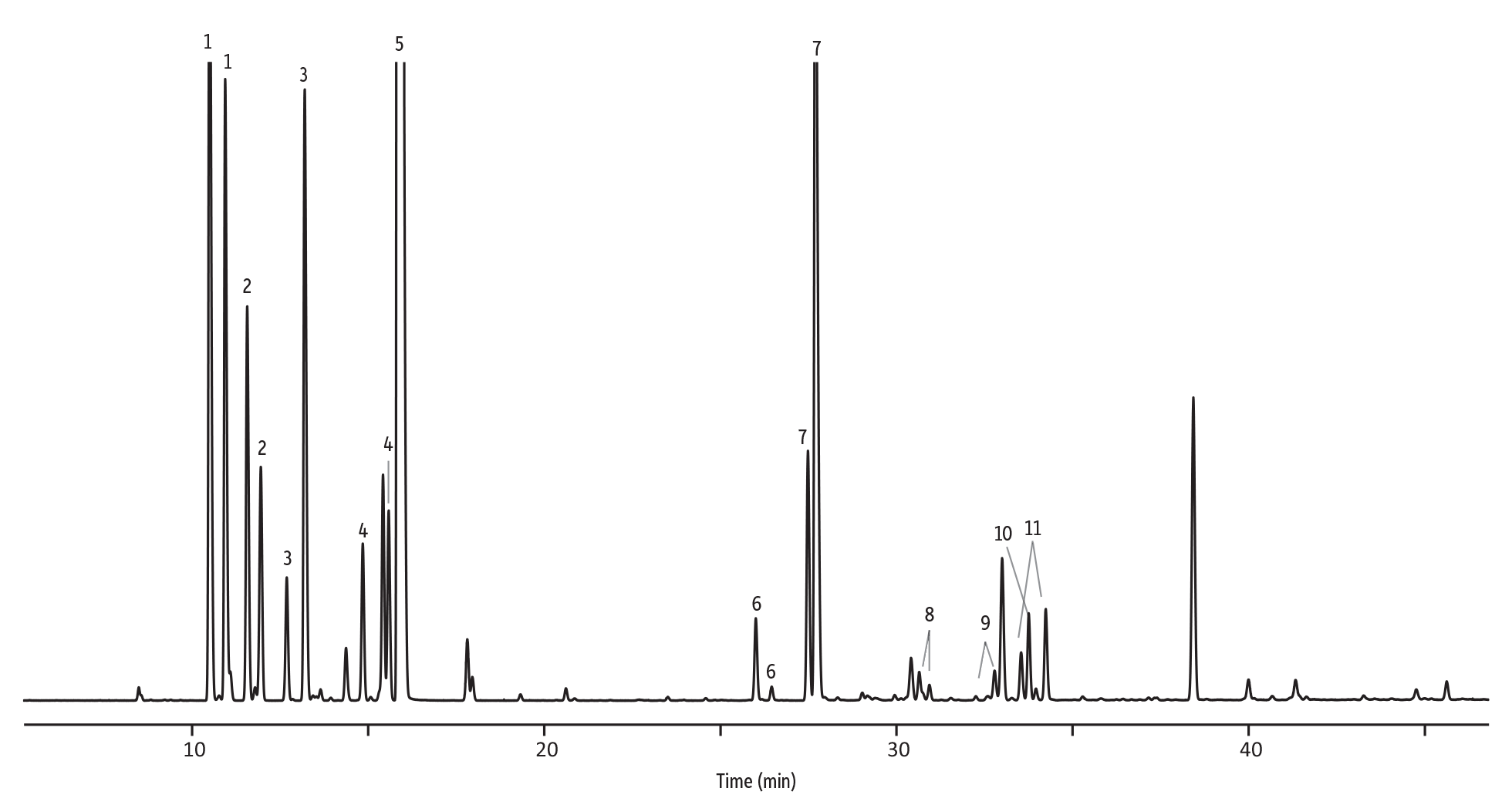
Chiral constituents in this oil include α-pinene, β-pinene, camphene, limonene, linalool, camphor, terpinen- 4-ol, α terpineol, borneol, and isoborneol. These compounds are resolved optimally on the Rt- βDEXsm column.
| Peaks | tR1 | tR2 | |
|---|---|---|---|
| 1. | α-Pinene (±) | 10.500 | 10.941 |
| 2. | Camphene (±) | 11.566 | 11.952 |
| 3. | β-Pinene (±) | 12.690 | 13.200 |
| 4. | Limonene (±) | 14.850 | 15.585 |
| 5. | Eucalyptol (1,8-cineole) | 15.837 | – |
| Peaks | tR1 | tR2 | |
|---|---|---|---|
| 6. | Linalool (±) | 26.011 | 26.463 |
| 7. | Camphor (±) | 27.492 | 27.704 |
| 8. | Terpinen-4-ol (±) | 30.647 | 30.935 |
| 9. | Isoborneol (±) | 32.254 | 32.786 |
| 10. | Borneol (±) | 33.000 | 33.756 |
| 11. | α-Terpineol (±) | 33.539 | 34.237 |
Figure 2: Rosemary oil on Rt-βDEXsm, GC_FF1355
Peppermint Oil
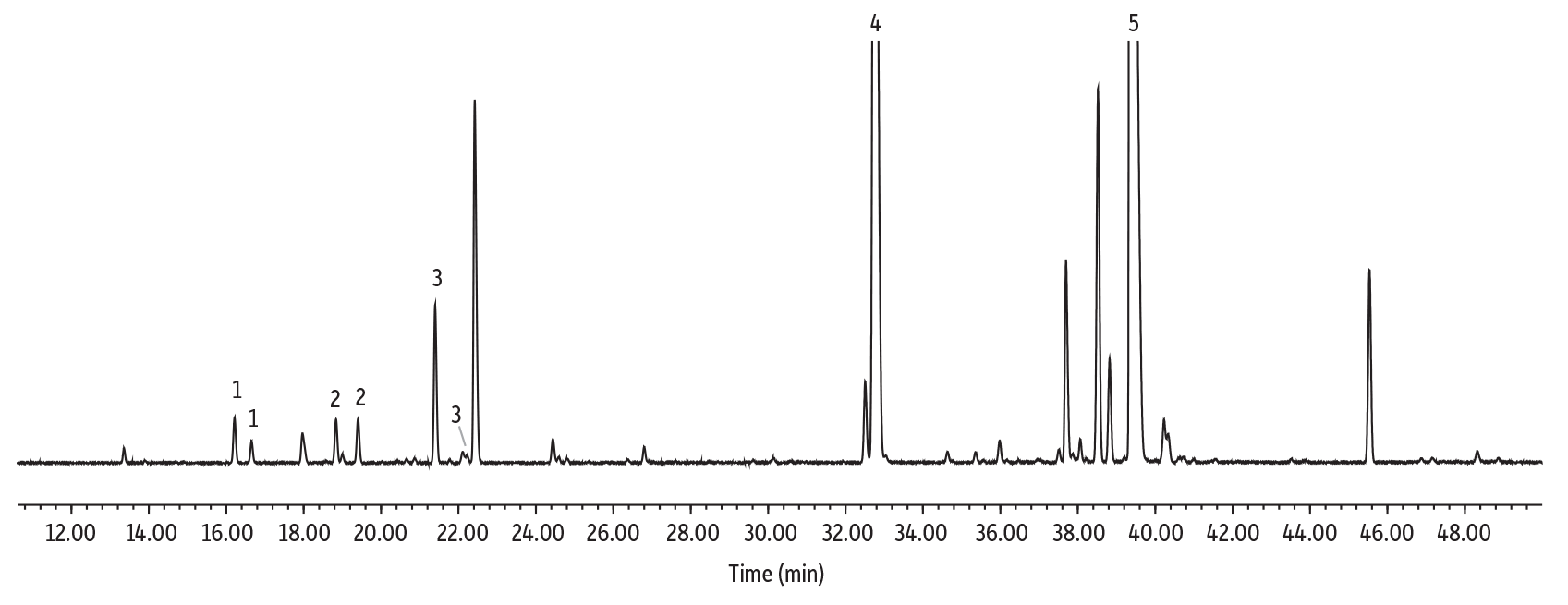
The Rt-βDEXsm column is optimum for the separation of (+/-) α- and β-pinene, and limonene. Since menthone and menthol enantiomers are major constituents of peppermint oil, reducing the sample size to prevent overloading of these components and provide better enantiomeric resolution may be necessary. An alternative solution is to use an Rt-βDEXm or Rt-γDEXsa as a secondary column since they provide better resolution of menthol.
| Peaks | tR 1 | tR 2 | |
|---|---|---|---|
| 1. | α-Pinene (±) | 16.214 | 16.654 |
| 2. | β-Pinene (±) | 18.836 | 19.404 |
| 3. | Limonene (L,D) | 21.396 | 22.216 |
| 4. | Menthone | 32.738 | – |
| 5. | Menthol | 39.340 | – |
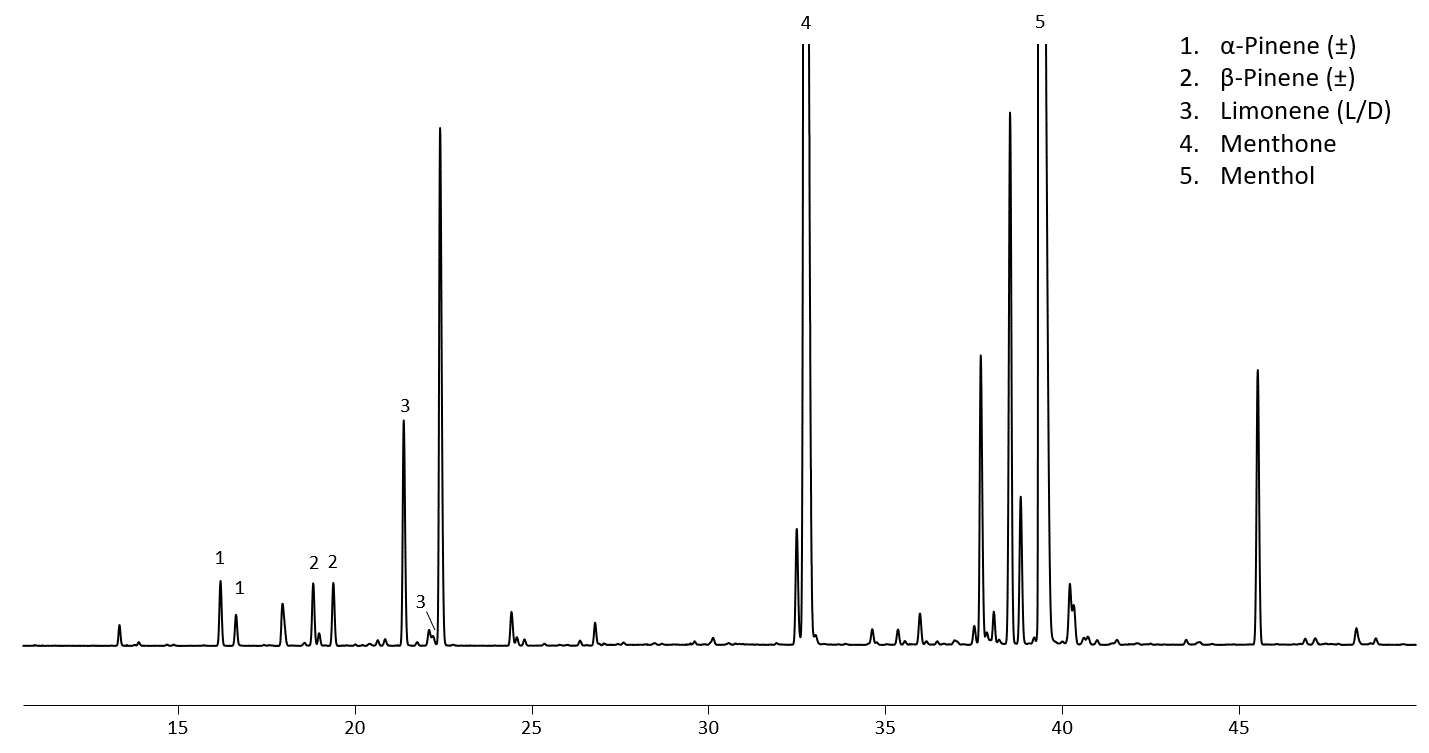
Figure 3: Peppermint oil on Rt-βDEXsm, GC_FF1356
In the next blog, we’ll look into dual column analysis of lavender oil.