



Last week I presented an invited talk at the Chromatographic society in the UK.
Alan Handley, driving force behind the GC meetings, gave me a working title: “Column selection: is there is more to life than using a boiling point column?
The answer is clearly “yes”, not because I like chromatography but also because “boiling point columns” have earned their place in many applications.
Column selection remains an interesting challenge. On one side we like to keep things as simple as possible, using only non-polar poly dimethyl siloxane based phases that have proven to be robust.(typical referred as a “boiling point” column..). Although phases like Rtx-1 are considered boiling point separation columns, they absolute do not separate according to boiling point if different classes of compounds are considered, see fig.1.
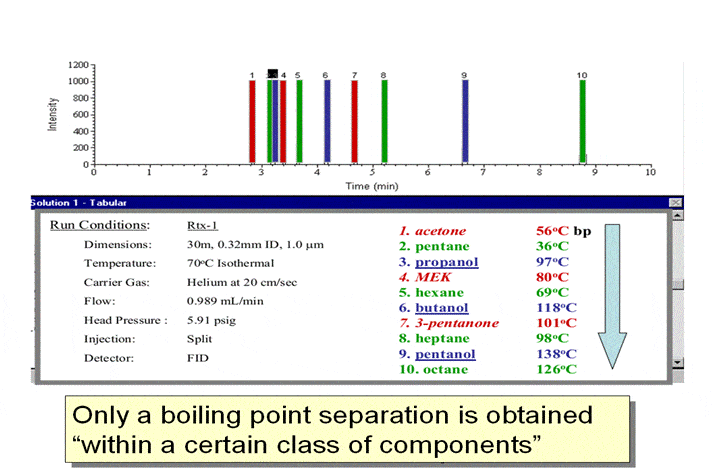
Fig.1 Elution order of compounds of different classes using the Rtx-1 phase. This is considered a boiling point separation, but this only is true for the same class of components
In SimDist analysis, typical boiling point separations are performed, using high temperature, intensive cross-linked phases that are coated on MXT tubing, see fig.2.
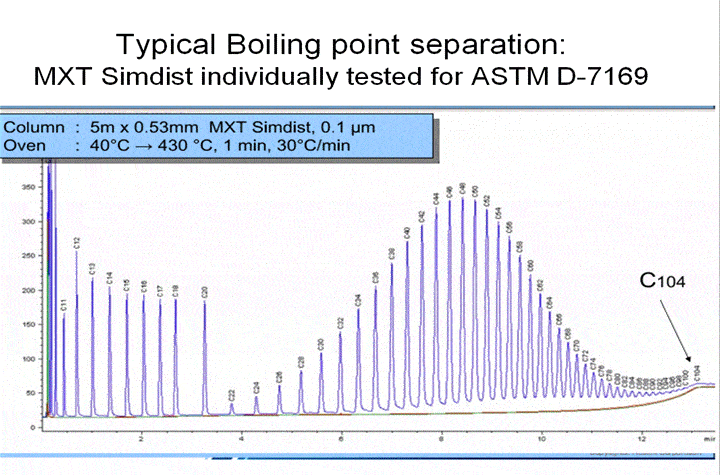
Fig.2 Simulated distillation is typically done on 100% PDMS type phases. Using MXT and Siltek deactivation makes these columns robust and with very low bleed
If such phases are coated in long capillaries we have the efficiency to do the separation for us, like done in ASTM 6730, using a100m Rtx-DHA-100.
If efficiency does not do the job, the column can also be used with a mass spectrometer, and again a separation is obtained, but then using the selectivity of the mass spectrometer.

Fig. 3 applications where stationary phase selectectivity is preferred
The other side is, to use selectivity to maximize separation, for instance if analysis times must be minimized. Here we can use relative short columns to do the separation. The main advantage is analysis time and cost per analysis. Selectivity is provided by stationary phase interactions, and we have seen that for a number of applications, “selectivity” allows us to do unique separations, using not only GC-FID, but also for applications where even the mass spectrometer does not qualify because of similarity of fragmentation ions or the bias caused by fragmentation of complex molecules;
Today’s stationary phase chemistries allow us to modify phases while maintaining robustness. Practical operation and temperature range of many phases is comparable with the “boiling point” column. Polar columns are stable up to 360 C.
Besides the listed applications selectivity plays a big role in column switching solutions and comprehensive (GCxGC) separations.
Another recent article was published recently in the Instrumental Scientist. Here we also zoom into the power of selectivity.