


- Unique polymer composition provides excellent retention and separation of intermediate polar compounds.
- Higher thermal stability ensures low bleed for sensitive detectors.
- Stable deactivation provides consistent retention, efficiency, and inertness.
- Pro EZGC libraries for simplified method development and optimization.
Unique Polymer Composition Enables Unique Selectivity
Restek’s Rtx-200 GC columns are coated with a trifluoropropylmethylpolysiloxane stationary phase, which provides a unique selectivity for compounds that display lone pair electrons, such as ketones, aldehydes, nitro-containing compounds, and halogen-containing compounds. The distinctive polarity of Rtx-200 columns ensures separations that often cannot be achieved with either nonpolar or polar columns—making them suitable for a broad range of analyses.
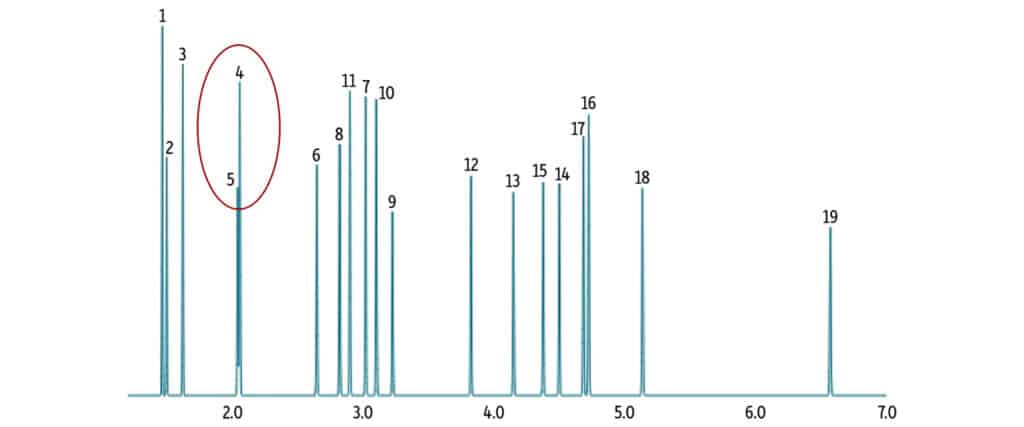
Using our Pro EZGC software to model GC separations, the retention of several common solvents was determined for three columns of different polarities: a nonpolar Rtx-1 column; a midpolar Rxi-624Sil MS column; and the selective Rtx-200 column (Figure 1). Under identical analytical conditions, Rtx-200 columns provide complete resolution of these solvents and a different elution order compared to either a Rtx-1 or Rxi-624Sil MS column.
Rtx-200
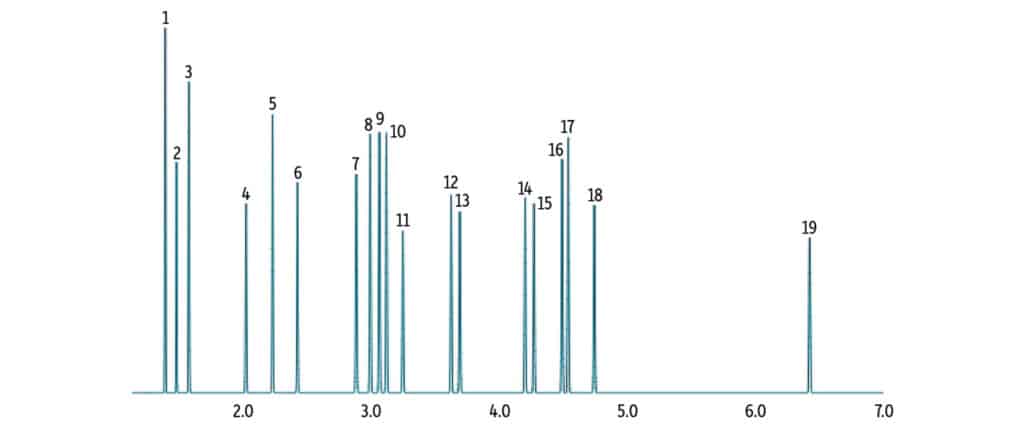
Rtx-1
Rtx-624Sil MS
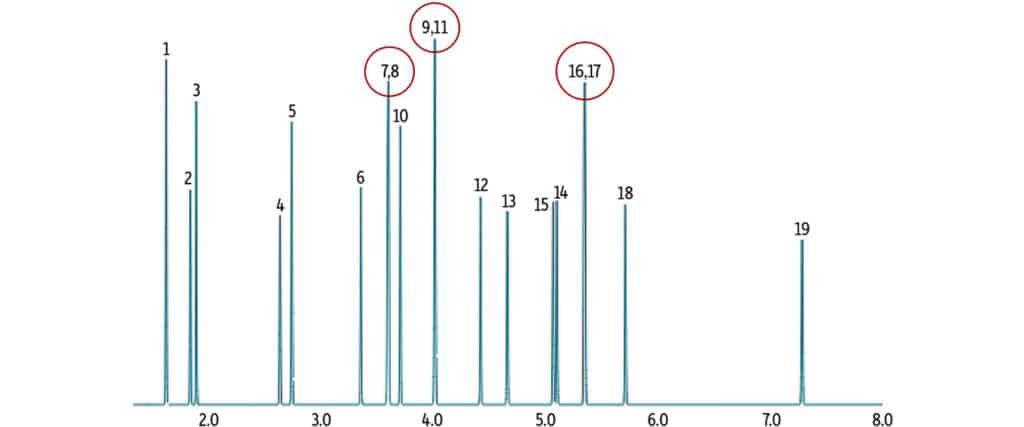
Peaks
- Chloromethane
- Methanol
- Bromomethane
- Methylene Chloride
- tert-Butyl Alcohol
- Chloroform
- Benzene
- 1,2-Dichloroethane
- Dibromomethane
- Fluorobenzene
- 2-Chloroethanol
- Toluene
- Tetrachloroethene
- Ethylbenzene
- Chlorobenzene
- o-Xylene
- Styrene
- n-Propylbenzene
- Naphthalene
Conditions
Column: 30 m, 0.32 mm ID, 1.0 µm
Carrier Gas: Helium, Constant Flow @ 2.0 mL/min
Average Velocity: 40.88 cm/sec
Outlet Pressure (abs): 14.70 psi
Oven Temp.: 35 °C (hold 1 min) to 235 °C @ 30 °C/min
High Thermal Stability and Low Bleed—Ready for MS
The stable column chemistry of Rtx-200 allows thermal stability to 360 °C with low bleed. The high thermal stability of the Rtx-200 phase makes it compatible with sensitive detectors and analyses that require high temperatures.
For applications that require even lower bleed, our Rtx-200MS columns have a bleed specification lower than that of Rtx-200, making them ideal for labs using sensitive mass specs.
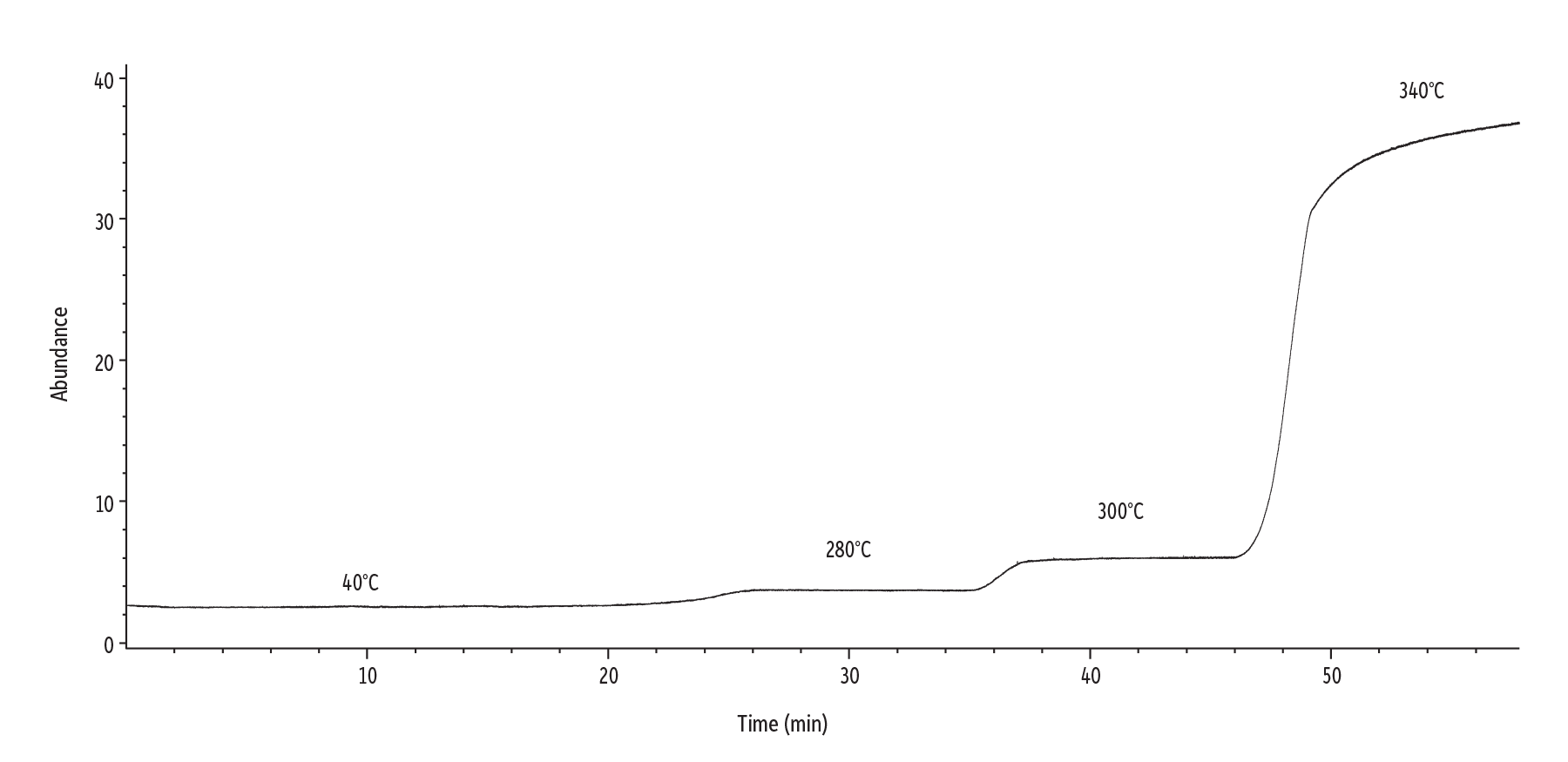
GC_GN1228
Conditions
| Column | Rtx-200ms, 30 m, 0.25 mm ID, 0.25 µm (cat.# 15623) |
|---|---|
| Standard/Sample | Instrument blank |
| Injection | split |
| Oven | |
| Oven Temp.: | 40 °C to 280 °C at 10 °C/min (hold 10 min) to 300 °C at 20 °C/min (hold 10 min) to 340 °C at 20 °C/min (hold 10 min) |
| Carrier Gas | He, constant flow |
| Flow Rate: | 1.4 mL/min |
| Linear Velocity: | 32.113 cm/sec @ 40 °C |
| Dead Time: | 1.54 min @ 40 °C |
| Detector | FID @ 300 °C |
|---|---|
| Make-up Gas Flow Rate: | 30 mL/min |
| Hydrogen flow: | 40 mL/min |
| Air flow: | 400 mL/min |
| Data Rate: | 50 Hz |
| Instrument | Agilent 7890B GC |
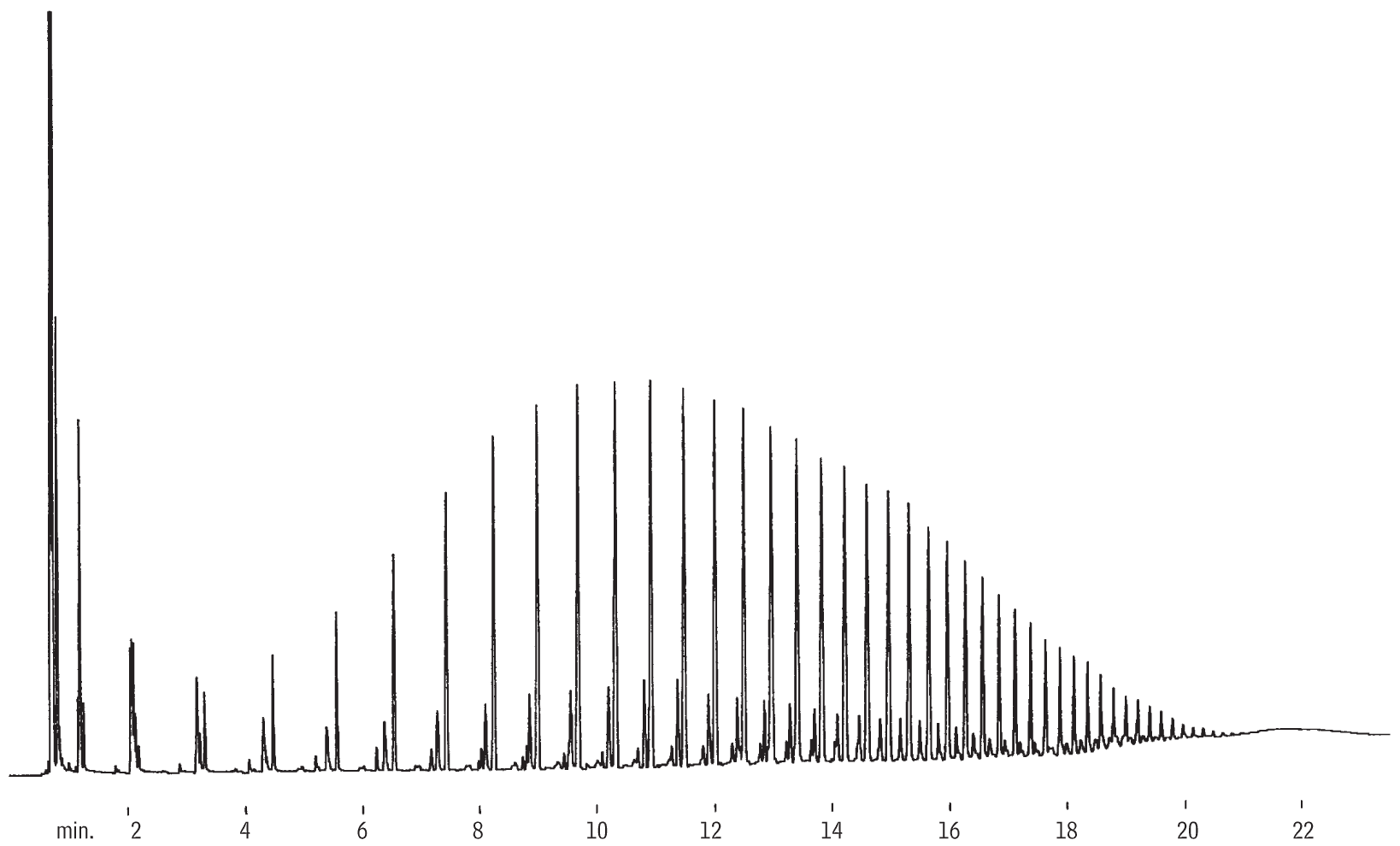
GC_CH00360
Conditions
| Column | Rtx-200, 15 m, 0.25 mm ID, 0.25 µm (cat.# 15020) |
|---|---|
| Standard/Sample | Polymethyl siloxane |
| Injection | |
| Inj. Vol.: | 1.0 µL split |
| Inj. Temp.: | 250 °C |
| Oven | |
| Oven Temp.: | 40 °C to 360 °C at 15 °C/min (hold 30 min) |
| Carrier Gas | H2, constant flow |
| Linear Velocity: | 40 cm/sec |
| Detector | FID @ 360 °C |
|---|---|
| Notes | FID sensitivity: 5.12 x 10⁻¹⁰ AFS Split vent: 40 cc/min. |
Versatile
Rtx-200 columns are available in a variety of dimensions (lengths, IDs, and film thicknesses), and can be used for a broad range of applications, from solvents to silanes to pesticides. Due to its neutrality and inertness, Rtx-200 columns can be used to analyze acidic, basic, or neutral compounds. Its unique polarity also makes it an ideal confirmation column for many analyses because it will produce a different elution pattern compared to most other stationary phases.
CFCs
The Rtx-200 is the best non-PLOT column option that can be used with GC-MS without the need for a particle trap or cryofocusing for chlorofluorcarbons (CFCs). This stationary phase’s unique selectivity exhibits the best retention and separation of these specific commonly found halogenated compounds (Figure 4).
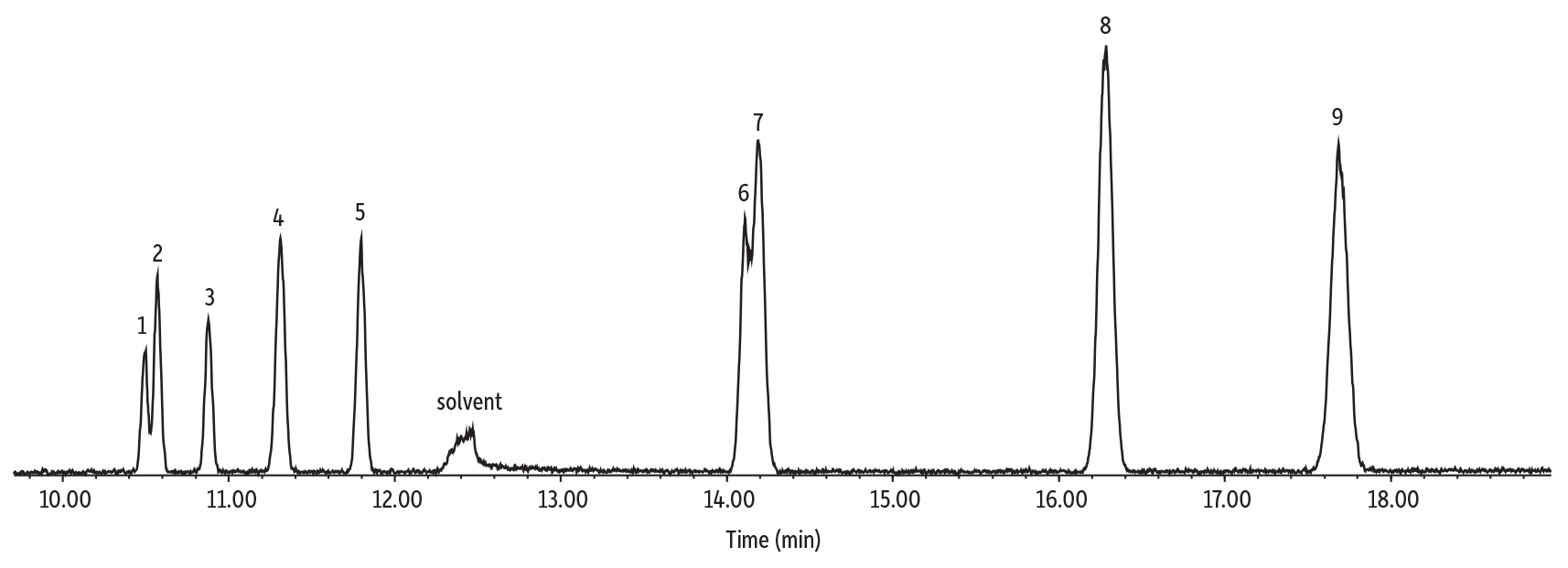
GC_PC1383
Conditions
| Column | Rtx-200, 105 m, 0.25 mm ID, 1.00 µm (cat.# 15059) |
|---|---|
| Standard/Sample | |
| Dichlorodifluoromethane (cat.# 30275) | |
| Fluorocarbons standard (cat.# custom) | |
| Trichlorofluoromethane (cat.# 30421) | |
| Diluent: | Methanol |
| Conc.: | 500 ppm |
| Injection | |
| Inj. Vol.: | 1 µL split (split ratio 400:1) |
| Liner: | Topaz 4.0 mm ID Precision inlet liner w/ wool (cat.# 23305) |
| Inj. Temp.: | 250 °C |
| Split Vent Flow Rate: | 400 mL/min |
| Gas Saver Time: | 2 min |
| Gas Saver Flow Rate: | 20 mL/min |
| Oven | |
| Oven Temp.: | 32 °C (hold 20 min) |
| Carrier Gas | He, constant flow |
| Flow Rate: | 1 mL/min |
| Linear Velocity: | 19.303 cm/sec @ 32 °C |
| Dead Time: | 9.553 min @ 40 °C |
| Detector | MS | ||||||||
|---|---|---|---|---|---|---|---|---|---|
| Mode: | Scan | ||||||||
| Scan Program: | |||||||||
| |||||||||
| Transfer Line Temp.: | 250 °C | ||||||||
| Analyzer Type: | Quadrupole | ||||||||
| Source Type: | Extractor | ||||||||
| Source Temp.: | 230 °C | ||||||||
| Quad Temp.: | 150 °C | ||||||||
| Electron Energy: | 1708 eV | ||||||||
| Tune Type: | PFTBA | ||||||||
| Ionization Mode: | EI | ||||||||
| Instrument | Agilent 7890B GC & 5977B MSD | ||||||||
| Sample Preparation | Standards were combined and diluted to 500 ppm, then transferred to a 2 mL vial (cat.# 21142) and capped with a short screw cap (cat.# 24498). | ||||||||
Chlorosilanes
Chlorosilanes are volatile, reactive compounds used as silylating agents and intermediates for silicone synthesis. Due to their highly reactive nature, these compounds are difficult to analyze by GC. However, a 60 m, 0.53 mm ID 3.0 µm Rtx-200 column can successfully analyze a wide range of chlorosilane compounds (Figure 5).
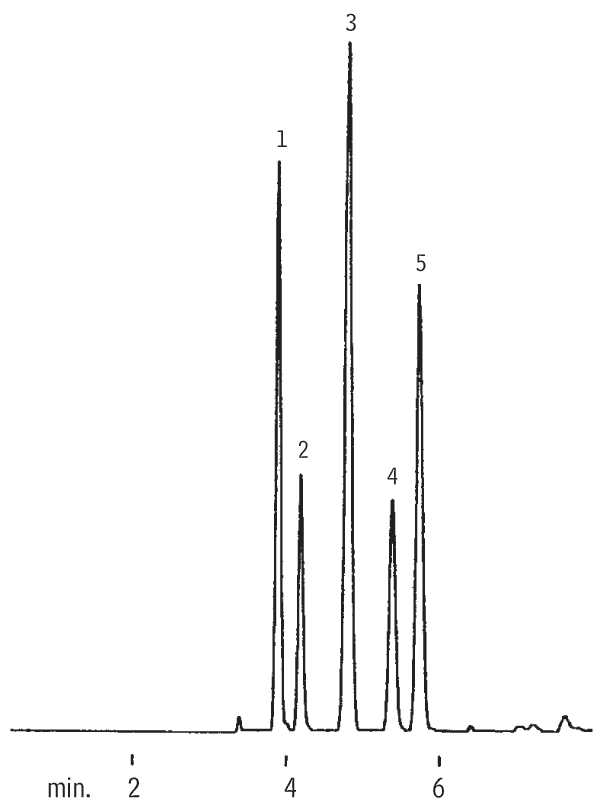
GC_CH00362
Conditions
| Column | Rtx-200, 60 m, 0.53 mm ID, 3.00 µm (cat.# 15088) |
|---|---|
| Standard/Sample | Methyl silanes |
| Injection | |
| Inj. Vol.: | 0.5 µL split |
| Inj. Temp.: | 200 °C |
| Oven | |
| Oven Temp.: | 40 °C to 250 °C at 8 °C/min (hold 5 min) |
| Carrier Gas | H2, constant flow |
| Linear Velocity: | 40 cm/sec |
| Detector | FID @ 270 °C |
|---|---|
| Notes | FID sensitivity: 1.02 x 10⁻⁹ AFS Split vent: 40 cc/min. |
Solvents
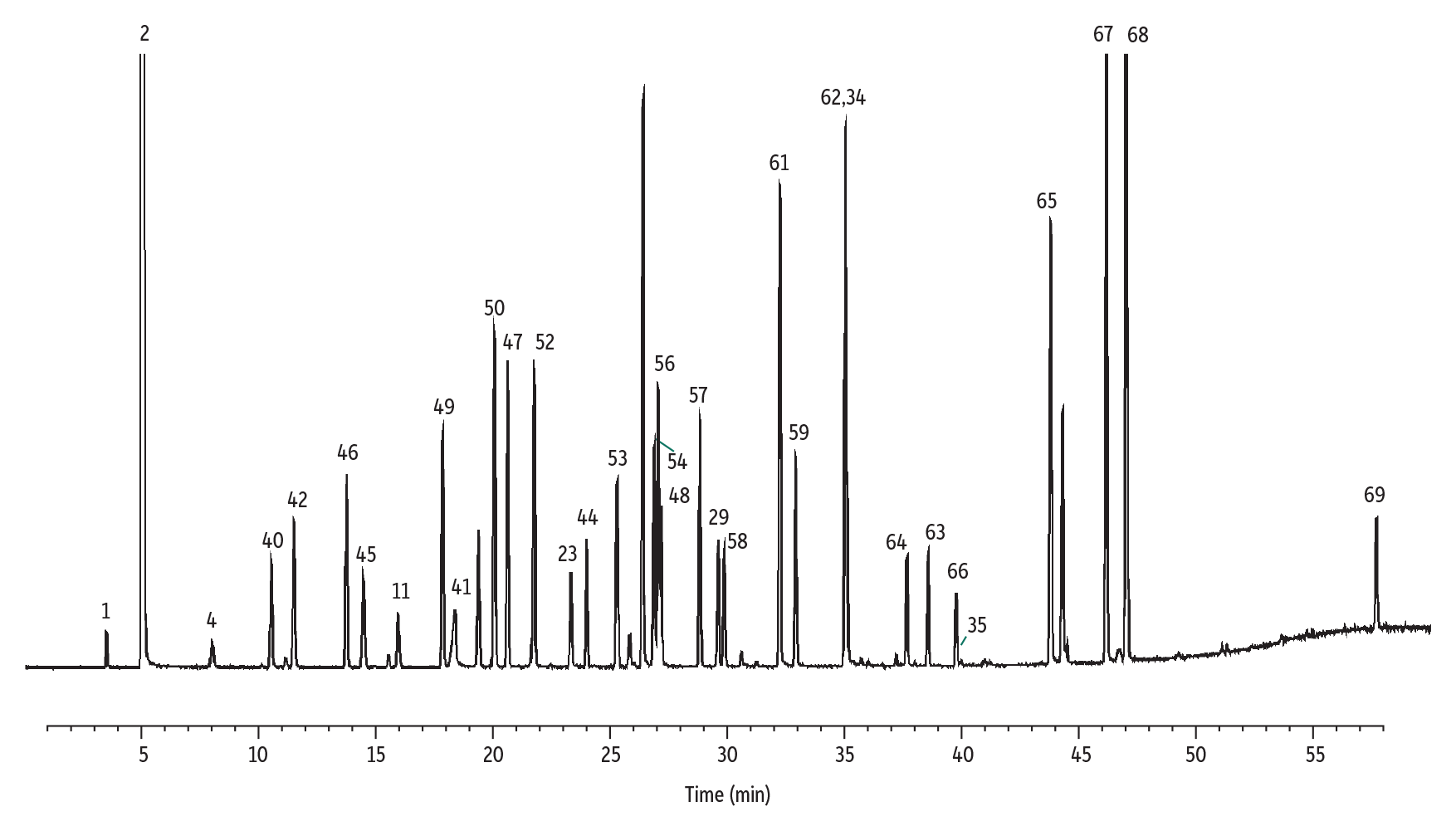
Testing solvent purity or analyzing solvents from manufacturing processes requires a column that quickly and accurately resolves a variety of industrial solvents. Rtx-200 columns are ideal for analyzing a wide range of common industrial solvents (Figure 6).
GC_CH00339
Conditions
| Column | Rtx-200, 60 m, 0.53 mm ID, 3.00 µm (cat.# 15088) |
|---|---|
| Standard/Sample | Solvent mix #2 |
| Injection | |
| Inj. Vol.: | 1.0 µL split |
| Inj. Temp.: | 275 °C |
| Split Vent Flow Rate: | 50 mL/min. |
| Oven | |
| Oven Temp.: | 40 °C (hold 5 min) to 285 °C at 5 °C/min |
| Carrier Gas | He, constant flow |
| Linear Velocity: | 40 cm/sec |
| Detector | MS |
|---|---|
| Mode: | Scan |
| Source Temp.: | 285 °C |
| Notes | TIC using open split interface (OSI). |
Pesticides in Dietary Supplements GCxGC (Secondary Column)
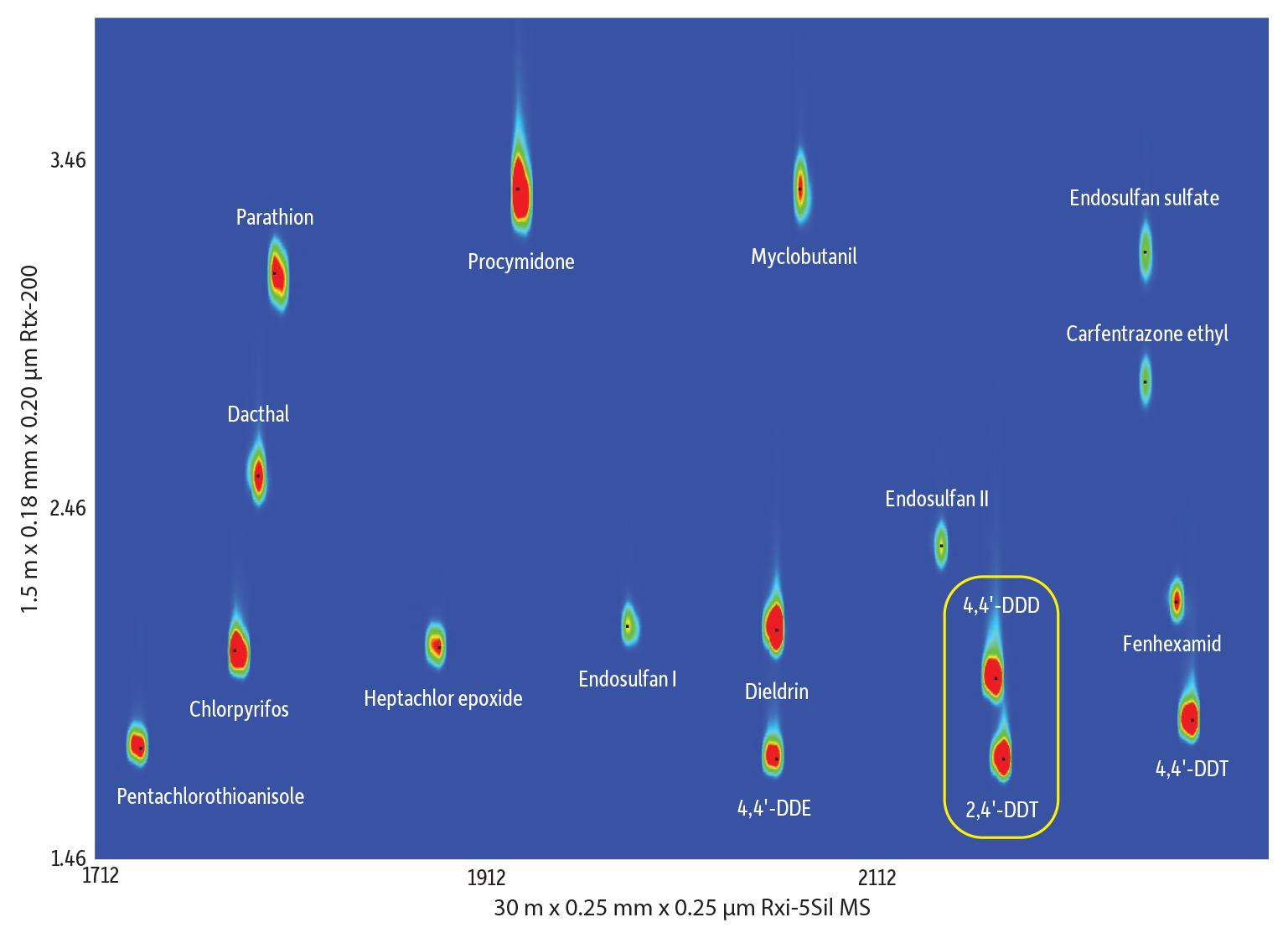
As shown by the extensive spread along the x and y axes, a GCxGC analysis with Rxi-5Sil and Rtx-200 columns easily separates and quantifies compounds with isobaric interferences, such as 2,4′-DDT and 4,4′-DDD (Figure 7).
GC_FF1188
Conditions
| Column | Rxi-5Sil MS 30 m, 0.25 mm ID, 0.25 µm (cat.# 13623) |
|---|---|
| Rtx-200 1.5 m, 0.18 mm ID, 0.20 µm (cat.# 45001) | |
| Standard/Sample | Mixed pesticide standard |
| Diluent: | Toluene |
| Conc.: | 2 ng/µL |
| Injection | |
| Inj. Vol.: | 1 µL splitless (hold 1 min) |
| Liner: | Gooseneck Splitless (4mm) w/Wool |
| Inj. Temp.: | 250 °C |
| Purge Flow: | 40 mL/min |
| Oven | |
| Oven Temp.: | Rxi-5Sil MS: 80 °C (hold 1 min) to 310 °C at 4 °C/min (hold 1.5 min) Rtx-200: 90 °C (hold 1 min) to 320 °C at 4 °C/min (hold 1.5 min) |
| Carrier Gas | He, constant flow |
| Flow Rate: | 1.8 mL/min |
| Modulation | |
| Modulator Temp. Offset: | 25 °C |
| Second Dimension Separation Time: | 4 sec |
| Hot Pulse Time: | 1.2 sec |
| Cool Time between Stages: | 0.8 sec |
| Detector | TOFMS |
|---|---|
| Transfer Line Temp.: | 290 °C |
| Analyzer Type: | TOF |
| Source Temp.: | 225 °C |
| Electron Energy: | 70 eV |
| Mass Defect: | -20 mu/100 u |
| Solvent Delay Time: | 4 min |
| Ionization Mode: | EI |
| Acquisition Range: | 45 to 550 amu |
| Spectral Acquisition Rate: | 100 spectra/sec |
| Instrument | LECO Pegasus 4D GCxGC-TOFMS |
| Notes | Liner cat.# 22405 was used to produce this chromatogram, but it has since been discontinued. We recommend cat.# 22406 [or cat.# 23303] as an alternative. For assistance choosing a replacement for this application, contact Restek Technical Service or your local Restek representative. – – – – – – See application note GNAN1338 for extraction and cleanup details. A 1.5 m length of the Rtx-200 column was trimmed from a 10 m column. Columns were connected with a Universal Press-Tight Connector (cat.# 20429). See chromatogram GC_FF1187 for full scale view. |
Increase Analysis Speeds with Low-Pressure GC-MS Column Kits
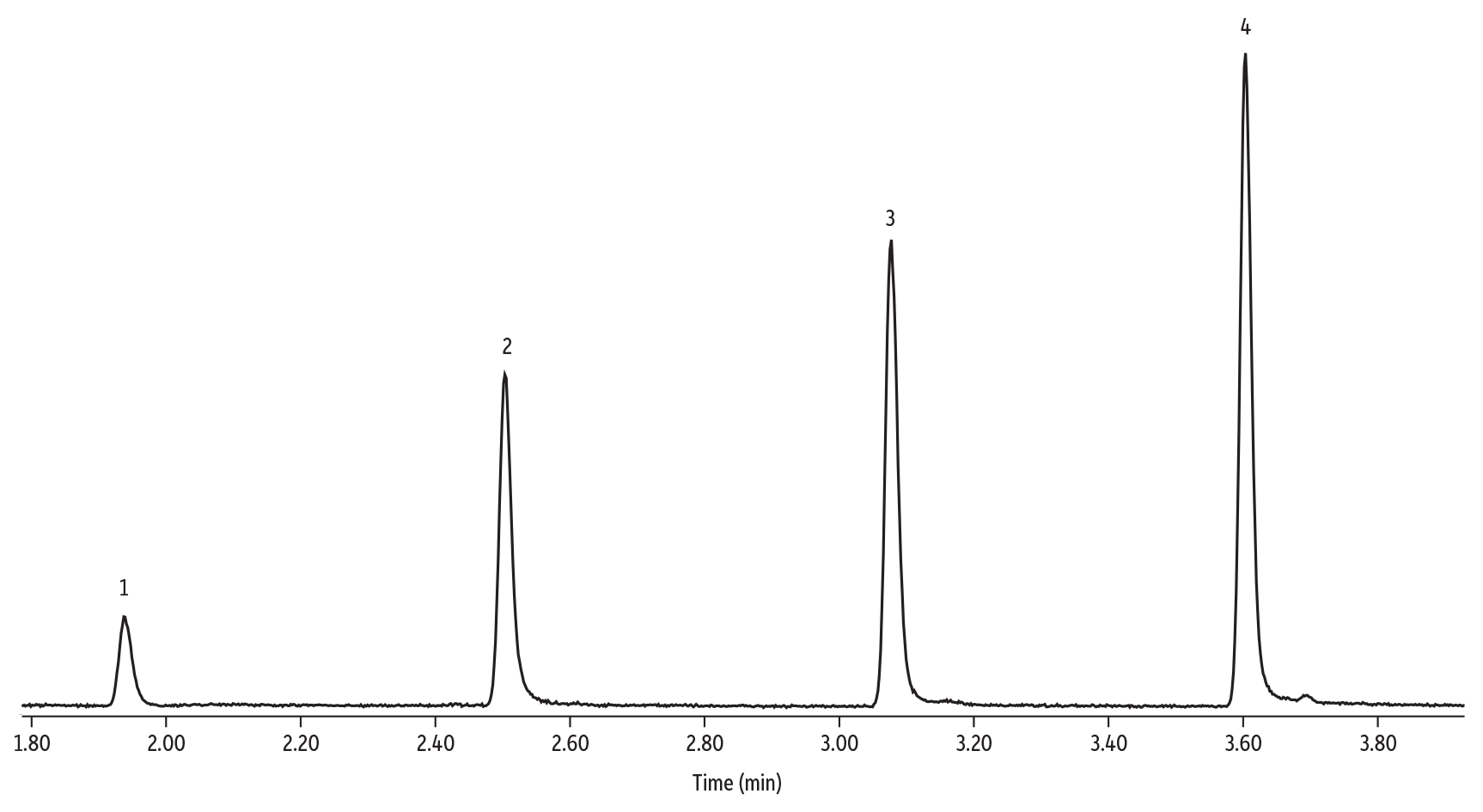
Restek’s Low-Pressure GC (LPGC) Rtx-200 column kit allows for significant speeds gains while also conserving helium. In this rapid analysis of four common fluorotelomer alcohols on the LPGC Rtx-200, excellent separations of all compounds were achieved with a run time of under four minutes (Figure 8). The LPGC method is 1.9x faster and uses 60% less helium than conventional GC-MS methods.
GC_EV1518
Conditions
| Column | LPGC Rtx-200 column kit, includes 10 m x 0.32 mm ID x 1.00 µm Rtx-200 analytical column and 5 m x 0.15 mm ID Rxi restrictor factory connected via SilTite connector (cat.# 11807) |
|---|---|
| Standard/Sample | |
| 2-(Perfluorobutyl)ethanol | |
| 2-(Perfluorohexyl)ethanol | |
| 2-(Perfluorooctyl)ethanol | |
| 2-(Perfluorodecyl)ethanol | |
| Diluent: | Methanol (PT) |
| Conc.: | 1 µg/mL |
| Injection | |
| Inj. Vol.: | 1 µL split (split ratio 5:1) |
| Liner: | Topaz, precision inlet liner, 4.0 mm x 6.3 x 78.5 (cat.# 23305) |
| Inj. Temp.: | 280 °C |
| Split Vent Flow Rate: | 4.5 mL/min |
| Oven | |
| Oven Temp.: | 35 °C (hold 0.5 min) to 280 °C at 35 °C/min (hold 5 min) |
| Carrier Gas | He, constant flow |
| Flow Rate: | 0.9 mL/min |
| Detector | MS | |
|---|---|---|
| Mode: | SIM | |
| SIM Program: | 131 m/z, 300 ms dwell | |
| Transfer Line Temp.: | 280 °C | |
| Analyzer Type: | Quadrupole | |
| Source Temp.: | 250 °C | |
| Quad Temp.: | 180 °C | |
| Solvent Delay Time: | 1.3 min | |
| Tune Type: | PFTBA | |
| Ionization Mode: | EI | |
| Instrument | Agilent 7890A GC & 5975C MSD | |
| Sample Preparation | All standards were combined into one solution at concentration 1 ppm in polypropylene vial (cat. #23242) with a polypropylene cap (cat. #23244). A 50 µL aliquot was analyzed by GC-MS using 100 µL insert (cat. #24512). | |
| Notes | Pulsed split injection was used; 30 psi until 0.15 min. | |
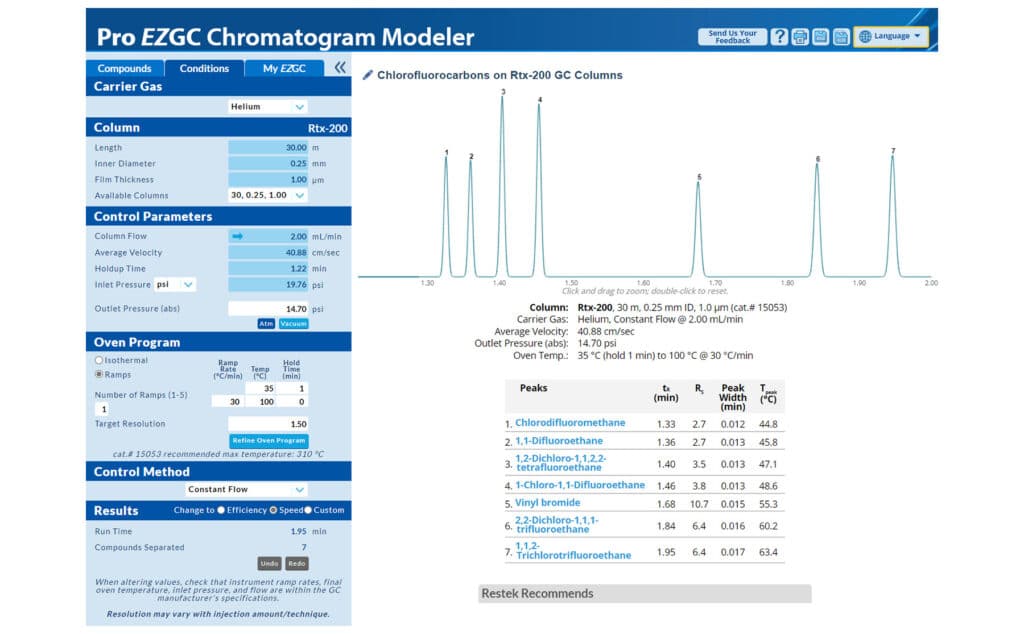
Simplified Analysis Optimization with Pro EZGC Software
Rtx-200 columns are supported by our Pro EZGC chromatogram modeler, allowing labs to simplify their analysis optimization. This free, easy-to-use software helps you perform GC method optimization and method development in minutes—without needing to use an instrument.