


Key Highlights
- Simplify your workflow with this method for automating SPE for PFAS on a PromoChrom SPE-03 system.
- Generate accurate, reliable results with the proven performance of Resprep PFAS SPE cartridges with filter aid.
- Factory-packed filter aid prevents clogs, reducing the need for time-consuming re-extractions.
Introduction
For many environmental labs, solid phase extraction (SPE) is a key tool in the analysis of per- and polyfluoroalkyl substances (PFAS) because it is required by most EPA methods and many ASTM methods. Usually based on styrene divinyl benzene (SDVB) or weak anion exchange (WAX) cartridges, SPE can allow labs to effectively extract PFAS compounds from aqueous matrices without the use of solvent-heavy techniques, like separatory funnels or continuous liquid-liquid extraction. Even solid matrices can be prepared using SPE with an initial solvent extraction and water exchange. SPE has traditionally been performed on vacuum manifolds, but automated systems offer significant efficiency advantages.
Move Beyond the Manifold: Automating SPE for PFAS
Most methods written for SPE primarily address the use of vacuum manifolds, providing detailed steps for using them in manual extractions. Automated SPE is often mentioned as being appropriate to use, but specific details on how to implement it are not provided due to potential differences among instruments. This means labs must determine for themselves how to implement automated SPE and whether certain cartridges will work for the methods they are using.
In a previous study, it was demonstrated that dual-bed Resprep PFAS SPE cartridges with filter aid (cat.# 28931) worked well with a Thermo AutoTrace 280 PFAS system [1]. Resprep PFAS SPE cartridges with filter aid were employed because the dual-bed carbon and WAX format provides a faster, simpler workflow compared to using separate WAX and carbon SPE cartridges. In addition, the factory-packed filter aid prevents clogging, so even dirty samples can be successfully prepared in a single extraction.
In the current work, we explored using a different automated system and compared the performance of Resprep PFAS SPE cartridges to dual-bed cartridges from several competitors and to a single-bed, WAX-only cartridge. Here, an SPE-03 system from PromoChrom was used because it features several conveniences, such as an integrated programable interface, bottle rinsing capabilities, and a smaller footprint. Our goal was two-fold: (1) to establish instrument parameters and demonstrate cartridge compatibility with the SPE-03 instrument, and (2) to compare the relative performance of the different cartridges.
Simplifying Method Transfer
The first hurdle with automating SPE for PFAS analysis is translating the vacuum manifold steps listed in a method to the SPE instrument. Due to the interface and detailed step-by-step listing of the SPE process required by most instruments, this can make the automated method seem more complicated than using a vacuum manifold. However, once you understand the detailed breakdown of the method, transferring the method becomes a fairly straightforward process. For convenience, Table I shows the PromoChrom method used for this study.
Table I: PromoChrom SPE-03 Parameters for Automating SPE for PFAS (Based on EPA Method 1633)
| Action | Inlet 1 (Solvent/Sample) | Inlet 2 (Air Ratio) | Flow (mL/min) | Volume (mL) | Time |
|---|---|---|---|---|---|
| Elute to Waste 2 | 1% Ammonium Hydroxide in Methanol | 8 | 15 | ||
| Elute to Waste 1 | 0.3 M Formic Acid in Water | 8 | 5 | ||
| Add Sample to Waste 1 | Sample | 5 | 560 | ||
| Rinse | Water | 20% | 70 | 2.5 | |
| Add Sample to Waste 1 | Sample | 5 | 5 | ||
| Rinse | Water | 20% | 70 | 5 | |
| Add Sample to Waste 1 | Sample | 5 | 5 | ||
| Rinse | Water | 20% | 70 | 5 | |
| Add Sample to Waste 1 | Sample | 5 | 5 | ||
| Shake | 20 sec | ||||
| Rinse | 1:1 0.1 M Formic acid:methanol | 20% | 70 | 1.3 | |
| Add Sample to Waste 1 | sample | 5 | 3 | ||
| Rinse | 1:1 0.1 M Formic acid:methanol | 20% | 70 | 5 | |
| Add Sample to Waste 2 | Sample | 5 | 5 | ||
| Shake | 20 sec | ||||
| Air Purge to Waste 2 | Air | 5 | 3 | ||
| Add Sample to Waste 2 | Sample | 5 | 5 | ||
| Blow N2 | 1 min | ||||
| Rinse | 1% Ammonium Hydroxide in Methanol | 20% | 70 | 1.3 | |
| Collect 1 | Sample | 5 | 3 | ||
| Rinse | 1% Ammonium Hydroxide in Methanol | 20% | 70 | 5 | |
| Collect 1 | Sample | 5 | 5 | ||
| Shake | 10 sec | ||||
| Collect 1 | Sample | 5 | 5 | ||
| Wait | 1 min |
Assessing Accuracy and Precision
To evaluate cartridge performance for automating SPE for PFAS with the PromoChrom system, we spiked deionized water samples at 5 ng/L using Restek’s PFAS 28 calibration standard (cat.# 30734). Extracted internal standards were not used so that true recoveries from the SPE process could be measured. We evaluated Resprep polymeric (WAX only) cartridges (cat.# 28268); dual-bed, WAX/carbon Resprep PFAS SPE with filter aid cartridges (cat.# 28931); and dual-bed WAX/carbon cartridges from three competitors. Figure 1 shows the recovery results from the cartridges.
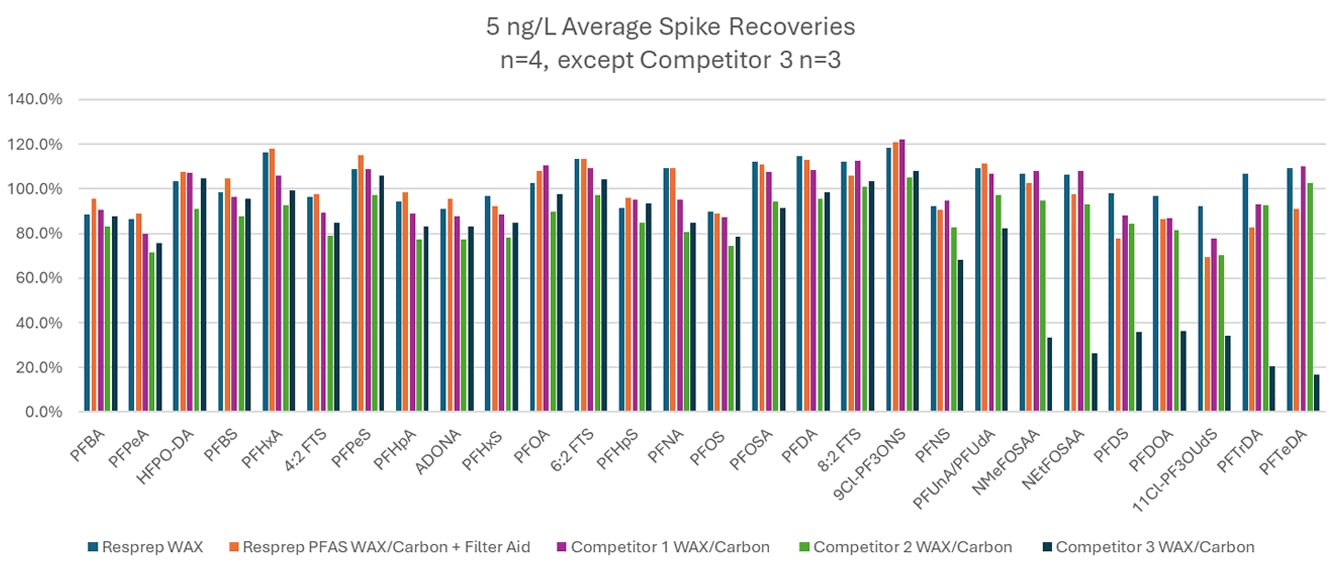
The recoveries are relatively similar for most compounds until the later eluting PFAS. For the last few eluting PFAS, we see that the WAX-only cartridge outperforms all the WAX/carbon dual-bed cartridges, indicating that the carbon is likely more retentive for these longer chain PFAS. Competitor 3 is especially affected by this, showing recoveries of less than 40% for some compounds.
Figure 2 shows the precision from the extractions. Overall, the Restek cartridges showed better precision than the competitors, with most results being much less than 15% RSD. There is a slight trend of increasing %RSD for later eluting PFAS, again likely due to increased retention due to the carbon layer. Competitor 3 is again an outlier, showing high variability for later eluting PFAS in addition to the poor recovery shown in Figure 1. Average accuracy and precision data across all PFAS are presented in Table II.
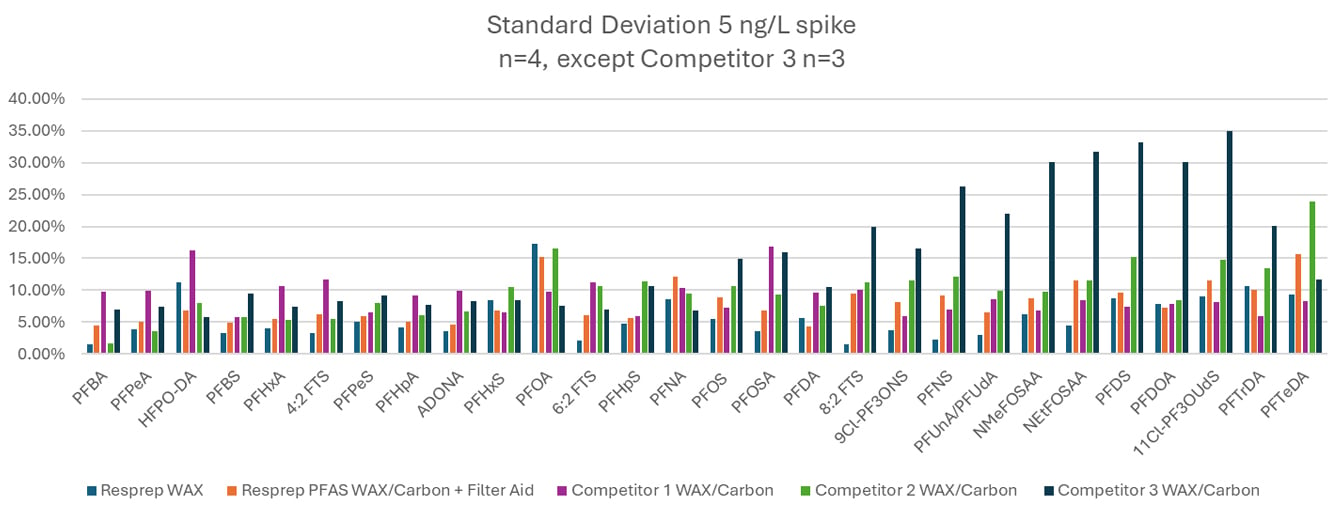
Table II: Average Recovery and Precision Across All PFAS Tested
| SPE Cartridge | Average %Recovery | Average %RSD |
|---|---|---|
| Resprep Polymeric (WAX only) | 102.2% | 5.8% |
| Resprep PFAS + Filter Aid (WAX/Carbon) | 99.6% | 7.9% |
| Competitor 1 (WAX/Carbon) | 98.7% | 9.0% |
| Competitor 2 (WAX/Carbon) | 87.7% | 10.0% |
| Competitor 3 (WAX/Carbon) | 75.7% | 15.3% |
Conclusion
Resprep WAX and WAX/carbon SPE cartridges have been shown to be compatible with common automated SPE systems, allowing labs interested in automating SPE for PFAS analysis to easily streamline their sample preparation. In addition, Resprep PFAS SPE cartridges with filter aid provided comparable or better accuracy and precision when evaluated against dual-bed WAX/carbon SPE cartridges from other vendors, ensuring that labs using them can generate accurate, reliable data. The factory-packed filter aid provides an additional advantage in that it prevents clogging, reducing the need for time-consuming re-extraction.
Acknowledgements
Restek thanks Maryland Spectral Services Inc. (https://www.mdspectral.com/) for use of their SPE-03 PromoChrom system for this study on automating SPE for PFAS testing.
References
1. J. Hoisington, Simplified SPE for PFAS analysis of non-potable waters, Application note, EVAN4369-UNV, Restek Corporation, 2024. https://discover.restek.com/en/application-notes/evan4369/simplified-spe-for-pfas-analysis-of-non-potable-waters
Erwähnte Produkte

Need Help with Your PFAS Analysis?
From method selection to product recommendations, our PFAS experts are here to help you navigate complex workflows and achieve accurate, reliable results.
Autoren